



Mohyla míru Memorial
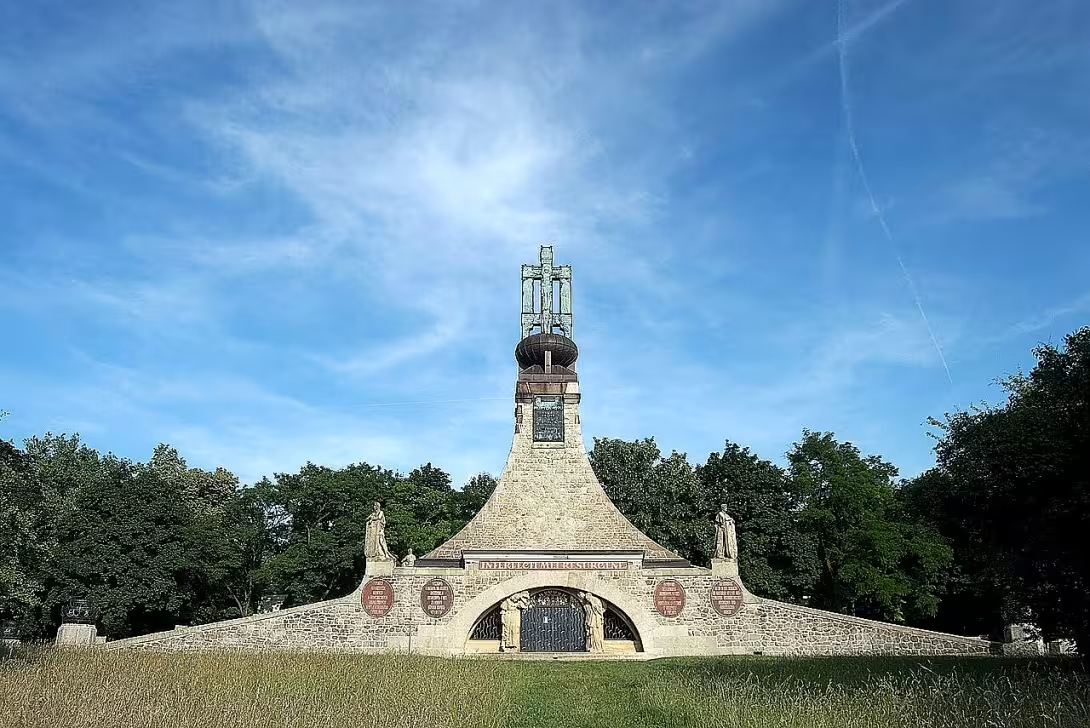
Mohyla míru is the first European monument to peace built on the Prague Hill as a memory of the Battle of Slavkov. This Art Nouveau monument is not only an architectural pearl, but also symbolizes the spirit of peace and memorable fallen soldiers from all nations. Mohyla míru testifies to historical events and efforts to make peace beyond time limits.
The monument was built between 1910 and 1912 under the initiative of Alois Slovák, a priest in Brno and a teacher. The Czech architect Josef Fanta designed it while the implementation was carried out by Otakar Nekvasil. The art elements were created by František Anýž and the sculpture was developed by Čeněk Vosmík. The funding was provided through public collections, donations and contributions from Austria-Hungary, Russia and France. The opening was originally planned for 1914, but it was only in 1923 because of the First World War.
The architecture of the Mohyla of Peace is realized in Art Nouveau style and resembles an old Slavic mound. A building built from a quarry stone consists of a four-sided chamallow needle over 26 metres high, which ends with a ten-metre copper ancient Christian cross. The cross rests on the globe and is decorated with embossed motifs of crucified Christ, God the Father, the Virgin Mary, Saint John and Adam's head. The pelican on the back of the cross symbolizes the Redeemer. The four shield rats in the corners of the building are the works of sculptor Chenek Vosmík and their shields symbolize France, Austria, Russia and Moravia. Boards with inscriptions on the front of the monument resemble the fallen of all nations in French, German, Russian and Czech languages.
Mohyla míru was included in the national list of cultural monuments in 1964. In 1992 it became part of the landscape monument zone of the battle field near Slavkov and in 2003 it became the property of the South Moravian Region. The monument is protected as a cultural monument of the Czech Republic.
Inside the Mohyla of Peace there is a square chapel with an altar of marble and mosaic with delivering angels. Under the floor of the chapel is located ossarium, where remains found in the territory of the Slavkov battlefield are stored. The chapel has unique acoustics - whispering in one corner is heard in the opposite corner in the same volume, which they call diagonal acoustics.
Near Mohyla peace is the Museum of Brno with an exhibition of the battle of three emperors. The museum was opened in the 1920s and in 2005 there was a premiere of a new, multimedia form of permanent exhibition. In 2010, a newly built pavilion with permanent exposure to Fenomén Austerlitz was opened behind the existing building.
Mohyla míru is not only a monument to historical events, but also a place that calls for reflection on the value of peace and memories of those who fought for it. It is a place worth visiting not only for historians, but also for any curious tourist who wants to understand the importance of peace and memory of the past.
Then and now
Drag the slider to compare how the landmark may have looked when it was built with the view today.
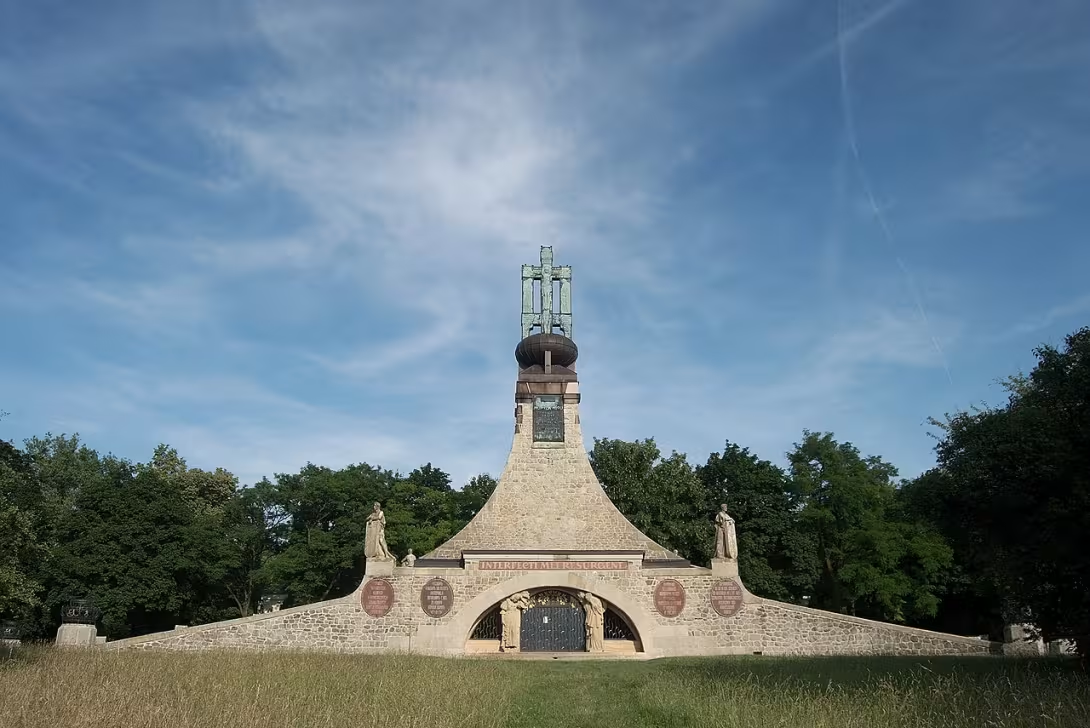
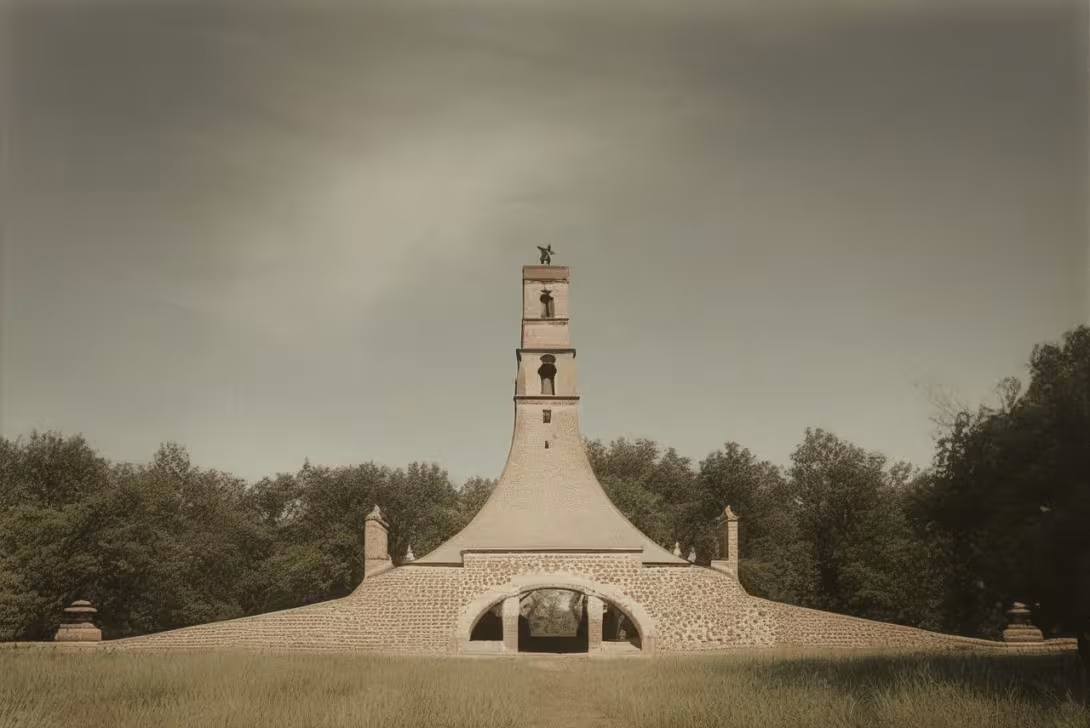
The historical appearance on the left is an AI-generated visualisation and serves as inspiration only.
Historical milestones
- 1912
- The completion of the Mohyla peace building.
- 1923
- Opening the chapel on the memorial.
Architectural development
Mohyla míru was built in Art Nouveau style with quarry stone and copper cross. The chapel contains a skeleton and has a unique acoustics that allows whispering in one corner and hearing in the opposite direction.
Historical events
- 1910
- The beginning of the Mohyla peace building.
- 1923
- Opening and consecration of the chapel on the memorial.
- 1964
- Registration in the state list of cultural monuments.
- 1992
- Incorporating into the landscape monument zone the battlefield of the Battle of Slavkov.
Owners
In 2003 he became the owner of the South Moravian Region.
Points of interest
- Mohyla míru is the first European monument to peace. - The monument was built between 1910 and 1912 under the initiative of Alois Slovák, Brno priest and teacher. - Mohyla míru is protected as a cultural monument of the Czech Republic. - Inside the Mohyla peace there is a square chapel with unique acoustics - whispering in one corner is heard in the opposite corner in the same volume, which they call diagonal acoustics. - Near Mohyla peace is the Museum of Brno with an exhibition of the battle of three emperors.
Guide
Show guide text
This text was created by artificial intelligence and has not been editorially reviewed. It may contain inaccuracies.
Welcome to this high ground, where history meets with a deep calm of nature. You are standing right in front of the Mohylla peace, which stands over the surroundings of the village Prace and with its majestic appearance invites you to reflect immediately. Feel this atmosphere, feel this sense of dignity radiating from this place. In front of your eyes is a monumental building, which is not just a cluster of stone and material, but a living witness of human efforts to understand the value of peace. Look at her face, trying to link the past to the present and remind us that even the biggest storms must be followed by silence and understanding.
This monument is not an ordinary work. It is the first such a peace monument throughout Europe, which gives it a very special significance. To understand why it stands here, on the Prague Hill, we must return in time to the events that have changed this landscape forever. This country was once a battlefield, a place where the fates of nations were decided, especially in the framework of the battle of the Slav. Mohyla míru, however, was not built as a celebration of the fight, but as a reminder of what the war brings - and above all the need for state peace. The whole process of creating this place was long and required great will. The construction work began in 1910 and lasted until 1912 when the whole work was finished. It is the result of the efforts of people who believed that the monument could serve as a bridge between nations, not as a barrier.
Now pay attention to the very form of this work. When you look at Mohyla, notice its special shape. It is designed as an ancient Slavic mound, which carries deep religious and cultural symbolism. The architecture of the building belongs to the Art Nouveau style, which is the style which at the time brought new, organic and rich shapes. Feel how this modern style connects with the traditional form of mothballs. If you look at her details, you'll see symbolic elements that aren't random. There are encoded stories of victory, namely the victory of French soldiers over Russian and Austrian troops. This symbolic language is meant to remind us of historical events, but it is also meant to lead us to the idea that the peace spirit must be superior to any national conflict. The monument was created as a manifestation of the peace spirit and is meant to serve as a reminder of the fallen soldiers of all nations, no matter which side they fought for.
Behind all this magnificent intent were great personalities. The main mover, the man who put his soul into this project, was Alois Slovák. He was a priest in Brno and a teacher, a man with a great visionary who believed in the moral power of the monuments. His initiative created something that no one else had done at the time. He was helped by other important people whose names are inextricably connected to this place. We can name Otokar Nequaville, Franta Anyže or Zhenka Vosmik here. These people, together with the architect, worked to ensure that Mohyla míru was not just an empty building, but a place with a deep spirit. And it is the architect who needs to be told that Josef Fanta was behind the whole visual expression. That's a name that brings great respect to architecture. His ability to connect ancient shapes to the most modern Art Nouveau aesthetics at the time is precisely what stands before you today.
Now I want to invite you to focus on one very interesting thing that's right inside this monument. Mohyla míru is not only an external building, it is also a place for spiritual meetings. Inside is a square chapel. Its shape is simple, but very strong. But what is really unusual about this chapel is its acoustics. If you had the opportunity to enter and stay in silence, you would feel the sound working in this space. It is a unique property that makes the chapel a place where even the quietest whisper or silence can be of great weight. This chapel was subsequently opened in 1923, several years after the completion of the construction itself, and gave the whole place another dimension of peace and prayer.
It is important to know that Mohyla míru is not only a historical object but is protected as a significant cultural monument of the Czech Republic. This means that every part of it, every detail you now observe, is kept for future generations as a precious legacy of our ancestors. It is a place that teaches us humility before history and also teaches us hope for the future, where peace will be the winner of every conflict.
Now that you know the story of this place, its creator and its deep sense, I suggest you continue your search. Walk around, see the surrounding countryside and try to find your own moments of silence. Mohyla míru offers you the space for reflection that we rarely find in today's fast world. Thank you for sharing this story with us. We wish you another pleasant moment in discovering the beauty and history of our region. We'll say goodbye, but we believe the memory of this peace monument will remain within you.
Tips for visitors
Best time to visit Peace mounds are in the spring or autumn season when the weather is pleasant and vegetation offers a beautiful background. This time of year also means lower attendance compared to sunny summer months, allowing you to enjoy a quiet and peaceful atmosphere.
It is possible to use both a passenger car and public transport to access the Mohyla peace. Public transport is an effective alternative; Details of the connection can be found in local search engines.
When planning your visit, bring suitable clothes according to the weather, especially if you visit during colder months. Additional information and maps are available online or when entering the site. Due to the cultural importance, it is advisable to bring protective sunglasses if you plan to take photographs.
Photographing the Mothys of Peace is best in the early morning or in the evening when light is softer and shadows are few. The best perspective offers the area around the monument itself, especially from the higher sections of the Prague Hill. For families with children, a visitor program including walking along the surrounding paths and learning about the history of the battle of three emperors is suitable.
Last but not least, don't forget to visit the Museum of Brno, located in the vicinity. Here you will find an exhibition about the battle of three emperors and other historical events of the region. This museum is an ideal addition to visiting the Mohyla of Peace, providing deeper context and knowledge of local history.
Frequently asked questions
Can the monument be visited?
This is a structure in a public space that can usually be seen from outside free of charge. We have not verified that this particular one is freely accessible.
Where is the monument?
Location: Prace, Jihomoravský kraj. The map on this page shows the exact spot.
Why is the monument protected?
It is listed in the Central List of Cultural Monuments of the Czech Republic as a cultural monument (register no. 1000145477).
Businesses nearby
Do you run a restaurant, accommodation, shop, museum, rental, wellness or other visitor service near this monument? Show yourself directly to the people heading to it — this is how they will see you in the app and on the web:
Events nearby


Zdroj akcí: otevřená data měst a obcí ČR (Národní katalog otevřených dat) a kalendář akcí Národního památkového ústavu.
Nearby
Nedaleko se nachází Muzeum Brněnska s expozicí bitvy tří císařů a dalšími historickými památkami.
Accommodation nearby
Trips and activities nearby
Guided tours, tickets and activities nearby from GetYourGuide
Affiliate link: if you buy from the partner, we may receive a commission. The price for you does not change.
Search tours and activities →Themed route
Thematic cruise route: Mohyla míru and surroundings
1.Mohyla míru (memorial)
Type: Historical memorial
This monument is dedicated to memories of historical events associated with the battle of three emperors. It's a place where you can see architectural details and talk about the past of the region.
2. Museum of Brno
Type: Historical Museum
The museum offers an extensive exhibition related to the battle of three emperors that took place in this area. It is an ideal place for a deeper understanding of the historical context and history of the local region.
3. Exposition of the Battle of the Three Emperors
Type: Specific exposition in the Museum of Brno
This exhibition focuses on one of the most important historical battles that has had a far-reaching impact on European policy. It's a great opportunity to explore military strategies and individuals involved in the conflict.
4. Other historical monuments in the Museum of Brno
Type: Historical exposure
In addition to the main exhibition of the battle of three emperors, the museum offers other interesting overview of the history of the region. These exhibitions provide a comprehensive view of the cultural and historical development of the area.
5. Railway station Museum of Brno
Type: Historical courtyard
Visiting the sights allows relaxed walks and provides an opportunity to relax between teaching activities. It's a place where you can enjoy the peace and beauty of historical architecture.
This route offers a comprehensive view of the history of the region around the village Prace, with emphasis on the battle of three emperors.
Seasonal recommendations
Spring: Mohyla míru offers a wonderful view of flowering shrubs and trees that surround the memory in the spring. Sun rays illuminate green vegetation, creating a unique atmosphere of peace and beauty. Because of today's warm hours, it is advisable to visit the memorial in the morning or in the evening when there are fewer visitors. It is recommended to wear light clothes with the possibility to add a layer to cooler times.
Summer: During the summer season Mohyla míru is a popular place for visitors looking for a heat shelter. Sunshine days bring excellent lighting for photography and understanding architectural details of the monument. Visiting is on top, so it is recommended to come early in the morning or later in the evening to avoid the crowd. Short legs and short gloves are ideal for warm weather, but don't miss the sun's protection.
Autumn: In the autumn season, the leaves of the Mohyla are gaining the peace of beautiful golden and red shades, creating a remarkable atmosphere. Sunshine days are warmer than in cramped autumn weather, but cold night hours require appropriate clothing. Visit the memory in the forefront for mild temperatures and beautiful light. It is recommended to wear layered clothes to prepare for rapidly changing weather.
Winter: Mohyla míru in winter offers a calm and quiet atmosphere. Snow cover can bring a memory of romantic and clean view, but don't forget to wear warm clothes when visiting. Best to visit the monument at noon, when the sun provides enough light and heat for a comfortable walk. Hot clothes, protective shoes and perhaps an umbrella are necessary to ensure comfort during the visit.
Visualizations and artistic views


The visualisations are generated by artificial intelligence and serve as inspiration.
Photos from the area
Real photos taken near the monument

Zdroj a licence jsou uvedeny u každého snímku.
Tips from visitors
No tips yet. Be the first!
Log in and add your tip.
Sources and literature
Photos: Kirk / CC BY-SA 3.0 — Wikimedia Commons. The author and licence also appear when you hover over the image.
Faktickým podkladem tohoto textu byl článek na Wikipedii, jehož autory jsou přispěvatelé Wikipedie. Článek je dostupný pod licencí CC BY-SA 4.0.
Location on the map


Příběhy a pověsti
Legendy, pověsti a příběhy spjaté s touto památkou
Fotografie návštěvníků
Zatím žádné fotografie. Buďte první, kdo přidá fotografii z návštěvy!
Log in a přidejte svou fotografii nebo hodnoťte.
Za ověřenou návštěvu v aplikaci získáte víc bodů — poznáme podle GPS, že jste na místě.
Reviews and comments