






Nový věk Sculpture
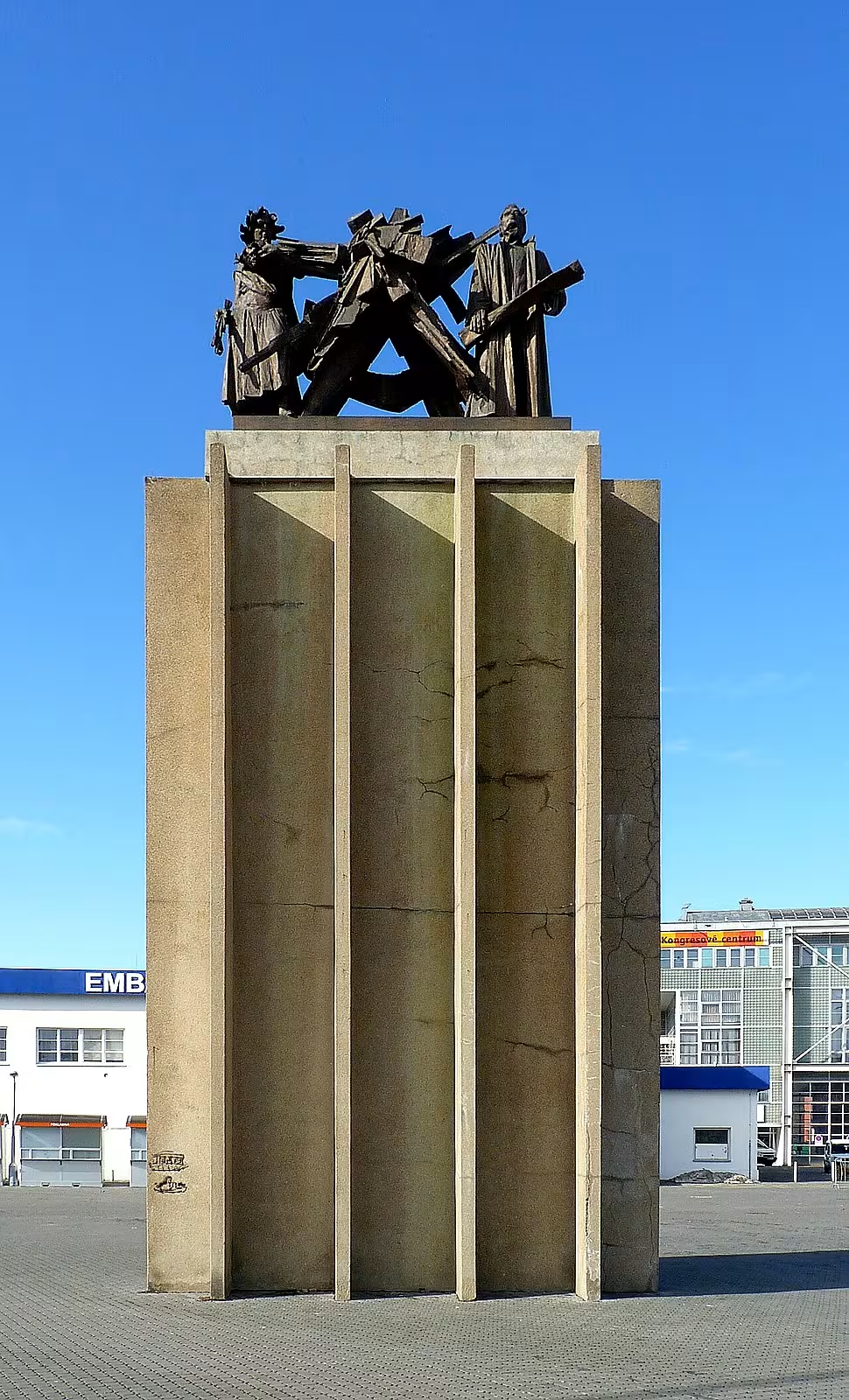
Nový věk is a sculpture group created in 1958 by Vincenc Makovský, located in the Brno-střed district. Designed for the Czechoslovak pavilion at the 1958 World Expo in Brussels, it won the Grand Prix and embodies the optimism of the atomic age. The work stands as a significant example of mid-20th-century Czechoslovak public art.
Produced during the Cold War, the piece reflects a global fascination with nuclear energy and scientific progress. Originally titled Atomový věk, it was intended to showcase technological and cultural achievements on the international stage at the Brussels World's Fair.
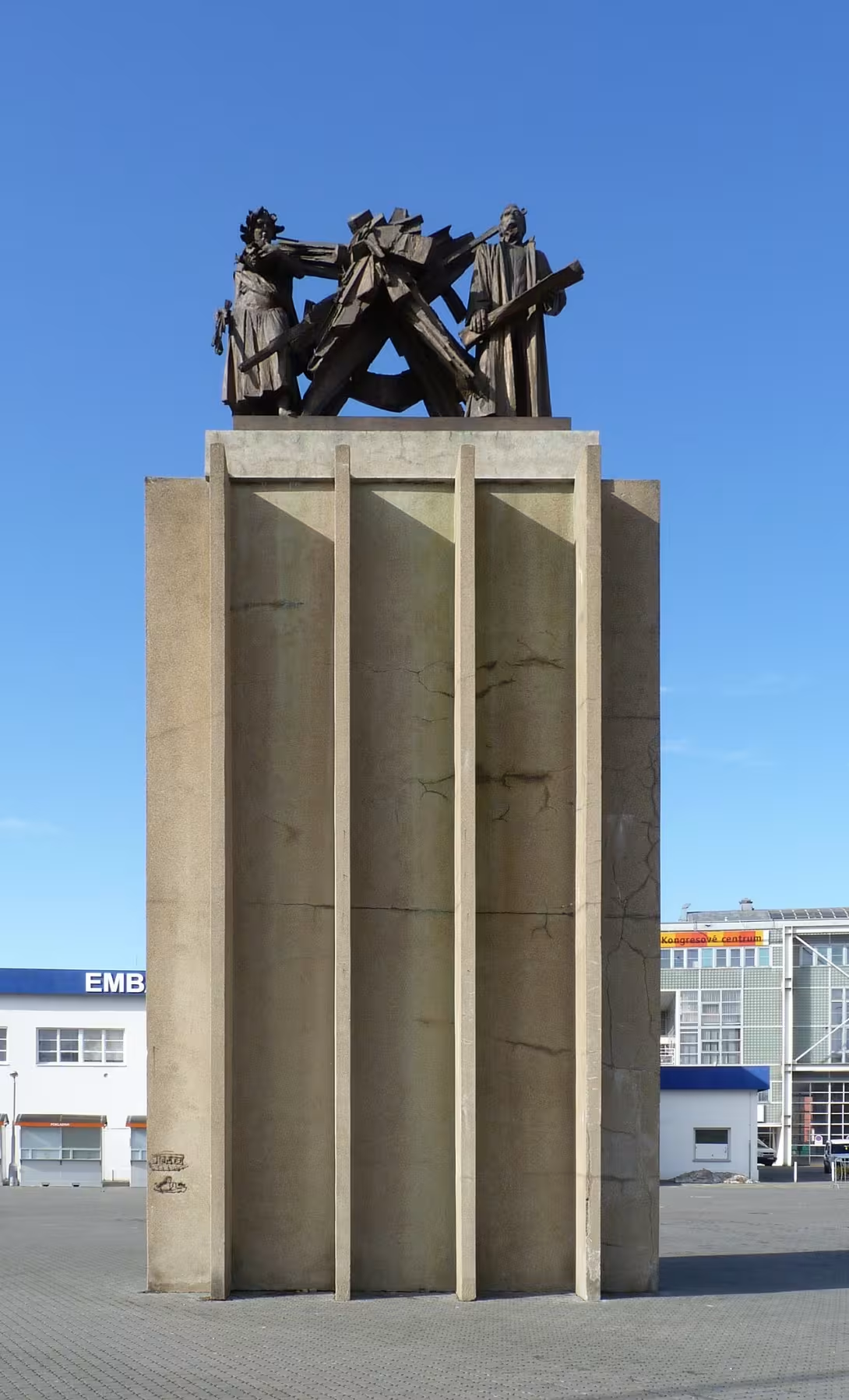
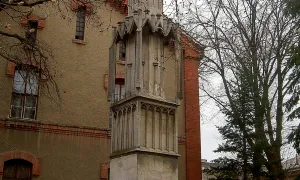
The composition features two allegorical figures and a central symbolic element. A cloaked man holding scrolls with plans represents Science. Beside him, a barefoot woman in antique-style clothing wears a leaf wreath and holds fruit in her left hand and a sheaf of grain in her right, symbolizing Agriculture. Between them is a stylized sun or crystal star with radiating rays, an allegory for the birth of matter and the dawn of the atomic age. This focal point reflects Makovský's interpretation of the contemporary scientific view of the universe. The sculpture is mounted on a vertically articulated reinforced concrete pedestal with stone cladding.
Following its success in Brussels, the original work was installed in 1959 in front of the main entrance to the Brněnské veletrhy a výstaviště. The monument has been officially heritage-protected since 1964. In the 1970s, a bronze cast copy was made and placed in Prague in front of the New Building of the National Museum, where it underwent restoration in 2014.
The original remains at the Brněnské veletrhy a výstaviště, where it continues to serve as a historical record of the scientific optimism of the late 1950s.
This sculpture offers a clear insight into the artistic and ideological ambitions of its era. It is a valuable site for those interested in the intersection of art, science, and history.
Then and now
Drag the slider to compare how the landmark may have looked when it was built with the view today.
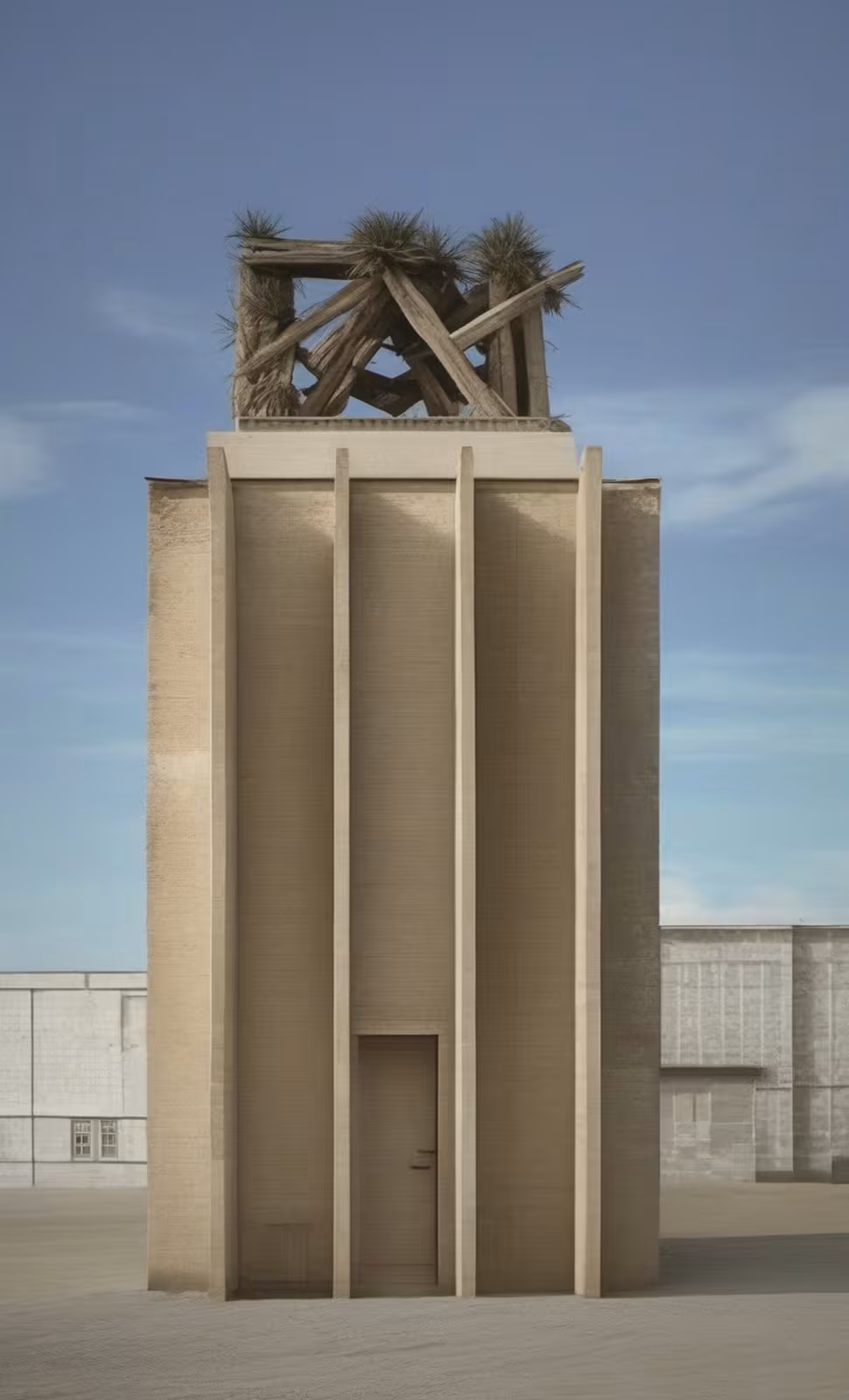
The historical appearance on the left is an AI-generated visualisation and serves as inspiration only.
Historical milestones
- 1958
- Created for the Expo 1958 in Brussels and awarded the Grand Prix.
- 1959
- Original sculpture installed in front of the main entrance to the Brno Exhibition Centre.
- 1964
- The sculpture became a heritage-protected monument.
Architectural development
The sculpture is mounted on a vertically articulated reinforced concrete pedestal with stone cladding. In the 1970s, a bronze cast copy was created and placed in Prague.
Historical events
1958: Awarded the Grand Prix at the World Expo in Brussels. 1959: The original sculpture was installed at the Brno Exhibition Centre. 1964: The monument was officially placed under heritage protection.
Points of interest
– Created by Vincenc Makovský in 1958 for the Czechoslovak pavilion at the World Expo in Brussels, the sculpture won the Grand Prix. – Originally titled Atomový věk, the work embodies the optimism of the atomic age and scientific progress. – The composition features allegorical figures representing Science and Agriculture, separated by a stylized sun or crystal star symbolizing the birth of matter. – The original sculpture was installed in 1959 in front of the main entrance to the Brněnské veletrhy a výstaviště and has been heritage-protected since 1964. – A bronze cast copy was created in
Guide
Show guide text
This text was created by artificial intelligence and has not been editorially reviewed. It may contain inaccuracies.
Welcome to Brno-střed. As you stand here, take a moment to simply breathe and absorb the atmosphere of this space. Before you, rising with a sense of purpose and grace, is the sculpture group known as Nový věk. It is more than just a collection of figures; it is a captured moment of human history, a frozen expression of what our ancestors believed the future would hold. As you look at the composition, try to feel the weight of the era from which it emerged—an era of immense transition, boundless curiosity, and a profound belief in the power of human ingenuity.
To truly understand what you are seeing, we must travel back in time, all the way to the year 1958. Imagine the world at that moment, a world still recovering from the shadows of conflict and looking eagerly toward the horizon of progress. That year, the eyes of the entire globe were turned toward Brussels for the World Expo. It was a grand stage where nations showcased their culture, their industry, and their dreams. It was here, in the context of this international celebration of achievement, that this masterpiece was born. Created specifically for the Czechoslovak pavilion, the sculpture was intended to represent the spirit and the potential of a nation stepping into a new era. The impact was immediate and profound; the work was awarded the Grand Prix, a testament to its exceptional quality and its ability to speak a universal language of hope.
Now, let us turn our attention to the sculpture itself. I invite you to look closely at the figures that form this striking group. Notice the sense of balance and the careful arrangement of the characters. On one side, you will find the figure representing Science. Observe the man; he is not merely a passive subject, but a symbol of human intellect and the structured pursuit of knowledge. In his hands, he holds scrolls containing plans and designs. These are not just pieces of paper; they represent the blueprints of our future, the mathematical precision and the visionary thinking that drive us to explore the unknown. He embodies the cerebral, the calculated, and the organized progress of the human mind.
Directly contrasting this intellectual force, look to the other side of the composition. Here, you see the figure of Agriculture. She is the personification of the earth’s bounty and the fundamental rhythms of life. Notice the details she carries—the fruit and the sheaf of grain. While the man with his scrolls represents the heights of human thought, this woman represents the essential foundation upon which all civilization is built. She reminds us that even as we reach for the stars and master the laws of physics, we remain deeply connected to the soil, the seasons, and the natural world that sustains us.
But the most captivating element lies between these two allegorical figures. Look at the center of the work, where a stylized sun or a crystal star rises. This is the heart of the sculpture. It serves as a powerful allegory for the dawn of a new age. It is the point where the intellect of Science and the vitality of Agriculture meet, illuminated by the light of discovery. It is the spark of a new beginning, a symbol of the enlightenment that comes when human knowledge is used to better the lives of all through the fruits of the earth.
The man responsible for bringing this vision to life was the renowned sculptor Vincenc Makovský. He was a master at capturing the zeitgeist, the very spirit of his time, and translating it into form. Through his hands, the abstract concepts of progress and prosperity became something tangible that you can stand before and contemplate today. After its triumph in Brussels, the sculpture found its permanent home here. In 1959, it was installed in front of the main entrance to the Brno Exhibition Centre, becoming a landmark of the city and a symbol of the region's connection to international culture and innovation. Its importance was officially recognized in 1964, when it was designated as a heritage-protected monument, ensuring that the vision of Vincenc Makovský would be preserved for generations to come.
As you stand here, there is a fascinating detail about this work that adds a layer of historical depth to your experience. The sculpture was not always known by the name you see today. Originally, it was titled Atomový věk—the Atomic Age. This title tells us so much about the mindset of the late 1950s. It was a period defined by an almost electric optimism regarding the power of the atom. People believed that nuclear energy would provide limitless possibilities, transforming everything from how we powered our homes to how we understood the very fabric of reality. The sculpture was a celebration of that specific, high-energy moment in human history.
The transition from the title Atomový věk to its current name, Nový věk, reflects a subtle but significant shift. While the "Atomic Age" was a specific technological era, the "New Age" is a broader, more eternal concept. It moves from the specific excitement of a single scientific breakthrough to a more universal celebration of human evolution and the continuous dawn of new possibilities. Whether you view it through the lens of the atomic era or the broader concept of a new age, the core message remains the same: a profound, unshakeable belief in the bright future that lies ahead.
Take a few more moments to walk around the sculpture. Notice how the light changes the way the forms appear to you. Consider the dialogue between the man, the woman, and the central star. They are not separate entities, but parts of a single, unified movement toward the future.
As you prepare to continue your journey through Brno-střed, carry this sense of optimism with you. The Nový věk is a reminder that even in times of great change, there is beauty in our pursuit of knowledge and our respect for the natural world. Thank you for spending this time with us. Please, continue your exploration and enjoy everything this beautiful city has to offer.
Tips for visitors
The best time to visit the Nový věk sculpture group is during the morning or late afternoon when the sunlight creates a beautiful backdrop for your photos.
Parking is available at the Brno Exhibition Centre, which is easily accessible by car. You can also use public transportation, such as buses and trams, to get there.
When visiting the monument, be sure to bring comfortable walking shoes and dress according to the weather.
For photography enthusiasts, the best spots to capture stunning images are around the sculpture group itself, with the surrounding buildings and greenery providing a unique backdrop. The morning or late afternoon sunlight is ideal for capturing warm and cozy photos.
If you're looking for something to do nearby, consider visiting the Brno Exhibition Centre itself, which hosts various exhibitions and events throughout the year.
Businesses nearby
Do you run a restaurant, accommodation, shop, museum, rental, wellness or other visitor service near this monument? Show yourself directly to the people heading to it — this is how they will see you in the app and on the web:
Events nearby


Zdroj akcí: otevřená data měst a obcí ČR (Národní katalog otevřených dat) a kalendář akcí Národního památkového ústavu.
Nearby
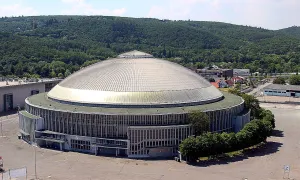
The monument is located at the Brno Exhibition Centre (Brněnské veletrhy a výstaviště).
Accommodation nearby
Trips and activities nearby
Guided tours, tickets and activities nearby from GetYourGuide
Affiliate link: if you buy from the partner, we may receive a commission. The price for you does not change.
Search tours and activities →Themed route
Thematic Tour Route
Stop 1: New Age (Sculpture) Located at the heart of Brno, this iconic sculpture is a must-visit for its thought-provoking design and historical significance.
Stop 2: Brno Exhibition Centre (Brněnské veletrhy a výstaviště) Explore the exhibition halls and discover the latest innovations and trends in various fields. The centre's unique architecture and lively atmosphere make it an exciting experience.
Stop 3: Exhibition Park Take a stroll around the park, which offers a peaceful retreat from the bustle of the city. Enjoy the scenic views and public art installations that dot the landscape.
Total distance: approximately 1 km
This tour route provides a unique blend of art, culture, and innovation, showcasing the best of Brno's modern attractions.
Seasonal recommendations
Spring
As you visit Nový věk (socha) in Brno-střed during the spring season, you can expect a gentle atmosphere with mild temperatures and blooming flowers. The natural surroundings will be particularly vibrant, with greenery and trees regaining their vitality after winter. To make the most of your visit, consider arriving early to avoid crowds and wear comfortable shoes for exploring the area.
Summer
During the summer months, Nový věk (socha) in Brno-střed is a popular spot for outdoor enthusiasts. The warm weather and long days create an energetic atmosphere, perfect for picnics or strolls along the surrounding streets. Be prepared for larger crowds and plan your visit accordingly. Wear light, breathable clothing and don't forget to bring sunscreen and a hat.
Autumn
As autumn arrives in Brno-střed, Nový věk (socha) takes on a cozy charm. The foliage will be ablaze with vibrant colors, creating a picturesque backdrop for your visit. The air will be crisp and cool, making it an ideal time to enjoy the outdoors without the summer heat. Arrive early to avoid the peak tourist season, and consider dressing in layers for the changing temperatures.
Winter
In the winter months, Nový věk (socha) in Brno-střed transforms into a serene and peaceful oasis. The cold weather will have passed, leaving behind a gentle chill that's perfect for a brisk walk or a warm cup of coffee. As you visit during this time, consider dressing warmly and arriving later in the day to avoid the morning rush. Take your time to appreciate the quiet atmosphere and enjoy the festive lights illuminating the area.
Visualizations and artistic views


The visualisations are generated by artificial intelligence and serve as inspiration.
Photos from the area
Real photos taken near the monument

Zdroj a licence jsou uvedeny u každého snímku.
Tips from visitors
No tips yet. Be the first!
Log in and add your tip.
Sources and literature
Fotografie: Michal Klajban / CC BY-SA 3.0 — Wikimedia Commons. The author and licence also appear when you hover over the image.
Faktickým podkladem tohoto textu byl článek na Wikipedii, jehož autory jsou přispěvatelé Wikipedie. Článek je dostupný pod licencí CC BY-SA 4.0.
Location on the map


Příběhy a pověsti
Legendy, pověsti a příběhy spjaté s touto památkou
Fotografie návštěvníků
Zatím žádné fotografie. Buďte první, kdo přidá fotografii z návštěvy!
Přihlaste se a přidejte svou fotografii nebo hodnoťte.
Za ověřenou návštěvu v aplikaci získáte víc bodů — poznáme podle GPS, že jste na místě.
Reviews and comments