



Obelisk Monument
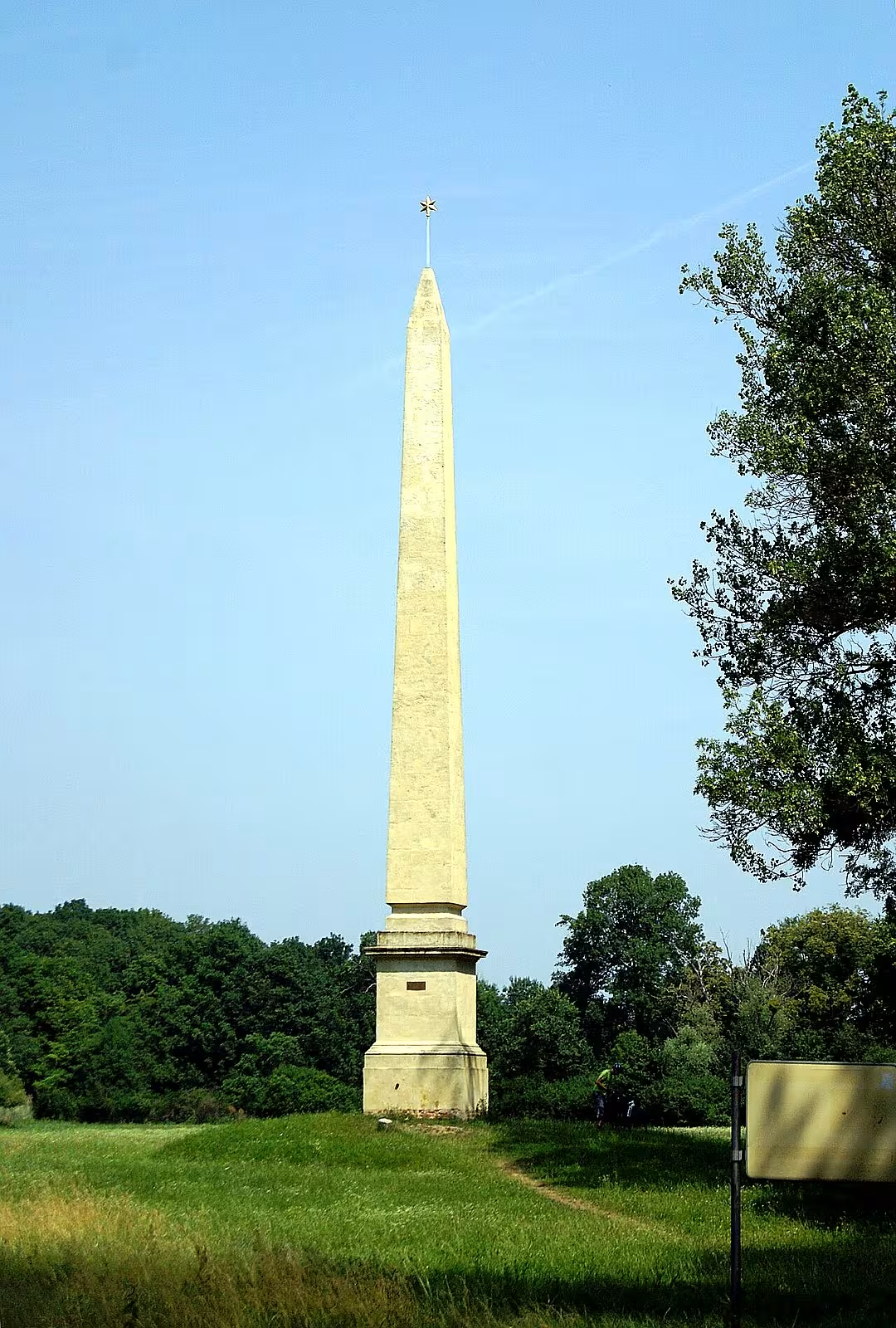
Obelisk in Lednico-Valtice is a classic monument built in 1798 in memory of the closure of peace in Campo Formiu. It is located in the district of Breclav, approximately three kilometres north of the village Lednice in the fenced branch. This twenty-three-metre-high building is the northernmost laid small construction of the entire complex and attracts attention with its untraditional shape and historical background.
The emergence of obelisk dates back to the end of the 18th century, the era of enlightenment and Napoleon wars in Europe. Prince Alois I. Josef z Lichtenštejna erected it in 1798 as a memory of peace between France and Austria, closed on 17 October 1797 in Campo Formio. Brother of builder, Jan Josef I., participated actively in the fighting on the part of Austria. Obelisks as a separate pillar monuments were spread already in ancient Egypt.
The architecture and artistic solution of the obelisk was designed by Josef Hardtmuth, the author of many salets in the Lednico-Valtice complex. The construction is on a square floor plan with a cubic plinth and a chamber needle, which reaches a height of twenty-three meters. On top is placed a six-pointed starfish on a metal tip, symbolizing enlightenment and belief in the power of reason.
The monument was connected to the prince's family from Liechtenstein, which owned the whole area. Historically, there were originally four obelisks in the region; until now, only this fridge has been preserved. The Valtice obelisk was built around 1813 under Prince John I. Josef and disappeared before or around 1870. The next, known as the Facka, has been standing at the height of Hlohovka since 1811; after the lightning glow in 1868 was dismantled and its peak decorated by an eight-pointed star. On the fourth obelisk on the island of the Middle Pond, there were few messages.
A number of legends and local proverbs link to the fridge obelisk. Locals often call it the Facka. According to one legend, it was built in a place where the prince received a slap from his wife for drinking and losing the village or becoming unfaithful. Another rumor is that the monument in the open landscape resembles a fist to the eye, which gave rise to his nickname.
Today, the monument is located in a fenced area of seven hundred hectares, where landscape changes are taking place aimed at restoring the native landscape before the Dyje River regulation. The owner is businessman and forest engineer František Fabichovic. Access to obelisk is not possible as the access gate was abolished in 2023. The construction is visible from the 5066 Grand Pavlovická bike race, which passes the industry at a distance of two hundred and fifty metres. Near there is a natural monument to Flower Lake.
This Classicist monument is a valuable example of the Enlightenment Garden Architecture and reminds us of a significant European history in the cultural landscape of South Moravia. Although the approach is now restricted, its silhouette continues to dominate the area and remains an unnoticeable dominant feature for wandering around the countryside.
Then and now
Drag the slider to compare how the landmark may have looked when it was built with the view today.
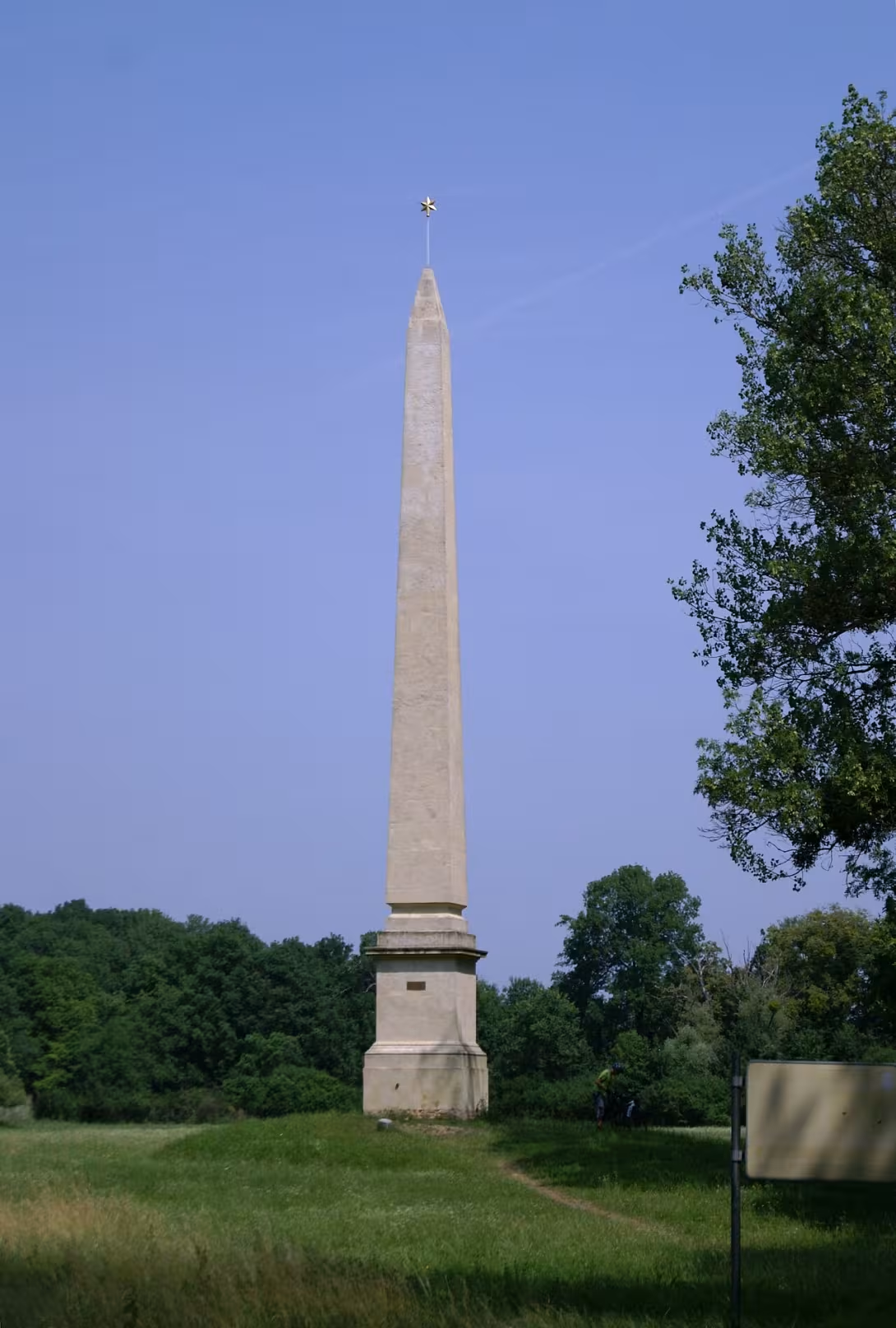

The historical appearance on the left is an AI-generated visualisation and serves as inspiration only.
Historical milestones
- 1797
- Peace in Campo Formio between France and Austria
- 1798
- Obelisk elevation
Architectural development
The construction consists of a chamber needle with a height of 23 metres, which is separated from the cubic plinth by a ledge. The peak ends with a six-point starfish. The project was created by Josef Hardtmuth.
Historical events
1797 - peace in Campo Formio; 1798 - the construction of an obelisk by Prince Alois I. Josef of Liechtenstein.
Owners
Prince family from Liechtenstein
Points of interest
- Obelisk is a classic monument built in 1798 in memory of peace between France and Austria. - It is located in the district of Breclav, approximately three kilometres north of the village Lednice in a fenced branch. - Architecture and art solution designed by Josef Hardtmuth; On top is placed a six-pointed starfish symbolizing enlightenment. - The monument was connected to the prince's family from Liechtenstein, who owned the whole area; until now, only this glacial obelisk has been preserved. - Today the owner is a businessman and forest engineer František Fabichovic, access to obelisk is not possible.
Guide
Show guide text
This text was created by artificial intelligence and has not been editorially reviewed. It may contain inaccuracies.
Welcome to this magical place full of history and stories. You're standing in front of an impressive obelisk that stands right in front of you and catches your attention with its slender and elegant silhouette. Allow me to guide you through this space and bring you closer to the story that is deeply connected to this building.
In front of you, you see a 25-metre-high monument that has a square ground plan and lies on a solid cubic plinth. When you look up carefully to the sky itself, you notice that the top of the building is decorated with a metal tip with a six-pointed starfish. This star was not chosen by chance, but carries profound meaning. It symbolizes enlightenment and a firm belief in the power of human reason, which were ideas that strongly influenced the thinking of the society at the time of the memorial.
Let us now move forward in time and look at the circumstances under which this monument originated and what was its main purpose. The year is seventeen hundred ninety-seven, and a great European policy is experiencing very moving times. Then peace was made in Campo Formio between the mighty France and Austria. It was in memory of the closure of this significant peace that one year later, in seventeen hundred ninety-eight, this memorable obelisk was erected. The whole building bears clear features of a classical monument whose architecture and overall art solution were designed by a gifted architect Josef Hardtmuth.
Now pay attention to historical figures whose names are inextricably linked to this place. At that time, the family of the nobles from Liechtenstein was ruled by important men, among whom Alois excelled first Joseph from Liechtenstein and Jan Joseph first from Liechtenstein. It was under their influence and as part of the extensive modification of the entire estate that buildings were created, which were not only to celebrate the monarch family, but also to commemorate important historical landmarks and spread enlightenment ideas in the landscape.
When you look around you, you realize that you are in Breclav County, approximately three kilometers north of Lednice, in a beautiful but fenced branch. And it is here that there is one very interesting and perhaps a bit surprising fact that makes this place quite unique. In the past, there were several such monuments in this vast area. More specifically, there were four obelisks originally. But time, landscape changes and human fate were relentless. Today you stand before the only surviving witness of the time. This obelisk is thus the last of its kind, which has endured all centuries until today, and bears for us the legacy of its builders.
I hope this stop was interesting to you and that you enjoyed the sight of this unique work of human art and history. When you continue to wander around, let your thoughts flow to the times of the past, when people built such monuments as lasting reminders of peace and human reason. Thank you for your attention, I wish you a wonderful rest of the day and I look forward to meeting you on the next discovery of our monuments. Goodbye.
Tips for visitors
The best time to visit the obelisk is spring and summer, when the surrounding landscape is in full bloom and the weather allows for walking around the fenced field. In these months it is also the longest daylight, which makes it easier to navigate in a vast area. In autumn you can admire the colorful leaves of trees, which contrasts with the stone structure of the monument, but it is necessary to count on lower temperatures and shorter days.
The monument is located in a fenced branch near the Dyje River, which means that access is only possible by foot or by bike on dedicated routes. It is recommended to use the Grand Pavlovická bike route, which allows comfortable access to the bike monument while offering beautiful views of the surrounding landscape.
Take comfortable shoes to walk on grass and partly reinforced terrain, plenty of drinking water and light clothes adapted to current weather. Since it is an outdoor area without shelters, it is advisable to carry an umbrella or waterproof jacket, especially during frequent summer storms. An extended walk around the industry can be difficult, so it is good to have light refreshments with you.
For photography is ideal morning or evening light, when the sun shines at an angle and creates dramatic shadows on a square plan and cubic plinth of obelisk. You can get the best views of the total silhouette of 23 meters high construction from lower places in the industry, where you can capture the contrast between the monument and surrounding vegetation. If you want to highlight the historical context, try shooting obelisk from positions where you can see the river Dyje in the background.
Near the obelisk lies the natural monument of the Flower Lake, which is an ideal goal for a short walk (within 30 minutes) and offers unique botanical diversity. The Grand Pavlovická Cyclotrase allows you to extend your trip and explore other parts of the Lednice-Valtice complex. For families with children, the industry is a suitable place to spend time actively, but it is important to ensure safety in water areas and to respect the rules of behaviour in natural monuments in order to avoid damage to a sensitive ecosystem.
Frequently asked questions
Can the monument be visited?
This is a structure in a public space that can usually be seen from outside free of charge. We have not verified that this particular one is freely accessible.
Where is the monument?
Location: Lednice, Jihomoravský kraj. The map on this page shows the exact spot.
Why is the monument protected?
It is listed in the Central List of Cultural Monuments of the Czech Republic as a cultural monument (register no. 1000149536).
Businesses nearby
Do you run a restaurant, accommodation, shop, museum, rental, wellness or other visitor service near this monument? Show yourself directly to the people heading to it — this is how they will see you in the app and on the web:
Events nearby


Zdroj akcí: otevřená data měst a obcí ČR (Národní katalog otevřených dat) a kalendář akcí Národního památkového ústavu.
Nearby
Památka se nachází v oplocené oboře u řeky Dyje. V blízkosti leží přírodní památka Květné jezero a cyklotrasa Velkopavlovická.
Accommodation nearby
Themed route
Thematic cruise route from Lednice
1.Obelisk (memorial)
Type: Historical memorial
Why is it worth a visit: Obelisk is a key part of the Lednico-valtice park and represents one of the most famous architectural monuments in the area. Its beautiful design and historical importance make it an essential explorable attraction.
2. Natural Monument of Flower Lake
Type: Natural monument
Why is it worth a visit: The flowering lake is a unique natural body known for its rich biodiversity and beautiful flowering areas. It is an ideal place to relax and observe nature in a quiet atmosphere.
3. Cyclotrase Grand Pavlovická
Type: Cyclotrase
Why is worth a visit: This cycling route offers a comfortable way to explore the landscape beauty surrounding the area. It is a great opportunity for cycling lovers and for those who want to enjoy the view of the landscape from a different perspective.
This route offers a combination of historical and natural attractions around Lednice, making it ideal for a day trip.
Seasonal recommendations
Spring in the castle park in Lednice brings awakening nature, when the surrounding meadow forests and vast lawns turn into fresh green shades. In spring, sun rays penetrate even bare branches of trees, creating unique lighting conditions for shooting the slim silhouette of a tall stone monument. The atmosphere here is very quiet and quiet, ideal for undisturbed contemplation. In terms of practical advice, prepare yourself for variable weather and occasional showers in the spring, so it is best to choose fixed waterproof shoes and laminated clothes. You can avoid crowds if you arrive in the morning.
Summer at the historic column offers a completely different atmosphere, dominated by lush green vegetation around the whole monument. The sun burns all day and the strong side light in the late afternoon beautifully models reliefs and inscriptions on the historical stone. In the main summer season, the largest number of hikers are heading here, which means having to count on a more busy environment. If you want to experience a quieter moment without a large number of people, come here early in the morning after dawn or late in the evening when the air temperature is falling slightly. Don't forget to bring your headgear, enough drinking water and sun protection cream, because you won't find much in the surrounding open areas of the shade.
Autumn turns the castle garden into a colourful palette full of yellow, orange and red tones of leaves, creating a unique and somewhat melancholic mood. Low sun creates long shadows and gives the whole monument a deep and dramatic expression. On colder autumn days, the attendance rate is relatively low, so you can enjoy the memory almost alone. For this season it is necessary to wear a warm sweater, a non-inflatable jacket and long pants, because from the water level and the surrounding forests can blow an unpleasant cold wind. The ideal time for visiting is around noon, when at least the weak sun warms.
Winter gives this place a fairy tale, especially when the landscape is covered with a layer of white snow that contrasts with a dark stone of vertical construction. Lighting in the winter months is very short, the sun sets early in the afternoon and the shadows are sharp. The atmosphere is completely silent, interrupted only by the crunch of snow under your feet. Due to freezing weather and reduced visibility, caution should be exercised on icy roads in the surroundings. Wear very warm winter shoes with anti-slip soles, gloves, hat and winter coat. The best time for a tour is around noon, when the outside is warmer and daylight reaches its maximum.
Visualizations and artistic views


The visualisations are generated by artificial intelligence and serve as inspiration.
Tips from visitors
No tips yet. Be the first!
Log in and add your tip.
Sources and literature
Photos: Aiedail8 / CC BY-SA 3.0 — Wikimedia Commons. The author and licence also appear when you hover over the image.
Faktickým podkladem tohoto textu byl článek na Wikipedii, jehož autory jsou přispěvatelé Wikipedie. Článek je dostupný pod licencí CC BY-SA 4.0.
Location on the map


Příběhy a pověsti
Legendy, pověsti a příběhy spjaté s touto památkou
Fotografie návštěvníků
Zatím žádné fotografie. Buďte první, kdo přidá fotografii z návštěvy!
Log in a přidejte svou fotografii nebo hodnoťte.
Za ověřenou návštěvu v aplikaci získáte víc bodů — poznáme podle GPS, že jste na místě.
Reviews and comments