



Lovecký zámeček (Lednicko-valtický areál) Hunting lodge
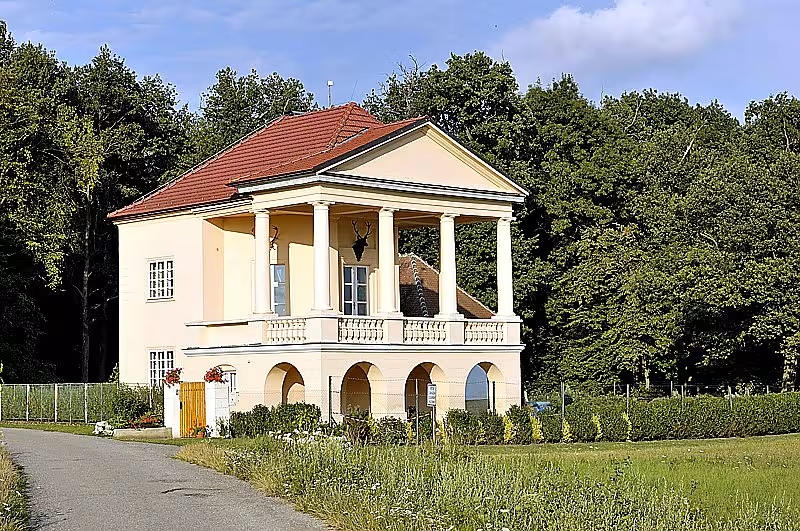
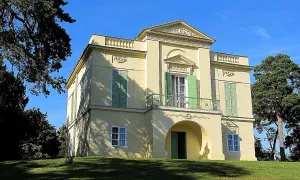
The hunting castle is a classicist small building in the Lednico-Valtice area in the district of Breclav, built in 1805-1806. It was originally used as a grove and a place to watch the Parforus hunt. This monument represents a typical example of classical architecture in the landscape.
The building was designed by Joseph Hardmuth during the Napoleon wars, which influenced Europe's policy. Classicism developed in Czech countries at the time.
It is a free-standing two-storey object with a porticus on the first floor, which is decorated with six Tuscan columns on prismatic bases connected by tapered balustrade. The low roof covers the total of the building. The ground floor consists of a three-axis half-circle arch, while an eight-sided salon with a French window is situated in the interior.
The castle performed both practical and representative tasks. On the ground floor there was a hunter, while the terrace on the top floor allowed the estate to watch the Parfora hunting in the meadow. The saloon served as a place for refreshments.
After 1945, the building went under the administration of the Regional Centre of State Monument Care in Brno and served as an ornithological observer. After 1990, the building was sold to a private owner.
The Hunting Castle is protected as a cultural monument of the Czech Republic and is located about 2 kilometres east of Lednice on the road towards Janohrad and Boar disciplines. Accessibility is limited to a side asphalt road due to private property.
This building represents a valuable addition to the architectural complex Lednico-valtice complex and its visit offers insight into the culture of hunting and classical architecture.
Then and now
Drag the slider to compare how the landmark may have looked when it was built with the view today.
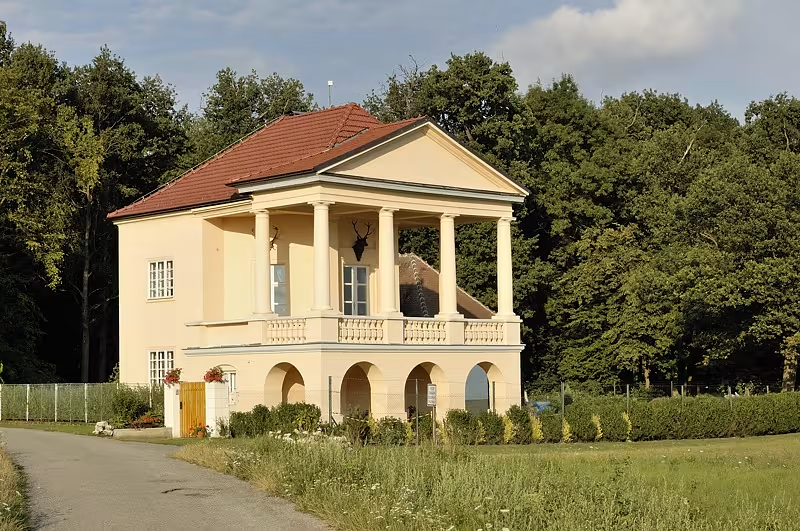

The historical appearance on the left is an AI-generated visualisation and serves as inspiration only.
Historical milestones
- 1805
- Beginning construction according to Josef Hardmuth's design.
- 1806
- Completion of construction.
- 1945
- Transfer of the building to the administration of the Regional Centre of State Heritage Care in Brno.
- 1990
- Sale of the building to the private owner.
Architectural development
It is a free-standing two-storey building in a classical style. The first floor is dominated by a porticus with six Tuscan columns and a cone balustrada. On the ground floor there is a three-axis semicircular arch.
Historical events
In 1805-1806 the construction was built. After 1945 she served as an ornithological observer. After 1990, the building was sold to a private owner.
Owners
After 1945 the Regional Centre of State Monument Care in Brno, after 1990 the private owner.
Points of interest
- Hunting castle is a classicist small building built in 1805-1806. - The building was designed by Joseph Hardmuth during the Napoleon Wars. - The castle performed both practical and representative tasks such as the housing of the hunter and the place for refreshments of the hunters. - After 1945 the building served as an ornithological observatory under the administration of the Regional Centre of State Heritage Care in Brno. - The hunting castle is protected as a cultural monument of the Czech Republic.
Guide
Show guide text
This text was created by artificial intelligence and has not been editorially reviewed. It may contain inaccuracies.
Welcome to one of those quiet, yet very important pearls that decorate the Lednice-Valtice area. Stop for a moment, take a breath and look ahead. You're standing in front of the Hunting Castle. At first glance, you may be interested in its modest size compared to those magnificent palaces you may have seen elsewhere in the area, but it is in this little detail that its attraction lies. It's a building that doesn't pretend to be anything but what it really is, yet it emits an unrepeatable peace and elegance. Feel the atmosphere of this place, where human architecture combines itself with the natural beauty of the landscape.
Let us now look together at how this building was created and at what time it was born. It was created at the very beginning of the nineteenth century, namely in the year eight hundred and five. It was a very stormy time for the whole of Europe, because at that time, the wars of Naples, which transformed maps of states and changed the fate of millions of people. It was in this tension and uncertainty that the design signed by architect Josef Hardmuth was created. His vision was to create an object that was practical but at the same time aesthetically aligned with the surroundings. The construction was completed very quickly, as early as eight hundred and six years ago, and has since stood here as a witness to history.
Now, if you focus on the architecture itself, notice its style. The hunting lodge is drawn up in a spirit of classicism. What did it mean for that time? Classicism was a return to ancient values, order, balance and purity of lines. If you look at the facade and overall proportions of the building, you will see that there is nothing unnecessary. Everything is balanced and harmonious. It is a small structure which, however, seems noble in its simplicity. Notice how naturally it fits into the landscape. The architect Hardmuth didn't want the building to overpower the landscape, but to work with it.
It's important to understand why this castle was built in the first place. It was not just an ornamental element in the landscape, but a building with a very specific purpose. Originally she served as a grove, a place for a man who was responsible for the care of the forest and animals. An apartment was reserved in the building for a hunter who lived and worked here. But the Hunting Castle performed even more representative tasks. Thanks to his strategic position, he allowed the monarch, the noble families who owned this area, to follow the so-called parforums.
Maybe you haven't heard that expression, so I'll give you a little closer. Parfortic hunting was a very specific and challenging way of hunting, when animals were not expected in trenches, but were hunted by dogs and hunters on open terrain, in this case by nearby meadows, until completely exhausted. It was a theater full of emotion, speed and tension. And from this very spot, from the Hunting Castle, the observers could watch in peace and comfort where the hunting took place and where both the animals and the hunters were located.
When you imagine inner spaces that are now protected as a cultural monument of the Czech Republic, think about the salon. In the interior there is a space designed for refreshments of the hunting participants. Imagine the moments when hunters came back here after a long and hard day in the field, the smell of food and drink spread in the room, and talks about the success and failure of the novel today. It was a place of meeting, relaxation and social life within the aristocratic layer.
This object has undergone various changes in property over the years, reflecting the history of our entire state. After a year of nine hundred forty-five when World War II ended, the building was transferred to the administration of the Regional Centre of State Monument Care in Brno. The State has thus made sure that this valuable building is not abandoned and that its historical value is preserved for future generations. This was a period of state care that lasted several decades. Then, however, there was a break in the year of a thousand nine hundred and ninety, when the object was sold to a private owner. It is fascinating to see the fate of a small building change along with the country's political and social system.
Now if you look at the Hunting Castle again, try to realize the contrast. On the one hand, we have strict lines of classicism and on the other hand, the wild nature of the hunt and nature surrounding it. It is a place where the order is confronted with chaos, which is where the human need for control and observation has met the freedom of meadows. It's a little piece of history that tells us about how people lived two styles ago, what they thought was fun and how they perceived the beauty of architecture.
The interesting thing is that even though the construction is small, its importance throughout the Lednice-Valtice complex is great. It's proof that even functional buildings, like the grove, could be designed with high aesthetic demands. Josef Hardmuth has shown here that even for a common hunter a space can be created that has its dignity.
Now I'm going to let you take a closer look at the details of this building. Take a walk around it, feel the silence of the surroundings and try to imagine the sound of hooves and barking of dogs that were here centuries ago. Notice how light is reflected from the walls and how the building operates in different angles of view. It is an ideal place for a brief moment to think about how quickly time passes and how important it is to protect these little monuments, which are like silent witnesses to the past.
I hope you find your visit to the Hunting Castle interesting and that you felt the spirit of the time in which it originated. This complex has many other secrets and beautiful places that await your discovery. I ask you to continue to explore the surroundings, to see the harmony of the landscape and to look for other clues of history that are hidden in this area. I wish you a pleasant journey and remember to enjoy every moment you spend in this unique space. Goodbye.
Tips for visitors
The best time to visit is early morning or late afternoon when the light is softer and there are not so many people around the building. In spring months or autumn there is a quieter atmosphere than in the main summer season.
You can reach the monument by car and public transport; The current connection is best checked in the traffic tracking system.
Take with you comfortable shoes suitable for nature walks and drinking water. For lovers of photography are the best places near the building, where thanks to surrounding vegetation creates beautiful shadows and light effects, especially at sunset.
In the surroundings you can explore Lednico-valtice area, Janohrad, Boar field or the city Lednice itself. For families with children it is ideal to walk this area thanks to large areas where children can run freely in the natural environment.
Frequently asked questions
Can the monument be visited?
Some buildings of this kind are open for guided tours, others serve another purpose or are privately owned. We have not verified whether and when this monument is open – please ask the operator.
What are the opening hours and admission?
We have not verified the opening hours or admission. Current information is published by the operator.
Where is the monument?
Location: Lednice, Jihomoravský kraj. The map on this page shows the exact spot.
Why is the monument protected?
It is listed in the Central List of Cultural Monuments of the Czech Republic as a cultural monument (register no. 1316962874).
Businesses nearby
Do you run a restaurant, accommodation, shop, museum, rental, wellness or other visitor service near this monument? Show yourself directly to the people heading to it — this is how they will see you in the app and on the web:
Events nearby


Zdroj akcí: otevřená data měst a obcí ČR (Národní katalog otevřených dat) a kalendář akcí Národního památkového ústavu.
Nearby
Lednicko-valtický areál, Janohrad, Kančí obora a město Lednice.
Accommodation nearby
Themed route
Thematic cruise route: Lednice-valtice area and surroundings
1. Lovecký zámeček (Lednicko-valtický areál) - lock The main goal of our route is the Hunting Castle, located in the village Lednice. This historical complex is one of the famous examples of German romanticism and has a rich history associated with the Liechtenstein family. The castle is famous for its beautiful gardens, parks and architectural design.
2. Boar field - nature reserve After visiting the castle we will go to the Boar branch, which is part of the Lednico-Valtice complex. This area is known for its vast forests and wild nature, where you can observe different species of birds and other animals. It is an ideal place for relaxing and walking on the natural background.
3. Janohrad - historical location The following target is Janohrad, located near Lednice. This area has a rich history and is famous for its ancient buildings and picturesque environments. It is a place where you can explore historical monuments and enjoy quiet moments in the natural surroundings.
4. City Lednice - municipal centre After visiting Janohrad we will return to Lednice, which is the administrative center of the complex. The city offers various cultural and gastronomic options where you can enjoy refreshments or explore local shops. It's the perfect place to end your trip.
This route offers a combination of historical, cultural and natural experiences that are linked to one of the most important cultural heritage of our region.
Seasonal recommendations
Seasonal recommendation for visiting the historical monument. Memorial: Lovecký zámeček (Lednicko-valtický areál) (lock), Lednice.
Spring: In the spring, the gardens around the castle awaken to life and bring the first colours of fresh flowers and young leaves. Light is soft and pleasant in this period, which creates an optimistic atmosphere. I recommend a visit in the morning when the air is the cleanest. Dress well, because the morning cold may be accompanied by sudden heat during the day.
Summer: The summer season is characterized by rich greenery and long days full of sun. The atmosphere is very lively, but due to the high traffic, it can be busy on the premises. It is best to arrive at the beginning of the operation so that you enjoy a quieter moment. Prepare light clothes, headgear and don't forget enough fluid for hydration.
Autumn: Autumn brings golden and red shades of leaves to the landscape and is often accompanied by mysterious morning fog over water surfaces. It's time for a quiet observation of nature in a less busy environment. Prepare high-quality shoes suitable for wet roads and warmer layers of clothing, as afternoon temperatures fall rapidly.
Winter: In winter, the monument is a very quiet and peaceful impression, especially in cold weather or snow. The daylight is weak and the days are short, which creates a melancholy mood. There are the least people in this period, which allows for a more private tour. It is necessary to have very warm clothes and to check shorter opening times before travelling.
Visualizations and artistic views


The visualisations are generated by artificial intelligence and serve as inspiration.
Photos from the area
Real photos taken near the monument


Zdroj a licence jsou uvedeny u každého snímku.
Tips from visitors
No tips yet. Be the first!
Log in and add your tip.
Sources and literature
Photos: Doronenko / CC BY 3.0 — Wikimedia Commons. The author and licence also appear when you hover over the image.
Faktickým podkladem tohoto textu byl článek na Wikipedii, jehož autory jsou přispěvatelé Wikipedie. Článek je dostupný pod licencí CC BY-SA 4.0.
Location on the map



Příběhy a pověsti
Legendy, pověsti a příběhy spjaté s touto památkou
Fotografie návštěvníků
Zatím žádné fotografie. Buďte první, kdo přidá fotografii z návštěvy!
Log in a přidejte svou fotografii nebo hodnoťte.
Za ověřenou návštěvu v aplikaci získáte víc bodů — poznáme podle GPS, že jste na místě.
Reviews and comments