



Oblouk House
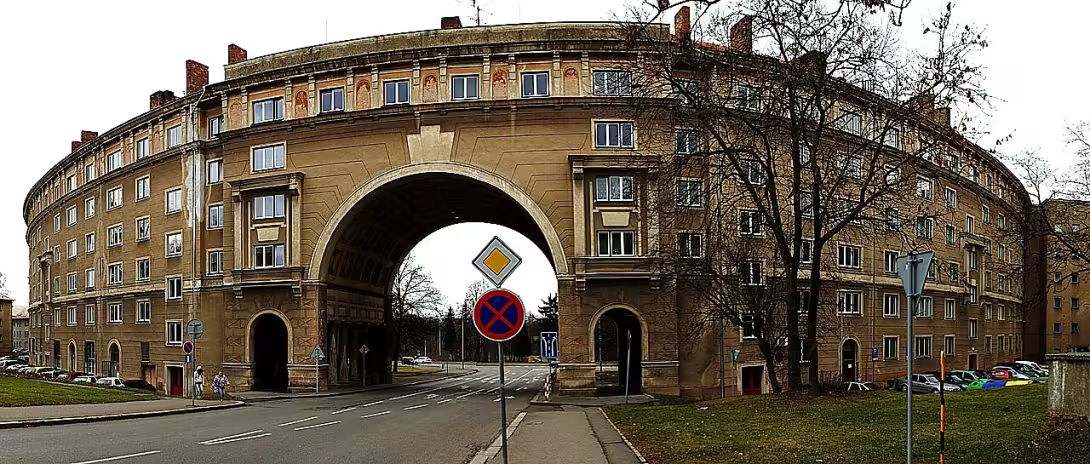
Oblouk is a multifunctional building in Ostrava. It represents one of the examples of socialist realism. This semi-circular object lies on the southern edge of the oldest part of the estate. It was supposed to serve as a magnificent gateway to a new workers' town and to this day remains the largest building in the territory of the new Poruba.
Construction started in June 1952. It took place together with the building of surrounding residential units on the street of the Union of anti-fascist fighters, one of which is Oblouk directly connected. According to period data, construction work was difficult and lasted throughout 1953 and 1954. The complex was completed in December 1954 when the first tenants moved into it, although the decorative plaster was finished later.
The architect Evžen Šteflíček was inspired by the main staff building at the Palace Square in St Petersburg, which Carl Rossi built in 1819-1829. But instead of a horse team, he placed a relief from Václav Shantroček. This represents going to work and coming home. The whole object consists of twelve separate units. The west end of the building ends the tower with clocks above the river Porobka, while the eastern part passes into residential houses of the estate.
The construction of the building is closely linked to the transport infrastructure. In the middle of the semicircle lies a road intersection from which two communications lead directly through the object. In these passages, the pedestrian space is separated from the road by stylized columns. A specific feature is a view from aerial images or maps, where the building together with the road forms a symbol of sickle and hammer.
The important events were the visit of Soviet representative N. S. Chruščova on 13 July 1957, when the President of Czechoslovakia Antonín Novotný welcomed him. Khrushchev did not appreciate the Stalinist architecture of the building and questioned the sufficient size of the windows. Later, on 27 March 2008, Oblouk was declared a cultural monument by decision of the Ministry of Culture of the Czech Republic.
In the immediate vicinity there are other important localities such as Turrets, Main Class, Alš Square, House of Culture Treasure, Elementary School Porobská 832 and Poruba Metasecvovy.
The object is a unique testament to the ideological architecture of its time and its influence on the urban form of Poruba. For people interested in the history and architecture of the 1950s, it is a mandatory stop when visiting Ostrava.
Then and now
Drag the slider to compare how the landmark may have looked when it was built with the view today.
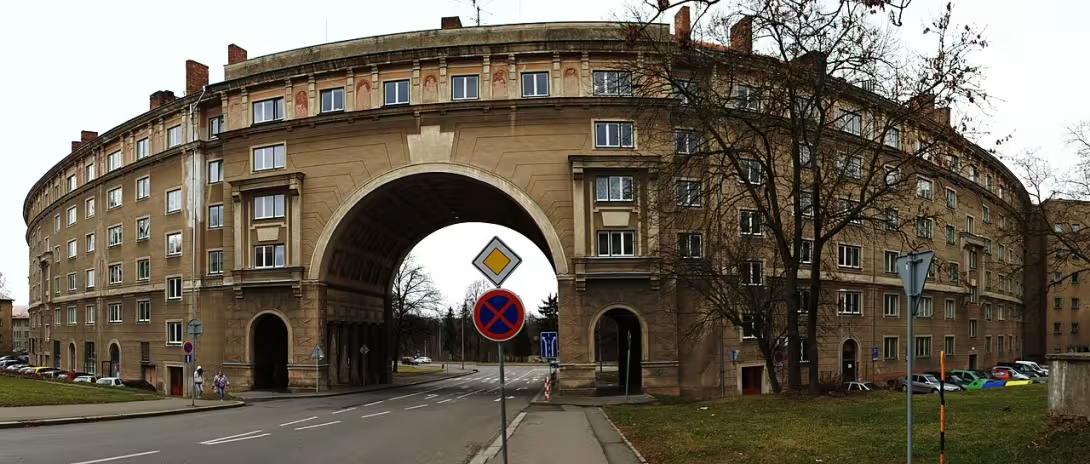
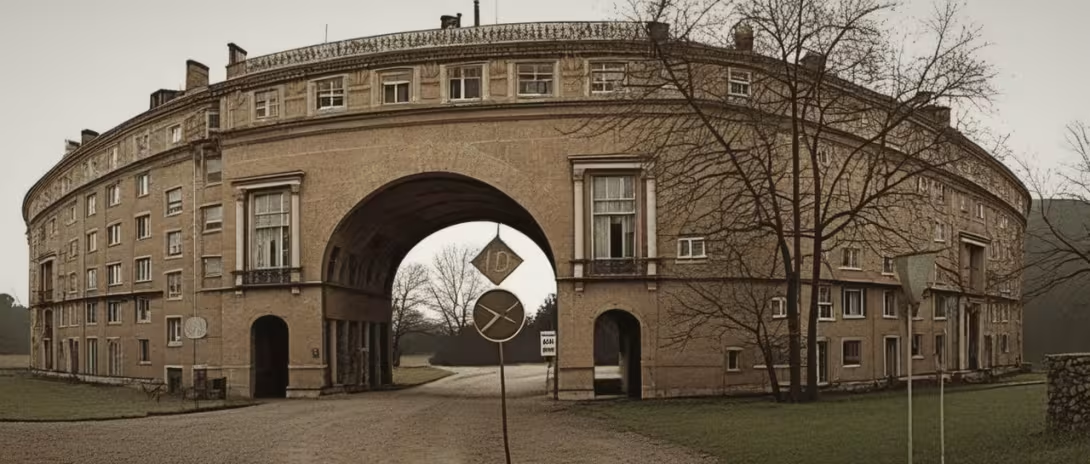
The historical appearance on the left is an AI-generated visualisation and serves as inspiration only.
Historical milestones
- 1952
- construction start
- 1954
- complete the complex and move in first tenants
- 1957
- visit N. S. Chruščova
- 2008
- declaration for cultural monument
Architectural development
The construction was started in June 1952 and completed in December 1954, while the decorative plaster was finished later. The architect was inspired by the main staff building in St Petersburg. The building combines residential functions with passable roads and ends with a clock tower.
Historical events
July 13, 1957: Visit to N. S. Chruščova, which did not appreciate the building as an example of Stalinist architecture. 27 March 2008: Declaration of the building for cultural monument by the Ministry of Culture of the Czech Republic.
Points of interest
- The building from the 1950s represents a demonstration of socialist realism and is the largest building in the territory of the new Poruba. - The architect was inspired by the building of the main staff in St Petersburg, but instead of a horse team, he placed a relief to show his departure to work and return home. - From aerial images or map the building together with the ground form a symbol of sickle and hammer. - In July 1957, a representative from the Soviet Union visited the building who questioned the size of the windows and did not appreciate architecture. - In 2008 the building was declared a cultural monument by decision of the Ministry of Culture of the Czech Republic.
Guide
Show guide text
This text was created by artificial intelligence and has not been editorially reviewed. It may contain inaccuracies.
Welcome to Ostrava, Poruba. Right now, you're facing one of the most significant and largest buildings in this entire city district. In front of you is Oblouk, a building that, with its size and unusual shape, has certainly attracted you at first sight. It is a building that resembles a massive gate, which welcomes you to the space that was once planned as an ideal city for workers. When you look at it, you see a semi-circular shape that surrounds space and creates a sense of a closed but representative complex.
Let us now stop a little bit at how it was created and at what time this building was created. You're standing in front of a monument to the 1950s. The construction of Oblouk began in the year nine hundred and fifty-two and the whole complex was completed in the year nine hundred and fifty-four. It was this year that the first tenants who found their new home in the building moved here. The whole project was designed by an architect named Evžen Šteflíček. The goal was to create something more than just ordinary houses. Oblouk was to be a symbol of a new era, a spectacular entrance to the emerging Poruba, which was to be a demonstration of modern and organized housing for working people.
Now that you are standing here, pay attention to the architecture itself and the details surrounding you. Note that although the building acts as one huge and continuous whole, it actually consists of twelve separate units. It's the fascinating playfulness of an architect who could connect so many different parts into one harmonious semicircle. Look around you and see how the building rhythms the space. A very characteristic element, which you will definitely overlook, are the passages designed for communication that allow you to flow through the building, and a dominant clock tower that serves as an orientation point for all those who pass through here. The whole style is called socialist realism, which was the direction that emphasized monumentality, clarity and celebration of work.
When we talk about the history of this place, we cannot forget the significant personalities that met with Oblouk. This building was such an important symbol of the development at that time that it became a pit stop for the leaders of the then power. In the year nine hundred and fifty-seven, the famous Soviet leader Nikita Sergei Khrushchev, who accompanied Czechoslovak President Antonín Novotný, hosted here. Imagine the atmosphere, the amount of escort and the importance this visit had at that time. Oblouk was not just an ordinary house, it was an exhibition cabinet of the then social arrangement and architectural ambitions.
Now, I want to impress you with one interesting thing that may not be visible at first sight, but gives the building a deeper meaning. The architect Evžen Šteflíček was inspired by the main staff building in St Petersburg. If you ever visit that Russian city, you'll notice a similar semi-circular arrangement. However, there was a very interesting change in the symbols in Ostrava. While you will find a horse team in St. Petersburg, here in Poruba there is a relief that represents the everyday life of ordinary people. You can see here the representation of going to work and returning home. It is a beautiful detail that transfers monumental architecture from military or state power to the realm of ordinary man and his daily efforts.
It's fascinating to realize how the perception of this building changed over time. From its completion in the 1950s to the present time, the building passed through various stages. Its historical and architectural value was finally officially recognised in the year two thousand eight, when Oblouk was declared a cultural monument. This step was to ensure its contribution to future generations in order to act as evidence of the concrete era of our history and as a demonstration of the urban planning of that time.
Now, if you look again at the overall composition of the building, consider it a bridge between the past and the present. Oblouk remains the largest building in the territory of the new Poruba and still dominates the surrounding landscape. It is a place where the ambition of architects meets the reality of the daily life of thousands of people who live and live here.
Let's slowly finish this short chapter of your guide. I hope that this information has helped you understand better why this building is so special and what it holds except concrete and bricks. Now you can take a quiet look at the facade, walk through the passes or just watch a game of time on the clock tower. I invite you to further explore the surroundings of Poruba, which has many other hidden stories and architectural pearls. Thank you for your attention and I wish you a pleasant continued journey to explore. Goodbye.
Tips for visitors
The best time to visit is the late afternoon when the sun hits the half-circle facade at an angle, which will highlight the details of socialist realism. The building serves as a gateway to the neighborhood, so it is ideal to observe it as part of a city walk.
You can easily reach the place by car or public transport; Check the current connection and stop options in the Internet search engine. As it is a residential and economic building, the tour is only carried out from the outside.
For shooting, we recommend you search for a place on the opposite side of the street to capture the entire width of the arch. The best light is during the golden hour before sunset, when the building gets a warm breath.
In the vicinity you can visit Alš Square, Main Class, Turrets, House of Culture Treasure, Elementary School Poruba 832 or admire Poruba Metasecvores.
Families with children appreciate the space around the building and a follow-up walk to metasecvoje, which is a pleasant goal for a common trip with elements of architecture and nature.
Frequently asked questions
Can the monument be visited?
This is a residential or farm building, not a museum with opening hours. Please view it from public space and respect the owners' privacy. We have no information about access to the interior.
Where is the monument?
Location: Poruba. The map on this page shows the exact spot.
Why is the monument protected?
It is listed in the Central List of Cultural Monuments of the Czech Republic as a cultural monument (register no. 1471198486).
Businesses nearby
Do you run a restaurant, accommodation, shop, museum, rental, wellness or other visitor service near this monument? Show yourself directly to the people heading to it — this is how they will see you in the app and on the web:
Events nearby
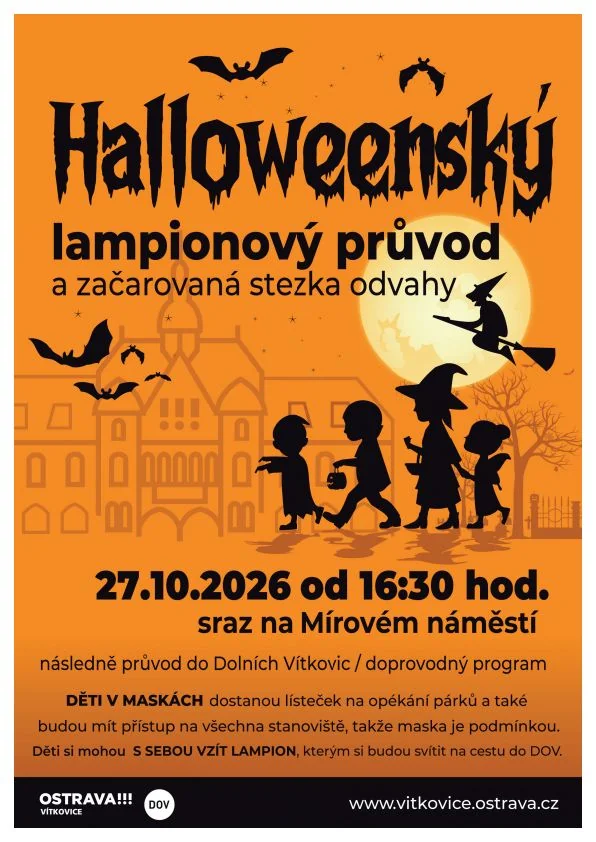
Zdroj akcí: otevřená data měst a obcí ČR (Národní katalog otevřených dat) a kalendář akcí Národního památkového ústavu.
Nearby
V blízkosti se nacházejí Věžičky, Hlavní třída, Alšovo náměstí, Dům kultury Poklad, základní škola Porubská 832 a Porubská metasekvoje.
Accommodation nearby
Themed route
Here is a proposal for a thematic walk:
1. Alš Square (central space) - The starting point of the journey where you can taste the atmosphere of the local center. 2. House of Culture Treasure (building) - A distinctive building that serves as a centre of cultural events. 3. Main class (street) - Walk through the main artery of the village which connects important points of the route. 4. Oblouk (monument) - The main destination of the trip, which represents the dominant architectural element. 5. Poruba metasecvoy (tree) - A natural monument nearby, ideal for a peaceful ending.
Seasonal recommendations
In spring, the surroundings of the building awaken to life and fresh green creates a fine contrast with the surface of the arch. Light is soft in the morning, which is ideal for capturing facade details. We recommend light but laminated clothing and a visit in the morning when the air is the cleanest.
In the summer months it dominates the place of intense sun and rich color surrounding nature. The building in sharp midday light is very strong, so it is best to come shortly before sunset when shadows are longest. Remember the cap and plenty of water, because in this area it can be very hot in the season.
Autumn brings golden shades of leaves to the surroundings, which give the monument a nostalgic atmosphere. The lighting is golden and milder in this period, which highlights the texture of the building material. Suitable is waterproof shoes and light jacket, the best time to walk is in the afternoon.
In winter, the arc is very steep and dominant, especially if the surface is covered with a layer of snow. The atmosphere is quiet and quiet, typical of freezing days at advent time. It is necessary to choose warm and waterproof clothes and thick gloves, and we recommend visiting when the natural light is the strongest.
Visualizations and artistic views


The visualisations are generated by artificial intelligence and serve as inspiration.
Photos from the area
Real photos taken near the monument


Zdroj a licence jsou uvedeny u každého snímku.
Tips from visitors
No tips yet. Be the first!
Log in and add your tip.
Sources and literature
Photos: I would appreciate being notified if you use my work outside Wikimedia. More of my work can be found in my personal gall / CC BY 3.0 — Wikimedia Commons. The author and licence also appear when you hover over the image.
Faktickým podkladem tohoto textu byl článek na Wikipedii, jehož autory jsou přispěvatelé Wikipedie. Článek je dostupný pod licencí CC BY-SA 4.0.
Location on the map


Příběhy a pověsti
Legendy, pověsti a příběhy spjaté s touto památkou
Fotografie návštěvníků
Zatím žádné fotografie. Buďte první, kdo přidá fotografii z návštěvy!
Log in a přidejte svou fotografii nebo hodnoťte.
Za ověřenou návštěvu v aplikaci získáte víc bodů — poznáme podle GPS, že jste na místě.
Reviews and comments