



Panský dvůr, Vinoř Homestead
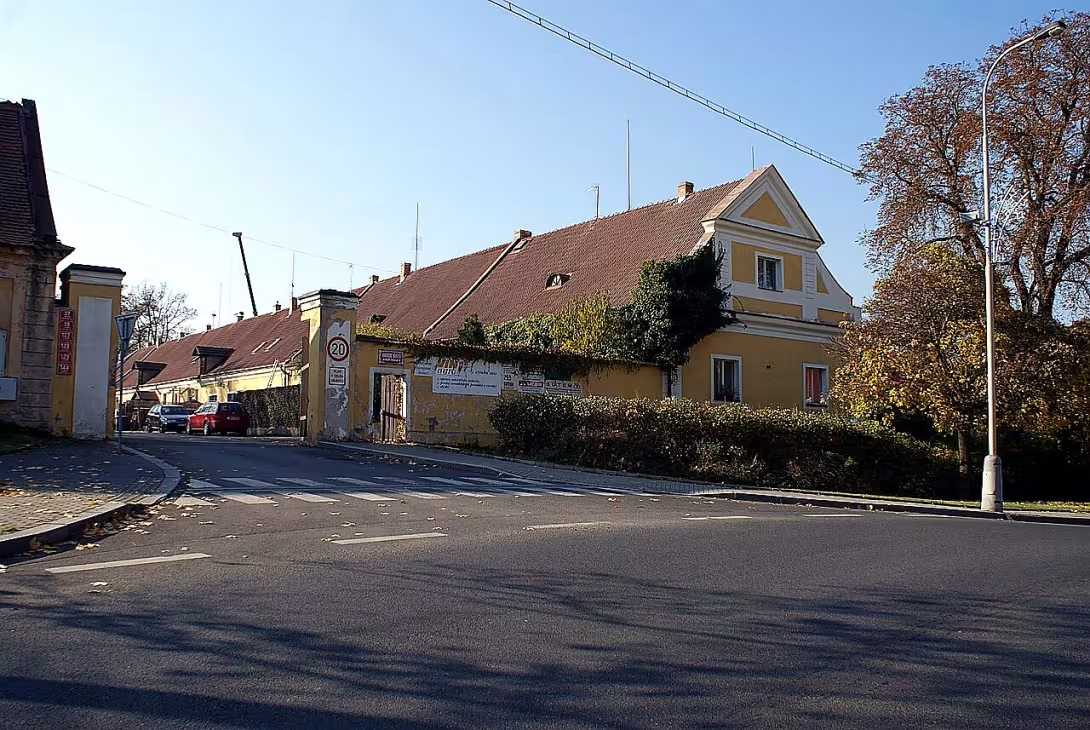
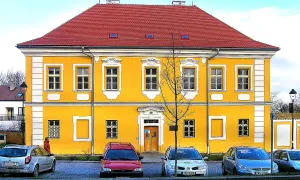
The court in Vinoři in Prague is a set of baroque economic buildings that are adjacent to the nearby castle and protected as a cultural monument of the Czech Republic. This complex includes several buildings, including residential buildings, granaries and farm buildings with a forge, and is important in its architectural composition, which includes elements of Baroque, Classicism and Art Nouveau.
The court was founded in the 18th century. During the 19th and 20th centuries, it underwent several building modifications. Historical sources suggest that his northeast side was the site of the original fort in the past. Some parts of the complex, such as a barn or an economic building, are already documented from 1840.
The architecture of the complex is diverse. Economic building no. 37 is a ground floor Baroque building with a longitudinal plan and a saddle roof with a bag cover. Its facade is decorated with a triangular shield with boasts in the corner and arched arcades with walled fillings. Both rolled and flat vaults were preserved in the interior. On the north-west side of the court are a set of Baroque residential and administrative buildings no. 127, 128, 129 and 144. These objects have preserved the silhouette of the baroque roof and there are visible views of the 19th century skylights at building No. 129. The interiors of these houses contain cross, rolled and flat arches with lunette or five-sided sections in window nuggets.
In the south corner of the complex there is a high Baroque granary which shows signs of classical modifications. The facade is decorated with an entrance portal with a triangular front or a door with a sun motif, with the remains of the barefoot preserved on the ground floor. The southwest part of the granary is broken down by lisenas and covered by decorative slats. There are also buildings with elements of industrial architecture and Art Nouveau, such as stables from the beginning of the 20th century built from a concrete wall with Art Nouveau shields.
The wall in the north-east corner of the yard is cut by a pillar gate with a profiled end which is connected to buildings No 37 and No 127. There is a small barn No. 145 built after 1840 and other economic objects that complement the historical character of the whole.
The court is an authentic view of the historical management near the wine castle and the Church of the Holy Cross. It's a place where you can see the alternating architectural styles within one functional unit. Visiting this area offers insight into the history of the site and its former economic background.
Historical milestones
- 18th century
- Establishment of the Court of Lords
- 1840
- Proof of some parts of the site such as barn or farm building
- after 1840
- Position of small barn no. 145
- 19th century
- Construction work and the development of a skylight for hay drop near building No. 129
- beginning of the 20th century
- The creation of stables with elements of Art Nouveau and industrial architecture
Architectural development
The original Baroque buildings were gradually modified during the 19th and 20th centuries, while the elements of Classicism and Art Nouveau appeared. The interiors managed to preserve different types of vaults such as flat, cross or rolled. Some objects, such as granary, show classical elements in the form of a front-mounted portal.
Historical events
In the 18th century the yard was founded and in the 19th and 20th centuries it underwent several building modifications.
Points of interest
- It is a set of baroque economic buildings protected as a cultural monument of the Czech Republic. - The architectural composition of the complex includes elements of Baroque, Classicism and Art Nouveau. - Historical sources indicate that the northeast side of the past was the site of the original fort. - The tall Baroque granary shows signs of classical modifications and has a door with a sun motif. - Stables from the early 20th century are built from a solid wall with Art Nouveau shields.
Guide
Show guide text
This text was created by artificial intelligence and has not been editorially reviewed. It may contain inaccuracies.
Welcome to the historic site of the court in Vinoři! You're standing in front of a set of buildings that tell a long and interesting history. You will understand why this complex is protected as a cultural monument of the Czech Republic.
The court was founded in the 18th century and gradually developed along with a nearby castle, which was once part of this settlement. Some parts of the complex were documented in 1840, which included a barn and an economic building. Remarkable is the position of small barn no. 145 after 1840, which gave new meaning to the complex. In the 19th century, other building modifications were carried out, such as the formation of skylights for haydrop near building No. 129. In the early 20th century, new stables with Art Nouveau and industrial architecture appeared on site.
Look up to the Baroque economic building, which is one of the most significant elements of this complex. Note her elegant architecture with elements of Baroque and Classicism. You can also notice a tall Baroque granary, which is not only a functional feature, but also an aesthetic attraction of this complex.
Although specific architects and historical personalities associated with this monument remain unknown, it is clear that the court was an important economic centre for its owners. Historical sources suggest interesting things: the north-east side was once the place of the original fortress, which gives this place even more historical interest.
Let's move on to the next part of the compound and look at residential houses with shields. These buildings tell about the lifestyle of people who once lived here. Note also the building elements of the Art Nouveau which gave the complex a new look at the beginning of the 20th century.
This manor court is an excellent example of how various architectural styles can suffer in the same area and tell about the rich history of the site. When you walk, notice the details each one brings.
Now, you've only known part of what this court is supposed to offer. I am very pleased that they have decided to explore this interesting monument and I hope that its history and beauty have reached out to you.
Thank you for your visit to the court in Vinoři. I hope that a lot of interesting information and inspiration has been found here. If you have time, I suggest you explore the surrounding area, where you will find other historical gems. Goodbye!
Tips for visitors
Best time to visit the Court in Vinoři is in the spring or autumn season when vegetation is in full beauty and the temperature is pleasant. These months also offer ideal lighting conditions for photography, especially in the morning or evening when light is mild and fine.
What to take with you: We recommend bringing sun protection clothes and a guide for tourists if available. You should also wear drinking water and perhaps some delicacy, especially if you plan to spend more time walking around.
Photography: The best places for photography are gardens and parks around the Pansky Court. Here you will find beautiful panoramic views, especially when the sun is over the horizon. Fine light in the morning or evening creates ideal conditions for the capture of historic buildings and natural environments.
What to visit in the area: Near the Panský dvìr, Vinoř Castle is an interesting architectural monument. In addition, you can explore the Church of Holy Cross Ascension and visit to relax at Vinoř Square. These places are ideal for the next tour of the court.
Tips for families with children: For young and older children it is advisable to suggest a walk around parks and gardens where they can play in the open space. In addition, the opportunity to explore historical buildings and explore their architecture can be used.
Frequently asked questions
Can the monument be visited?
This is a residential or farm building, not a museum with opening hours. Please view it from public space and respect the owners' privacy. We have no information about access to the interior.
Where is the monument?
Location: Vinoř, Hlavní město Praha. The map on this page shows the exact spot.
Why is the monument protected?
It is listed in the Central List of Cultural Monuments of the Czech Republic as a cultural monument (register no. 1597544241).
Businesses nearby
Do you run a restaurant, accommodation, shop, museum, rental, wellness or other visitor service near this monument? Show yourself directly to the people heading to it — this is how they will see you in the app and on the web:
Nearby
Vinořský zámek, kostel Povýšení svatého Kříže a Vinořské náměstí.
Accommodation nearby
Trips and activities nearby
Guided tours, tickets and activities nearby from GetYourGuide
Affiliate link: if you buy from the partner, we may receive a commission. The price for you does not change.
Search tours and activities →Themed route
Thematic cruise route from Vinoře
1. Panský dvůr, Vinoř (Main objective) Type: Historical residence The court is a key monument in the village Vinoř. Its history dates back to the 16th century when it was built as a castle for the administration of the estate. It is an ideal place for those who want to know the history of the region and see architectural elements of past times.
2. Vinoř Castle Type: Historical construction Vinoř Castle is another historically important object located near the Pansky Court. Interesting is its architecture and history associated with local noble families. Visiting the castle provides insight into life in the past and allows you to enjoy a beautiful view of the surroundings.
3. Church of the Elevation of the Holy Cross Type: Religious construction This church is an important religious centre in the village Vinoř. Its architecture and interior are attractive to lovers of history and art. In addition, it offers a quiet place to relax and reflex, which is ideal for those who want to stop for a while during the trip.
4. Vinoř Square Type: Public area Vinoř Square is the center of local life and offers the opportunity to enjoy quiet moments in a friendly environment. It is a place for meeting the locals or for a short stop where today's life in Vinoři and its atmosphere can be recognized.
This route offers a combination of historical monuments and contemporary local life, allowing visitors to know both the past and the presence of the village Vinoř.
Seasonal recommendations
Spring: In spring, the Pansky Court in Vinoři turns into a special place where flowering shrubs and trees celebrate the advent of new life. The sun's rays light up on a green peaceful courtyard and create a pleasant light that emphasizes historical architecture. This time of year is ideal for visiting without worrying about excessive numbers of people because the crowds are still relatively small. We recommend visiting the yard at noon, when the sun illuminates every detail while the temperature is pleasant for walking. A good choice of clothes is light clothes or jackets that can be easily postponed if the sun starts to warm.
Summer: The Court of Lords in Vinoři full of life and light. Sun Day illuminates every angular part of the monument, making it an ideal place for photography. The atmosphere is full of summer peace, but in the main times the court can be visited by more people. We recommend you arrive early in the morning or late in the afternoon to avoid Wednesday's hot hours and crowds. The warm clothes should be accompanied by short gloves or headscarf to protect against sunlight.
Autumn: Autumn visit of the Pansky Court in Vinoři offers a stunning view of the colour change of the leaves. Shadows become longer, and sunlight joins the memory in fine colours. This time of year is ideal for visiting because the crowds are usually smaller than in summer. The temperature is gradually decreasing, so we recommend wearing warm clothes and perhaps an umbrella if there could be short-term precipitation. The best time to visit is at noon when the atmosphere is calm and pleasant.
Winter: In winter months the Pansky Court offers in Vinoři cozy sunlit place. Winter light creates long shadows and highlights historical architectural details. It is recommended to visit the yard at noon, when sunlight is brightest and warm. It is necessary to wear warm clothes, helmets and winter shoes for a comfortable visit in cold weather.
Visualizations and artistic views


The visualisations are generated by artificial intelligence and serve as inspiration.
Photos from the area
Real photos taken near the monument


Zdroj a licence jsou uvedeny u každého snímku.
Tips from visitors
No tips yet. Be the first!
Log in and add your tip.
Sources and literature
Photos: Feťour / Public domain — Wikimedia Commons. The author and licence also appear when you hover over the image.
Faktickým podkladem tohoto textu byl článek na Wikipedii, jehož autory jsou přispěvatelé Wikipedie. Článek je dostupný pod licencí CC BY-SA 4.0.
Location on the map

Příběhy a pověsti
Legendy, pověsti a příběhy spjaté s touto památkou
Fotografie návštěvníků
Zatím žádné fotografie. Buďte první, kdo přidá fotografii z návštěvy!
Log in a přidejte svou fotografii nebo hodnoťte.
Za ověřenou návštěvu v aplikaci získáte víc bodů — poznáme podle GPS, že jste na místě.
Reviews and comments