



Redlichova vila Villa
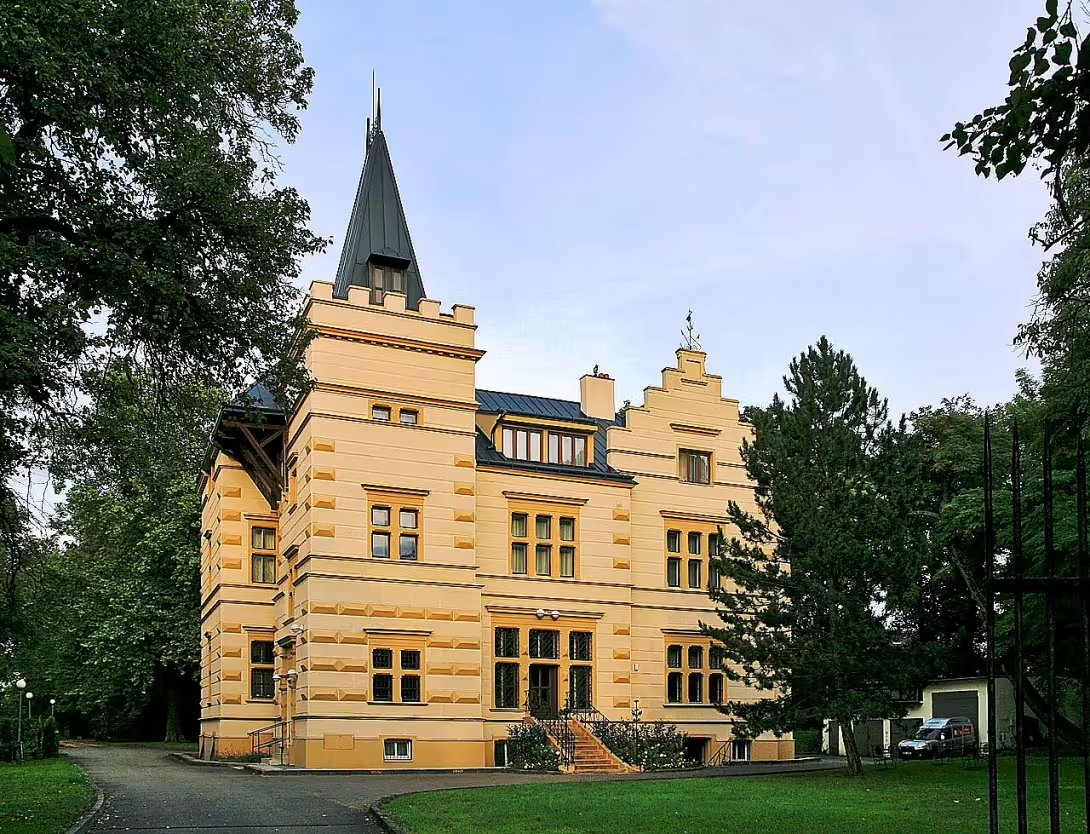
Redlichova vila in Slavkov near Brno is a historic building from 1884. It was created as the home of Hermann Redlich, owner of a local sugar factory. Since 2001, the building has been protected as a cultural monument and is now used under the name Vila Austerlitz as a private accommodation facility.
The villa was designed by Brno architect August Prokop, then director of the Moravian Industrial Museum. Hermann Redlich had its headquarters built near its business to be within direct traffic range. This building, known as the upper or red villa, was later supplemented by a lower white villa. The creation of the building dates back to the 1980s, when Austria-Hungary culminated in the expansion of industrial production and sugar processing, closely linked to the development of the railway network.
Architectural rendition is based on a historic style. The expert analyses show inspiration from Tudor's neo-goths through Hanover School; the architect used an additive grouping of materials on an irregular plan. In connection with the villa, Jan Sedlák mentions the influence of the German Renaissance, which reflected a period of departure from the cosmopolitan italising Neo-Renaissance towards the Nordic models. The exterior is characterized by prismatic volumes, belt rustic, arching barefoot on the corners, window chambres and chisel roof of the tower. The interior layout included a representative hall with staircase, dining room with fireplace, billiard room and upstairs bedroom and innkeeper rooms. The entire building is surrounded by an English park of 1.5 hectares.
After Hermann Redlich's death in 1895, his son Viktor inherited the villa. The Redlich family owned a sugar factory until the Nazi occupation, when both Viktor and Felix Redlich were forced to emigrate to Canada because of their Jewish origins. During World War II, the sugar factory was forced into the administration of the German Empire. After liberation and nationalisation in 1948, the building became state owned. In the postwar period the villa served as a forestry training and accommodation centre under the administration of the company South Moravian forests. In 2005 the property was purchased by ENBRA, which equipped it and started the operation of accommodation services. In 2020 the villa underwent a partial reconstruction.
The history of the mansion is closely linked to the development of the Slavkov sugar factory, which was among the largest in the monarchy. Hermann Redlich, which was acquired by the company in 1877, was able to push the railway line from Brno to Přerov directly around the sugar factory, thereby saving the cost of the train to the detriment of urban interests. In 1905, the sugar factory became the scene of a bloody suppressed strike for a universal equal voting right. In April 1945, during the front crossing, the area of the villa was hit by the bombing that killed Jan Kočovský.
Redlichova vila presents an important proof of industrial history and architecture in the end of the 19th century in Moravia. Its preservation and current use allow for an insight into the lifestyle of the then business elites. Visiting this place offers an opportunity to get to know the historical architecture in the authentic environment of the sugar complex.
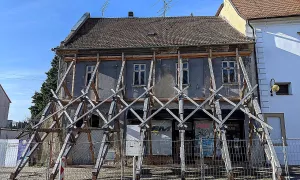
Then and now
Drag the slider to compare how the landmark may have looked when it was built with the view today.
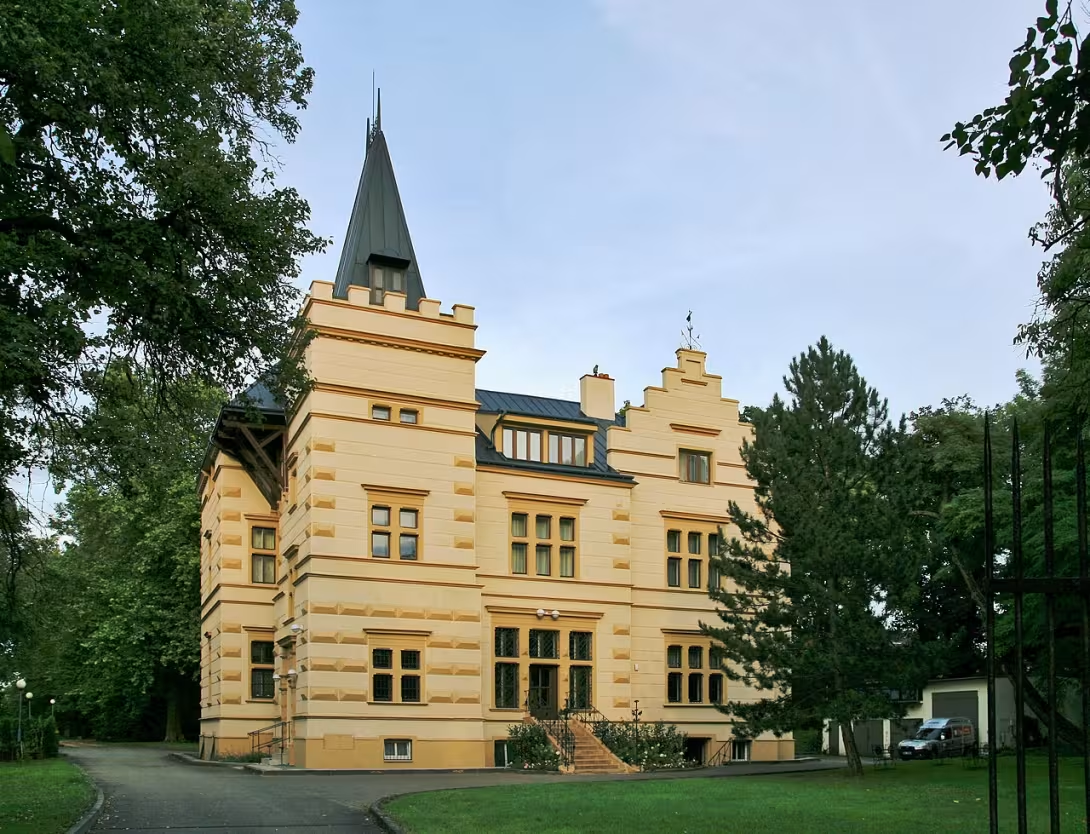

The historical appearance on the left is an AI-generated visualisation and serves as inspiration only.
Historical milestones
- 1877
- Hermann Redlich won the Slavkovsky sugar factory.
- 1884
- Finishing the construction of Redlich's villa.
- 1895
- The death of Hermann Redlich and the inheritance of the villa by the son of Victor.
- 1948
- The nationalization of the building and the transition to state ownership.
- 2001
- Object declared a cultural monument.
- 2005
- The purchase of the villa by ENBRA and the opening of accommodation.
Architectural development
The villa was built in a historic style as a so-called red villa. It was later supplemented by a lower white villa in the sugar factory. The object has undergone modifications for educational purposes after nationalisation.
Historical events
In 1884 the villa was completed. In 1905, a right strike took place in the sugar factory. Before World War II, the Redlich family emigrated to Canada.
Owners
Hermann Redlich (from 1884), Viktor Redlich (heritage after 1895), German Empire (forced administration during World War II), State (after nationalization).
Points of interest
- The construction was established in 1884 as the owner of the local sugar factory Hermann Redlich. - The building is also known as the upper or red villa and was later supplemented by the lower white villa. - The architecture of the villa is based on a historic style with inspiration in Tudor neogotry and German Renaissance. - There is an English park around the villa with an area of one and a half hectares. - Since 2001, this historic building has been protected as a cultural monument.
Guide
Show guide text
This text was created by artificial intelligence and has not been editorially reviewed. It may contain inaccuracies.
Welcome to the historical monument of Redlich Villa, a beautiful building located in Slavkov near Brno. You are standing in front of an elegant object built at the end of the 19th century, which tells interesting stories of the past with its architecture and history.
Redlichova vila was built according to the design of architect August Prokop for Hermann Redlich, owner of the local sugar factory. In 1877 Hermann Redlich acquired this sugar factory and four years later the construction of its headquarters was completed. This villa, also known as the upper or red villa, became part of the sugar factory complex and together with others, commonly referred to as the lower or white villa, forms a pair of buildings built by the Redlich family.
Look up at the front of the villa. Note the historic style of architecture that draws inspiration from Tudor's neo-Gothic and German Renaissance. These elements are visible in complex niche, slender windows and elegant decorating that give the construction a unique character.
In 1895, the inheritance passed after Hermann Redlich on to his son Viktor. After nationalization of the sugar factory in 1948 the villa became a property of the state and later, in 2001, it was declared a cultural monument. In 2005 she bought ENBRA and started operating as an accommodation facility.
The interesting thing is that this villa was not only the home of the Redlich family, but also witnessed many changes in society. You are now standing in a place where personal fates and historical events intersect.
Inviting you to explore other parts of the complex and enjoy the beauty of this monument. I hope your visit will be full of discoveries and thoughts about the history of this place. Thank you for your attention and have a nice walk!
Tips for visitors
The best time to visit is in the morning during the working week when the surroundings of the villa are quiet and the light falling on the historic facade allows you to take detailed pictures without disturbing elements. Weekends are getting more frequent because of the locals.
You can easily reach the villa by car or public transport. Check the current public transport connections in the internet connection search engine.
It is ideal for photographers to capture the exterior architecture of the villa in the afternoon when the sun highlights the plastic elements of the facade. We recommend that you take with you a wider lens to capture the entire object and place it in the surrounding building.
In the vicinity of the villa you can explore the premises of the former sugar factory and the adjoining employee colony that illustrate the industrial history of the place. The walk can be completed in the historical center of Slavkov near Brno, which is easily accessible by foot from the villa.
For families with children, the location is suitable for easy walking around. We recommend taking a snack and a drink with us, because there may not always be snacks in the immediate vicinity of the villa. Children can discover interesting architectural details on the villa building.
Frequently asked questions
Can the monument be visited?
Some buildings of this kind are open for guided tours, others serve another purpose or are privately owned. We have not verified whether and when this monument is open – please ask the operator.
What are the opening hours and admission?
We have not verified the opening hours or admission. Current information is published by the operator.
Where is the monument?
Location: Slavkov u Brna, Jihomoravský kraj. The map on this page shows the exact spot.
Why is the monument protected?
It is listed in the Central List of Cultural Monuments of the Czech Republic as a cultural monument (register no. 1000443148).
Businesses nearby
Do you run a restaurant, accommodation, shop, museum, rental, wellness or other visitor service near this monument? Show yourself directly to the people heading to it — this is how they will see you in the app and on the web:
Nearby
Slavkovský cukrovar, zaměstnanecká kolonie, historické centrum města Slavkov u Brna.
Accommodation nearby
Trips and activities nearby
Guided tours, tickets and activities nearby from GetYourGuide
Affiliate link: if you buy from the partner, we may receive a commission. The price for you does not change.
Search tours and activities →Themed route
Thematic cruise route: Redlichova vila and surroundings
1.Redlichova vila (villa) The main objective of our route is Redlichova vila, a historical residence which represents a classical architecture from the 19th century. The villa was designed for an industrialist and its elegant courtyard and interior offer a view of the life of prominent personalities at the time.
2. Slavkovsky sugar factory (industrial monuments) About 500 metres from Redlich's villa is Slavkovsky's sugar factory, one of the oldest industrial buildings in the region. The sugar factory is interesting with its history and architecture, which reflects the flowering time of the sugar industry in Slavkov.
3. Employee colony (historical monuments) The next target is an employee colony that was built for sugar workers. This neighborhood offers a view of the lifestyle of industrial workers and its architecture is an example of social planning from the 19th century.
4. Historical center of the city Slavkov u Brna (historical monuments) Finally, we will look at the historical centre of Slavkov u Brna, where we will find ancient houses and streets that tell us about the history and development of this place. The centre is an ideal place for relaxing and sightseeing after a day trip.
This route offers a view of the rich industrial and cultural history of the village Slavkov u Brna, each location having its unique stories and architectural features.
Seasonal recommendations
Spring: In the spring the garden around the villa awakens into life and the color of the flowers complements the architecture of the building. The light is fine in this period and does not shine, which is ideal for observing the facade details. We recommend wearing layered clothes because the wounds can still be cold. It's the time when the first visitors start showing up, but it's not as much of a crowd as it was in the summer.
Summer: The summer months bring strong sun and rich green vegetation to Slavkov near Brno, which shade the surroundings. The atmosphere is lively and full of energy, but heat can be tiring in the morning. For the best experience come at the beginning of the morning to avoid the biggest crowds and the highest temperature. Don't forget light summer clothes and plenty of fluids.
Autumn: Autumn visit offers a unique atmosphere thanks to the golden and brown shades of leaves in the area. The morning mist adds mystery to the place and the low sun creates long shadows that highlight the shapes of the house. It is advisable to take a warmer jacket and comfortable shoes for walking on a wetter landscape. In this period, it is calmer, which allows us to perceive history in silence.
Winter: In winter, the villa is very quiet in the landscape and still, especially when trees are without leaves. The light is weak and the days are short, which creates a melancholy touch. Due to the cold and shorter opening times it is necessary to carefully plan your visit and choose very warm clothes. It is best to arrive soon after opening to use the remaining daylight.
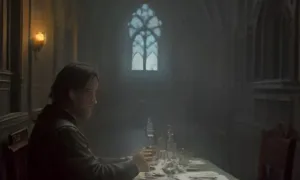
Visualizations and artistic views


The visualisations are generated by artificial intelligence and serve as inspiration.
Photos from the area
Real photos taken near the monument


Zdroj a licence jsou uvedeny u každého snímku.
Tips from visitors
No tips yet. Be the first!
Log in and add your tip.
Sources and literature
Photos: Martin Strachoň / CC BY-SA 4.0 — Wikimedia Commons. The author and licence also appear when you hover over the image.
Faktickým podkladem tohoto textu byl článek na Wikipedii, jehož autory jsou přispěvatelé Wikipedie. Článek je dostupný pod licencí CC BY-SA 4.0.
Location on the map


Příběhy a pověsti
Legendy, pověsti a příběhy spjaté s touto památkou
Fotografie návštěvníků
Zatím žádné fotografie. Buďte první, kdo přidá fotografii z návštěvy!
Log in a přidejte svou fotografii nebo hodnoťte.
Za ověřenou návštěvu v aplikaci získáte víc bodů — poznáme podle GPS, že jste na místě.
Reviews and comments