



Rodný dům V. Šolce House
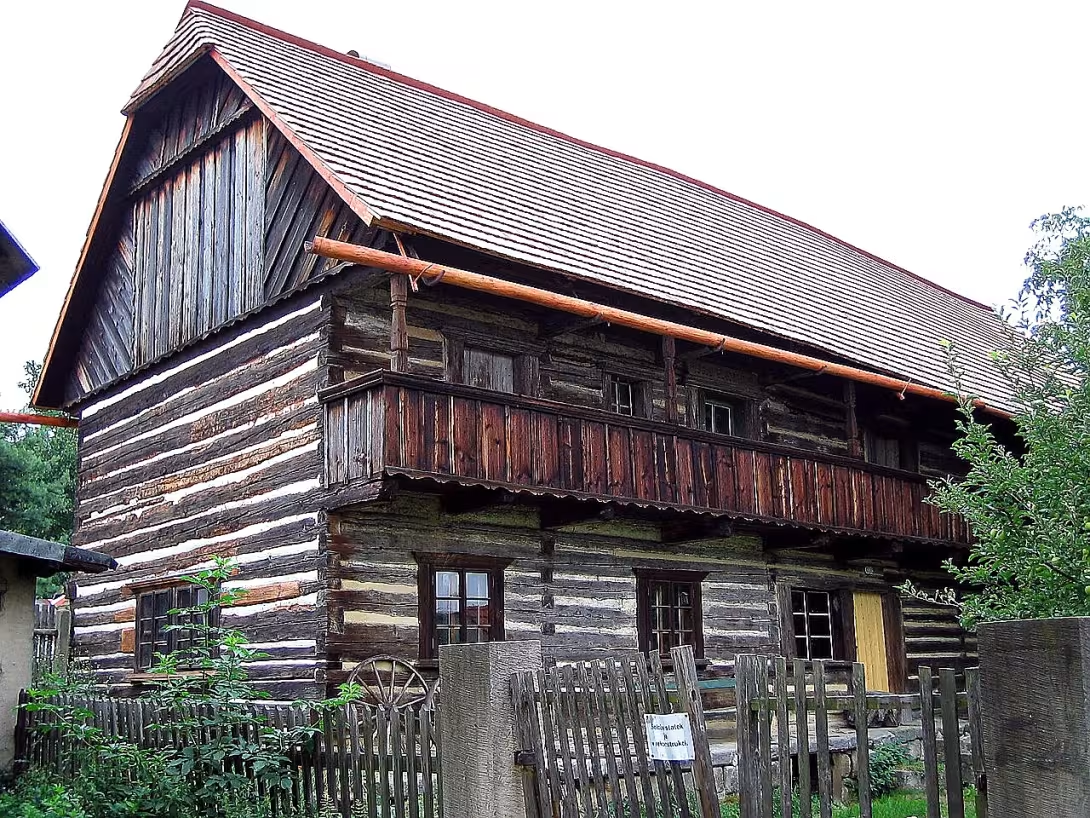
The Sholco farmhouse in Sobotec is a well-preserved country estate from 1811, which represents a typical labyrinth of the Bohemian type. The building in Šolcov Street No. 133 in Jičinsko has been used since 1974 as an art gallery and a significant cultural centre of the region.
The history of the building is linked to the family of Šolc, whose property was held until the end of the 19th century. The first written mention of the estate dates back to August 6, 1810, when the original object burned down after the lightning strike. The current form of the house was created in the same place thanks to the owner Josef Šolce. The inscription on the cover shows completion of the construction on 5 September 1811. In 1838 the poet Václav Šolc was born here, the author of the collection Prvosenka, who also died on the farm in 1871.
Architecturally, it is a grafted structure, the characteristic element of which is a braid extending along the entire length of the upper floor. In the 20th century, the complex passed through a number of modifications. In the 1930s, the owner Karel Samšiňák purchased the estate and his family used it for various purposes. The ground floor hall served as a scout clubhouse and a camera was operated on the floor in the 1950s. After expropriation by the state, the house in 1958 was entered on the list of real cultural monuments. However, the subsequent reconstruction in the 1960s was not carried out in a good way and led to degradation of internal space to the warehouse.
A fundamental turn in the fate of the monument occurred in 1971 when RNDr. Karel Samšiňák, CSc. He started a gradual renewal and opened the exhibition hall in 1974 in the ground floor. After 1990 the farm was returned to the Samshin family as part of the restitution. Between 2006 and 2009, under the leadership of Karel Samšinák and his son Jan, a thorough general reconstruction of the entire complex took place, including adaptation of the adjacent wall masonry to the Lapidarium. Since 2009, the exhibition hall has been named Gallery Karl Samšinák.
Since the end of 2023, the estate has been in the administration of the South China Museum, to which it was donated by RNDr. Jan Samšiňák. The premises are open to the public from 1 May to 31 October each year. Visitors can see exhibitions of paintings in the Karel Samshinak Gallery or sculptures in the Lapidarium or in the garden, which since 2010 serves as an open-air exhibition. In addition to the exhibitions there are also concerts and meetings.
The Sholco estate represents a valuable example of folk architecture, which, thanks to the long-term care of the Samshinak family, successfully linked the historical legacy to a living culture. Visiting this place offers a unique opportunity to familiarize yourself with the history of the Czechoslovak estate and to see the contemporary art in an authentic environment.
Historical milestones
- 1811
- Finishing the construction of the new house after the fire.
- 1958
- Listing to the list of real cultural monuments.
- 1974
- Opening of the art gallery.
- 2009
- The ceremonial name of the exhibition hall at the Charles Samshinek Gallery.
Architectural development
The estate was built as a garb after a fire in 1811. During the 20th century it has undergone several modifications, including adaptation of the ground floor to the exhibition hall and conversion of the adjacent mastiff to the Lapidarium. A thorough general reconstruction of the complex took place between 2006 and 2009.
Historical events
1810: Fire of the original building after lightning strike. 1838: The birth of the poet Václav Šolka. 1974: Opening of exhibition activities by Karel Samshinak. 2023: Donation of the estate to the Royal Hradec Region.
Owners
The House of Šolcí (until the end of the 19th century), the family of Samshinak (from the 1930s to 2023), the Králové Hradec Region (from 2023).
Points of interest
- The estate is a preserved village garb from 1811, which was created at the site of the original building destroyed by lightning. - In 1838 the poet Václav Šolc was born, who died here in 1871. - A characteristic element of the construction is the storehouse that stretches along the entire length of the upper floor. - In the 1950s, there was a photo workshop on the floor of the house. - Since the end of 2023 is a monument in the administration of the museum in Jicin, to which it was donated by Jan Samšiňák.
Guide
Show guide text
This text was created by artificial intelligence and has not been editorially reviewed. It may contain inaccuracies.
Welcome to Sobfather. Right now, when your headphones are on, you are in a place that is extremely important to this region. You're standing right in front of the Sholco farm. Look around you and feel the atmosphere of this place. In front of you is a well-preserved country estate that carries all that makes our history so fascinating. It is a view of traditional life, of the work of human hands and of the power of nature that has managed to destroy this house and also rebirth it. Feel the calm atmosphere around this building, and try to imagine what stories these walls have seen in the last two centuries.
To understand why this house looks like this, we need to go back deep into the past together. The history of this place is linked to unexpected twists. Imagine a year of 1,000 hundred eleven. At that time, there was one major event that completely changed the face of this farm. The original structure that stood here was destroyed by the destructive force of lightning. This event was probably a great test for the people at the time, but it also became the beginning of a new chapter. It was after this fire that the whole estate was rebuilt to serve the next generation, in the form you see today before your eyes. This reconstruction has given us such a beautiful structure that has endured centuries and still stands as a symbol of endurance.
Now pay attention to the details of architecture that you have right in front of you. Notice how the building is built. It's a classic Bohemian type of country estate. The main feature that is likely to interest you immediately is the grafted structure. These wooden beams form a solid skeleton of the whole house and give it the right, warm and historic atmosphere. If you look up to the top floor, you'll see something very specific and beautiful. It's a stump that stretches along the top floor. This wooden corridor is not only a practical element for moving between rooms, but it is also one of the most important building elements that gives this estate its unique appearance. Feel the rhythm of the wood and the tradition that is felt in every cut of these beams.
But this house is not just about wood and construction. It is primarily a place that was home to very important personalities. In these rooms he was born and here he also left the world poet Václav Šolc. His life and his creation are closely linked to this place. Imagine a young man who sought inspiration in these spaces for his verses and found peace in these landscapes for his soul. To him, this farm was the whole world. Sholc lived his life here from his first breath to his last moment. Later, however, the role of this house changed. Since the year one thousand and seventy-four, there has been no more than routine rural work, but the place has started to serve as an art gallery. It became the cultural heart of the entire region. In this context, we must not forget names such as Karel Samšiňák, Josef Samšiňák or Jan Samšiňák, who are closely associated with this place and its cultural life. Even the exhibition hall bears the name of Karl Samshinak, which is proof of deep respect for his legacy and importance to this place.
You may be interested in one thing that carries a certain mystery and fascination. Think about how a tragedy like the destruction of a house could become something so beautiful and lasting. It was from the disaster, the unexpected blow of heaven, that this preserved garb was created. It's a fascinating circle of fate. A house that was destroyed by celestial power became a protector of art and culture. This event, which was supposed to be the end, has become the basis for what we admire today.
Now I want to invite you to further explore. Whether you choose to enter and see the current exhibitions that take place here or just wander around and see the beauty of this rural architecture, pay attention to every detail. This farm is a living museum waiting for you, which has something to offer. Thank you for spending this moment with us, and we wish you a very pleasant encounter with art and history in this beautiful place.
Tips for visitors
The best time to visit is in the morning during the working week when you avoid crowds and enjoy a quiet atmosphere of grafted architecture. In the summer months there is a pleasant shadow thanks to the construction of the house.
You can easily reach Sobotka by car or public transport. We recommend that the exact connection be verified in online search engines.
For photography we recommend to use the morning or late afternoon light, which beautifully depicts the structure of wooden beams and stoves. The best shots can be taken from the courtyard, where the typical Czech style of construction stands out.
Within 30 minutes' drive by car or bike, you can visit the castle Kost, which is the jewel of the Czech Paradise, or walk through the historic city Sobotka itself, which offers picturesque corners.
For families with children, the farm is an ideal place because of its rural character. Children can discover the traditional way of life of our ancestors in a safe environment that is not too large and is suitable for smaller visitors.
Frequently asked questions
Can the monument be visited?
Some buildings of this kind are open for guided tours, others serve another purpose or are privately owned. We have not verified whether and when this monument is open – please ask the operator.
What are the opening hours and admission?
We have not verified the opening hours or admission. Current information is published by the operator.
Where is the monument?
Location: Sobotka, Královéhradecký kraj. The map on this page shows the exact spot.
Why is the monument protected?
It is listed in the Central List of Cultural Monuments of the Czech Republic as a cultural monument (register no. 1000131080).
Businesses nearby
Do you run a restaurant, accommodation, shop, museum, rental, wellness or other visitor service near this monument? Show yourself directly to the people heading to it — this is how they will see you in the app and on the web:
Nearby
Město Sobotka, hrad Kost, oblast Českého ráje.
Accommodation nearby
Seasonal recommendations
Spring: In the spring, the family house of V. Šolce in Sobotec is transformed into a special place where nature begins to revive and trees are covered with leaves. Sun rays illuminate gallery interiors with softer lights, creating pleasant atmospheric conditions for moments of reflection and artistic impressions. This time of year is suitable for visiting, because the crowd of people is usually not many, which means more comfort in walking through exposures and discovering works of art. We recommend that visitors wear clothes suitable for mild temperatures, which can be characteristic of spring weather by morning cold and afternoon heat leakage.
Summer: Summer brings in the family home of V. Sholka full of sun days that illuminate the gallery interior with vibrant and energizing rays of light. When flowers are blooming outside and trees are taking on green, the inner space of the art monument offers refuge from the summer heat. This time of year is most visited, which can lead to longer fronts and full space. It is therefore recommended to visit early in the morning to avoid a crowd of people. Clothes should be light and light, suitable for warm summer atmosphere.
Autumn: In the autumn the family house of V. Šolce in Sobotka obtains melancholy beauty when tree leaves dye and fall to the ground. The sun's rays shining through cooler air illuminate the gallery's interior differently than in the warm months, contributing to a calm and reflective atmosphere. This time of year is ideal for visiting because the crowd of people is usually not as much as in the summer. Clothes should be mild and suitable for colder temperatures that begin to appear on days with falling sunlight.
Winter: During the winter, the family house V. Šolce in Sobotec gains quiet and quiet characteristics when they are covered outside by snow and ice. The sun rays shining through the cold winter atmosphere illuminate the gallery interior, creating a clear and clean atmosphere that is ideal for thinking. This time of year offers visitors a peaceful experience without large crowds of people. The opening times of the gallery may be shorter, so it is advisable to visit it early in the day. We recommend wearing warm clothes and sun protection because even on cold days the sun can be strong.
Visualizations and artistic views


The visualisations are generated by artificial intelligence and serve as inspiration.
Photos from the area
Real photos taken near the monument

Zdroj a licence jsou uvedeny u každého snímku.
Tips from visitors
No tips yet. Be the first!
Log in and add your tip.
Sources and literature
Photos: Manka / CC BY 3.0 — Wikimedia Commons. The author and licence also appear when you hover over the image.
Faktickým podkladem tohoto textu byl článek na Wikipedii, jehož autory jsou přispěvatelé Wikipedie. Článek je dostupný pod licencí CC BY-SA 4.0.
Location on the map
Příběhy a pověsti
Legendy, pověsti a příběhy spjaté s touto památkou
Fotografie návštěvníků
Zatím žádné fotografie. Buďte první, kdo přidá fotografii z návštěvy!
Log in a přidejte svou fotografii nebo hodnoťte.
Za ověřenou návštěvu v aplikaci získáte víc bodů — poznáme podle GPS, že jste na místě.
Reviews and comments