



Růžový palouček Memorial
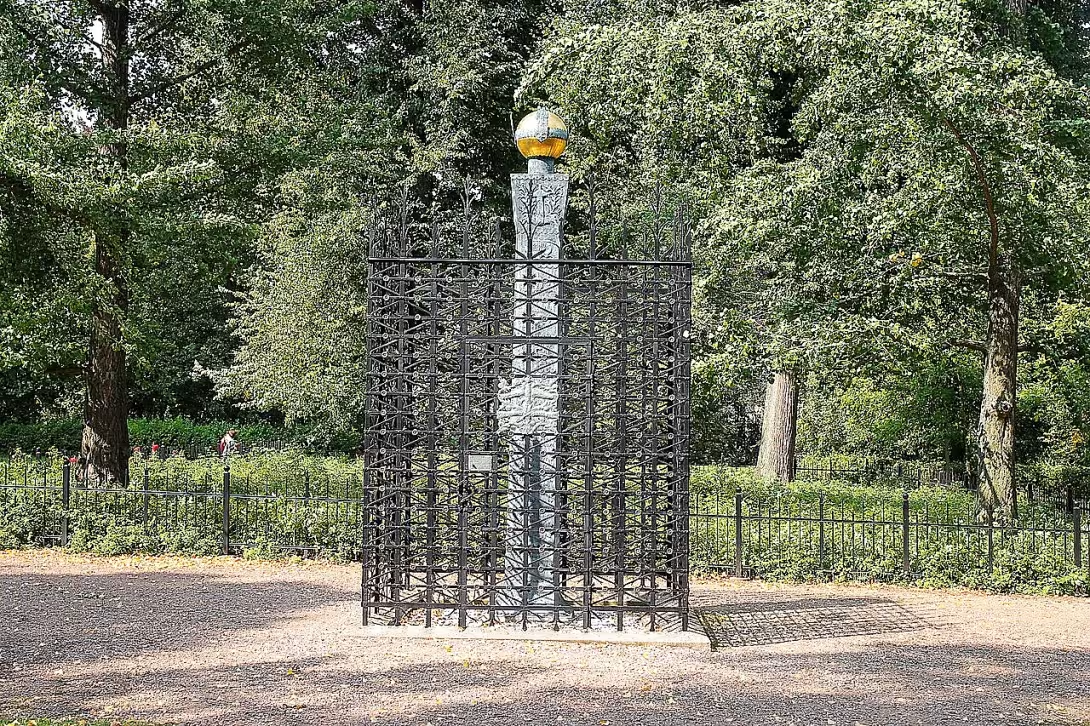
Růžový palouček is a memorable site and a cultural monument of approximately 1.85 hectares. It is located in the cadastral territory of Újezdradec near Litomyšle, about 7 kilometres west of the city, between the municipalities of Morasice and Úješík. The building is a remarkable copper monument to the Czech brothers, the surrounding park and the extensive growth of Gallic roses.
In the 1787 Josephin cadastral, the place is recorded under the name Red Thumb with a note of its uselessness. The author Alois Jirásek made a significant contribution to the current knowledge of the site. Here in 1876, during his time at Litomyšl Gymnasium, he found inspiration for the Old Czech reputation. In his work he placed a reputation for the parting of the Czech brothers with the native landscape after the defeat of the state uprising.
The monument was prepared by the Bohemian School in Litomyšl according to the design of architect Alois Metelák. Siberian copper donated by Czechoslovak legionaries was used as material. The construction has the shape of a square column with a calichic result, on which lies a gilded globe with a diameter of half a metre. The column adorns copper reliefs with symbolic representation of relations with Czech brothers, names of members of the Union of Brotherhood, dedication of creators and words by Alois Jirásek. The entire object is surrounded by a grate with information about the date of discovery. The park in the area was built in 1925 by architect Kulishan and includes, for example, two-legged jinn.
The ownership and management of the site has changed several times over the years. In 1903, the Society for the Acquisition of the Pink Heart was established by the public who managed to buy the land in 1906. The aim of the organization was to take care of the thumb and build a monument. In 1952, the company's activities were forced to cease. It was only renewed in 1990 under the name of the Association of Friends of the Pink Thumb in Úříce.
The key event was the festive unveiling of the memorial on June 19, 1921, when some 70,000 visitors gave the Alois Jirásek speech in front of it. Until 1938, there was a meeting on the day of the burning of Jan Hus. This tradition was restored after World War II for only two years. The site was officially declared a cultural monument on 1 January 1989.
There are many rumours associated with the monument. In addition to the farewell of the Czech brothers, the golden chalice was supposedly buried here and white roses flowed from their tears. Another legend says there were supposed to be seven kings here to negotiate eternal peace. There are also stories about Russian soldiers from the time of the Napoleon Wars and the claim that roses from this place cannot be relocated and the thumb is resisting the intruders.
Today Růžový palouček is managed by the Association of Friends of the Pink Heart in Úříce, which again hosts festivities. The monument serves as a symbol of faith and national identity. Visiting this place offers a meeting with the history of Czech Protestantism and landscape influenced by the literary work of Alois Jirásek.
Historical milestones
- 1787
- entry in the Josephine cadastral as Red Thumb
- 1906
- purchase of the place by the Association for the acquisition of the Pink Heart to the public
- 1921
- the discovery of the memorial on 19 june
- 1989
- declaration by cultural monument
Architectural development
The memorial was prepared by the Romeslonic School in Litomyšl from Siberian copper donated by Czechoslovak legionnaires. The column is decorated with copper reliefs and surrounded by a protective grate. The park was built in 1925 by architect Kulishan.
Historical events
1921 - the discovery of the monument to czech brothers with the participation of 70 000 visitors; 1989 - declaration of the place by cultural monument.
Owners
Association for the Acquisition of the Pink Heart to the Public (since 1906), Association of Friends of the Pink Heart in Úříce (since 1990)
Points of interest
- The place is a remarkable copper monument of the Czech brothers, a park and a growth of Gallic roses. - The monument was made of Siberian copper donated by Czechoslovak legionnaires. - At the top of the square pole lies a golden globe with a diameter of half a meter. - When the memorial was discovered on June 19, 1921, Alois Jirásek gave a speech in front of some 70,000 people. - Rumors include that there were white roses from the Czech brothers of tears or that seven kings were to meet here to negotiate eternal peace.
Guide
Show guide text
This text was created by artificial intelligence and has not been editorially reviewed. It may contain inaccuracies.
Welcome to this quiet and decorative place that bears the name Růžový palouček. Stop for a moment, take a deep breath of the smell of the surrounding park and look around you. You're standing in a space that spreads its beauty on an area of almost two hectares. The first thing that you're interested in is this beautiful growth of Gallic roses that surround the monument and give it softness and depth. It is a place where nature encounters history and where every flower resembles the fragility of human destiny, but also the persistence of faith.
Now let's look together at the very center of this space. Before you stand a copper monument of the Czech brothers. It's a monument that carries the weight of the century and the sadness of parting. To understand why this column is standing here, we have to go back deep in history. This place is closely linked to the painful moment when the Czech people had to say goodbye to their native landscape. This happened after the defeat of the state uprising, when many of the Czech brothers were forced to leave their home in order to preserve their faith and their beliefs. It is the place of the symbol of exile, but also of immortal hope.
Notice now the details of the construction itself. The monument has the shape of a square column that guards the silence of this park. Please look up to the very top. You see a golden globe there? It has a diameter of half a metre and September as a symbol of the global dimension of suffering and belonging. The whole project was designed by the architect Alois Metelák, who was able to express deep meaning in the simplicity of the column.
When you examine the surface of the monument, think about the material from which it is made. This column is not made of ordinary copper. It is made of copper from the area behind the Ural, in northern landscapes, donated by Czechoslovak legionaries. It's a fascinating detail because the material itself tells the story of the courage and sacrifice of people who fought for their country's freedom in foreign countries. With this gift, two generations of fighters for truth and freedom have joined together.
The history of this place is not short. If we look at the old records, namely the Josephine cadastral of seven hundred and eighty-seven, the place here was referred to as the Red Thumb. For years, however, it has not been in the hands of the public. Only in the year one thousand and nine hundred and six people united the Society for the Acquisition of the Pink Thumb, which bought this place precisely so that it could be accessible to all and serve as a point of reflection.
The key moment was the day of June nineteenth in the year one thousand nine hundred twenty-one. On this very day, the memorial was festively revealed. Imagine the atmosphere when people gathered here to honor the memory of their ancestors and to pay their respects to those who had to leave. The names of prominent personalities, such as the writer Alois Jirásek, who perceived the depth of Czech action and the spirit of this nation, are also associated with this place.
Interestingly, Růžový palouček is not just a historical point on the map, but it is primarily a symbol. A symbol of faith, endurance and indignation. It was officially declared a cultural monument of the first January of the year a thousand nine hundred and eighty-nine, which only confirms its irreplaceable importance to our national identity.
Now, I'm begging you to take another look around. Feel the contrast between the hardness of the copper column and the fragility of the roses. It is a reminder that even after the most severe injuries and defeats, life can flourish again and memory can remain alive. This space was created to find peace and space for our own thoughts.
I suggest you now slowly go around the whole monument, stop at the individual roses and let the silence of this park consume you. Try to imagine the people who stood here centuries ago, and with a heavy heart they said goodbye to their homeland, not knowing if they'd ever come back. This column is their silent witness.
Thank you for coming with me to this symbol of hope. I hope the pink toe atmosphere has reached out to you and that you're leaving here with a sense of inner peace. We wish you a pleasant further journey and many other discoveries in our beautiful landscapes. Goodbye.
Tips for visitors
The best time to visit is the period of the flower of Gallic roses, when the whole park around the monument smells beautiful and shines with colors. Transport to this place between the municipalities of Morasice and Újezdradec can be arranged by car or public transport. Check the specific connections in the current timetables.
In the park we recommend to take your shoes suitable for walking through green space and water with you. As the monument is viewed from the outside, there is no need for any special equipment to enter the buildings.
For the best photos of the copper column with gilding, choose the time shortly before sunset, when golden light highlights the details of the monument. The pictures that capture the column combined with the surrounding roses look the best.
Families with children can enjoy a walk through the park and a joint search for different kinds of roses. The villages of Morasice and Újestec are nearby, which you can place in your path.
Frequently asked questions
Can the monument be visited?
This is a structure in a public space that can usually be seen from outside free of charge. We have not verified that this particular one is freely accessible.
Why is the monument protected?
It is listed in the Central List of Cultural Monuments of the Czech Republic as a cultural monument (register no. 1000152441).
Businesses nearby
Do you run a restaurant, accommodation, shop, museum, rental, wellness or other visitor service near this monument? Show yourself directly to the people heading to it — this is how they will see you in the app and on the web:
Events nearby
Zdroj akcí: otevřená data měst a obcí ČR (Národní katalog otevřených dat) a kalendář akcí Národního památkového ústavu.
Nearby
Památka se nachází mezi obcemi Morašice a Újezdec asi 7 km západně od Litomyšle.
Accommodation nearby
Themed route
Here is the design of the thematic route:
1. Morasice (village) - The starting point of the road where you can swing before moving to nature. 2. Růžový palouček (memorial) - The main destination of the trip, which will capture its looks and history. 3. Escaper (village) - Final stop of the route for rest after walking.
Seasonal recommendations
In spring the surroundings of the monument awaken to life and the fresh greenery contrasts beautifully with the colours of the building. Light is soft and pleasant in this period, which is ideal for observing details from outside. We recommend light but laminated clothing and a visit in the morning when the air is the cleanest. In the summer months it dominates the radiant sun, which highlights the clear tones of the monument. The atmosphere is hot and space is full of people, so it is best to choose the time shortly before sunset when the heat is smaller. Don't forget the cap and enough water to avoid overheating. Autumn brings golden and red shades of leaves to the surroundings that create a nostalgic mood. The lighting is rich and deep, which makes the poles of the monument a very hunting target. Wet coats and shoes are suitable, because the weather is very variable in this period. Zimą acts in quiet and calm, possibly in white snow, which gives him a noble look. Short days mean that the best time for an outside tour is around noon when the most light is. Hot clothing, thermo-pads and fixed footwear with anti-slip soles are essential.
Visualizations and artistic views

The visualisations are generated by artificial intelligence and serve as inspiration.
Photos from the area
Real photos taken near the monument

Zdroj a licence jsou uvedeny u každého snímku.
Tips from visitors
No tips yet. Be the first!
Log in and add your tip.
Sources and literature
Photos: Draceane / CC BY-SA 4.0 — Wikimedia Commons. The author and licence also appear when you hover over the image.
Faktickým podkladem tohoto textu byl článek na Wikipedii, jehož autory jsou přispěvatelé Wikipedie. Článek je dostupný pod licencí CC BY-SA 4.0.
Location on the map
Příběhy a pověsti
Legendy, pověsti a příběhy spjaté s touto památkou
Fotografie návštěvníků
Zatím žádné fotografie. Buďte první, kdo přidá fotografii z návštěvy!
Log in a přidejte svou fotografii nebo hodnoťte.
Za ověřenou návštěvu v aplikaci získáte víc bodů — poznáme podle GPS, že jste na místě.
Reviews and comments