






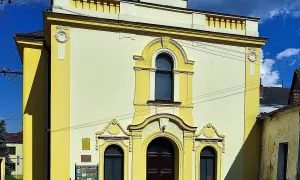
Sbor Českých bratří v Kunvaldu Museum building
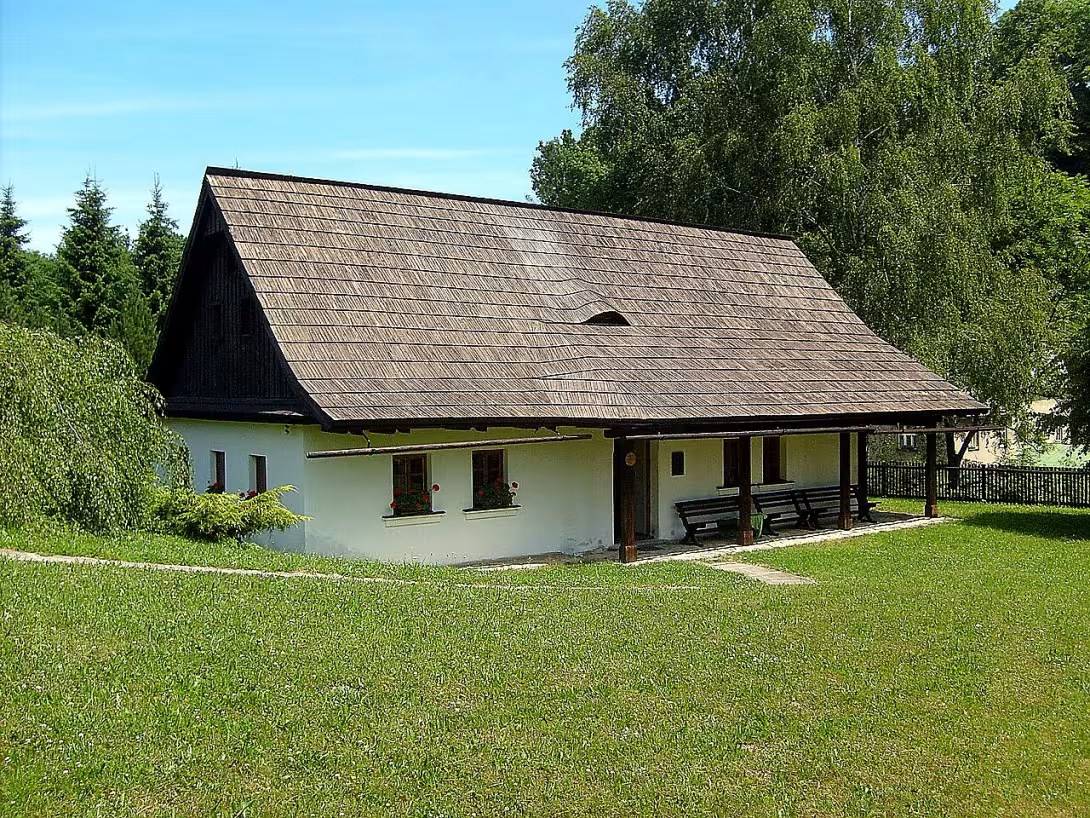
The house at the Choir in the village Kunvald is a monument to the first community of pre-white mountain Union brotherly. This medieval building served as a venue for the assembly of Czech brothers and today it works as a museum. The building represents an important symbol of the spiritual legacy of this reformer group.
The presence of the community of Czech brothers in Kunvald is documented from 1457 to 1458. The exact date of building the house is unknown. It is believed that Matěj z Kunvaldu, the son of a local peasant, was working at this place or from here. The congregation was founded during the pre-white mountain reformation in Czech countries.
The building has undergone several modifications over the centuries. Before the Battle of White Mountain, the original structure of the choir was converted into a brotherly school. After the Velvet Revolution, the object was extensively reconstructed.
The fate of the building was closely linked with political upheaval. In 1547 the brotherly church was closed by order of the ruler Ferdinand I. Habsburg and the brothers were expelled from the estate. After the victory of the counterReformation, the building served as a school for Catholic children until 1750. In 1929 the Czech Brotherhood Church bought the house, which established a memorial. Since 1958, the building has been a cultural monument. Since 2025, it has owned the Pardubice Region.
The Corps overcame the first wave of persecution around 1460, although its leaders had to go temporarily into exile. The reconstructed building was officially opened in 1991 for the 400th anniversary of the birth of Jan Amos Komenský.
At present, there is a museum exhibition in the cottage. For visitors there are regular tours or group visits by prior arrangement. The area also serves for religious services and communal meetings of believers, which are occasionally organized by the Preservation Corps from Potštejn. Pardubice Region transformed the object into a symbolic place intended for descendants of Czech emigrants.
The House of the Corps is a unique witness to the Czech Reformation and its endurance. Visiting this place allows a deeper understanding of the history of the Brotherhood Unity.
Historical milestones
- 1457
- Proof of the existence of the community of Czech brothers in Kunvald.
- 1547
- Closure of the brother's church by order of Ferdinand I. Habsburg.
- 1929
- The purchase of a house by the Czech Brotherhood Church of the Evangelical Church.
- 1958
- Registration of the building into the register of cultural monuments.
- 1991
- Opening of the reconstructed building at the 400th anniversary of the birth of J. A. Komenský.
- 2025
- Transfer of ownership to the Pardubice Region.
Architectural development
The exact date of the building is unknown. The object was converted into a brother's school before the Battle of White Mountain and later served as a Catholic school. After the Velvet Revolution, the building underwent extensive reconstruction.
Historical events
1457- 1458 proof of the community of Czech brothers, 1547 closing of the church at the order of Ferdinand I., 1929 purchase of the Object of the Czech Brotherhood Evangelical Church, 1958 registration in the register of cultural monuments.
Owners
Czech Brotherhood Church Evangelical (since 1929), Pardubice Region (from 2025)
Points of interest
- The house at the Choir in the village Kunvald is a monument to the first community of pre-white mountain Union brotherly.
- The presence of the community of Czech brothers in Kunvald is documented from 1457 to 1458.
- The congregation was founded during the pre-white mountain reformation in Czech countries.
- In 1929 the Czech Brotherhood Church bought the house, which established a memorial.
- Since 1958, the building has been a cultural monument.
Guide
Show guide text
This text was created by artificial intelligence and has not been editorially reviewed. It may contain inaccuracies.
Welcome to Kunvald, the picturesque valley of the Orlické Mountains, where history confuses itself with nature and every alley hides its story. You're standing in front of the Choir House, a place that's much more than just an old building. It is a living witness to history, a place where one of the most important spiritual and cultural revolutions in our countries was born over 500 years ago. Look at this humble object in front of you. At first glance, it is a simple building, but know that in its walls the rainbow of the whole community of Czech brothers was pulsating. This building, also known as the House of the Choir, served as the place of the first brotherly gatherings in the mid-fifteenth century. It is a monument to the first community of pre-white Union brotherly, and it was here, in these areas, that ideas were born that later affected the whole of Europe.
Let's move back a few steps in time to understand why this place is so important. The existence of the community of Czech brothers in Kunvald is documented from 1457 to 1458. This was the period when a wave of reformation erupted in Czech countries. People were looking for a way to the truth that seemed closer to the Church's practice. Kunvald became one of the first places where these people began to meet, pray and study Scripture. It was a time when a new social structure was created, based on equality, education and love for a neighbor. The congregation was founded during the pre-white mountain reformation, which means that its roots date back to a time when the White Mountain had not yet been declared, but when people's minds had changed. This community was not only a religious group, but also a cultural and educational centre that laid the foundations for the later development of Czech education.
Now pay attention to the building itself. Although the exact name of the builders remains in the haze of history and the architects of this building are unknown, the very structure of the house tells us much about the spirit of the time. Look at the facade and feel the atmosphere of the place. The building has undergone various functions over the centuries. Originally she served as a brotherly church, instead of worship and assembly. Later, its purpose changed and became a school, and even a Catholic school. This change of function is visible in the history of an object that has adapted to the changing political and religious circumstances in the country. Today there is a museum exhibition that reminds us of the history of Czech brothers. The entrance inside will lead you to the space where you can look into the life of the brothers, see the objects they used, and learn more about their faith and everyday life.
Key personalities associated with this place and with the history of Czech brothers generally include Matěj z Kunvaldu. Although we have less concrete information about him than other big names, his name is inextricably tied to this place and to the beginnings of the congregation. It was one of those who lived here, believed and formed a community. Another important name to mention is Ferdinand I. Habsburský. His name appears in the history of this house in connection with the events of 1547. This year, the brotherly church was closed at his command. This event symbolizes the pressure that the Czech brothers were subjected to as a result of the defeat on White Mountain and the subsequent rise of the Habsburgs to power. The closure of the church meant the end of a public expression of faith for many people in the region, but it did not end in their spiritual life. Rather, it forced him to continue underground or private, which underlines the strength of their beliefs.
But the biggest star that connects to Kunvald and to the heritage of the Czech brothers is Jan Amos Komenský. Although Komenský was born in Nivnica, Kunvald is a place of extraordinary importance for his life and work. It was in Kunvald where he met the Czech brothers, where he accepted their faith and where he began his journey, which later led him around the world. In 1991, on the occasion of the 400-year anniversary of the birth of Jan Amos Komenský, this building was opened after reconstruction. This event was a symbol of the renewal of the memory of how deeply the Komenský is connected to this place and the tradition that the Czech brothers founded here. Komenský, known as the teacher of nations, drew on what he experienced here. His ideas of education, tolerance and peace are rooted in this very community that was meeting in this house.
There is one interesting thing that may interest you, which shows the complexity of the history of this place. Although the House of the Choir today is a symbol of the Czech-brotherly faith, its fates have not always been so clear. In 1929, the house was purchased by the Czech Brotherhood Church of the Evangelical Church, which was an important gesture for restoring its original purpose and reminding history. Before that, however, he went through various stages, including the period when he served as a Catholic school. This change in functions from a brotherly church to a school to a Catholic school shows how the political and religious situation in the country changed and how the perception of this place changed. It's a reminder that history isn't black and white, but it's full of shades and changes.
In 1958, the building was entered into the records of cultural monuments, which confirmed its high national value. And in 2025, another significant step was taken when ownership was transferred to the Pardubice Region. This change in ownership indicates that this memory will be taken care of by a region that is interested in being made available to the public and known as much as possible. It is proof that this monument is not just a local matter, but it is important for the whole country.
Now that you're standing in front of this house, try to imagine what it looked like 500 years ago. Hear the noise of the voices of the people who have gathered here to pray and debate. You can feel the atmosphere of a place that was home and sanctuary for your people. This house is not only a stone building, but also a symbol of courage, faith and education. It's a place where ideas were born that changed the world.
Before we say good-bye, I want to invite you in to take a closer look. Explore the exhibition, read the texts, look at the objects. Every detail will help you better understand what it meant to be a member of the community of Czech brothers in Kunvald. And remember, history doesn't end with the book being closed. It continues with us, the way we look at the world, the way we learn and the way we try to live in peace and tolerance. Thank you for taking the time to visit this beautiful and important place. Let them kill you
Tips for visitors
The best time to visit is the morning time when the museum has a quieter atmosphere and you can relax to see the historical spaces associated with the Unity Brotherhood.
You can reach the monument by car and public transport; The current connection and parking options in Kunvald are best checked before travelling in internet maps or transport newsletters.
We recommend that you bring comfortable shoes for a tour of historical interiors and the most suitable interior spaces are the buildings that offer an authentic atmosphere, ideally in natural daylight.
It is advisable for families with children to prepare short stories about the history of the fraternity to make a visit for the smallest educational and interesting.
Businesses nearby
Do you run a restaurant, accommodation, shop, museum, rental, wellness or other visitor service near this monument? Show yourself directly to the people heading to it — this is how they will see you in the app and on the web:
Nearby
🏰 Historic sites (79)
- Museum of old machinery and technology 4.2 km + 420737239065 web
- Busta T.G. Masaryka 4.6 km
- Marian Columns 4.6 km
- Municipal Museum Žamberk 4.9 km
- Memorial to victims of World War I 4.9 km
- Domek Prokopa Divishe 5.0 km Bethlehem 326 + 420 608 427 064 web
- Family home Prokopa Diviše 5.0 km
- Railway Museum of Rokytina in the Orlicke Mountains 5.0 km Silver top
- memorial of Gen. Knop and victims of the Second World War 5.3 km
- Former waterworks 5.4 km
- Moral column 5.5 km
- Gedenken an die Opfer des I. und II. Weltkrieges 5.5 km
- K. _ 5.6 km
- T. G. Masaryka 5.6 km
- Castle Rokytina in Orlické horás 5.6 km web
- Sypka - Museum of Orlicke Hor 5.6 km web
- Gedenken an Rudolf Weiss 5.9 km
- ruiny dworu obronnego 6.5 km
- Infantry cabin on Holém 7.3 km
- Memorial to the fallen in World War I 7.7 km
🍽️ Restaurants and dining (92)
- BatA 4.3 km + 420 608 356 665 web
- Kavarna 4.6 km
- Buffet in the Deep 4.6 km Deep 143 + 420776186722 web
- Nón La 4.6 km Masaryk namesti 144
- Pizza Edi 4.6 km Deep 92 + 420775061237 web
- Pizzeria Men's House 4.7 km Masaryk Square 6 web
- Brewery Žamberk 4.8 km
- Ricci 4.9 km
- Not only caffe at Páji 4.9 km Railway station 764 + 420776186722 web
- Pizza U Divadla 5.1 km Railway station 216 + 420607706539 web
- Restaurant U Mostu 5.2 km
- U Vavricks 5.3 km
- Orlichan 5.5 km
- Na Yachtach 5.6 km
- Guesthouse Rampušák 5.6 km
- Stop Bar 5.6 km
- Eduard 5.7 km
- U Nás 5.8 km
- Orlická cottage U Rampušák 5.9 km web
- Guesthouse Hruška 6.1 km
🏨 Accommodation (58)
- Autocamping Under Black Lesem 4.3 km + 420 465 614 755 web
- Taboriste under the water tent 5.1 km web
- Horský Hotel Rokytenka 5.2 km web
- Hotel Orlichan 5.5 km Square T. G. Masaryk 102
- U Adama 5.6 km
- U Bear 5.6 km
- U Capsules 5.7 km + 420 777 087 811 web
- Hotel Eduard 5.7 km
- Still life 6.0 km
- Earth Gate 6.2 km
- BatA 6.2 km
- Bobík 6.2 km
- ATC Nobility palouk 6.3 km + 420724147317 web
- ATC Nobility palouk 6.3 km + 420724147317 web
- Petro palouk 6.4 km
- Guesthouse Pastviny 6.4 km
- Gościniec u Dany 6.4 km + 48 74 811 91 90 web
- Chata 6.9 km
- Pension North 7.5 km
- Samota u Hadince 7.7 km + 420 602 245 921 web
🚲 Rentals and sport (9)
- TOSK Žamberk 4.4 km
- Viktor Bike Sport 4.5 km Under Town Hall 153 + 420724738658 web
- Sport Milena Bulíčková 4.7 km Railway station 554
- Outdoor Sport, s.r.o. 5.6 km
- Natural swimming pool 6.2 km
- Club Biathlon Letohrad, p.s. 8.8 km
- Cyklo sport Mach 12.3 km
- Sport 12.5 km
- Spartan Arena 14.0 km
🥾 Hiking and nature (196)
- Krejsová kopec 1.1 km
- Na Cheerleaders 2.4 km
- Na Ice cream 2.8 km
- Nad Kasárnami 3.1 km
- Potoký kopec 3.1 km
- Húrka 3.2 km
- ZZzstav 3.8 km
- Valley Záhorského poroka 3.8 km
- Na castle 4.0 km
- Great Sucha 4.4 km
- Raseliniště pod Přečem 4.4 km
- Front kopec 4.5 km
- Jerábska 4.5 km
- Nade 4.6 km
- Homole 4.7 km
- U Public 4.9 km
- Soldier Sets 4.9 km
- Rosálka 5.1 km
- Tyršova podikatex 5.2 km
- Kopec 5.3 km
Accommodation nearby
Themed route
1. Reserves of the Choir of the Czech Brothers - Outdoor space. The first point of the route to prepare you for a tour of the historical object. 2. Main exposition of the monument - Museum tour. Here you will learn essential information about history and significant figures. 3. Archive - Document section. It offers a deeper insight into historical records and written testimony. 4. The immediate area of the monument - Outdoor space. A quiet place to contemplate and end the journey.
Seasonal recommendations
Spring brings fresh energy to Kunvald and awakening nature, which creates a fine green background around the monument. Lighting is soft during this period and very suitable for detailed observation of historical elements. We recommend visiting the morning hours when the weather is most stable. Due to variable temperatures, it is best to choose layered clothes that allow you to react easily to sudden changes in weather.
In the summer months the atmosphere is vibrant and full of light, while the surrounding vegetation is in full bloom. The number of visitors is the highest in the main summer season, which is why it is advisable to arrive at the beginning of the operation so that you enjoy a quieter tour. Prepare light clothes, headgear and don't forget enough drinking water for higher temperatures.
Autumn season is characterized by golden shades of the landscape and morning fog, which give the place a calm and slightly melancholy touch. The light in the afternoon is at this time very deep and ideal for photography. Due to the moist surface of the roads and cooling air, we recommend shoes with good grip and warmer clothing.
Zimą is a monument in silence and nobility, which is highlighted by sober landscape and short day. The atmosphere is very focused and calm at this time. Due to lower temperatures and limited daylight, it is best to plan a visit around noon hours. Don't forget to wear very warm clothes and tight shoes and check any changes in opening hours before travelling.
Visualizations and artistic views

The visualisations are generated by artificial intelligence and serve as inspiration.
Tips from visitors
No tips yet. Be the first!
Log in and add your tip.
Sources and literature
Photos: Ben Skála, Benfoto / CC BY-SA 3.0 — Wikimedia Commons. The author and licence also appear when you hover over the image.
Faktickým podkladem tohoto textu byl článek na Wikipedii, jehož autory jsou přispěvatelé Wikipedie. Článek je dostupný pod licencí CC BY-SA 4.0.
Location on the map
Příběhy a pověsti
Legendy, pověsti a příběhy spjaté s touto památkou
Fotografie návštěvníků
Zatím žádné fotografie. Buďte první, kdo přidá fotografii z návštěvy!
Log in a přidejte svou fotografii nebo hodnoťte.
Za ověřenou návštěvu v aplikaci získáte víc bodů — poznáme podle GPS, že jste na místě.
Reviews and comments