



Socha svatého Jana Nepomuckého (Kunvald) Statue
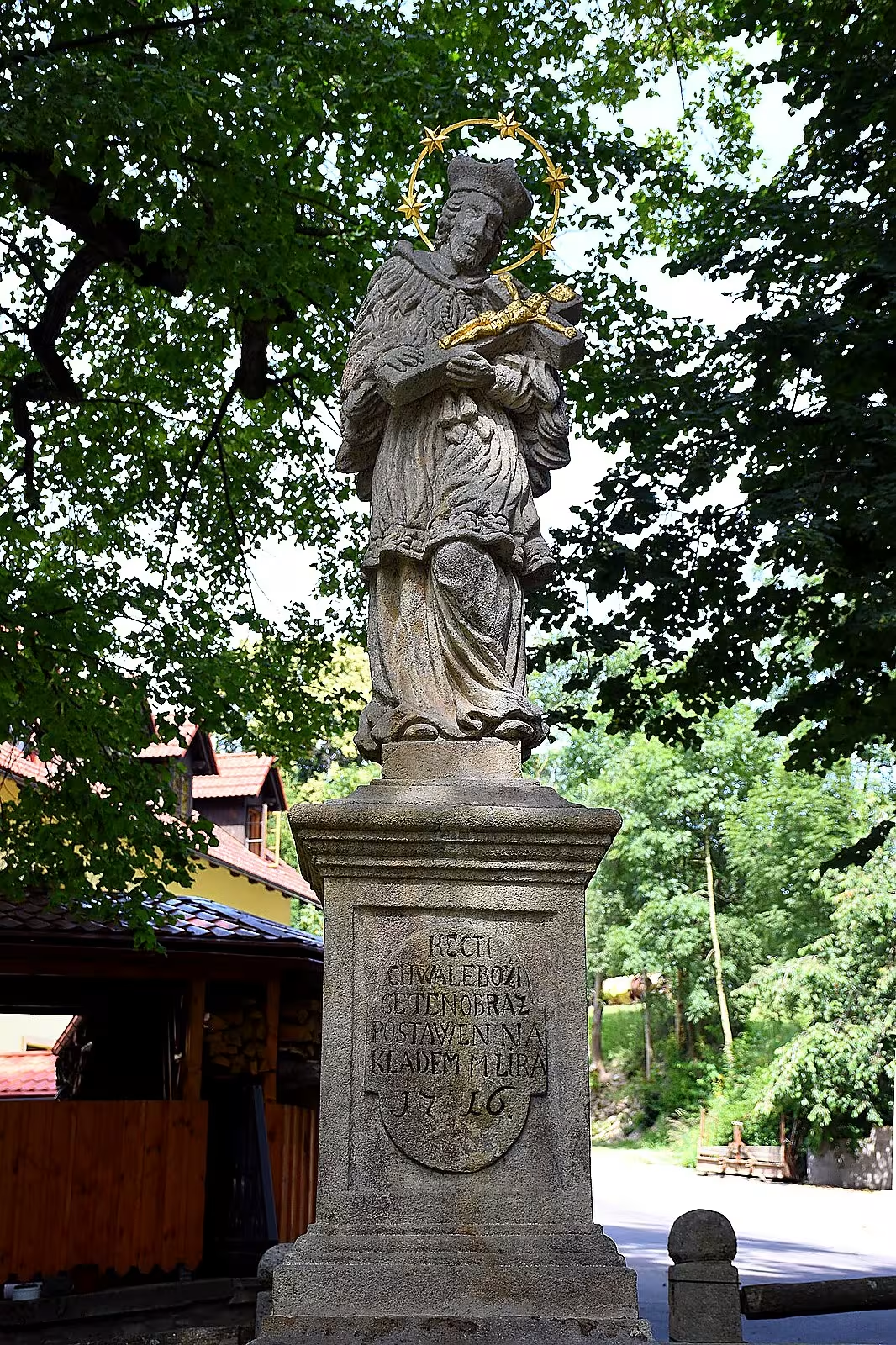
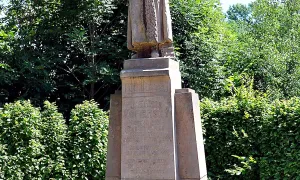
The sandstone statue of St. John Nepomuk in Kunvald dates back to 1716. It represents an important Baroque building in Ústí nad Orlicí district. It is unique because it was created before the official sacrament of the saint and serves as a token of gratitude for saving life.
The statue was built on a load of rich peasant Martin Lír. He made it as a thank you for the help that St. John Nepomucký allegedly provided. On his way from Prague, Lír was trapped and trapped in the Jewish district of Josefov. At the time of his greatest anxiety, he prayed to his patron. According to legend, a saint suddenly appeared to him and brought him out of prison. In 1716, the Czech countries were under the rule of the Habsburgs and the Baroque style was in full bloom.
This sandstone object stands on the modified terrace in front of the farm No. 137 in the town Kunvald. The statue is located in a square balustard under the memorable linden above the road to which a stone staircase leads. The figure of the saint stands on a four-sided three-piece stone pedestal with a prism stick and a profiled ledge. The walls of the wood decorate the medallions. The inscription "KE CTI / CHWALE BODIES / GE TEN OBRAZ / STRAVEN NA / KLADEM M.LÍRA / 1716 /" is drawn on the front. The rear party shall inform of the repair carried out by the Memorial Office in 1941. The saint is depicted in life size in traditional garment with a biret on his head. In his arms he holds a crucifix with a gilded corpus of Christ and his head adorned with a halo with five gilded stars.
Since 1958 the statue has been protected as a real-estate cultural monument of the Czech Republic. In 1941 it was repaired by a memorial office and in 2004 it underwent a total renovation.
Today the statue is accessible to visitors as an important historical element of the site. Its unique origin and baroque processing make this place an interesting destination for interested in history and sacral art.
Then and now
Drag the slider to compare how the landmark may have looked when it was built with the view today.
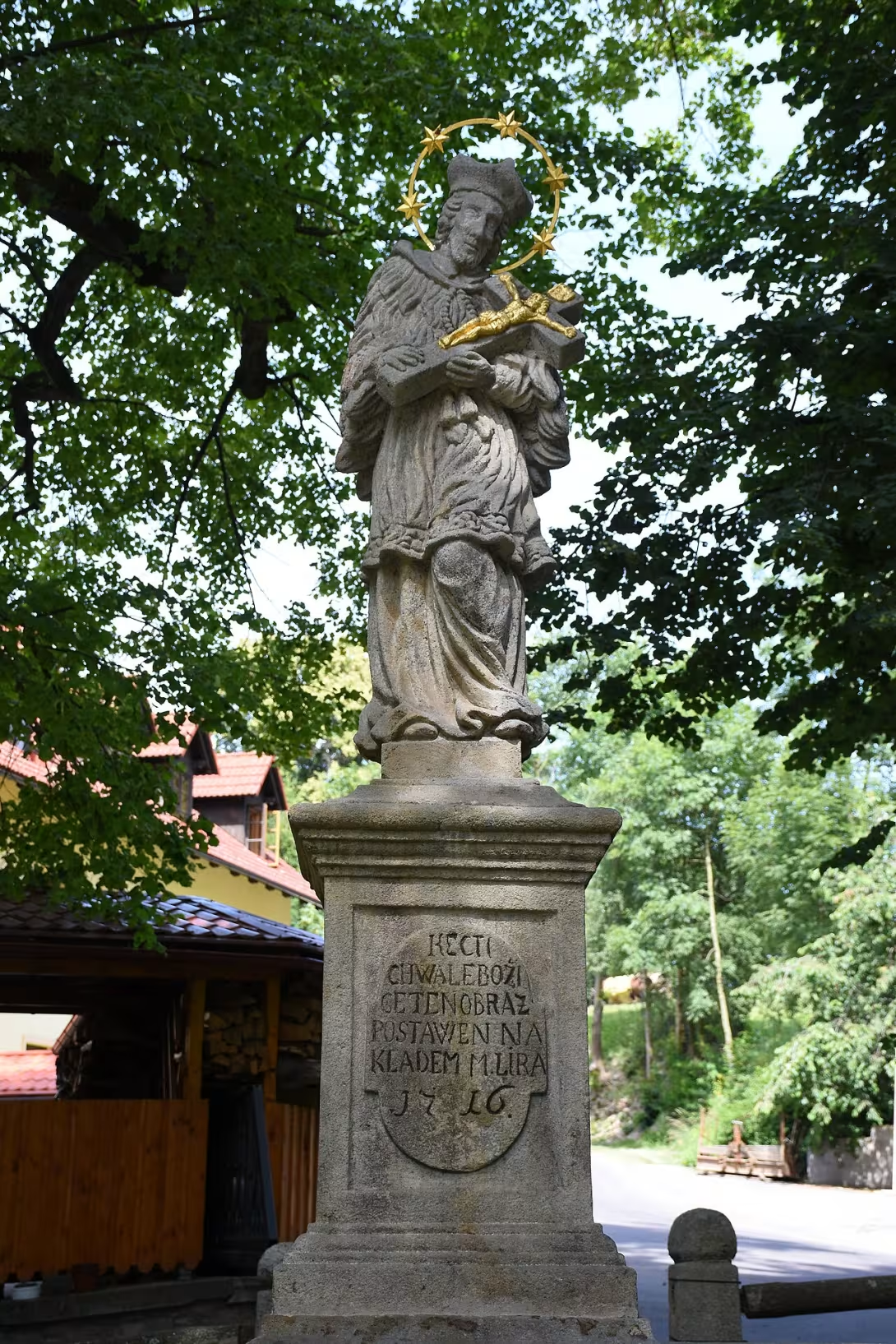

The historical appearance on the left is an AI-generated visualisation and serves as inspiration only.
Historical milestones
- 1716
- The creation of the sandstone statue of St. John Nepomuk
- 1941
- Repair of the statue by a memorial office
- 1958
- Protection of the statue as a cultural monument
- 2004
- Implementation of the total renovation of the statue
Architectural development
The statue stands on a four-sided three-piece stone pedestal with a prism blade and a ledge. In 2004 the statue underwent a total renovation.
Historical events
- 1716
- Status of the statue of St. John Nepomuk.
- 1941
- Fix the statue with a memorial office.
Points of interest
- The statue was created in 1716 before the official sacrament of the saint. - It was built by a rich farmer Martin Lír as a thank you for taking him out of the prison in Prague. - The figure is life-size and holds a crucifix with a gilded corpus of Christ and a halo with five gilded stars. - The four-sided stone pedestal is decorated with medallions and inscription about the construction of the work in 1716. - Since 1958 the statue has been protected as a real cultural monument of the Czech Republic.
Guide
Show guide text
This text was created by artificial intelligence and has not been editorially reviewed. It may contain inaccuracies.
Welcome to Kunvald, a place where history is bound to nature and where every stone tells its own story. Right now, you're standing on a modified terrace in front of the local farmhouse, and there's a figure in front of you who's been guarding the peace of the neighborhood for centuries. Look at this sandstone statue of St. John Nepomuk. Feel her presence, her quiet calm and the way she fits into the landscape of this town. It's the first impression that's likely to hit you, a sense of stability and faith embodied in stone. Let us now look together at how this sculpture was created and why it is even here. We have to move deep into the past in our minds, namely 1716. At that time, the Baroque era ruled in art and architecture, which emphasized emotions, dynamics and deep spirituality. It is in this spirit that the statue was created. But its creation was not just a matter of aesthetics or religious tradition. Behind this statue is a very personal and powerful human story. This story is the fate of a man named Martin Lír. Martin was a rich peasant at the time, a man who probably had everything in his life he could have wanted, until fate drove him into the dark halls of Prague's dungeon. Imagine the despair, the darkness and the cold that accompanied the prison stay in the eighteenth century. Martin Lír was trapped and it seemed the way out was closed. At this critical moment, however, a legend begins. According to the story, Martin was saved from this suffering by the help of St. John Nepomuk. Whether it was a miracle, an unexpected change of circumstances or the power of faith, Martin Lír returned to freedom and to his family. When Martin Lír returned home to Kunvald, he felt great gratitude in his heart. He wanted to express this feeling in a way that would last generations. He decided to build this sandstone statue as a public thank you for his rescue. The statue is therefore not only a religious symbol, but above all a monument to the gratitude of one person for the freedom gained. It's a tangible proof of how powerful a person can feel to be saved from despair. Now I ask you to pay full attention to the very appearance of the statue. Get close to her and pay attention to the details that are in front of you right now. The first thing you're interested in is the size of a character. The statue is life-size, which means St. John Nepomukki stands before you as a real man. This intention was likely to bring the saint closer to the people so that he was not just a distant symbol, but rather a close protector. Now look into the hands of the Holy One. They hold a crucifix in them, a cross with the figure of Christ suffering. If you look carefully, you will see that the body of Christ is gilded. Gold is not only an ornament, but a symbol of divine light, hope and victory over death. This clear contrast between the grey sandstone and the golden shine is supposed to attract a view and remind us of the otherworldly. Another very important detail is the halo, the circle with the stars surrounding the holy head. Notice five gold stars. These stars are a traditional symbol of St. John Nepomuk and in the Christian symbol they resemble the light that appeared above the Vltava River in the place where the Holy One was thrown into the water. They are a symbol of purity and celestial glory. Feel how these little gold details revive an entire stone figure and give it nobility. When you look at the surface of the stone, you might notice that sandstone bears traces of time. It's a beautiful material, but prone to erosion. That is why this statue has been cared for over the years. In 1941, an important repair was carried out by a memorable office to prevent further disintegration of details. Later, in 1958, the statue was officially recognized as a cultural monument of the Czech Republic, which provided it with state protection and recognition of its historical value. The latest major intervention took place in 2004 when the total renovation was carried out. Thanks to this care we can now admire the statue in such good condition and see details that could otherwise be erased forever by wind and rain. Now I want to impress you with one interesting thing, which may not be obvious at first glance, but reveals a deeper layer of faith in that time. Remember the year of creation of the statue, it was 1716. If we looked at the official church records, we'd find something fascinating. By the time Martin Lír had built this statue, St. John Nepomuk was not officially sanctified by the Church. This means that the popular respect for this saint was much stronger and faster than the official processes in Rome. Martin Lír and the people around him believed in his power and help before the church formally confirmed it. It is a fascinating testimony about how faith spread among ordinary people and how Saint John became the favorite patron in the hearts of people before he gained his official title. You are therefore faced with a work that combines personal drama, miracles, folk faith and baroque art. This statue is a silent witness of centuries, saw generations of people passing by, saw changes in Kunvald and throughout the country, and yet it still stands here to remind us of the value of freedom and gratitude. Now that you know the story of Martin Lír and the secrets of the golden stars, I suggest that you take a moment to feel the atmosphere of this terrace. Look around you at the surrounding property and landscape that surrounds this corner of Kunvald. Let yourself be inspired by the calm this statue radiates. But your journey through this beautiful place ends only now. I invite you to explore further the surroundings, to walk on Kuwald roads and to discover other hidden treasures that this place offers you. I hope this short trip to history has helped you understand more what you see before you, and that you're leaving with a sense of enrichment. Thank you for your attention and I wish you a pleasant continuation in your discovery of Kunvald. Goodbye.
Tips for visitors
The best time to visit the statue of St. John Nepomuk in Kunvald is an early spring or late autumn day when the weather is quiet and sunny. This time of year offers ideal conditions for viewing statues from outside without overcrowding tourists. Thanks to light, the details of the Baroque work are better reflected.
Access to the monument is possible by car and public transport. The current information about the traffic connection can be found in the online search engine.
When visiting the statue, it is advisable to take the camera or mobile phone with you to capture the details of the work. Also remember the protective sunglasses and enough drinking, especially in the summer months. Thanks to the location of the statue on the terrace, it is suitable for shooting from different angles.
In the vicinity of the monument there is a historical farmhouse that can be visited and explored. In addition, the town of Kunvald offers beautiful natural landscapes suitable for short walks or picnics. For families with children, the opportunity to explore outdoor space and visit local shops is an interesting experience.
Frequently asked questions
Can the monument be visited?
This is a structure in a public space that can usually be seen from outside free of charge. We have not verified that this particular one is freely accessible.
Where is the monument?
Location: Kunvald. The map on this page shows the exact spot.
Why is the monument protected?
It is listed in the Central List of Cultural Monuments of the Czech Republic as a cultural monument (register no. 1000141292).
Businesses nearby
Do you run a restaurant, accommodation, shop, museum, rental, wellness or other visitor service near this monument? Show yourself directly to the people heading to it — this is how they will see you in the app and on the web:
Nearby
🏰 Historic sites (80)
- Muzeum starých strojů a technologií 3.9 km +420737239065 web
- Busta T.G. Masaryka 4.3 km
- Mariánský sloup 4.3 km
- Městské muzeum Žamberk 4.5 km
- Pomník obětem 1. světové válce 4.6 km
- Domek Prokopa Diviše 4.7 km Betlém 326 +420 608 427 064 web
- Rodný domek Prokopa Diviše 4.7 km
- pomník gen. Knopa a obětem II. sv. války 4.9 km
- Železniční muzeum Rokytnice v Orlických horách 5.2 km Stříbrný vrch
- bývalá vodárna 5.6 km
- Morový sloup 5.7 km
- Gedenken an die Opfer des I. und II. Weltkrieges 5.7 km
- T. G. Masaryka 5.7 km
- K. Zalozeni Dobrovolne Pozarni Ochdany 5.7 km
- Zámek Rokytnice v Orlických horách 5.8 km web
- Sýpka - muzeum Orlických hor 5.8 km web
- Gedenken an Rudolf Weiss 6.2 km
- ruiny dworu obronnego 6.8 km
- Pěchotní srub na Holém 7.5 km
- Pomník Obětem 1. a 2. světové války 7.9 km
🍽️ Restaurants and dining (97)
- Babeta 4.0 km +420 608 356 665 web
- Kavarna 4.2 km
- Bufet v Hlubokáně 4.3 km Hluboká 143 +420776186722 web
- Nón Lá 4.3 km Masarykovo namesti 144
- Pizza Edi 4.3 km Hluboká 92 +420775061237 web
- Pizzeria Panský dům 4.3 km Masarykovo náměstí 6 web
- Pivovar Žamberk 4.5 km
- Nejen caffe u Páji 4.5 km Nádražní 764 +420776186722 web
- Ricci 4.5 km
- Pizza U Divadla 4.8 km Nádražní 216 +420607706539 web
- U Vavřičků 4.9 km
- Restaurace U Mostu 5.2 km
- Na Jatkách 5.2 km
- Orličan 5.7 km
- Penzion Rampušák 5.7 km
- Stop Bar 5.7 km
- Eduard 5.9 km
- U Nás 6.1 km
- Orlická chata U Rampušáka 6.2 km web
- Formanka 6.3 km
🏨 Accommodation (59)
- Autocamping Pod Černým lesem 3.9 km +420 465 614 755 web
- Taboriste pod stan pro vodaky 4.8 km web
- Horský Hotel Rokytenka 5.4 km web
- Hotel Orličan 5.7 km náměstí T. G. Masaryka 102
- U Kapličky 5.7 km +420 777 087 811 web
- U Adama 5.7 km
- U Medvěda 5.8 km
- Hotel Eduard 5.9 km
- Zátiší 6.0 km
- Babeta 6.2 km
- Bobík 6.2 km
- ATC Šlechtův palouk 6.2 km +420724147317 web
- ATC Šlechtův palouk 6.3 km +420724147317 web
- Petrův palouk 6.3 km
- Penzion Pastviny 6.4 km
- Zemská brána 6.5 km
- Gościniec uDany 6.8 km +48 74 811 91 90 web
- Chata 6.8 km
- Pension Severák 7.7 km
- Usedlost Hamernice 8.0 km +420 602 660 198 web
🚲 Rentals and sport (9)
- TOSK Žamberk 4.0 km
- Viktor Bike Sport 4.2 km Pod Radnicí 153 +420724738658 web
- Sport Milena Bulíčková 4.4 km Nádražní 554
- Outdoor Sport, s.r.o. 5.8 km
- Přírodní Koupaliště 6.2 km
- Klub biatlonu Letohrad, p.s. 8.5 km
- Cyklo sport Mach 12.2 km
- Sport 12.4 km
- Spartan aréna 14.0 km
🥾 Hiking and nature (202)
- Krejsův kopec 0.8 km
- Na Veselíčku 2.1 km
- Hůrka 3.0 km
- Na Zmrzlíku 3.1 km
- Nad Kasárnami 3.3 km
- Potocký kopec 3.4 km
- Zbudov 3.8 km
- Na hradě 3.9 km
- Údolí Záhorského potoka 4.0 km
- Velká Suchá 4.3 km
- Vojáčkovy sady 4.6 km
- Rašeliniště pod Předním vrchem 4.8 km
- Nad Jesínkem 4.8 km
- Rozálka 4.8 km
- Jeřabinka 4.8 km
- Tyršova rozhledna 4.8 km
- Přední kopec 4.9 km
- Homole 4.9 km
- U Vejdových 4.9 km
- Velký Hájek 5.0 km
Accommodation nearby
Seasonal recommendations
Spring: In the spring season, Kunvald is charming with its vibrating greenery and flowering shrubs that decorate the surroundings of the statue of St. John Nepomuk. The sun illuminates the memory in warm rays, creating a pleasant atmosphere for visitors. Exploring this historical statue is suitable at noon when the sun provides the best lighting and allows you to enjoy the natural beauty of the surrounding region. We recommend to wear light clothes with the possibility to add a layer because the temperature can be variable.
Summer: In the summer period Kunvald is full of life and glow. The sun illuminates the statue of St. John Nepomuk for a long time, allowing you to look at every detail of the monument in detail. Nature around is in full power and green meadow offers a pleasant view. The best time to visit is in the morning or evening when the sun is not so intense and you can enjoy a cool journey without unpleasant heat stress. We recommend wearing light clothes and taking a protective umbrella or hat with you.
Autumn: In autumn the Kunvald becomes melancholic beauty when leaves of falling trees colour the surrounding area in a vibrant palette of shades. The sun illuminates the memory in weaker rays and creates an atmosphere of respect and peace. The best time for a tour is at noon, when sunlight best illuminates the statue and surrounding landscape. We recommend wearing warmer clothes with the possibility to add layers because temperatures may decrease significantly.
Winter: In winter Kunvald is covered with snow and offers a different view of the statue of St. John Nepomuk. Sun rays illuminate the snow cover, creating a beautiful contrast to the colour of the monument. The best time to visit is in the morning or evening when the sun lights up the statue with a special light and you can enjoy a quiet walk. We recommend wearing warm clothes, protective shoes for a snowman and perhaps some umbrella or hat against the frost.
Visualizations and artistic views


The visualisations are generated by artificial intelligence and serve as inspiration.
Tips from visitors
No tips yet. Be the first!
Log in and add your tip.
Sources and literature
Photos: Ben Skála, Benfoto / CC BY-SA 3.0 — Wikimedia Commons. The author and licence also appear when you hover over the image.
Faktickým podkladem tohoto textu byl článek na Wikipedii, jehož autory jsou přispěvatelé Wikipedie. Článek je dostupný pod licencí CC BY-SA 4.0.
Location on the map
Příběhy a pověsti
Legendy, pověsti a příběhy spjaté s touto památkou
Fotografie návštěvníků
Zatím žádné fotografie. Buďte první, kdo přidá fotografii z návštěvy!
Log in a přidejte svou fotografii nebo hodnoťte.
Za ověřenou návštěvu v aplikaci získáte víc bodů — poznáme podle GPS, že jste na místě.
Reviews and comments