






Schlickův dům v Chebu House
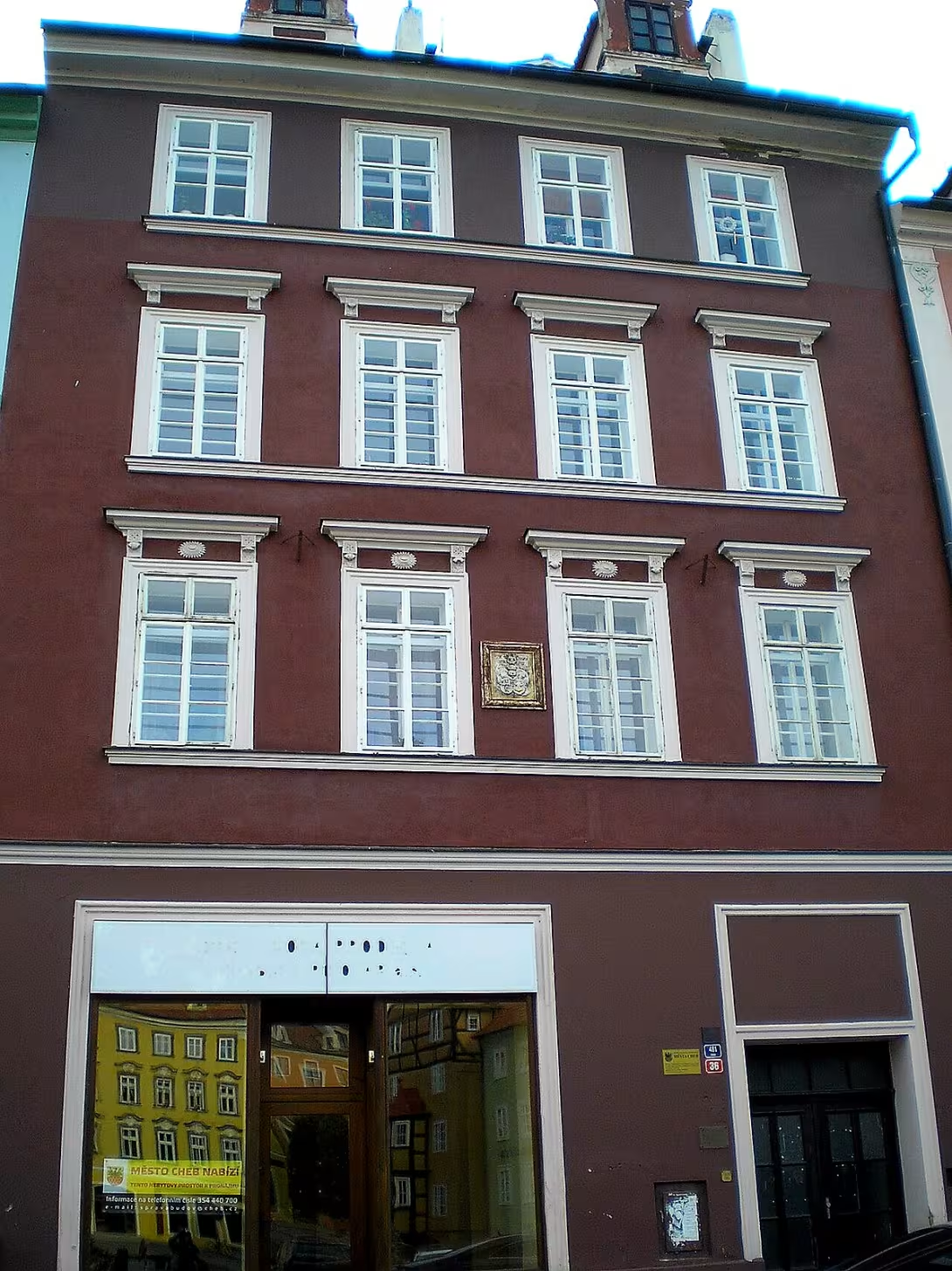
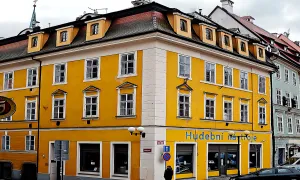
Schlick's house is an important townhouse on King George's Square from Poděbrad in Cheb. This three-story building took its present form in the spirit of historism in the 19th century. Originally, it served as the family residence of the noble House of Schlick and today represents a typical example of urban architecture that combines a historic facade with a modern ground floor.
The oldest history of the house was left with few concrete messages, yet it is known that the building was originally the seat of the Schlick family. In the 19th century, in the period of the national revival and industrial revolution, the house underwent a major reconstruction. The architect V. Prökl was the author of this design.
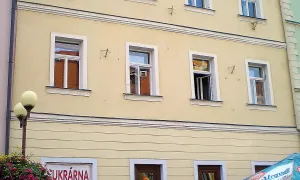
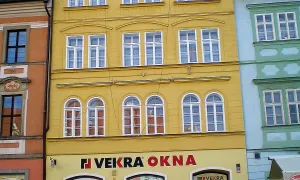
The building has a saddle roof with two walled skylights. The facade facing the square richly breaks the cordon and the post-date ledge. The windows are frayed with champagne, above those on the first and second floors there are profiled moldings carried by decorative consoles. A significant element of the facade is the stucco coat of arms in the first floor window axis, which refers to the original owner.
The property history includes the noble rod Schlicků and later the merchant Böhm, for whose possession the aforementioned reconstruction took place in the 19th century. In the second half of the 20th century, the ground floor underwent significant modernization in order to meet the business needs at the time.
The house currently serves on the upper floors for housing, while the ground floor is used by commercial operators. The building is located in the historical centre of Cheb, in close proximity to monuments such as Cheb Castle.
Schlick's house represents valuable proof of the transformation of urban architecture over the centuries and its historic facade appropriately complements the character of King George's Square from Poděbrad. When visiting the historical core of Cheb, it is worth paying particular attention to the stucco coat of arms on the first floor, which resembles the noble past of this building.
Historical milestones
- around 1500
- Probably the creation of a primordial townhouse in the history of town
- 1800-1899
- Place the rebuilding of the house in the spirit of historism according to the design of architect V. Prokla
- 1950-1999
- The modernisation of the building's premises for business use
Architectural development
The original family house was rebuilt in the 19th century in the spirit of history. The facade is decorated with stucco coat of arms in the axis of the windows of the first floor. The ground floor underwent significant modernization in the second half of the 20th century to meet the needs of business premises.
Historical events
19th century: rebuilding the house to the present form according to the design V. Prökla. Second half of the 20th century: reconstruction of the ground floor of the building.
Owners
The Schlick family, obchodník Böhm.
Points of interest
- The house is a corner building on King George's Square from Poděbrad in Cheb, which has three floors. - In the nineteenth century, the house was rebuilt according to the design of architect V. Prökl. - On the facade there is a stucco coat of arms, which resembles the original noble owner of the Schlick family. - The building has a saddle roof with two walled skylights and the windows are framed by shambles. - The owner of the house was also obchodník Böhm, for whose possession the house was converted.
Guide
Show guide text
This text was created by artificial intelligence and has not been editorially reviewed. It may contain inaccuracies.
Welcome to the heart of Cheb, King George's Square of Podebrad. You're standing right in front of one of the most prominent townsfolk houses in this historic core. Look in front of you and let the view slide over the richly divided facade of this three-story building. It's a corner house, which gives it some kind of dynamic and emphasis, like he wants to breathe air from both sides of the street. At first sight, you must be attracted to its height and proportions. There's a saddle roof on the roof that's broken by two walled skylights. These skylights are not only a functional element, but at the same time visually finish the silhouette of the house and link it to the surrounding urban landscape.
This house is not just an ordinary building, but a monument that carries layers of history dating back to the beginning of the 16th century. Around 1500, the original townhouse was probably built here. At that time, Cheb developed as an important business and craft centre, and the township layer built representative mansions. This house, however, became the property of the noble House of Schlick, which gave it a specific character. The House of Schlick belonged to important families in Czech countries and their presence in Cheb is proof of how closely the nobility was linked to the development of this city. The house became a home, a place where history was written and the fate of the region was decided.
Now pay attention to architectural details that you can see directly from here. The facade is richly fragmented and full of elements that demonstrate careful design. Note the cordon and post-term realms, which horizontally disintegrated the facade and give it rhythm. These moldings shade the windows and protect the wall from rain, but at the same time create a playful game of light and shadow. Look at the windows that are equipped with champagne. Shambranes are framed frames around windows, which serve as a decorative element and highlight their shape. Between the floors or under the ledge you can see decorative consoles that carry part of the roof structure while serving as decorative elements.
The current form of the house you see today is the result of a major reconstruction that took place in the nineteenth century, namely from 1800 to 1899. This reconstruction was carried out in the spirit of historism, which means that the architect was inspired by older architectural styles and tried to restore or reinterpret them. The author of this design was architect V. Prökl. His work on this house shows how aesthetic preferences have changed over the centuries. From the original Renaissance or early Baroque look, the house turned into a building that matched the taste of the time. Yet he kept some original elements that give him an authentic character.
On the facade there is a stucco coat of arms, which is an important historical document. This coat of arms resembles the original noble owner, rod Schlicků. It's kind of a signature that stays on the building for centuries. Erb is shown in stucco technology, which is a material that fits well into the overall appearance of the facade and is sufficiently weather-resistant. Looking up you can find this coat of arms and try to distinguish its details. Although you may not know the heraldic, it is clear that it was a high-ranking family.
The history of this house is also associated with other personalities. In addition to the Schlick family, the name of the trader Böhm is attached to this place. His presence here suggests that the house was not only the seat of the nobles, but also a place of business. Cheb has always been a city of merchants and craftsmen, and so it is no wonder that the owners from various social classes have taken turns in his houses. Businessman Böhm probably used the premises of the house for his business, which contributed to his economic importance at the time.
In the 1990s, from 1950 to 1999, the house undergone another significant change. The ground floor of the building was modernised for commercial use. This change affected the lower part of the house where business premises can be located today. For a visitor, this means that the lower floor may have a different character than the upper floors that preserve their historical character. This modernisation is proof of how the functions of historical buildings change in line with the needs of the present. Yet we try to preserve their original appearance and value.
The interesting thing that may interest you is that this house is a corner building in King George's Square of Podebrad. The square itself is the historical centre of Cheb and the house is part of it. Its location on the corner gives it a distinctive and makes it easily identifiable. When you go through the square, this house is one of the elements that shapes its atmosphere. It is a place where history and the present meet, where tourists and locals walk.
During the tour you can see how the house is harmonically connected to the surrounding building. The saddle roof with two walled skylights is typical of this part of the city and creates a unified visual unit with other buildings. The richly fragmented facade with cordon and post-date mantelpiece, shambrans and decorative consoles is evidence of artistic processing. Each element has a reason and a function, either aesthetic or practical.
Architect V. Prökl, who designed the reconstruction in the nineteenth century, left his print on the house. His design reflects a historical style that was popular at the time. Historism tried to build on the past and took the elements from different epoch. In the case of this house it was probably inspired by the Renaissance or Baroque, which was very widespread in the Czech Republic. The result is a building that is noble and dignified but also accessible and understandable.
The Schlick Stucco crest is another proof of their influence. Erb is located on the facade and is visible from the square. It's kind of a symbol that reminds us of who the original owner of this house was. The House of Schlicks had a significant position in the history of Czech countries and their headquarters are now valuable monuments. This house is one of them, and its existence is proof of their wealth and influence.
Businessman Böhm is another person connected to this place. His presence here suggests that the house was not only the seat of the nobles, but also a place of business. Cheb has always been a city of merchants and craftsmen, and so it is no wonder that in its homes the owners from various social classes have been taking turns. Businessman Böhm probably used the premises of the house for his business, which contributed to his economic importance at the time.
In the 1990s, in the period from
Tips for visitors
The best time to visit is the morning of the working week, where you can avoid crowds of tourists and you can easily view the detailed facade of the house in the square. The light at this time is ideal for excelling architectural elements.
The historical centre of Cheb can be reached comfortably by foot from the train and bus station. If you arrive by car, use the parking lot on the edge of the monument zone, from where it is only a short walk to the house.
For photography we recommend using the morning or late afternoon sun, which beautifully depicts the rich layout of the facade. The best shot is directly from King Jiří's Square from Poděbrad, where the corner position of the building stands out.
In the immediate surroundings, do not miss a tour of the historical centre of the town, the square of King Jiří of Podebrad with its typical atmosphere and Cheb Castle, which offers a unique view of medieval history.
For families with children the location is ideal thanks to the pedestrian zone in the square where children can move safely. The tour of the exterior of the house is simple and can be easily connected to the visit of the castle, which children usually enjoy very much.
Businesses nearby
Do you run a restaurant, accommodation, shop, museum, rental, wellness or other visitor service near this monument? Show yourself directly to the people heading to it — this is how they will see you in the app and on the web:
Nearby
Historické centrum města Cheb, náměstí Krále Jiřího z Poděbrad, chebský hrad.
Accommodation nearby
Themed route
1. Cheb Castle - Castle. A place with a rich history that serves as a gateway to exploring the city. 2. Historical center of Cheb - city zone. A walk through the old streets reveals the atmosphere of ancient times. 3. Square of King George of Poděbrad - Square. The central point of the city where the main roads and beautiful buildings meet. 4. Schlickův dům v Chebu - memorable house. Top of the road, which represents an important architecture and history of the Schlick family.
Seasonal recommendations
In the spring life wakes up around the historic house. The light is soft and soft, which beautifully highlights the details of the old architecture. In the surrounding alleys you can feel the fresh air and see the first flowers. I recommend you take several layers of clothing because the weather can be variable. There aren't as many people as there are in the summer, so you can enjoy a quieter tour of the morning.
The summer season brings to Cheb the greatest strain of visitors and bright, sharp sun. The atmosphere is lively and full of energy, which perfectly complements the historical importance of the place. Because of the big crowds, it's best to arrive right after opening so you can avoid the biggest rush. Dress lightly and don't forget drinking mode because it can be hot in the alleys.
Autumn offers a magical and a little melancholy atmosphere. Colors in the surroundings turn into shades of gold and orange, creating an amazing contrast to historical facades. The morning fog gives the place a mystery. For walks around the city, choose comfortable shoes that can handle moisture. The best time to visit is the afternoon when the light is the most beautiful for photography.
In winter Cheb is calmer and the house looks very cozy in contrast to the cold outside. Days are short and light is weak, which requires planning visits during clear hours. The need is very warm clothes and quality shoes. The opening time is shorter in this period, so check in advance to ensure that you do not fail.
Visualizations and artistic views

The visualisations are generated by artificial intelligence and serve as inspiration.
Photos from the area
Real photos taken near the monument


Zdroj a licence jsou uvedeny u každého snímku.
Tips from visitors
No tips yet. Be the first!
Log in and add your tip.
Sources and literature
Photos: Novojaro / CC BY-SA 3.0 — Wikimedia Commons. The author and licence also appear when you hover over the image.
Faktickým podkladem tohoto textu byl článek na Wikipedii, jehož autory jsou přispěvatelé Wikipedie. Článek je dostupný pod licencí CC BY-SA 4.0.
Location on the map
Příběhy a pověsti
Legendy, pověsti a příběhy spjaté s touto památkou
Fotografie návštěvníků
Zatím žádné fotografie. Buďte první, kdo přidá fotografii z návštěvy!
Log in a přidejte svou fotografii nebo hodnoťte.
Za ověřenou návštěvu v aplikaci získáte víc bodů — poznáme podle GPS, že jste na místě.
Reviews and comments