

silniční most v Horní Vltavici Road bridge
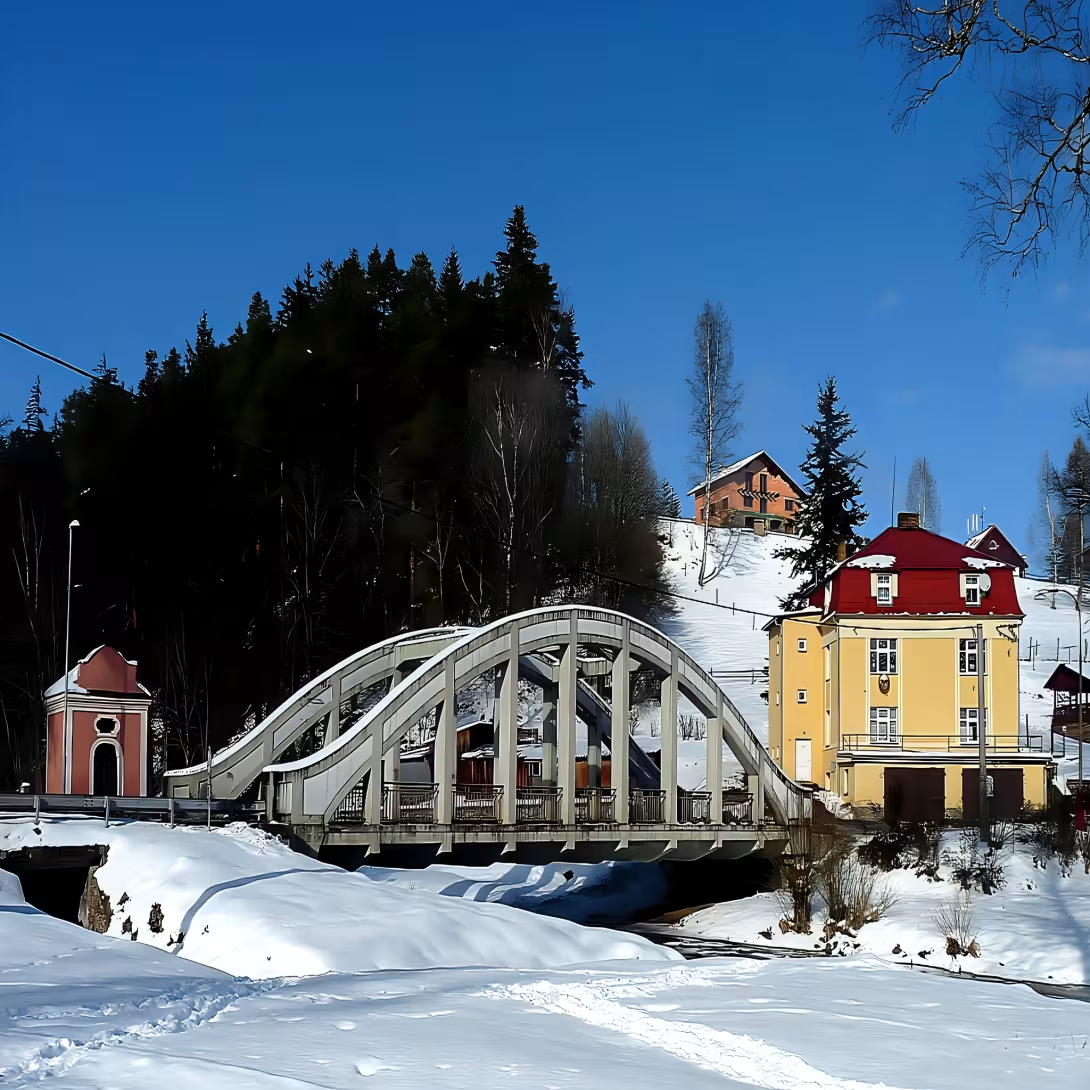
The Silniční most v Horní Vltavici is a steel-reinforced concrete bridge spanning the Teplá Vltava river in southern Horní Vltavice. Built in 1926 to replace an earlier wooden bridge, it has been well-maintained and stands out for its unique design and historical importance.
The original wooden bridge was replaced with a steel-reinforced concrete one in 1926. The new bridge features a 35-meter-long, 8.7-meter-wide structure supported by two pillars with six stays, capable of carrying up to 60 tons.
Its design is characterized by its durable and strong steel-reinforced concrete structure. The Technical Office for Bridge Construction in Prague oversaw the construction, which was carried out by Pittel Brausewetter Betonbau Prag. Since 1939, the bridge has served as a symbol on the town's seal.
Located near a Baroque chapel dedicated to St. John Nepomuk, the Silniční most v Horní Vltavici adds to its historical and cultural significance. Today, it remains an important landmark in the region, offering breathtaking views of the Teplá Vltava river and surrounding landscape.
In 1997, the bridge underwent renovations to ensure its continued safety and functionality. Visitors can still appreciate its unique design and architectural features, making it a worthwhile stop for anyone interested in history, architecture, or simply taking in the beauty of the region.
Then and now
Drag the slider to compare how the landmark may have looked when it was built with the view today.
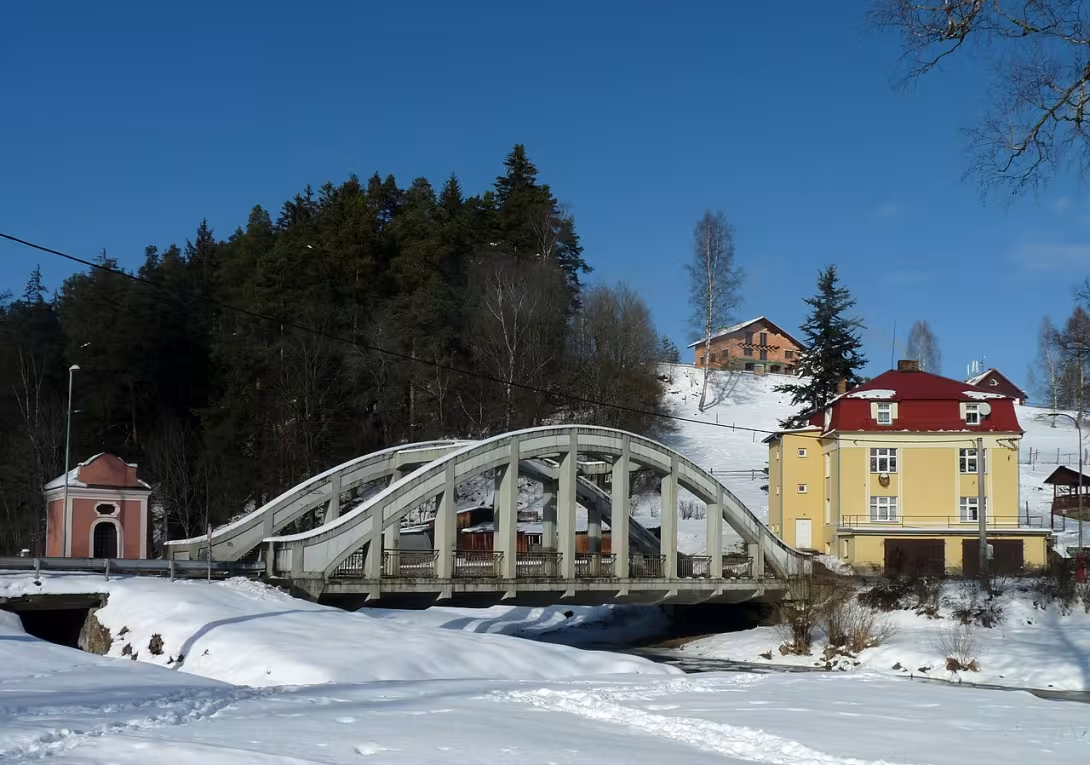
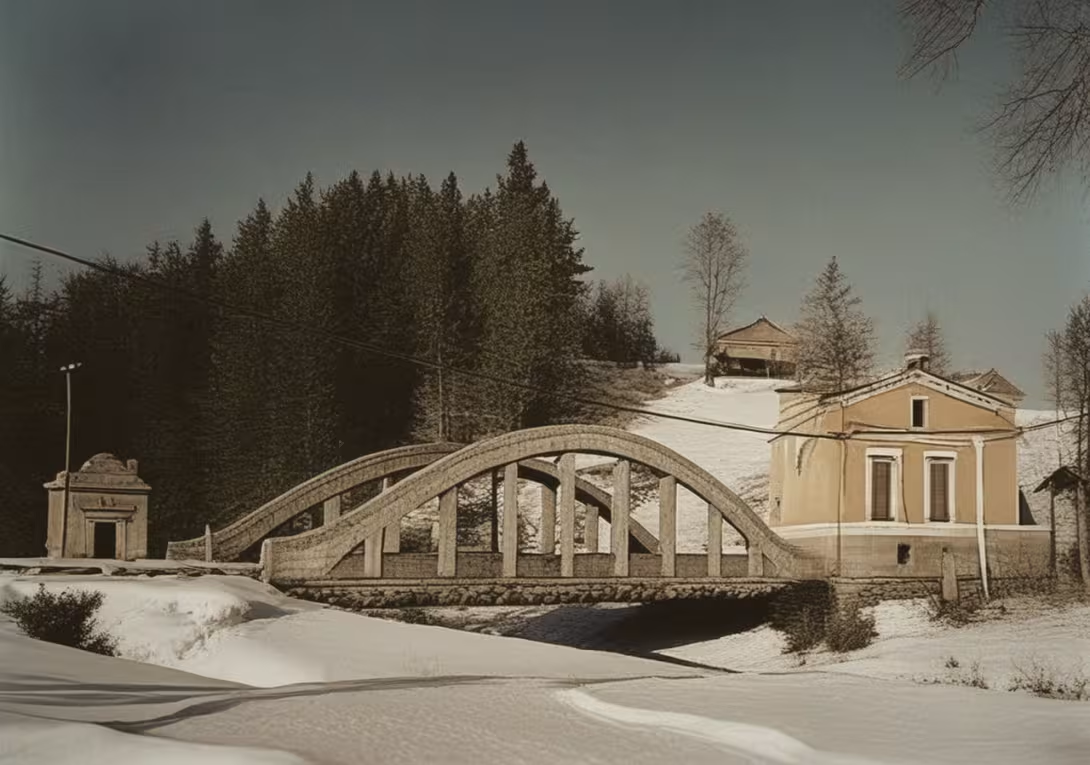
The historical appearance on the left is an AI-generated visualisation and serves as inspiration only.
Historical milestones
- 1926
- Construction of the steel-reinforced concrete bridge completed.
- 1939
- The bridge becomes a symbol on the town's seal.
- 1997
- Major renovations carried out to ensure safety and functionality.
Architectural development
The bridge features a steel-reinforced concrete structure with a length of 35 meters and a width of 8.7 meters.
Historical events
The original wooden bridge was replaced by a steel-reinforced concrete one in 1926.
The bridge was renovated in 1997.
Points of interest
– Built in 1926, the bridge replaced an earlier wooden bridge. – The structure is 35 meters long and 8.7 meters wide, supported by two pillars with six stays. – It is capable of carrying up to 60 tons. – Since 1939, the bridge has served as a symbol on the town's seal. – It is located near a Baroque chapel dedicated to St. John Nepomuk.
Guide
Show guide text
This text was created by artificial intelligence and has not been editorially reviewed. It may contain inaccuracies.
Welcome to Horní Vltavice. Please, take a moment to settle in, adjust your headphones, and simply look ahead of you. You are standing before the silniční most v Horní Vltavici, a structure that might at first glance seem like a simple piece of infrastructure, but as you will soon discover, it is a vital artery of this community and a testament to early twentieth-century engineering. As you gaze at the bridge spanning the Teplá Vltava river, notice how it integrates into the landscape, bridging not just two banks of water, but two different eras of transport and technology.
Let us step back in time to the year 1926. To understand why this bridge is here, we have to imagine what stood in its place before. For a long time, the crossing over the Teplá Vltava was served by a wooden bridge. While wooden structures were common and easier to build with local materials, they were susceptible to the elements, the wear and tear of increasing traffic, and the unpredictable nature of the river. By the mid-1920s, it became clear that Horní Vltavice needed something more permanent, something that could withstand the test of time and the growing weight of modern vehicles. This led to the construction of the current silniční most v Horní Vltavici. Completed in 1926, this bridge represented a bold leap forward, replacing the old timber planks with the cutting-edge material of the age: steel-reinforced concrete.
Now, I invite you to take a closer look at the architecture of the bridge. As you observe the structure, notice the material. The use of steel-reinforced concrete was a hallmark of the industrial era, combining the compressive strength of concrete with the tensile strength of steel. This allowed the bridge to be far more durable and capable of supporting much heavier loads than its wooden predecessor. If you look closely at the design, you will see that the bridge is supported by two sturdy pillars. These pillars are the backbone of the entire crossing, anchoring the structure firmly into the riverbed of the Teplá Vltava.
Pay special attention to the stays. You will notice six stays that help distribute the weight and maintain the stability of the span. This specific configuration is what gives the bridge its characteristic profile and ensures its longevity. In terms of scale, the bridge stretches 35 meters in length and measures 8.7 meters in width. While these numbers might seem modest by the standards of modern highway overpasses, for a local crossing in 1926, this was a significant piece of engineering. It was designed not just for the pedestrians and horse-drawn carriages of the past, but for the future. In fact, the bridge is capable of carrying up to 60 tons, a capacity that ensured it remained functional as trucks and heavier machinery became common in the region.
As you stand here, it is interesting to think about the people who built this. While the names of the specific architects and engineers have been lost to time, their legacy is written in the concrete and steel before you. They built something that was meant to last, and their success is evident in the fact that the bridge is still serving the people of Horní Vltavice today.
Beyond its technical specifications, the silniční most v Horní Vltavici holds a deeper symbolic meaning for the local community. If you were to look at the official seal of the town, you would find a surprising detail. Since 1939, this very bridge has served as a symbol on the town's seal. Think about that for a moment. Usually, towns choose a church, a coat of arms, or a natural landmark for their seal. The choice of a road bridge is quite unique. It suggests that the people of Horní Vltavice viewed this structure as more than just a way to get from one side of the river to the other. It was a symbol of progress, of connection, and of the town's ability to modernize and move forward into the new century. The bridge became an emblem of the town's identity, representing the link between the community and the wider world.
Of course, maintaining a structure that faces the elements every day is a constant challenge. The river Teplá Vltava flows beneath it year-round, and the changing seasons take their toll on any material. To ensure that the bridge remained safe and functional for future generations, a major renovation was carried out in 1997. This work was essential to preserve the integrity of the steel-reinforced concrete and to ensure that the bridge could continue to handle the demands of modern traffic without compromising the historical character of the site.
As you look around the immediate area, you might notice that the bridge is located near a Baroque site, adding a layer of historical contrast to the scene. On one hand, you have the ornate, artistic spirit of the Baroque era, and on the other, the functional, industrial strength of the 1926 bridge. Together, they tell the story of Horní Vltavice as a place where different eras coexist harmoniously.
Before you move on, I encourage you to take one last look at the six stays and the two pillars. Imagine the bridge in 1939, when it was officially adopted as the town's symbol, and compare that to how it looks now. It has survived wars, political shifts, and the relentless flow of the river, remaining a steadfast point of connection for everyone who passes through. There is a certain quiet dignity in a structure that does its job so reliably for nearly a century.
Now that you have explored the history and the engineering of the silniční most v Horní Vltavici, I invite you to actually walk across it. Feel the solidity of the concrete beneath your feet and listen to the sound of the Teplá Vltava flowing below. As you cross, you are following in the footsteps of thousands of residents and travelers who have used this path since 1926.
Thank you for joining me for this brief look into the history of this landmark. Please feel free to explore the surrounding area of Horní Vltavice at your own pace. Whether you are heading toward the Baroque architecture nearby or continuing your journey through the town, may you find more hidden stories waiting to be discovered. Enjoy your stay, and goodbye for now.
Tips for visitors
The best time to visit the silniční most v Horní Vltavici is during the warmer months when the Teplá Vltava river is most scenic. The location is accessible by car and public transport; please verify current schedules using a transport search engine for the most accurate information.
For photography, the bridge's steel-reinforced concrete structure provides excellent geometric subjects. The best light is typically found during the early morning or late afternoon. It is recommended to bring comfortable walking shoes and appropriate gear for the outdoor environment.
In the immediate vicinity, you can visit the Baroque chapel dedicated to St. John Nepomuk. This provides a wonderful opportunity to see both early 20th-century engineering and historical religious architecture in one trip.
Families with children can enjoy the calm atmosphere, but constant supervision is necessary due to the proximity of the river and the bridge structure. Be sure to pack essentials like water and snacks for a comfortable visit.
Frequently asked questions
Can the monument be visited?
This is a structure in a public space that can usually be seen from outside free of charge. We have not verified that this particular one is freely accessible.
Where is the monument?
Location: Horní Vltavice. The map on this page shows the exact spot.
Why is the monument protected?
It is listed in the Central List of Cultural Monuments of the Czech Republic as a cultural monument (register no. 1000157053).
Businesses nearby
Do you run a restaurant, accommodation, shop, museum, rental, wellness or other visitor service near this monument? Show yourself directly to the people heading to it — this is how they will see you in the app and on the web:
Events nearby
Zdroj akcí: otevřená data měst a obcí ČR (Národní katalog otevřených dat) a kalendář akcí Národního památkového ústavu.
Nearby
🏰 Historic sites (421)
🍽️ Restaurants and dining (110)
- Krmelec 0.1 km
- Bistro na hřišti 0.3 km web
- Bistro VV 0.3 km +420792777010
- U pštrosa 0.7 km
- Stop Cafe 2.2 km web
- Zátoňská Hospoda 3.2 km
- Hotel Kristian 3.4 km +420 380 423 099 web
- Pod Boubínem 3.5 km
- Restaurace Kubovka 3.5 km +420720431141
- Cafe-Restaurant 3.9 km
- Pension Lenora 4.5 km
- Restaurace u Grobiána 4.6 km +420 607 616 691 web
- Pohoda 5.7 km Strážný 38 +420 603 859 330 web
- EURO Asia Restaurace 5.8 km
- Dvůr Lískový vrch 6.0 km +420 775 604 191 web
- Rybarská restaurace 6.0 km Strážný 45 +420 725 589 499 web
- Soumarská hospoda - U Maxů 7.3 km
- Bufet U Kotvy Áčko 7.3 km
- Bufet U Kotvy Béčko 7.3 km
- Restaurace Lipka 7.6 km
🏨 Accommodation (158)
- Salivar 0.2 km
- TJ Vltava 0.3 km
- U Čermáků 0.3 km
- Pod Mlýnským vrškem 0.4 km
- Bázum 0.6 km +420 222 532 547 web
- Pension u Molu 2.3 km
- Kemp Pod Boubínem 2.3 km web
- penzion Romana Maunová 2.3 km +420 737 824 428 web
- Chata Boubín 3.0 km web
- Penzion Zátoňská Hospoda- Restaurant 3.2 km +420 728 122 672 web
- Zámeček Zátoň 3.3 km
- Penzion pod Pralesem 3.3 km +420 606 083 025 web
- Pension U Zdichynců 3.4 km +420 604 468 741
- Hotel Kristian 3.4 km +420 380 423 099 web
- Penzion Polka 3.4 km
- Apartmány Kopaničáková 3.5 km +420 728 396 139 web
- Penzion Anna 3.9 km web
- Lenora 4.0 km web
- Penzion Chlustov 4.2 km
- Penzion U Geobiana 4.7 km +420 607 616 691 web
🚲 Rentals and sport (14)
- Pujcovna Lodi 7.3 km web
- Kemp Hájná Hora 10.4 km
- Marek sport 11.0 km
- Tělocvična ZŠ TGM 11.3 km
- Klematek 11.4 km
- krytý bazén 11.4 km
- Vodník 11.6 km
- Plavecký bazén 11.7 km
- Koupaliště 11.7 km
- Tělocvična II. ZŠ Smetanova 11.9 km
- Tělocvična kotelna - Všeobecné a sportovní gymnázium 11.9 km Mírová 540
- Pujcovna elektrokol kvilda 21 14.7 km
- Sport 11 14.7 km
- Jana Sport 14.8 km Kvilda 120
🥾 Hiking and nature (229)
- ZDROJ PIT NEVODY 1.1 km
- Pod Ostrohem 1.9 km
- Ostroh 2.3 km
- Clandova studánka 2.5 km
- Slatinský vrch 2.5 km
- Jilm 2.7 km
- Hornovltavické pastviny 2.9 km
- Jilmová skála 2.9 km
- Žlíbský vrch 2.9 km
- Červený vrch 3.0 km
- Pažení 3.0 km
- Medvědí brloh 3.1 km
- Markétina studánka 3.2 km
- Obří hora 3.2 km
- Chlustov 3.2 km
- Polka 3.3 km
- Obrovec 3.5 km
- Basumský hřeben 3.7 km
- Kytýrka 3.8 km
- Šeravská huť 4.2 km
Accommodation nearby
Themed route
Thematic Tour Route
The main goal of this tour is to explore the Silniční Most (Road Bridge) in Horní Vltavice, a charming village surrounded by natural beauty.
Stop 1: Baroque Chapel St. John Nepomuk Chapel Type: Cultural Landmark Why visit: This picturesque chapel, dedicated to St. John Nepomuk, is a must-see due to its stunning architecture and serene atmosphere. Take a moment to admire the chapel's ornate details and peaceful surroundings.
Stop 2: Road Bridge Silniční Most Type: Engineering Marvel Why visit: This impressive road bridge offers breathtaking views of the surrounding landscape. Learn about its history and construction while taking in the sights from the bridge's unique vantage point.
Stop 3: Village Center Horní Vltavice Village Type: Cultural Experience Why visit: Explore the charming village center, where you can discover local shops, cafes, and restaurants. Enjoy the warm atmosphere and get a feel for rural life in this picturesque region.
This tour offers a unique blend of natural beauty, cultural heritage, and engineering marvels. Take your time to appreciate the sights and sounds of Horní Vltavice and its surrounding attractions.
Seasonal recommendations
Spring
The most notable feature of visiting the historic landmark, the road bridge in Horní Vltavice, during spring is the blooming of flowers and greenery surrounding the area. The atmosphere is filled with the sweet scent of blossoms and the sound of birds chirping. As for practical advice, it's best to avoid peak hours between 11 am and 2 pm when schools are on a field trip. Instead, plan your visit early in the morning or late in the afternoon when the crowds have dispersed. Wear comfortable shoes and layers as the weather can be unpredictable.
Summer
Summer is the perfect time to enjoy the scenic views of the bridge during the warmest months. The atmosphere is lively with people picnicking and enjoying the outdoors. To avoid the crowds, consider visiting early in the morning or later in the evening when the sun is not too harsh. Wear sunscreen, a hat, and comfortable clothing to ensure a pleasant experience. Keep in mind that the bridge might be closed for maintenance during peak hours.
Autumn
As autumn arrives, the landscape surrounding the historic landmark takes on a golden hue with the changing leaves. The atmosphere is cozy with the crisp air and the sound of leaves crunching underfoot. For practical advice, plan your visit early in the morning or late in the afternoon when the sun is not too harsh. Wear layers as the temperature can drop significantly at night. Avoid peak hours between 11 am and 2 pm when schools are on a field trip.
Winter
Visiting the historic landmark during winter brings a serene atmosphere with snow-covered landscapes and twinkling lights. The most notable feature is the festive lighting of the bridge, making it a romantic spot for couples. For practical advice, plan your visit early in the morning or late in the evening when the crowds have dispersed. Wear warm clothing, including gloves and a hat, as the temperature can drop significantly. Keep in mind that some areas might be closed due to snow and ice.
Visualizations and artistic views


The visualisations are generated by artificial intelligence and serve as inspiration.
Photos from the area
Real photos taken near the monument


Zdroj a licence jsou uvedeny u každého snímku.
Tips from visitors
No tips yet. Be the first!
Log in and add your tip.
Sources and literature
Photos: Czeva / CC BY-SA 3.0, rozlišení zvýšeno umělou inteligencí — Wikimedia Commons. The author and licence also appear when you hover over the image.
Faktickým podkladem tohoto textu byl článek na Wikipedii, jehož autory jsou přispěvatelé Wikipedie. Článek je dostupný pod licencí CC BY-SA 4.0.
Location on the map
More monuments – Horní Vltavice
Show all in the municipality
Příběhy a pověsti
Legendy, pověsti a příběhy spjaté s touto památkou
Fotografie návštěvníků
Přidat fotografiiZatím žádné fotografie. Buďte první, kdo přidá fotografii z návštěvy!
Máte k místu vzpomínku nebo zajímavý příběh?
Log in a přidejte svou fotografii nebo hodnoťte.
Za ověřenou návštěvu v aplikaci získáte víc bodů — poznáme podle GPS, že jste na místě.
Reviews and comments
⭐ Byli jste tu? Ohodnoťte památku a pomozte dalším. Přihlásit přes Google →