



Socha svatého Jana Nepomuckého (Dětřichov) Statue
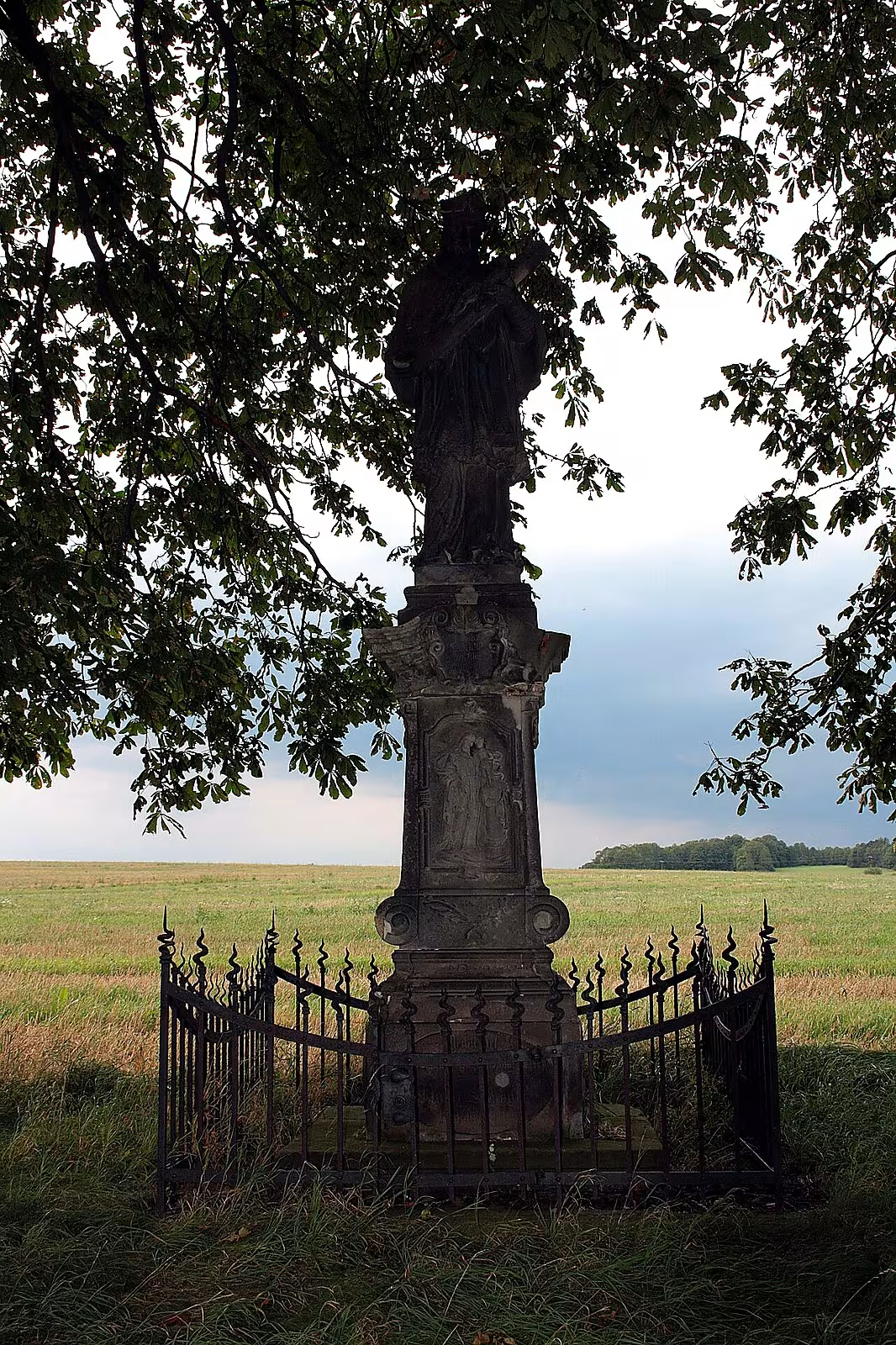
The statue of St. John Nepomucký in DětřichovA is a classic sandstone monument from 1831, which stands in a village in the north of the Czech Republic in the Frýdlantý district. The building is registered as a cultural monument and represents an example of quality art work. It forms part of the local genius loci and represents the historical stage of the development of the village.
The sculpture is installed north of the intersection where the road number I / 13 connecting Liberec and Frýdlant diverges in the western direction of communication number III / 03513. There are two grown chestnuts growing in the immediate neighbourhood of the statue. In the 1930s, Czech countries were in the period of national renewal and emerging classicism under Habsburg rule. Small sacral monuments were an important part of the landscape's identity and act of piety.
The client of the sculpture was Anton Semdner in 1831. Forty years later, in 1871, she had it repaired at her expense by Apollonie Semdnerová, while Jos. Gabler was also involved in the reconstruction. Since 6 April 1966 this sculpture has been officially registered between the cultural monuments of Czechoslovakia and the Czech Republic.
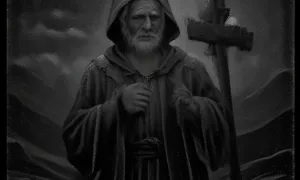
The classicist work is made of sandstone and surrounded by a metal fence with a goal that defines the area from the surrounding area. The statue is settled on a stone stage, followed by a massive plinth in the shape of a block. The fallopian part is topped with a profiled ledge, which narrows down and turns into a volute blade decorated with plastic reliefs of saints in shallow niche. The south side is carried by St. Joseph's relief with St. Joseph's and palmetami, the east side is supplemented by Saint Ludmila with St. Ludmilla's label, the west side is made by St. Wenzeslaus's relief with the text and the last relief is represented by St. Antonín of Paddov's description of St. Antonius Pad. His name is carved under each of the saints. The top part of the pedestal is a profiled head decorated from the front of the cartouche with carved biblical inscription. The statue of St. John Nepomuk is represented in contrast to the right foot. The saint wears canoe robes consisting of clerics, rochets and almutes over his shoulders. His head is covered with a halo with a halo and he holds a crucifix in his hands.
There are mirrors on the sides of a massive plinth with inscriptions and biblical quotes. On the south front is an introduction to St. John Nepomuk by Anton Semdner from 1831. The east side carries a text asking for the protection of the homeland and the power in death, the west side contains a confession about the faithful follow-up of God's words on the way of life and the north back side informs of the recovery in 1871 by the cargo of Apollo Semdner and Jos. Gablera.
Today this monument is freely accessible in Dětřichov near the border with Poland. Visiting this place offers a view of a good example of 19th-century regional sandstone sculpture, which remains a solid part of the local landscape despite the time.
Then and now
Drag the slider to compare how the landmark may have looked when it was built with the view today.
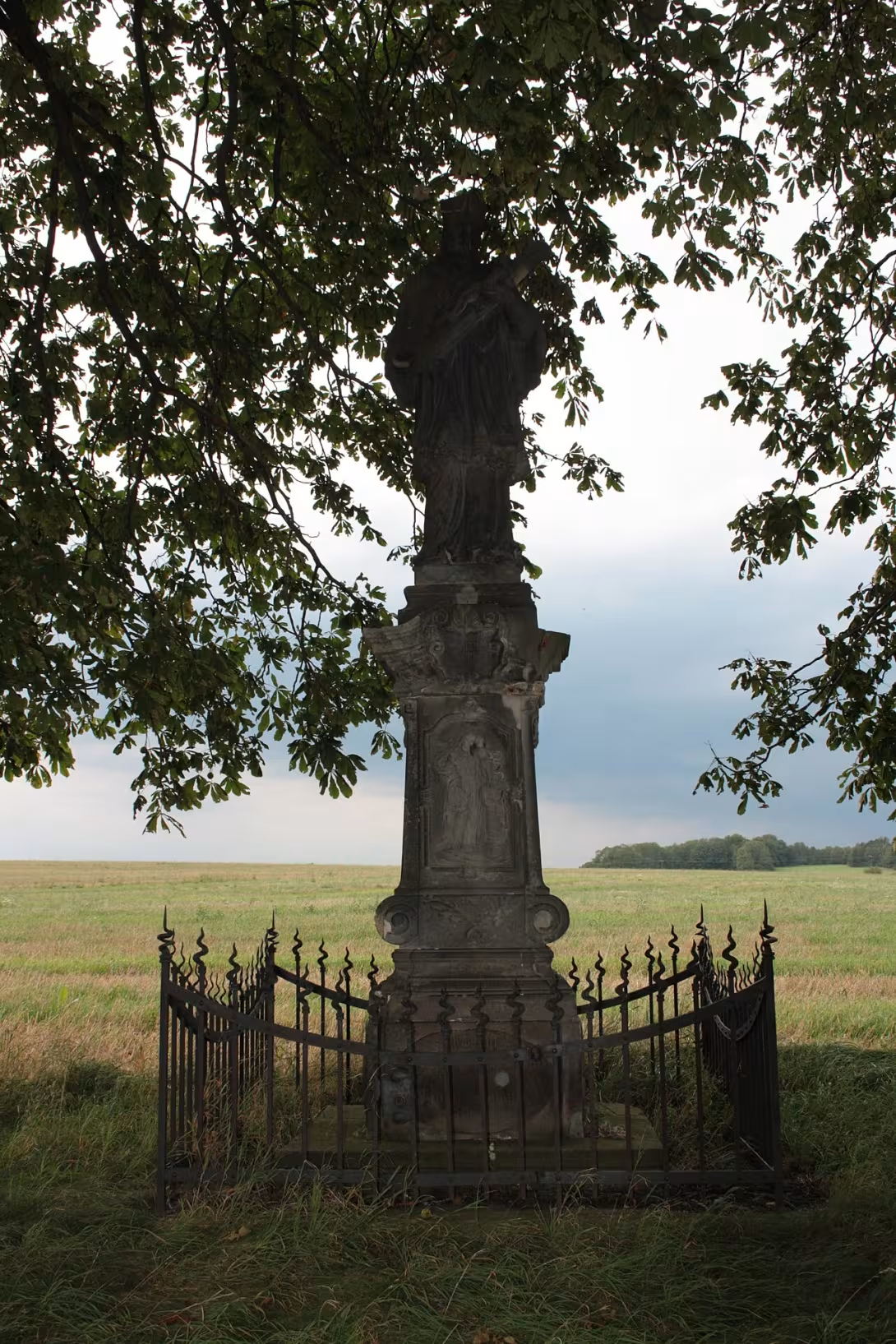
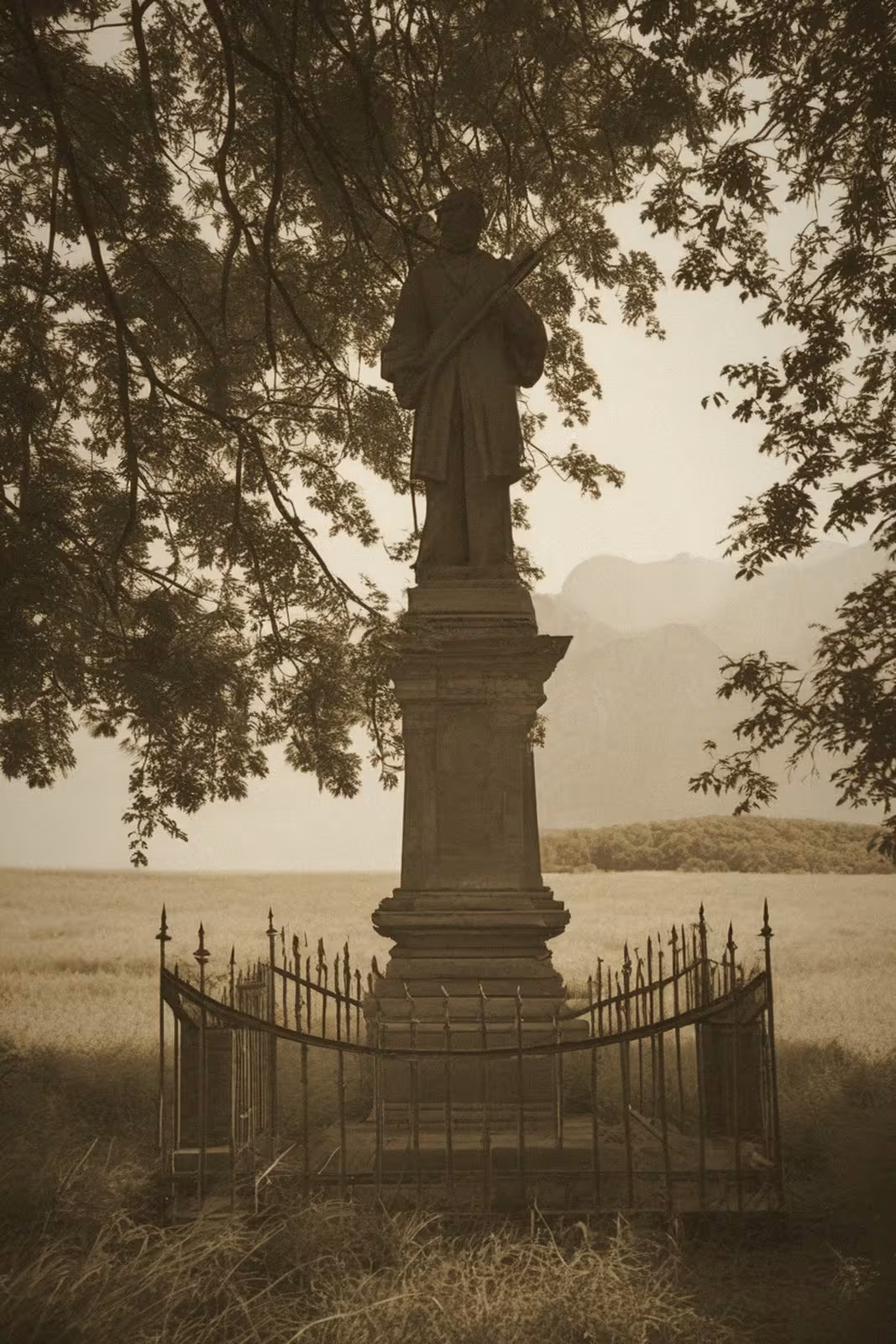
The historical appearance on the left is an AI-generated visualisation and serves as inspiration only.
Historical milestones
- 1831
- Ordering and creating a sculpture by Antons Semdner.
- 1871
- Fixing the statue at the expense of Apollonia Semdner.
- 1966
- The statue was officially included as a cultural monument.
Architectural development
The sculpture was made of sandstone in the classic style of 1831 to order Anton Semdner. The Sokl part is finished with a profiled ledge, which passes into a volute blade with shallow niche for reliefs. In 1871, the statue was repaired at the expense of Apollo Semdner. A protective metal fence was also established around the building.
Points of interest
- It is a classical sandstone monument from the year of the ranking of the year one thousand eight hundred thirty-one, which stands in the village Dětřichov in the north of the Czech Republic. - The client of this sculpture was in the year one thousand eight hundred thirty-one Anton Semdner and forty years later she had it repaired at her expense by Apollonie Semdnerová with the participation of a person named Jos. Gabler. - Since the sixth April of the year one thousand nine hundred sixty six, the sculpture has been officially recorded among cultural monuments. - The statue is surrounded by a metal fence with a goal and is situated on a stone stage, followed by a massive plinth in the shape of a block decorated with plastic reliefs of saints in shallow niche. - The statue of St. John Nepomuk represents a saint in Canovnik's clothing, with a quadrant and a halo on his head, holding a crucifix in his hands.
Guide
Show guide text
This text was created by artificial intelligence and has not been editorially reviewed. It may contain inaccuracies.
Welcome to our stop today in the picturesque village of Dětřichov, located in the very north of our republic in the area called the Frýdlant Extraction. Right now you're standing in a place where history and the peace of ancient times breathe upon you. Take off your daily worries for a moment and listen to the story of the memory you have right in front of you.
If you look ahead, you'll see a classic sandstone statue of St. John Nepomuk. The whole piece is tastefully enclosed by a low metal fence that protects this precious historical object from unwanted contact. Skulpture is built on a really massive and solid plinth that serves as a dignified base for the main figure of a saint.
Now let's take a closer look at the details that this stone work is literally littered with. When you focus your eyes on a massive plinth under the statue, notice the beautiful reliefs that decorate it from the sides. They depict other great saints. Saint Joseph, Saint Ludmila, Saint Wenceslas and St. Anthony of Padua follow us from here. Each character carries his own story and gives the place a deeper spiritual dimension. On the very top of this pedestal stands the holy saint John Nepomucký. It is depicted in a traditional canovnik's garment, it has a typical quadrant on its head and around it carries a halo shaped in stone. The crucifix is firmly gripped in his hands, a cross to which he clings his gaze. The whole work is very harmonious and radiates a special calm that surrounds this entire area in Dětřichov.
Let us now return almost 200 years back to the past to understand how this monument came about. The year is a thousand eight hundred thirty-one. There lived a man named Anton Semdner who became the principal client and initiator of this sculpture. A work was commissioned to remind a great saint and to protect the village. Whoever was exactly the creator of stone beauty at the time, it has not been preserved until today, the name of the creator remains forgotten in the fog of time, but his craftsmanship speaks for him today.
Let's move on in time a little further, to the year one thousand eight hundred seventy-one. Every old thing, and the stone separately, sometimes needs a helping hand and care to resist the tooth of time. 40 years after the creation of the statue, a woman named Apollonie Semdnerová took care of it. It is she who has ensured the necessary repair and overall maintenance of the monument at her own expense. Thanks to her generosity and respect for her ancestors, we can admire this beauty in such a preserved state today. The name Jos. Gabler appears among other persons connected to this place, whose trail was also printed in the history of the village.
Time passed and Dětřichov changed, but the statue of St. John Nepomuk remained a fixed point in the landscape. Many decades passed and the year was written a thousand nine hundred sixty-six. At this time, experts have definitively confirmed the value and beauty of this work. The statue was officially and officially included among the monuments protected by the state as an important cultural monument to our country. Since then, the authorities and monuments have taken closer supervision of this historic gem in order to protect it for all generations to come.
When you stand before this silent stone witness for centuries, you realize how many human destinies, prayers, and stories relate to this place in the north of our country. Anton Semdner almost two centuries ago wanted to leave a sign of faith and hope in the village. Apollonie Semdnerová, in turn, showed dedication by ensuring that the decaying details were corrected after years. And today it is you who have come here, stopped and devoted your time and attention to this work of art.
We hope that you enjoyed our stop today and that you enjoyed the tour of the details on the plinth and the saint himself in Canovnik's robe. When you continue your discovery of Dětřichov and its surroundings, keep your eyes open for further traces of the past that await your discovery. Thank you for listening to our guide, we wish you a beautiful rest of the day and a happy journey on your next wandering landscape. Goodbye.
Tips for visitors
For the best experience, choose a sunny day when the light hits the sandstone surface from the side. This is especially happening in the morning or before sunset. The low sun highlights the depth of reliefs on the pedestal and gives the entire sculpture a plastic look that disappears in the flat midday light.
When shooting, focus on the details of classical processing. The most interesting views are offered from the level of the eyes to capture the delicate faces of the saints on the relief. If you want to capture the statue in the context of the landscape, step back towards the north, from where its silhouette will stand out against the sky of the Frýdlant prolapse.
The path to the monument leads through the village Dětřichov. Since the object is near crossing roads, we recommend to move carefully along the side or adjacent grassy areas. The location is available on local roads; We recommend that the current connection be verified by public transport in a digital search engine.
Families with children can take a visit as a game to find hidden characters. On a massive plinth are carved other saints who can try to calculate or describe their appearance.
As part of the trip you can explore the wider surroundings of this part of northern Bohemia. The statue lies close to the border with Poland, which encourages walking on roads in the region of Frýdlantska. The whole area is interwoven with history, which is perfectly represented by this sandstone monument standing north of the main intersection.
Frequently asked questions
Can the monument be visited?
This is a structure in a public space that can usually be seen from outside free of charge. We have not verified that this particular one is freely accessible.
Where is the monument?
Location: Dětřichov. The map on this page shows the exact spot.
Why is the monument protected?
It is listed in the Central List of Cultural Monuments of the Czech Republic as a cultural monument (register no. 1000151138).
Businesses nearby
Do you run a restaurant, accommodation, shop, museum, rental, wellness or other visitor service near this monument? Show yourself directly to the people heading to it — this is how they will see you in the app and on the web:
Events nearby
Zdroj akcí: otevřená data měst a obcí ČR (Národní katalog otevřených dat) a kalendář akcí Národního památkového ústavu.
Nearby
Socha stojí severně od křižovatky silnic I/13 a III/03513 v Dětřichově v regionu Frýdlantského výběžku blízko hranic s Polskem.
Accommodation nearby
Trips and activities nearby
Guided tours, tickets and activities nearby from GetYourGuide
Affiliate link: if you buy from the partner, we may receive a commission. The price for you does not change.
Search tours and activities →Themed route
1. Statue of St. John Nepomuk - statue. This historic stone monument stands north of the intersection of the roads of the first and third order in Dětřichov. It is the main objective of our trip in this border region.
2. Road crossing in Dětřichov - transport node. It is located in the immediate vicinity of the main statue where the roads marked with one over thirteen and three over zero thirty-five thirteen are crossed. The location shall constitute the central reference point of the whole location.
3. North area of intersection - area. This area lies close to the border with Poland in the Frýdlanta region. It offers a quiet environment for a short walk around the main monument.
Seasonal recommendations
In the spring, the surrounding area of the statue of St. John Nepomuk offers a fresh atmosphere when nature awakens to life again. The soft spring light and the growing green vegetation in the village create a pleasant framework for sightseeing. For a visit, choose layered clothes and comfortable shoes suitable for an outdoor walk. The best time to stop at this stone work is in the morning, when daylight beautifully highlights the details of the carved surface and there is great peace without many passers by.
During the summer months it attracts a monument to bright sun rays and lively atmosphere of the rural environment. Long days allow for a tour even in the late hours, while evening golden light gives sandstone a warm touch. Light clothing and sun cover are recommended. It is best to go to the statue early in the morning or in the evening when you avoid the greatest heat and sharp midday light. In the main summer season, the occasional movement of passing hikers or cyclists can be expected.
The autumn season covers the surroundings of the monument in the colorful colours of fallen leaves and foggy herpes, creating an impressive, slightly melancholy mood. The low autumn sun casts long shadows and makes the contours of the holy figure visible. Exploration of the building requires a warm jacket or windbreaker and solid shoes that can withstand a damp ground. The ideal time for visiting is around noon, when the morning fog usually vanishes and the sun illuminates the whole place sufficiently. Visitors tend to be very low at this time.
In winter, the outdoor monument is given a very distinctive character, especially if snow or frost covers the surrounding countryside. The contrast of a dark stone with a white blanket highlights the silhouette of the statue and brings deep silence. Be sure to wear a warm winter coat, hat, gloves and high-quality shoes with anti-slip soles for safe movement on the frozen surface. The place is quite quiet in this period.
Visualizations and artistic views


The visualisations are generated by artificial intelligence and serve as inspiration.
Photos from the area
Real photos taken near the monument


Zdroj a licence jsou uvedeny u každého snímku.
Tips from visitors
No tips yet. Be the first!
Log in and add your tip.
Sources and literature
Photos: Jan Polák / CC BY-SA 3.0 — Wikimedia Commons. The author and licence also appear when you hover over the image.
Faktickým podkladem tohoto textu byl článek na Wikipedii, jehož autory jsou přispěvatelé Wikipedie. Článek je dostupný pod licencí CC BY-SA 4.0.
Location on the map
Příběhy a pověsti
Legendy, pověsti a příběhy spjaté s touto památkou
Fotografie návštěvníků
Zatím žádné fotografie. Buďte první, kdo přidá fotografii z návštěvy!
Log in a přidejte svou fotografii nebo hodnoťte.
Za ověřenou návštěvu v aplikaci získáte víc bodů — poznáme podle GPS, že jste na místě.
Reviews and comments