



Socha svatého Jana Nepomuckého (Mnichovice) Statue
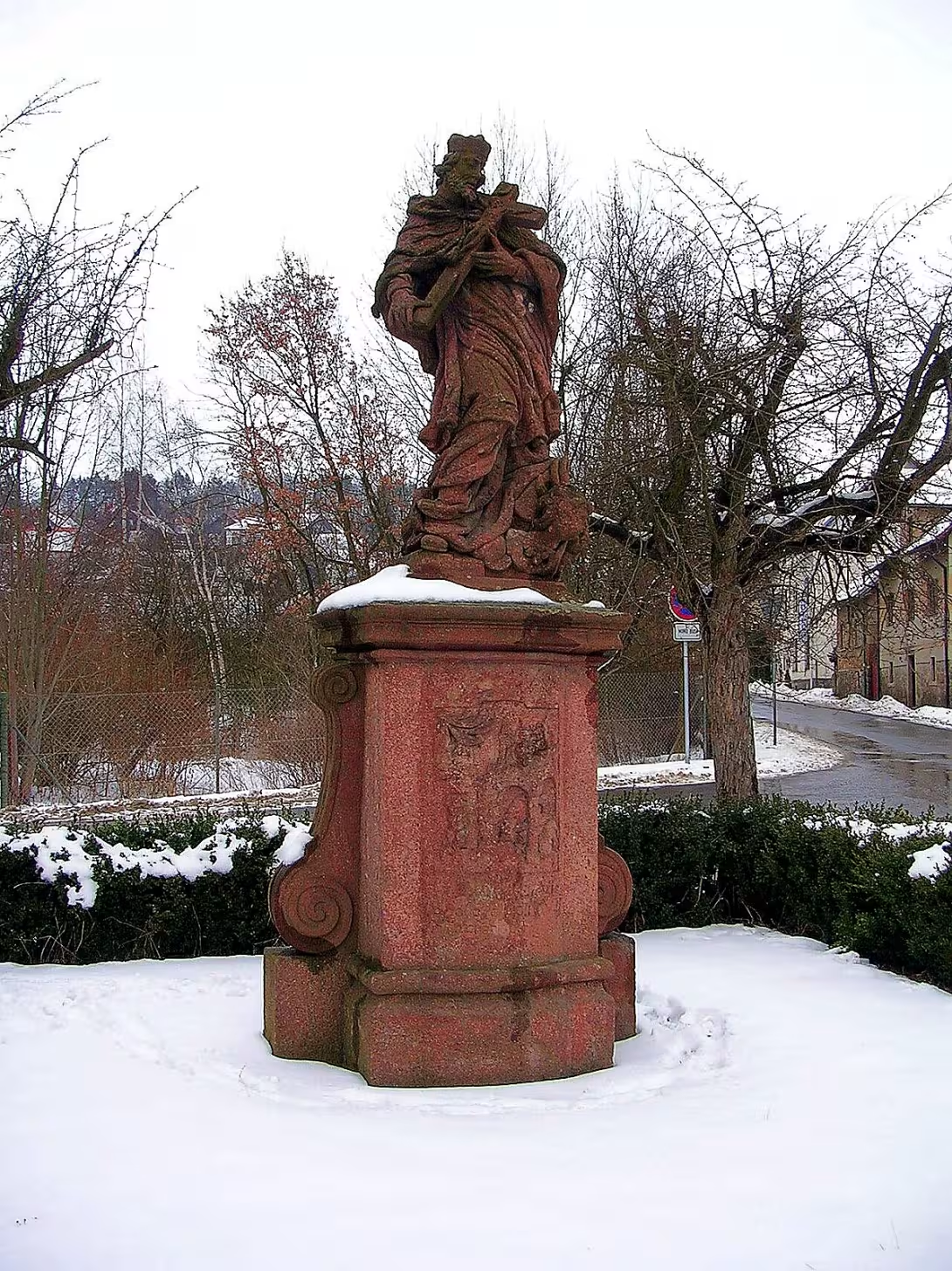
The statue of St. John Nepomuk at the Janská Square in Munich, Prague-East district, is a Baroque monument from 1737. Carved from a red-brown nutchish sandstone, it represents a typical example of the sacral sculpture of the time.
The chronogram on the pedestal dates back to 1737. This era was linked to the Catholic Reformation, which in Central and Southern Europe promoted plastic and dramatic forms in architecture and art. In Munich there was a priest Matěj Jan František Najíč who financially supported the Baroque reconstruction of the Church of the Birth of the Virgin Mary between 1713 and 1756.
The artistic processing of the statue corresponds to the baroque style. The figure of the saint is adamantly bent and clothed in a richly shaded garment. Jan Nepomucký is depicted as a cleric priest, a rochet, an almus with a biret on his head. On his left shoulder he rests the cross with the figure of Jesus Christ, which he holds with both hands, while his face is thrown to the crucified.
The base of the statue, also carved out of a nutty sandstone, has symmetrically expanding volt supports and ends with a broken ledge. Two angels' heads are placed on the floor. The front side carries a relief depicting the overthrow of Jan Nepomuk from the bridge to the river.
In 1941, the statue was moved to modify communication. By increasing the terrain, it moved from its original position, where it stood closer to the house number 126, to the current location, which led to the destruction of the four better surrounding it.
An interesting thing is the deviation from the traditional view: the statue lacks halo. By 1988, however, five gold-plated stars circled the head of the saint.
Today, the statue of St. John Nepomuk is an important part of Janský Square. The preserved relief and detailed treatment of the robe provide visitors with a specific idea of Baroque art in this location. The monument is accessible to all who are interested in history and art.
Historical milestones
- 1737
- The creation of the statue of St. John Nepomuk in Janská Square in Munich.
- 1713-1756
- Pastor Matěj Jan František Najíč supports Baroque reconstruction of the Church of the Birth of the Virgin Mary in Munich.
- 1941
- The statue of St. John Nepomuk is moved because of modifications to communication in Janská Square.
- 1988
- The loss of five gold-plated stars surrounding the head of the statue of St. John Nepomuk.
Architectural development
The statue and the pedestal are carved out of a nutty sandstone. The base is extended on the sides with volute supports and ended with a broken ledge, with two angels' heads on the floor.
Historical events
- 1737
- The downfall of Jan Nepomuk from the bridge to the river is shown in the relief on the base of the statue.
- 1941
- The statue was moved to the present place and four linden around it were defeated.
Points of interest
- The statue is carved from a red-brown nutcracker sandstone. - The base contains a relief depicting the overthrow of Jan Nepomuk from the bridge to the river. - In 1941, the statue was moved to modify communication, which led to the destruction of four better. - Since the traditional depiction, the statue deviates by missing the halo. By 1988, the head of the saint was circled by five gold-plated stars.
Guide
Show guide text
This text was created by artificial intelligence and has not been editorially reviewed. It may contain inaccuracies.
Welcome to the heart of Munich. You are standing in front of one of the most important and beautiful symbols of this city, a Baroque championship that has lasted for almost three centuries. Before you go on your walk, let yourself stop for a moment, soak up the atmosphere of this place and pay full attention to the figure looking at you from the red-brown rock. The first thing that will probably reach out to you immediately is the warm, warm shade of the material from which the statue is carved. It is not an ordinary grey stone, but a nutty sandstone whose red-brown tones give the whole character a special life and almost human touch, as if the warmth of ancient years were still melting in the stone.
Behold now the very figure of St. John Nepomuk. Notice how his body carved into the unusual, elegant and dynamic curve that baroque artists loved so much. This elongated figure does not seem motionless, but it seems that there is still some internal movement, some spiritual tension. The Holy One is depicted as a priest, which you can tell by his richly scraped robes. Pay attention to the details of the folds of the cloth. Even though it's just a hard sandstone, an artist could conjure up the softness and movement of a substance that spills over the figure of a saint. On the left shoulder, the Holy One rests on the cross, and if you approach it, you will see that there is a figure of Jesus Christ on this cross as well. This detail combines human suffering with the divine presence and gives the entire composition the depth that baroque art always carries.
To understand why this statue is standing right here, we must go back together in time deep into the past, by the year thousands seven hundred thirty-seven. This is the year that this work was created and placed in Janská Square. At that time Mnichovice experienced a period of great change and spiritual bloom. Notice the historical context around this statue at that time. In the years between 1,700 and 1,700, there was a great vicar, Matěj Jan František Najíč. He was not only a spiritual administrator but also a great supporter of baroque style throughout the city. Thanks to his willingness and support, there was also extensive reconstruction of the local Church of the Birth of the Virgin Mary. So this statue is not just a random stone object, but is a solid part of the then great project, which was to turn the city into a place full of baroque beauty and faith.
Now please, lower your eyes and pay attention to the pedestal on which the statue stands. This is where one of the most important stories tells this stone. On the pedestal you will find carved relief, that is the image coming out of the surface of the stone. This output depicts a tragic and famous moment from the life of St. John Nepomuk - his overthrow from the bridge into the river. This detail directly links the statue to the legend of his martyrdom and reminds us that even in the beauty of baroque art, pain and sacrifice may be present.
But you might wonder why this statue is standing in this particular place. It's interesting because it was originally placed closer to the house number hundred twenty-six. However, we still have to consider that the place where you are standing is not the original. In a thousand and nine hundred forty-one, there had to be major changes in the area. The statue has been moved to its present place to modify communication and change roads in Janske Square. But this change had a price, which you may not see at first sight, but which was sad for the people back then. In these communication works, four beautiful ones were destroyed better, which probably stood there. Thus, the statue also carries traces of the city's expansion and necessary sacrifices, which bring modern adjustments to the space.
If you look at the head of a saint now, you might notice something that you find unusual or something that you lack in the overall effect of the statue. This statue deviates from how St. John Nepomuksky is traditionally depicted. If you saw her in other cities, there would probably be a halo around his head made of gold stars. But there are no stars here. But this loss is not thousands of years old. In the year of the thousand and nine hundred and eighty eight, five gold-plated stars that once surrounded the head of a saint were lost. This emptiness around the head gives the statue a little melancholy and mysterious feel today, as if time has tried to hide some of its glory.
You stand before a witness to history that has endured centuries, changes in urban architecture and the loss of its precious ornaments. Yet it still stands here, carved out of red-brown sandstone, and reminds us of the era of the baroque, the era of the vicar Najíč and the era when Mnichovice turned into a modern city. Take one last moment to see how light breaks on those complex folds of clothing and how the color of sandstone changes its shade depending on how the sun is shining.
I hope that this brief view of the statue of St. John Nepomuk has brought you a little insight into the history of this place. Now you can move on quietly and continue your journey through the city, which is full of other attractions and hidden stories. I wish you a nice walk Mnichovicemi.
Tips for visitors
The best time to visit the statue of St. John Nepomuk in Munich is an early afternoon when the sun lights up the statue from the side and brings ideal conditions for photography. This time also allows you to enjoy a quiet atmosphere without a host of tourists.
It is advisable to use public transport or a passenger car to achieve the monument.
It is advisable to bring protective sunglasses when visiting to ensure comfort when viewing the statue. Photographers can take a high-quality camera and perhaps a marker or a monopod for stabilization.
The statue is placed on a public area, which means that photographs can be taken without restriction. The best places for photography are in front of the statue and from the side of the sun to capture its full depth of colors.
In the vicinity of the monument there are several interesting places for 30 minutes. Visit for example historic buildings or parks that offer beautiful walks and other possibilities for families with children.
Frequently asked questions
Can the monument be visited?
This is a structure in a public space that can usually be seen from outside free of charge. We have not verified that this particular one is freely accessible.
Where is the monument?
Location: Mnichovice. The map on this page shows the exact spot.
Why is the monument protected?
It is listed in the Central List of Cultural Monuments of the Czech Republic as a cultural monument (register no. 1000141348).
Businesses nearby
Do you run a restaurant, accommodation, shop, museum, rental, wellness or other visitor service near this monument? Show yourself directly to the people heading to it — this is how they will see you in the app and on the web:
Events nearby
Zdroj akcí: otevřená data měst a obcí ČR (Národní katalog otevřených dat) a kalendář akcí Národního památkového ústavu.
Nearby
🏰 Historic sites (121)
- Emilie Freundová 0.4 km
- Richard Nettl 0.4 km
- Hedvika Nettlová 0.4 km
- Pomník Járy Cimrmana 0.4 km
- památník obětem odboje 0.4 km
- Růžena Fuchsová 0.5 km
- Milada Fuchsová 0.5 km
- MUDr.Karel Fantl 0.5 km
- Nora Fantlová 0.5 km
- Robert Michael Fantl 0.5 km
- Marie Fantlová 0.5 km
- Mirjam Fantlová 0.5 km
- Štefánikova mohyla 0.5 km
- Marie Freundová 0.6 km
- Josef Freund 0.6 km
- Padlým hrdinům 2.6 km
- Lumír Březovský 2.8 km
- Jan Hus 3.0 km
- Josef Lada 3.1 km
- zámek Berchtold 3.3 km web
🍽️ Restaurants and dining (282)
- Kavárna 0.3 km
- U mariánského sloupu 0.3 km
- Hostinec Orca 0.4 km
- Jídelna Mnichovka 0.4 km web
- Hostinec u nádraží 0.4 km web
- Mnichovická krčma 0.5 km web
- Bufet 0.5 km
- Viet Thai Chuť 0.5 km web
- Šibeniční vrch 0.9 km web
- U Koupadla 1.1 km
- Air Bag Cafe 1.4 km
- Bistro U Hastrmana 2.4 km +420 733 565 440 web
- U Aničky 2.6 km
- Terasa 2.7 km
- U Sapíků 2.7 km +420 323 641 186 web
- U Císaře 2.7 km
- Hostinec na Klokočné 2.8 km +420 602 656 488 web
- Na Hřišti 2.9 km
- Hostinec U Huberta 2.9 km
- U Milotů 3.0 km web
🏨 Accommodation (54)
- U Studny 0.3 km
- Hotel Myšlín 1.7 km
- U Sapíků 2.7 km web
- U Míly 3.2 km
- Hotel zámek Berchtold 3.3 km +420 313 039 741 web
- Sen 4.0 km web
- Touha 5.3 km
- Hotel U Ledu 5.5 km Ringhofferova 336 web
- Legner 5.7 km
- Vodacké tábořiště 5.8 km
- Hotel Sedmikráska 5.9 km K Mýtu 47 +420604950148 web
- Kemp u BOŘKA 5.9 km
- Hotel u sv. Huberta 6.4 km +420 731 920 731 web
- Pavilon 7.1 km Bezručova 222/68 +420 323 631 073 web
- Penzion U Čerta 7.2 km web
- Penzion Centrum 7.7 km
- Mlýn Pataki 7.8 km Doubecká 32 +420323660029 web
- Pyšelka 8.1 km +420 317 705 914 web
- penzion U Vlkové 8.2 km Benešovská 174
- Hotel Zámek Štiřín 8.3 km web
🚲 Rentals and sport (36)
- Sportcentrum Zámek Berchtold 3.2 km
- Sportovní hala 5.5 km
- Bowling Vojkov 6.2 km +420323660231 web
- Cyklosport Kern 6.3 km Šípková 279 +420 323 607 816 web
- Sportoviště u lesa 6.5 km
- Uliarczyk Jiří Ing. 6.8 km +420722930716 web
- Sokolovna 6.8 km
- Střída sport 7.2 km web
- Sokolák 7.7 km
- Na Fialce 7.8 km web
- Na Fialce 7.8 km web
- Cykloservis Vyžlovka - Josef Dřízhal 8.0 km Skalská 275 +420 728 508 057 web
- CYKLOSERVIS JEVANY 8.2 km Sportovní 359 732365079 web
- TK Wilson centrum 9.6 km
- Koupaliště Kolovraty 10.1 km Nad Nádrží +420 734 692 740 web
- Sokol Kolovraty 10.5 km
- FK Dobřejovice 11.0 km
- cross arena 11.0 km
- Zeus bike 11.3 km
- SSK Kostelec nad Černými lesy 11.9 km
🥾 Hiking and nature (107)
- Park Járy Cimrmana 0.4 km
- Hřiště u tygra 0.6 km web
- Šibeniční vrch 0.8 km
- Park J. Holíka 0.9 km
- Božkovské jezírko 1.2 km
- Klokočná 2.9 km
- Vysoký les 3.3 km
- Bartošky 4.4 km
- Bílý kámen 4.4 km
- Bílý kámen 4.4 km
- Emergency hut 5.0 km
- U jezírka 5.2 km web
- Manda 5.6 km
- Pecný 5.7 km
- Bosonohá stezka 5.8 km
- Ladova ves 6.0 km
- Přírodní památka Louka u Vojkova 6.1 km
- Radimovka 6.2 km
- Břeský vrch 6.9 km
- Park P. Koreše 7.4 km
Accommodation nearby
Trips and activities nearby
Guided tours, tickets and activities nearby from GetYourGuide
Affiliate link: if you buy from the partner, we may receive a commission. The price for you does not change.
Search tours and activities →Themed route
1. Statue of St. John Nepomuk (statue) - The main destination of the trip, which represents an important religious symbol in the village. 2. The base of the statue (architectural element) - Detailed view of the base which bears the holy figure himself. 3. The immediate surroundings of the statue (space) - A place for peaceful reflection and observation of the area in Munich.
Seasonal recommendations
Spring: In the spring, the neighborhood wakes up and everything starts to green. The light is soft in this period and does not shine. It is advisable to take several layers of clothing because the morning air can still be cold. The best is to come soon after sunrise when nature is freshest.
Summer: In the summer months the surrounding area is full of thick green and the sun shines the strongest. The environment is warm and the days are very long. I recommend choosing light summer clothes and taking with you a headgear for protection from heat. The best time to visit is late afternoon when the temperature is more pleasant.
Autumn: Autumn brings shades of yellow and brown to the landscape. The morning mist around the statue creates a quiet and mysterious mood. It's good to have a waterproof jacket ready and a warmer sweater. The best place to visit is when the sun shines low and the colour of the leaves is the most distinctive.
Winter: In winter, there is calm and often cold. If snow falls, the surroundings are very clean and quiet. The days are short and the lights are low. It is necessary to wear a thick winter jacket, scarf and gloves. The most suitable visit is around noon to make the most daylight available.
Visualizations and artistic views

The visualisations are generated by artificial intelligence and serve as inspiration.
Photos from the area
Real photos taken near the monument

Zdroj a licence jsou uvedeny u každého snímku.
Tips from visitors
No tips yet. Be the first!
Log in and add your tip.
Sources and literature
Photos: cs:ŠJů / CC BY-SA 3.0 — Wikimedia Commons. The author and licence also appear when you hover over the image.
Faktickým podkladem tohoto textu byl článek na Wikipedii, jehož autory jsou přispěvatelé Wikipedie. Článek je dostupný pod licencí CC BY-SA 4.0.
Location on the map




Příběhy a pověsti
Legendy, pověsti a příběhy spjaté s touto památkou
Fotografie návštěvníků
Zatím žádné fotografie. Buďte první, kdo přidá fotografii z návštěvy!
Log in a přidejte svou fotografii nebo hodnoťte.
Za ověřenou návštěvu v aplikaci získáte víc bodů — poznáme podle GPS, že jste na místě.
Reviews and comments