






Červený Újezd Castle
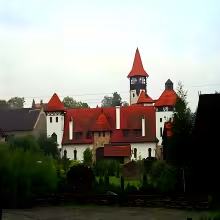
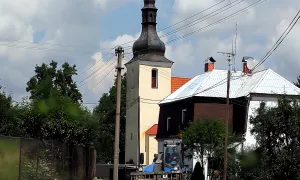
In the village Červený Újezd near At first sight, there is a building that gives the impression of an ancient fortress. In fact, it is a historic new construction completed in the years 2001-2002 - a deliberate project by investor Pavel Orna, who has decided to create an object based on traditional craft techniques and at the same time corresponding to the demands of the present day. The "castle" is therefore a new structure, not a restored historical structure.
The various styles are mixed here architecturally without the right to a faithful reconstruction of one epoch. Gothic is manifested in the form of windows and stalls, Renaissance manuscript bears painted ceilings and sgraffiti. Exhibited exhibits are mainly period originals; the replicas are used mainly in the tavern and lounges. The whole area is surrounded by a moat.
The heart of the complex is a private Museum of Czech Rural Affairs. Around 2008, the operator advertised over 4,000 items documenting everyday rural life from the 17th to the beginning of the 20th century. The collection comes from the Czech Republic and Slovakia and the owner collected it for over 40 years. Part of the exhibits are for sale.
The castle garden plays a botanical garden with over a thousand plant species, many of which are marked with information tables. The range of domestic animals and the scandal of small village buildings include: windmill, bell tower, spyster, wine cellar, salash, hay, smoker, lover and wood pit. Admission to the castle and garden is paid separately.
The regular offer includes a theatre company showing contemporary dances and scenes. The freely accessible restaurant Krčma is trying to create a late medieval atmosphere with its proprietas and thematic music and offers old Czech dishes. Accommodation is possible in apartments furnished in various historical styles - Gothic, classical and Baroque. For private and corporate events you can rent Knights Hall, Armory, Baroque lounge, Mill lounge or Czech barn. It is commercial traffic that means that the premises can sometimes be closed to the public for private events such as weddings or company festivals.
This modern building has nothing to do with the original castle and the economic court, which existed historically in the Red Strait. In the 16th century, the manor was managed by the descendants of Jan Žďárský from Žďár. In 1580 Gotthard Florian was joined under the Reddish administration by Novice and Tachlovice, after 1582 they separated the Redneck estate for a while from Kladenský. The stormy year 1611, when Pasov mercenaries went with the consent of Rudolf II to Prague, touched the Red Escape directly - the village was set free. One year later, after the coronation of Rudolph's brother Matyas by the Roman-German Emperor, the new ruler showed the family the honour of a personal visit: he visited Cvíbor Tiburc Žďárský and his minor ward Florián Jetřich, the then owner of the estate.
Červený Újezd thus offers two distinct planes: a fascinating modern experiment with historical architecture and folk museums on the one hand and fragments of the true historical fates of the noble family on the other. It is an unusual stop for a visitor seeking a varied family cruise destination within the reach of Prague - unless it is discouraged by the possibility of closure of the premises during a private event.
Then and now
Drag the slider to compare how the landmark may have looked when it was built with the view today.
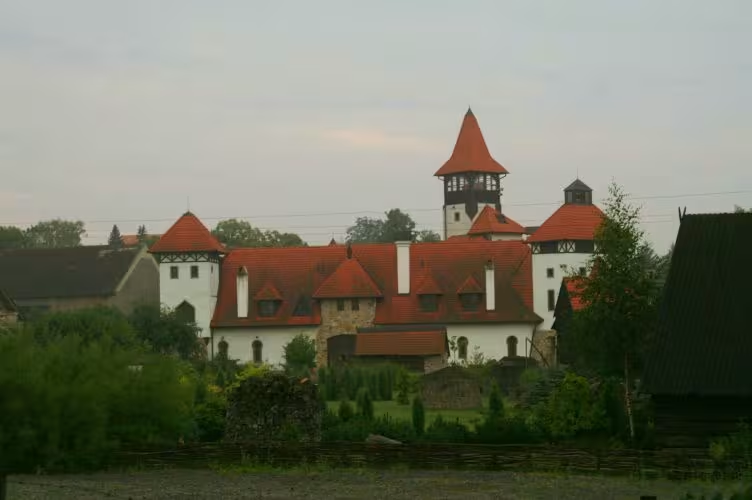
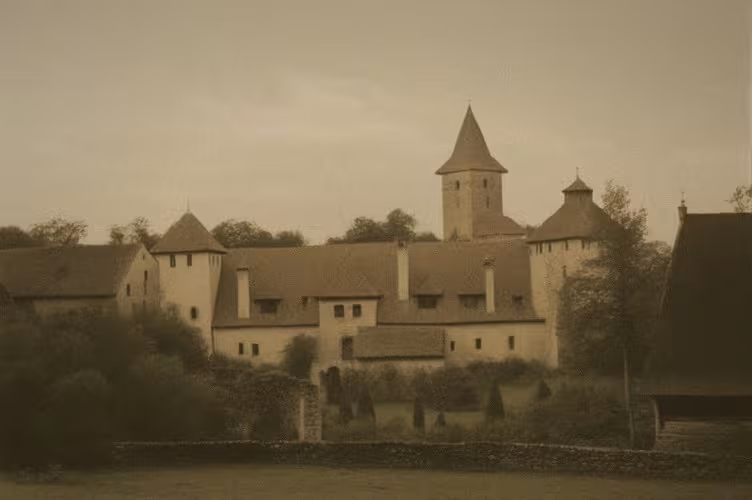
The historical appearance on the left is an AI-generated visualisation and serves as inspiration only.
Historical milestones
- 1611
- leaving the original castle of pasov mercenaries
- 1612
- visit of emperor Matyas in Red Ticket
- 2001
- start construction of the current historical complex
- 2002
- completion of construction
Architectural development
The current object is a new building in the style of knighthood. It uses elements of goth, such as windows and stoves, and Renaissance, such as sgraffiti and painted ceilings. The whole complex is surrounded by a moat.
Historical events
In 1611, the original castle was launched by Pasov mercenaries. In 1612 Emperor Matyas visited the estate. The current new construction was built in 2001- 2002.
Owners
Pavel Orna (since 2001)
Points of interest
- The construction looks like an ancient fortress, but it's actually a new building completed in 2001- 2002. - The architecture combines gothic windows and mats with Renaissance painted ceilings and sgraffiti. - The area is surrounded by a moat and a garden with over a thousand plant species. - The private Museum of Czech Rural Affairs contains over 4,000 items from the Czech Republic and Slovakia. - There is a scandal of small village buildings, such as windmill, bell tower and wine cellar.
Guide
This guide is narrated by a synthetic voice generated by artificial intelligence.
Show guide text
This text was created by artificial intelligence and has not been editorially reviewed. It may contain inaccuracies.
Welcome to the Red Edge, the heart of the Central Bohemia Region. Stop for a moment and just look around you. You are standing in front of an area that will immediately transfer you to another time. In front of you is a building that looks like a medieval knighthood associated with a noble estate. Feel the atmosphere of peace and nobility that this space radiates. You may feel that you are right now in front of a monument that has stood here for hundreds of years and in its walls breathes the history of ancient times. It is a very strong first impression, which causes astonishment and curiosity in visitors.
But let us now discover the secret behind these walls. Although everything around you looks ancient, the truth is much more modern. What you see is not the original historical castle that once stood in the village, but a fascinating historical new building. This whole complex was built in the years two thousand and one to two thousand and two. It was an ambitious project that was created as a private investment. His creator was Pavel Orna, who had a clear vision. He wanted to create a place where two worlds would meet. On the one hand, we will find respect for traditions and efforts to preserve traditional craft practices, and on the other hand modern demands on the comfort and functionality of the current space. The result is this unique area, which today serves as a museum and a scandal, namely the Museum of the Czech Rural.
Now that you know what type of construction it is, let's focus our attention on the details surrounding you. Look carefully at the facade and architecture of the buildings. Notice how masterfully the elements of different epoch have been combined here. Your attention should now rest on gothic windows that give the building a strict and castle character. If you look at the way in which the individual parts of the building are connected, you will see the stoves, which are open pavements that are typical of older architecture and allow easy movement between the rooms.
If you proceed further, I suggest you pay attention to the surfaces of the walls. Notice the sgraffiti, that is, the decorative striped ornaments that decorate the walls. They are elements typical of the Renaissance, which supply the whole complex with lightness and elegance. And if you get a look at the interiors, don't forget to raise your head. There are Renaissance painted ceilings waiting for you, which are the real jewel of the entire complex. This whole space is surrounded by a moat that not only complements the appearance of the fortress, but also separates this calm world from the surrounding vibrations.
However, in order to fully understand the spirit of this place, we must return to the real history of the village Červený Újezd, which is much older than the current construction. Even if there's a new building in front of you, it's encrypted with the memory of this place. History here was often dramatic. Imagine the year one thousand six hundred eleven. At that time the original castle in the village was taken out by Pasov mercenaries. It was a period of unrest and destruction when the wealth and beauty of local settlements fell behind them in bloody conflicts.
Only a year later, however, the situation changed and the municipality experienced a moment of great recognition. In the year of a thousand and six hundred twelve visits to the Red Ticket, Emperor Matyáš Habsburk himself honored this place. Imagine the atmosphere at that time, the festive crossing of carriages and the excitement of the locals from the presence of the supreme ruler. These shadows of the past, personalities like Matyáš Habsburk or Jan Žďárský, form an invisible layer on which today's museum builds. The present site thus serves as a bridge between these tragic and famous events of the past and today.
Now I want to impress you with one interesting thing that makes this place a real one. In addition to the architecture itself, which is essentially a great work of art imitating history, the complex is surrounded by an extensive botanical garden. It's a place where nature and the human hand work together in perfect harmony. More than a thousand different kinds of plants grow in this garden. It's a fascinating collection that complements the museum experience. Imagine the contrast where from the stone corridors and the knight's atmosphere of the fortress you enter a vibrant, green world full of colors and smells. It's a space for meditation and admiration for the diversity of nature.
The mystery and fascination of this place remains the very line between truth and illusion. When you look at the building, your eyes tell you you're in the 16th or 17th century. But your knowledge tells you that the construction was completed in the year two thousand and two. It is in this tension that lies the spell of the Red Escape. It is a demonstration that human desire for beauty and tradition is so strong that it can rebuild a world that we have long lost in modern times.
Now that you know the story of the origin of this place, its architectural details and its historical context, it's time for you to explore everything on your own. I suggest you let your curiosity guide you. Go through the stalls, get charmed by the paintings on the ceiling and enjoy a moment of peace in the botanical garden between thousands of plants. Visit the Czech Rural Museum and discover how people have lived in the past and what craft skills in these walls try to keep alive.
I wish you a pleasant and inspiring tour. Let yourself be consumed by the atmosphere of this modern fortress and enjoy your time in the Red Strain. When you finish your journey, try to look again and think about how closely the past and the present are connected here. I hereby bid you farewell and welcome to the labyrinth of history and beauty. Enjoy your stay.
Frequently asked questions
Is Červený Újezd open to the public?
Yes, Červený Újezd is open to the public. It is open all year round, but the best time to visit is from April to October when the conditions for hiking are most favourable.
How do I get to the place by car / public transport?
You can get by car or bus. The nearest stop is in a nearby town, from where you will then continue walking along the marked path.
How much is the entrance fee and is it paid on the spot?
Payment is made at the cash register in a nearby information centre.
Is the tour suitable for children and seniors?
Yes, the tour is also suitable for families with children. It is advisable for seniors to choose a more comfortable route and use the service guide.
How long does the tour take?
The tour takes approximately 1-2 hours, depending on your speed and interest in the history of the castle.
What are the opening times and booking is required?
Opening hours are 9: 00 to 5: 00. Reservation is not mandatory, but is recommended for larger groups or during summer holidays.
What's interesting in the immediate vicinity?
In the immediate surroundings you will find forests and hills that are suitable for hiking. There are other historical monuments nearby, such as Křivoklát Castle.
For kids
Imagine going back to the past in the Middle Ages. Instead of buses and cars, there were carriages drawn by horses or lifts drawn on their feet. People wore long coats and hats to protect their heads from the wind.
One of the places you could live was Castle Červený Újezd. It was a massive 14th century castle that stood on a hill above the village. He had tall walls and towers that seemed immortal.
But what happened to this magnificent castle? Why is today a ruin? This is the story of how time and nature changed this place.
Businesses nearby
Do you run a restaurant, accommodation, shop, museum, rental, wellness or other visitor service near this monument? Show yourself directly to the people heading to it — this is how they will see you in the app and on the web:
Events nearby


Zdroj akcí: otevřená data měst a obcí ČR (Národní katalog otevřených dat) a kalendář akcí Národního památkového ústavu.
Nearby
The town of Unhost is nearby.
Accommodation nearby
Trips and activities nearby
Guided tours, tickets and activities nearby from GetYourGuide
Affiliate link: if you buy from the partner, we may receive a commission. The price for you does not change.
Search tours and activities →Themed route
1. Unhost , city, ideal place to start the trip. 2. Červený Újezd, museum, main destination of the trip offering knowledge of history. 3. Červený Újezd, exposition, tour of inner spaces and historical collections. 4. Červený Újezd, courtyard, final walk in the immediate area of the monument.
Seasonal recommendations
Spring visit brings with it awakening nature and fine, light lighting, which beautifully highlights the surrounding landscape. The atmosphere is optimistic and calm, which makes the perception of history easier. We recommend wearing layered clothes because spring weather can be unpredictable. It is ideal to arrive in the morning when the air is the cleanest and the traffic is not yet so high.
In the summer months the monument is healed in full summer bloom and the sun creates bright, sharp shadows. It's the period of the greatest activity where the largest crowds of people move around. To avoid the greatest heat and crowds, plan to visit immediately after opening. Remember light summer clothes and plenty of fluids for a pleasant experience.
The autumn season attracts golden shades of leaves and foggy morning views that give the place melancholy beauty. Lighting is soft at this time and very suitable for photography. For a comfortable walk around the building choose practical shoes and warmer layers of clothing. The best time to visit is the lunch period, when the sun still illuminates historical details sufficiently.
Zimą history in the Red Escape becomes cosy and quieter, especially when the surroundings are covered by snow or frost. The atmosphere is quiet and focused, which is ideal for viewing the museum's internal exhibits. Due to shorter times and lower temperatures, prepare for very warm clothes. During this period there is the least visitors, which guarantees maximum peace while studying the monument.
Visualizations and artistic views


The visualisations are generated by artificial intelligence and serve as inspiration.
Photos from the area
Real photos taken near the monument


Zdroj a licence jsou uvedeny u každého snímku.
Atmosphere of the place
This atmospheric visualisation of the place and period was generated by artificial intelligence. It is not real footage of the location.
Tips from visitors
No tips yet. Be the first!
Log in and add your tip.
Sources and literature
Fotografie: Kriplozoik / CC BY-SA 3.0, rozlišení zvýšeno umělou inteligencí — Wikimedia Commons. The author and licence also appear when you hover over the image.
Faktickým podkladem tohoto textu byl článek na Wikipedii, jehož autory jsou přispěvatelé Wikipedie. Článek je dostupný pod licencí CC BY-SA 4.0.
Location on the map

Příběhy a pověsti
Legendy, pověsti a příběhy spjaté s touto památkou
Fotografie návštěvníků
Zatím žádné fotografie. Buďte první, kdo přidá fotografii z návštěvy!
Přihlaste se a přidejte svou fotografii nebo hodnoťte.
Za ověřenou návštěvu v aplikaci získáte víc bodů — poznáme podle GPS, že jste na místě.
Reviews and comments