






Kostel Zvěstování Panny Marie (Plaňany) Church
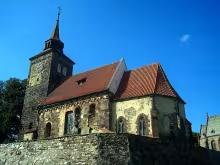
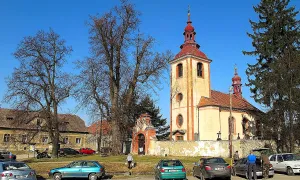
In the village Plaňany in the district of Kolín stands a stealth, yet an exceptional church. The Church of the Annunciation of the Virgin Mary - dedicated to St. Peter by 1620 - is a Roman Catholic philistine church of the Parish of Peèka and a Romanesque building from the third quarter of the 12th century. In its existence, it bears witness to the ancient and relatively significant settlement of this place.
The history of the site is even older than the church's appearance today. Archaeological research from 1937 showed that a sacral building from the period from the 10th to 11th century stood at the same place - the remains of a circular building, namely a rotunda, were found under the floor of the present church. The church was built in its place as a fortified church (castellatum): from the south it was protected by a pond, from the remaining three world sides probably a protective wall. The year of its creation is evidenced by the year carved into one of the blocks of the southern wall of the ship - "1168- 1892" - with the first number indicating the time of establishment, the second year of overhaul.
In the last quarter of the 14th century, the church was extended to the highest Gothic presbytery with a rib arch. The foundations of the original priesthood were uncovered in 1938 two metres below the floor; The Gothic victory arch in the eastern wall of the ship was probably broken. In 1716 came a disaster in the form of lightning - after the fire it was necessary to reduce the tower by the last, it is assumed that a completely wooden floor.
In the third quarter of the 18th century, the Baroque reconstruction was carried out on the instruction of Marie Tereza of Savoy. Originally a flat-ceiling ship received a baroque general vault with window lunettes, the interior was decorated and a musical ring was formed on the site of the Romanesque bleachers. During the reconstruction of 1792-1805, the original narrow, high-laid Romanesque windows were blinded and new windows were broken, without a clear meaning. That's when the original Romanesque southern portal was destroyed - only fragments left in the southern wall of the ship. In 1892, the western entrance was set up with a simple sandstone rectangular lining and the windows of the priesthood were gotivated with sandstone and circles. Six years earlier, in 1886, there was a puristic adjustment that tried to restore the original Romanesque look - historians are considered inconsiderate.
The exterior of the church captures the first time. The single-boat construction of small dimensions - the ship measures 13.5 metres in length and 7.6 metres in width - ends in front of the west facade with a massive square tower 38.5 metres high with a length of 6,4 metres and a wall strong on the ground floor. The tower survived for centuries, untilled by its own foundations, separated from the base of the ship by a mere two-centimeter spasm. Special attention deserves to be paid to the masonry: the walls of the ship and the tower are made up of regularly carved sandstone blocks laid in horizontal layers of uneven width, with the builder alternating red rock sandstone with a yellow nutty. The result is an extraordinary colour effect which is expected to be inspired by North Italian architecture.
After the construction of the larger church of the Born of St. John the Baptist in 1910-1913, the old church served as a cemetery and gradually disintegrated. In 2014, 600 000 CZK was released to repair the architectural heritage program. Since 2018, further work has been carried out - the church has received new roofs and interior modifications are being planned.
For an inquisitive tourist, Plaňany is a stop where a thousand years of construction history intersects in one place: rotunda covered by a Romanesque ship, Gothic vaults, baroque reconstruction and traces of purist intervention. The alternately coloured wall itself is worth a stop.
Then and now
Drag the slider to compare how the landmark may have looked when it was built with the view today.
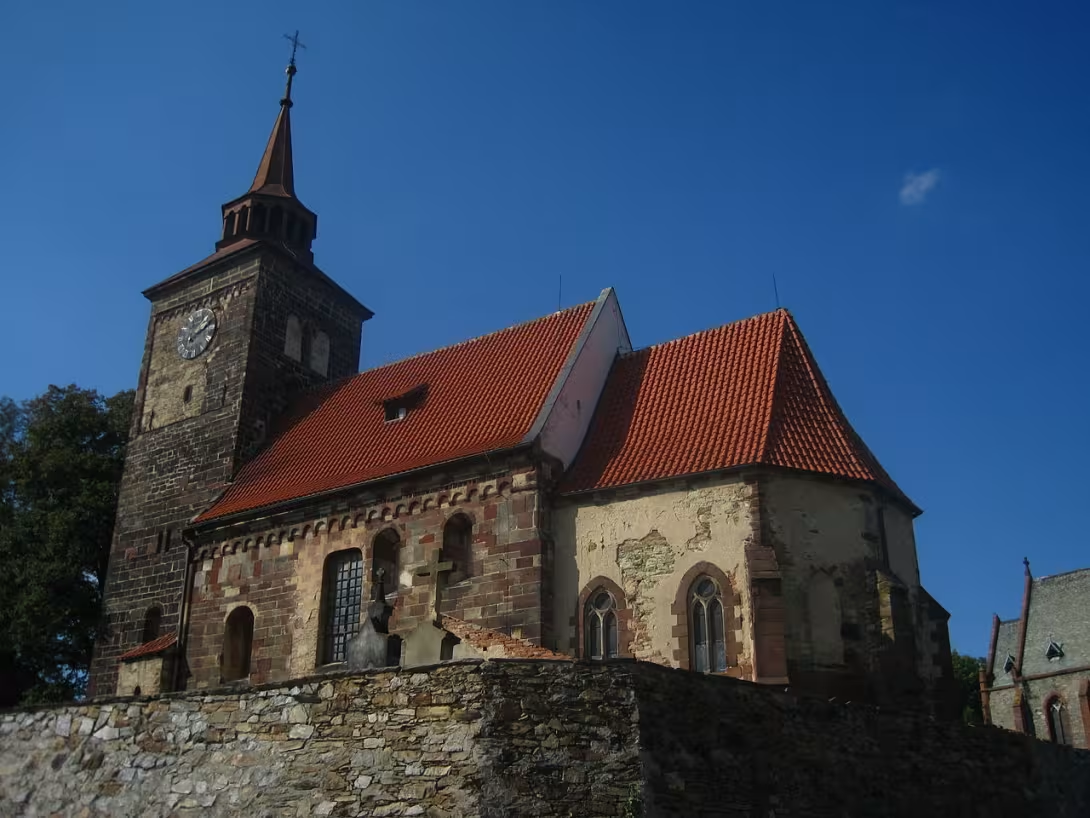

The historical appearance on the left is an AI-generated visualisation and serves as inspiration only.
Historical milestones
- 10.-11th century
- Archaeological research confirmed the existence of rotunda at the site of the present church.
- 1168
- The foundation of the Romanesque ship of the church, evidenced by the year on the block.
- 1300-1399
- Adding a top gothic presbytery with a rib arch.
- 1716
- Decreasing the tower from the lightning fire.
- 1892
- General repair of the church, including adjustment of window lining and west entrance.
- 2014
Architectural development
The church was built as a fortified Romanesque building (a castelatum) with a protective pond and walls. In the 14th century it was extended by a Gothic presbytery. In the 18th century, it underwent baroque reconstruction, including the enclosing of the ship, the vaulted vault and the construction of the musical circle. In the 19th century, original Romanesque windows and portals were blinded, and a new western entrance was added. The tower was reduced after the fire in 1716. Current repairs include a new roof and interior modifications.
Historical events
- 10.-11th century
- There was a rotunda on the site of the present church, as evidenced by archaeological findings from 1937.
- 1168
- The foundation of the current Romanesque ship of the church, evidenced by year on the block of the south wall.
- 14th Century
- Adding a top gothic presbytery with a rib arch.
- 1886
- Inconsiderate puristic adjustment in order to restore the original Romanesque look.
Points of interest
- The Church of the Annunciation of the Virgin Mary was originally dedicated to St. Peter until 1620.
- The present church was located in the 10th-11th century rotunda whose remains were found under the floor in 1937.
- The church was built as a fortified church (castellatum), protected by a pond and probably a protective wall.
- The 1168 on the south wall of the ship marks the year of the church.
- The church tower stands on separate foundations separated from the base of the ship by a two-centimeter claw.
Guide
This guide is narrated by a synthetic voice generated by artificial intelligence.
Show guide text
This text was created by artificial intelligence and has not been editorially reviewed. It may contain inaccuracies.
Welcome to the Church of the Annunciation of the Virgin Mary in the Planans. You stand before one of the oldest preserved monuments of the Middle Bohemian Early Middle Ages, a church that carried history for almost a thousand years. In front of you, there is a simple but massive structure, whose walls tell us of a time when people who have not yet known Gothic arches or baroque decorating have prayed. Notice how its shapes have changed with every time - from Roman simplicity to later modifications that gave him a new feel.
Let's go back to the past. The church, as we see it today, was built in the second half of the 12th century, when a Romanesque ship was built here - the oldest part that survived until today. This year's 1168, engraved on one of the blocks, reminds us that this place was once an important center of faith. But before that, in the 10th or 11th century, there was a rotunda - a small circular church whose remains were discovered only in 1937 under the current floor. This proves that Plaňany was inhabited and spiritually important even when Czech countries were still forming.
Now look at the facade of the church. You see a simple facade before you, reflecting its original Romanesque character - roughly trimmed blocks, narrow windows and sober shape. Later, in the 14th century, a presbytery was added to this ship - already in Gothic style, with a rib arch, which was a progressive technique at the time. These changes to the church gave depth and a new spiritual dimension. Note also that the tower that originally stood here was reduced after the fire in 1716 - probably because of safety, but also to adapt the church to new period ideas.
Now pay attention to details that may surprise you. The church was originally dedicated to St. Peter, and only later, in 1620, it received today's name - The Annunciation of the Virgin Mary. This reminds us of how the religious traditions here have transformed with time. Another interesting thing is that this church was not only built as a place of worship, but also as a fortified building - protected by a pond and probably other defensive elements. This suggests that in the past he had to be an important point not only spiritual but also strategic.
Now imagine one of the greatest mysteries of this place. Under your feet lies not only Romanesque walls, but also traces of older rotunda. If you look at the floor, you might realize that every stone here has a history. The church underwent many modifications - from baroque changes in the 18th century to inconsiderate repairs in the 19th century, which were to restore the construction of its original face. And yet he managed to preserve his authenticity as if he were whispering to us the stories of those who once came here to pray.
Take another look before leaving. This church is not only a monument to architecture, but also a place where time, faith and human destinies clash. If you have a moment, stay a little longer and feel the atmosphere - how the calm of the medieval sacral structure is combined with the times that followed. Whether you decide to continue around Plaňan or go back home, remember this church as a witness to many generations, which still stands firmly in its place today.
Thank you for examining the history of the Church of the Annunciation of the Virgin Mary. May his peace and memory accompany you to those who once came here, as you did today.
Tips for visitors
{'paragraph': 'Best time to visit the Church of the Annunciation of the Virgin Mary is early in the morning or at the end of the afternoon. In these hours there is a quiet environment that allows you to fully enjoy the atmosphere of this historic place. In addition, in these times there is also a pleasant light which can highlight detailed carving work and Romanesque elements of the church.'}
{'paragraph': 'Parking around the church can be found in public parking lots in the center of Plaňan. The location is also available by car and public transport. It is recommended to check the current connection in the search engine or on the website of the transport company. Admission is paid on site, the current price list can be found on the official site of the sights.'}
{'paragraph': 'When visiting take on comfortable clothes and shoes because the church is located in the historical part of the village and the journey can be uneven. You will also bring a map or navigation so that you can easily navigate around. If you are interested in photography, remember to take a camera or mobile phone with a high-quality lens.'}
{'paragraph': 'The best places for photography are the inner space of the church, especially windows with Romanesque vaults and altar decorations. Outside it is ideal to capture the surrounding landscape and the church entrance portal in the morning or afternoon light. Entry to the church is permitted, but it is necessary to keep calm and respect other visitors.'}
{'paragraph': The Church of the Birth of St. John the Baptist, located just 200 metres from the main church, is also worth visiting around the Church of the Annunciation of the Virgin Mary. This newer church from 1910-1913 offers an interesting contrast with the early medieval architecture of the Church Annunciation. It is also advisable for families with children to visit the local cemetery, where the tombs of important families from Plaňan are located. '}
{'paragraph': It is advisable for families with children to use a visit to the church as an opportunity to learn about history and architecture. Children can look at small windows that are typical of Romanesque architecture and find out what the church construction looked like over 800 years ago. In the vicinity of the church it is also possible to find small paths that children can perform while looking at the surrounding nature. '}
Frequently asked questions
Is Kostel Zvěstování Panny Marie (Plaňany) open to the public?
Yes, the church is open to the public all year round. The opening hours are 9: 00 to 5: 00.
How do I get to the place by car / public transport?
The church is located in the heart of Plaňan and is well accessible by bus or train from nearby cities. Parking is possible in the parking lot near the church or nearby.
How much is the entrance fee and is it paid on the spot?
Entry to church is free, but it is possible to donate funds for its maintenance.
Is the tour suitable for children and seniors?
Yes, it is advisable to visit the church with children or seniors. The tour can be adapted to the individual needs of visitors.
How long does the tour take?
The church tour takes approximately 30-60 minutes, depending on the interest and speed of visitors.
What are the opening times and booking is required?
The church is open to the public all year round from 9: 00 to 17: 00. Reservation is not required, but in case of larger groups or special events it is recommended to contact the local administrator.
What's interesting in the immediate vicinity?
The local museum, which represents the history and culture of the region, is worth visiting nearby. It is also possible to visit the nearby river Jizera and its surroundings.
For kids
Imagine going back to the past in the Middle Ages. You were a little knight or a girl from the village of Plaňany, and you're about to visit a local church. How did it look here? There was a big wooden structure with a bright bell tower that lit up like a star at night.
The church stood in the place of the older Romanesque church, which was built before Plaňany became a village. At that time, farmers and shepherds lived here, who managed fields and kept animals. What happened? Religious services were taking place and people came here to pray and holy events.
Businesses nearby
Do you run a restaurant, accommodation, shop, museum, rental, wellness or other visitor service near this monument? Show yourself directly to the people heading to it — this is how they will see you in the app and on the web:
Nearby
{'memories': [{\ 'name': 'Church of the Birth of St. John the Baptist (Plaňany)', 'type': 'church', 'distance': 'in the village, about 200 m from the Church of the Annunciation', 'description': 'newer church of 1910-1913, originally serving as the main parish church', while the church of the Annunciation was used as a cemetery church. '}, {' name ':' Parish church of St. Peter and Paul (Pečky) ',' type ':' church ',' distance ':' around 5 km ',' description ':' Parish church to which church in the Plananes belongs to it as a filial church. '],' natural _ elements':
Accommodation nearby
Trips and activities nearby
Guided tours, tickets and activities nearby from GetYourGuide
Affiliate link: if you buy from the partner, we may receive a commission. The price for you does not change.
Search tours and activities →Themed route
Thematic cruise route: Baroque Plaňany and their church treasures
1.Kostel Zvěstování Panny Marie (Plaňany) * Baroque gem from the 18th century * - The visit begins with the main goal: a picturesque church with richly decorated interior and historical tombstones. Its location in the middle of the village and quiet atmosphere offers an ideal introduction to the trip.
2. Church of the Birth of St. John the Baptist (Plaňany) * Modern parish church in the historical heart * - Just 200 metres from the previous church stands his younger "brother," built at the turn of the 19th and 20th centuries. The comparison of both structures will show the diversity of local architecture.
3. Parish Church of St. Peter and Paul (Baths) * Church pearls in the neighbouring village * - Cca 5 km from Plaňan are located another significant sacral building with rich history. Its Gothic-Renaissance elements and location in the middle of a picturesque environment are worth visiting.
The route connects three churches that reflect different periods and stylish periods of local architecture. Ideal for lovers of history and architecture.
Seasonal recommendations
Spring Spring in Planany offers the church Annunciation of the Virgin Mary a fine, bright light that penetrates glass windows and illuminates the interior with a golden reflection. The surroundings of the monuments awaken to life: the meadows flourish with white and blue flowers, the forests become green and the air smells of wet ground. The atmosphere is calm, almost meditative, as time passes by. In this period, the church is surrounded by flowering trees that shade the pavement and create pleasant shaded shelters. It is ideal to visit a monument on a sunny day, when light attracts to walk around the surrounding roads. However, I recommend avoiding Saturdays and not sharing when local families often come here. It is convenient to dress light but covering clothing - the morning can be cold while the afternoon overheating the sun. The best time is early morning, when the church is still calm and nature is full of life.
Summer Summer brings hot, sunny days to Plaňan, when the Church of the Annunciation of the Virgin Mary shines in the sun as a pearl in the green sea fields. The surrounding area is lit by bright, almost yellow light, which highlights the details of stone elements and creates contrast with dark shadows under the trees. The atmosphere is lively, but also hospitable - in the main summer months visitors from the surrounding area come here to enjoy not only the memory but also the surrounding nature. Due to the high temperatures, it is advisable to visit the church early in the morning or in late in the afternoon when there are fewer crowds and heat receding. Dress light, airy clothes, but don't forget your hat or sunglasses - the sun here can be very intense. In the summer months it is also good to bring plenty of water, as there are not always drinking water sources in the vicinity of the monument.
Autumn Autumn in the Planans brings to the church the Annunciation of Our Lady a fine, soft light that penetrates glass windows and creates playful shadows on the stone walls. The surrounding area is turned into a palette of yellow, orange and red shades, forests become a theatre of change and air smells of fallen leaves. The atmosphere is calm, almost mysterious, as if time has slowed down here. In this period the church is surrounded by trees that are beginning to sprout, and their shadows are projected on the pavement of the pavement. It is ideal to visit a monument on a sunny day, when light attracts walks along the surrounding roads, but also in rainy weather, when the church grows on mysticism. I recommend avoiding weekends when local families often come here. It is convenient to wear warmer clothes - the morning may be cold, while the afternoon temperatures are slightly increasing. The best time is the afternoon when the church is lit with mild light and nature full of colors.
Winter Winter in the Planans brings peace and quiet charm to the Church of the Annunciation of the Virgin Mary, when light penetrating glass windows creates fine shadows on the stone walls. The surrounding area is covered with a white snow coating, which resembles a quiet noise that time is slowly passing by. The atmosphere is calm, almost meditative, as if time had stopped here. In this period the church is surrounded by trees that are covered with white snow coating, and their shadows are projected on the pavement pavement. It is ideal to visit a monument on a sunny day, when light attracts walks along the surrounding roads, but also in rainy weather, when the church grows on mysticism. I recommend avoiding weekends when local families often come here. Suitable is to dress warm, covering clothes - temperatures can be low and the wind can be cold. The best time is the afternoon, when the church is lit with mild light and nature full of peace. In advent time, the church is often lit with candlesticks, which adds to the spell.
Visualizations and artistic views


The visualisations are generated by artificial intelligence and serve as inspiration.
Photos from the area
Real photos taken near the monument


Zdroj a licence jsou uvedeny u každého snímku.
View from the area
This animation was generated by artificial intelligence from a real photograph of the surroundings. The motion and details are not real footage of the location.
Atmosphere of the place
This atmospheric visualisation of the place and period was generated by artificial intelligence. It is not real footage of the location.
Tips from visitors
No tips yet. Be the first!
Log in and add your tip.
Sources and literature
Fotografie: MartinVeselka / CC BY-SA 4.0 — Wikimedia Commons. The author and licence also appear when you hover over the image.
Faktickým podkladem tohoto textu byl článek na Wikipedii, jehož autory jsou přispěvatelé Wikipedie. Článek je dostupný pod licencí CC BY-SA 4.0.
Location on the map

Příběhy a pověsti
Legendy, pověsti a příběhy spjaté s touto památkou
Fotografie návštěvníků
Zatím žádné fotografie. Buďte první, kdo přidá fotografii z návštěvy!
Přihlaste se a přidejte svou fotografii nebo hodnoťte.
Za ověřenou návštěvu v aplikaci získáte víc bodů — poznáme podle GPS, že jste na místě.
Reviews and comments