



kostel svatého Víta v Kolíně Church
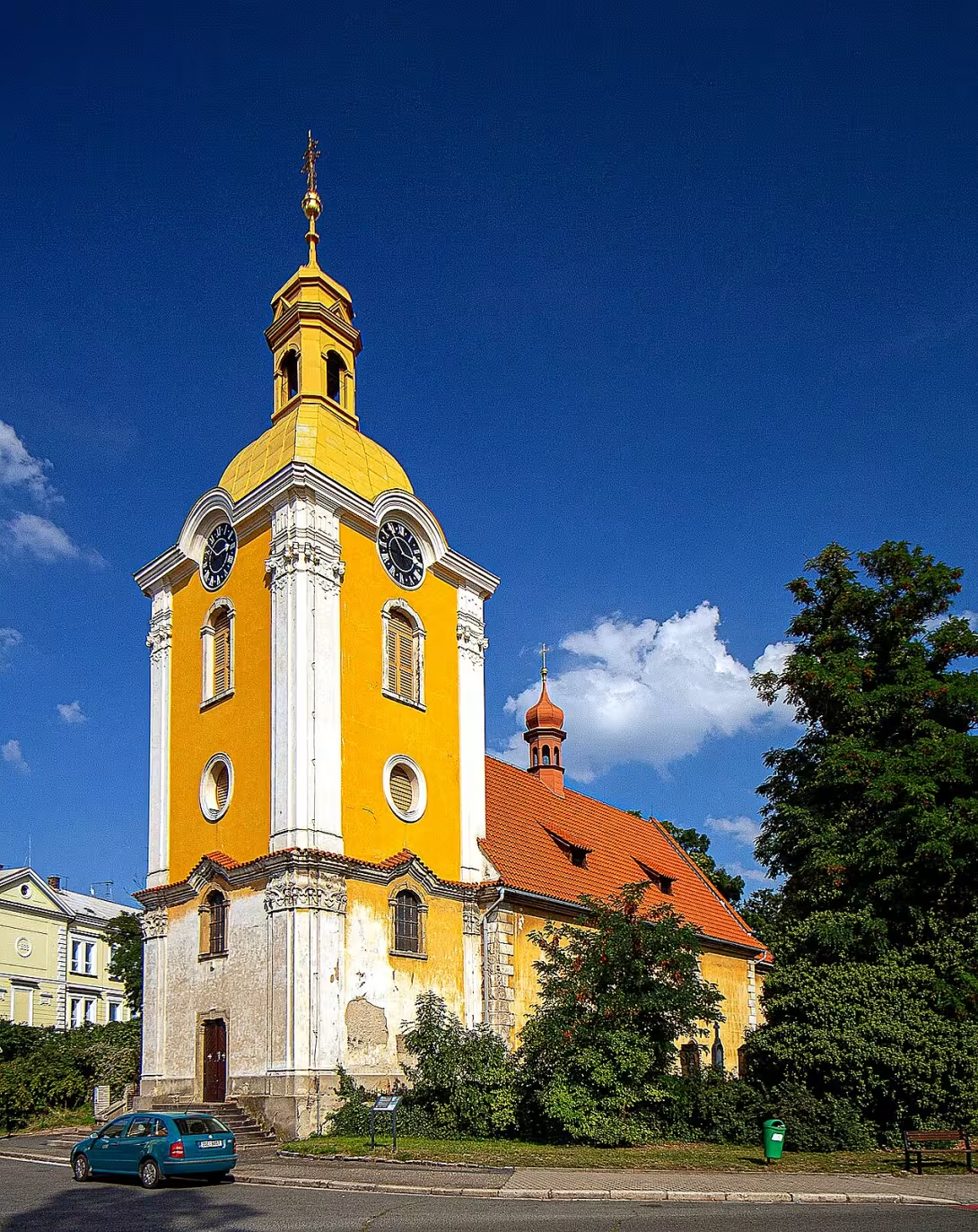
The church of St. Vitus is located in Kolín in the town of Zalabí on the site of the former village of Munich. It is a one-ship philic temple of the Roman Catholic parish Kolín, which is protected as a cultural monument. It documents its long history of transformations through which the Czech sacral buildings have undergone.
The temple was founded in 1378. However, its existence was not without testing - it was damaged by a fire in 1497 and repaired in 1513. During the Thirty Years' War, the church was desolate. In 1683 it was expanded and equipped with new furniture, thereby returning its functionality. The tower recorded the last major modification in 1771 when it was given a new cover. The cemetery used in 1782- 1882 was spread around the church, which was partially abolished in connection with the construction of the Masaryk Bridge.
The building is a single-boat church, oriented, with a tower in the west facade and sacristy at the left side of the presbytery. The tower is storey, with corners lined with baroque pilasters. It enters the hall that offers two entrances - the main and secondary Gothic. The ship has a flat ceiling and windows semi-circular on both sides. There's a Gothic entrance in the south wall. The presbytery (4,00 × 5,80 m) is encapsulated by a cross arch with a Gothic broken winning arch. In its south and east walls there are Gothic windows with smooth edges. The sacristy is built from a broken rock (4,08 × 3,06 m) with cross ribs coming out of the ground and a terminal with a six-beam star.
The interior equipment bears the stamp of the baroque - the main altar and two side altars are made of wood richly decorated with twisted leaves, angels, holy and large sunflowers. Wooden benches are April with baroque profiled faces. The church thus carries within it the Gothic elements of the fourteenth century, but its present appearance is mainly shaped by reconstructions and equipment from the 17th and 18th centuries.
Then and now
Drag the slider to compare how the landmark may have looked when it was built with the view today.
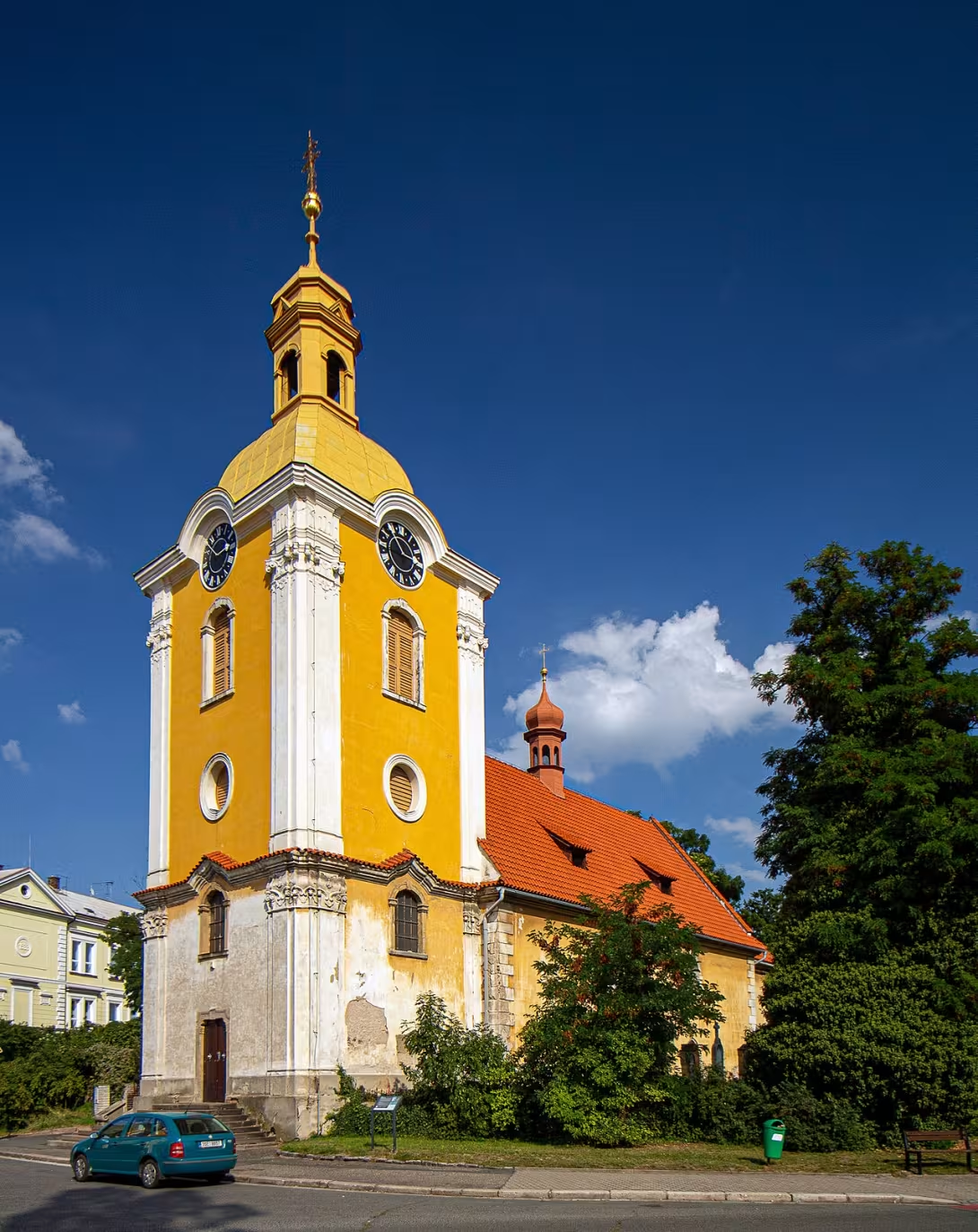

The historical appearance on the left is an AI-generated visualisation and serves as inspiration only.
Historical milestones
- 1378
- The mysterious phase of the church as a single-boat Gothic building.
- 1497
- Church fire, then repaired.
- 1683
- Baroque enlargement and church equipment with new furniture.
- 1771
- New tower cover.
- 1782
- Opening burial in the cemetery behind the church.
- 1882
- Partial abolition of the cemetery in connection with the construction of the Masaryk Bridge.
- 1988
- The cutting of the cemetery during the construction of the latchet to the road bridge over the Elbe.
Architectural development
The church was created as a simple Gothic building in 1378. In the 17th century it underwent Baroque modifications, including enlargement and interior decoration. In 1771, the tower was equipped with a new shelter. Sacristy is made of broken stone with a typical baroque arch.
Historical events
In 1497 the church was damaged by fire and subsequently repaired. During the Thirty Years' War it was desolate and in 1683 it passed through the expansion and equipment of new furniture. In 1771, the tower got a new cover.
Points of interest
- The church of St. Vitus was founded in 1378 on the site of the former village of Munich.
- In 1497 it was destroyed by a fire, then repaired in 1513.
- During the Thirty Years' War, the church was desolate and its functionality was restored after enlargement and new furniture was furnished in 1683.
- The church tower got a new cover in the last major modification in 1771.
- There was a cemetery around the church from 1782 to 1882, which was partially abolished during the construction of the Masaryk Bridge.
Guide
This guide is narrated by a synthetic voice generated by artificial intelligence.
Show guide text
This text was created by artificial intelligence and has not been editorially reviewed. It may contain inaccuracies.
The Church of Saint Vitus stands in Kolín, in the city district of Zálabí, that is on the site of the former settlement Mnichovice. It is a Roman Catholic subsidiary church, which falls under the parish of Kolín, and is protected as a cultural monument.
It was built in the year 1378. Just over a hundred years later, in 1497, it was damaged by fire and underwent repairs in 1513. During the Thirty Years' War, the church fell into disrepair. It came back to life in 1683, when it was enlarged and received new furnishings. The tower received a new roof in 1771.
The church is surrounded by a cemetery, where burials took place in the years 1782 to 1882. Part of the cemetery was closed during the construction work that was related to the building of the Masaryk Bridge.
The building is a single-nave structure, plastered and oriented, with its chancel facing east. In the western facade stands a multi-storied tower, whose corners are adorned with Baroque pilasters. On the left side of the chancel is an attached sacristy. The church is entered either by the main entrance through a vestibule, or by a side Gothic entrance.
The nave has a flat ceiling and semicircular windows on both sides. In the southern wall a bricked-up Gothic entrance has been preserved. The nave is separated from the chancel by a Gothic pointed triumphal arch.
The chancel is rectangular, measuring four meters by five meters eighty centimeters, and is vaulted with a ribbed vault. In the southern and eastern walls there is a Gothic window with smooth framing, and in the northern wall there is an entrance to the sacristy.
The sacristy is built of rough, unplastered stone and is supported on the outside at the corners by two massive pilasters. It measures four meters eight centimeters by three meters six centimeters. The ribbed vault ribs run directly from the ground and converge at a boss with a six-pointed star. Light enters it through two rectangular windows.
The main altar, two side altars and the railing between the nave and chancel are made of wood. They are decorated with dense, strongly twisted foliage, angels, figures of saints and large sunflowers. The pews are made of oak wood and have Baroque-profiled fronts.
Tips for visitors
Best visiting time
Church of St. Vitus is the most pleasant to visit in the morning when there is a quiet and pleasant light for photography. The ideal period for visiting is in spring or autumn, when the outside is pleasant temperature and surrounding nature is in full beauty. In summer there are often more visitors in the church, but in the morning there is still enough space for a tour.
From the centre of Kolína the church is only a short walk away.
What to take with you
For a comfortable visit take comfortable shoes because the church stands on a slightly steep terrain. It is also appropriate to take a map or mobile navigation if you want to look around, for example at Castle Bezdez. Don't forget to wear suitable clothes according to the weather because it can be cold in the church and in the surroundings.
Photography - best places and light
For the most beautiful photos visit the church in the morning or afternoon light, when the rays of the sun create interesting shadows and illuminate Gothic elements. The best places for the pictures are the entrance portal, the interior with Baroque modifications and the surrounding garden. In the interior photography is allowed, but avoid flashing lightning to avoid damage to the paintings.
What to visit in the area (within 30 minutes)
Close to the church is worth visiting Jirásek Square, which is the center of the city and offers many historical buildings and cafes. Near is the Masaryk Bridge over the Elbe, which is interesting for walking walks overlooking the river.
Tips for families with children
Children can view the interior of the church and hear stories about its history. In the vicinity of the church you can play at Jiráskov Square, where there is enough room for children's activities. For children it will also be interesting to visit the castle Bezdez, where there is an exhibition dedicated to the Middle Ages.
Frequently asked questions
Can the monument be visited?
Religious buildings are usually open mainly during services; at other times a visit is normally arranged with the parish or the operator. We have not verified specific times.
Where is the monument?
Location: Kolín V, Středočeský kraj. The map on this page shows the exact spot.
Why is the monument protected?
It is listed in the Central List of Cultural Monuments of the Czech Republic as a cultural monument (register no. 46040/2-790).
For kids
Imagine going back 686 years to a time when there was no laundry or tea in the world. Kolín was a small town surrounded by forests and the Elbe River. The Church of Saint Vitus was not as beautiful as it was today, but even then, people considered it something extraordinaire.
How did it look here? Who lived here? What happened here?
In Kolín lived mainly craftsmen and merchants. The city was densely populated because there was an important trade path between Bohemia and Germany. People sold goods like salt, wine or textiles.
Businesses nearby
Do you run a restaurant, accommodation, shop, museum, rental, wellness or other visitor service near this monument? Show yourself directly to the people heading to it — this is how they will see you in the app and on the web:
Nearby
The church is surrounded by Jirásek Square and the Masaryk Bridge over the Elbe. In the vicinity (up to 5 km) there is, for example, the castle Bezdez, the castle Red Escape or the nature reserve Red Escape with rich flora and fauna.
Accommodation nearby
Trips and activities nearby
Guided tours, tickets and activities nearby from GetYourGuide
Affiliate link: if you buy from the partner, we may receive a commission. The price for you does not change.
Search tours and activities →Themed route
Thematic cruise route: Kolín and its surroundings
1. Church of St. Vitus in Kolín A Gothic church from the 14th century that dominates the city centre. Its architecture and historical importance associated with Czech history (e.g. the Hussite War) make it a necessary stop for lovers of history and sacral art.
2. Jirásek Square One of the most beautiful squares in Bohemia, surrounded by historical houses and churches. Its name refers to Alš Jirásek, who lived here, and offers the picturesque atmosphere of the medieval city with the possibility of a short rest on the benches.
3. Masaryk Bridge over Elbe Technical and historical monument connecting Kolín with the village Kolín II. The bridge named after the first Czechoslovak president provides a picturesque view of the river and surrounding landscape, ideal for walking or photography.
4. Castle Bezdez One of the most important medieval forts in Bohemia, about 10 km from Kolína. Its strategic location at the top and preserved remains of chateau walls attract a trip to nature with a historical touch.
5. Castle Red Escape Renaissance chateau with park, located about 5 km from Kolína. Its architecture and surrounding nature reserves with rich flora and fauna offer a quiet environment for walks and relaxation.
Seasonal recommendations
Spring: In spring, kostel svatého Víta v Kolíně appears in the most beautiful colors of the blooming nature. The sun rays particularly highlight the subtle details of Gothic architecture, which makes visitors feel like the church is waking up from its winter sleep. At this time nature is surrounded by flowering shrubs and trees, creating a harmonious contrast with the historical environment of the monument. For the visit it is recommended to dress suitable for mild weather - short gloves and scarf may be useful because the temperature may change suddenly during the day. The best time to visit is in the morning or evening when natural light and crowd load are optimal.
Summer: Summer in Kolín offers ideal conditions for visiting St. Vitus church. The sunny days bring bright and warm light, which emphasizes the architectural beauty of the monument. The atmosphere is full of vitality, which is reflected in the surrounding green and flowering park environment around the church. The main summer season may increase attendance, so it is advisable to come earlier in the day to explore the memory with peace and without long queues. Remember the sun protection - creamy protective equipment, hat and light clothing are necessary for a comfortable stay.
Autumn: Autumn visit to St. Vitus Church offers a unique atmosphere. The colour of the leaves in this period adds intensity and depth to the landscape panorama, giving visitors a sense of complete harmony with the historical environment. The sun rays in autumn days particularly highlight Gothic lines and details, making the visit particularly attractive. The climate is gradually cooling, so it is advisable to come up with warmer clothes - a kind of jumpsuit and hat. The best time to visit is at noon, when sunlight is the most famous.
Winter: Winter brings the Church of St. Vitus an atmosphere of quiet and calm. Less visitors means that you can explore the memory with greater focus on its historical significance and architecture. The sunny days bring a fine light that illuminates the church in a special way, often highlighting its Gothic elements. In the winter months, however, it is important to come with warmer clothes - fur coat and sunglasses are necessary, especially when travelling on bicycles or walking.
Visualizations and artistic views


The visualisations are generated by artificial intelligence and serve as inspiration.
Photos from the area
Real photos taken near the monument

Zdroj a licence jsou uvedeny u každého snímku.
Tips from visitors
No tips yet. Be the first!
Log in and add your tip.
Sources and literature
Photos: VitVit / CC BY-SA 4.0 — Wikimedia Commons. The author and licence also appear when you hover over the image.
Faktickým podkladem tohoto textu byl článek na Wikipedii, jehož autory jsou přispěvatelé Wikipedie. Článek je dostupný pod licencí CC BY-SA 4.0.
Location on the map





Příběhy a pověsti
Legendy, pověsti a příběhy spjaté s touto památkou
Fotografie návštěvníků
Zatím žádné fotografie. Buďte první, kdo přidá fotografii z návštěvy!
Log in a přidejte svou fotografii nebo hodnoťte.
Za ověřenou návštěvu v aplikaci získáte víc bodů — poznáme podle GPS, že jste na místě.
Reviews and comments