



Socha svatého Jana Nepomuckého (Sychrov) Statue
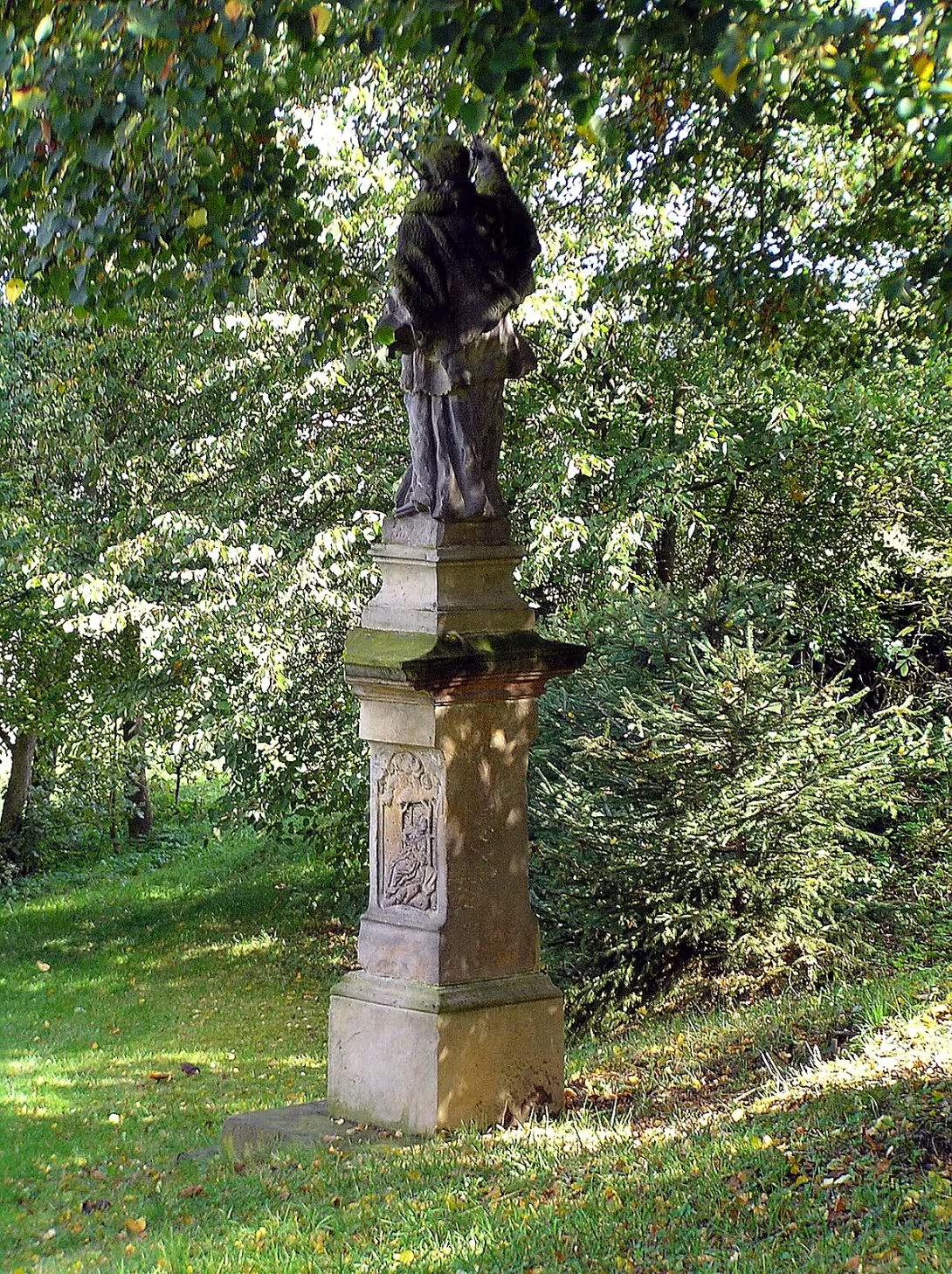
The statue of St. John Nepomuk in the village Sychrov in Mladoboloslav is a late Baroque work from 1782. The monument, protected since 1958, stands out for precise processing of fine grain sandstone. It represents an important piece of evidence of sculptures of the Kosmonian family Jelínky.
The creation of the building is confirmed by an engraved inscription on the back of the staff base. Historical sources are attributed the authorship of Martin Ignatius Jelínek, a member of the famous sculpture family. The work was created during the period of reign of Josef II, when baroque traditions grew in Czech sculpture and the effects of classicism began to appear.
The statue of the saint itself measures 1.7 meters and stands on a 2.1 meter high, richly decorated three-piece pedestal. It's broken into the heel, the blade, and a voluously sealed warhead. The reliefs of the Virgin Mary, Saint Vojtěch and Saint Francis of Xaversky are carved on three sides on the prism stick. Saint Jan Nepomucký is depicted in a traditional canovice robe which consists of clerics, rochet and mozzet. The figure is strongly bent in contrast; in the left hand holds the biret and in the right lifting the metal cross. The original decor was supplemented by a pair of kneeling angels with a torch and a martyr's palm, placed on the corners of a Roman warhead.
Historical records show that both the statue and its reliefs have had traces of polychrome in the past, highlighting the details of the dress and the overall decoration. The reconstruction took place in 1897, as evidenced by the inscription on the front of the foot. Unfortunately, the original text with the names of donors that was part of the warhead was not preserved.
The building is located in the northeast part of Sychrova, in the slope under the Chapel of the Virgin Mary. Thanks to its historical value and artistic design, the monument is open to the public and represents a valuable goal for those interested in Baroque sculpture in the region. Visiting this place offers the opportunity to see an authentic example of craftsmanship from the end of the 18th century in its original rural environment.
Historical milestones
- 1782
- The creation of a statue, supported by the inscription on the back of the base.
- 1897
- Reconstruction of the statue has been carried out.
- 1958
- The statue was declared a cultural monument.
Architectural development
The statue is carved from fine grain sandstone and placed on a 2.1 meter high stylobate. The base is divided into a foot, a shank and a voluously arched warhead, while the shank adorns the relief of the Virgin Mary, Saint Vojtěch and Saint Francis Xaversky.
Historical events
The creation of the statue in 1782 and its subsequent reconstruction in 1897.
Points of interest
- The statue is a late Baroque work from 1782, which has been protected since 1958. - The author of the work is attributed to Martin Ignatius Jelinek of the great sculptures. - The empires of the Virgin Mary, Saint Vojtěch and Saint Francis Xaversky are carved on three sides of the pedestal. - The statue of the saint is 1.7 meters and stands on a 2.1 meter high pedestal. - In the past, the statue and its reliefs were decorated with coloured paint that highlighted the details.
Guide
Show guide text
This text was created by artificial intelligence and has not been editorially reviewed. It may contain inaccuracies.
Welcome. You stand on the northeast edge of the village Sychrov and before you stand a stone statue of St. John Nepomuk. In the silence of the surrounding countryside, you seem like a silent witness for centuries. The statue is not large, it measures about one metre 70, but its presence is delicate and yet clearly legible. It is made of fine grain sandstone, the surface of which bears traces of time and weather. The figure of the saint rests on a richly decorated three-piece pedestal that elevates the statue above the ground level and attracts the view. When you look at it, you can see how light hits stone surfaces and how shadows highlight the shape of the garment and features of the figure. The surrounding environment is quiet, so the statue offers a moment to stop and concentrate on the detail that easily escapes on a busy day. You can see how the statue communicates with the surrounding space and how its stone matter contrasts with the softness of the garment.
Look at the character yourself. Saint John is depicted in the traditional clothing of the canary, which blends freely into his body. The body is filmed in gentle motion, weight transferred to one leg, giving the whole statue a fine dynamic and nature. His hands hold objects that speak of his office and faith, yet the character seems relaxed and welcoming. One hand holds a biret, the other, a metal cross. These objects are his typical symbols and help recognize him without writing. If you approach, notice the details of the garment, the fine folds and the way the sculptor caught the substance. The surface of sandstone is fine, but after centuries of outdoor exposure there is a gentle erosion that gives the stone depth and character. Each fold and each line are the result of the careful work of the hand, which more than two hundred years ago in the stone sought shape and expression.
Let's go back in time now. The statue was created in 1782, as evidenced by the inscription carved on the back of the base. The author is Martin Ignác Jelínek, a member of an important sculpture family whose name is associated with many parts in Czech countries. The work belongs to the late Baroque period, which in the Czech landscape brought sensitive religious statues designed for respect and protection of the place. The statue was probably created as an expression of the faith of the locals and as a sign of divine protection over the village and its inhabitants. In the eighteenth century, such sculptures were often placed on baits, on trips or on homes to remind the spiritual dimension of everyday life. It was a time when faith crossed public space and the statues of saints served as invisible bridges between heaven and earth. The late Baroque sculptures often combined sensitivity with delicate drama, and even here you can feel the gentle movement and inner calm of the figure.
Notice the base now. His shaft carries carved reliefs from three sides. On one side you will find the Virgin Mary, on the other, Saint Vojtěv and on the third, Saint Francis Xaversky. These figures complement the main statue and create a small continuous gallery of holy protectors. The base is three-piece and richly decorated, so even though the statue itself is small, the whole looks dignified and thoughtful. Each side of the pedestal offers a different view and a different saint, so you can see the statue from all sides and discover new details. Reliefs are carved directly into the stone pedestal and form a whole with it, which speaks of respect for more than one holy protector.
The history of the statue did not end with its creation. A reconstruction was carried out in 1897, which returned the original respectable form. And in 1958, the statue was declared a cultural monument, which means it is protected and closely monitored by experts. This status shows that the statue is not just an ordinary ornament of the village, but a valuable piece of sculpture work at the end of the eighteenth century. Protecting the cultural monument ensures that the statue is preserved for future generations and that any interference in its form will be carried out with utmost consideration. As visitors, this means that you are looking at a work that has its official value and is part of a wider cultural heritage. This protection also means that the statue is part of the register of cultural monuments and that its condition is regularly checked.
The interesting thing is that we know exactly when the statue was created, thanks to the inscription on the back of the base. Such dating is not a matter of course for outdoor statues in small municipalities. It is also remarkable that the authorship is attributed to Martin Ignácia Jelínek from a family who dedicated sculpture to several generations. You can imagine how the sculptor worked on the sandstone, how he picked the stone, and how he invented a composition to last centuries. The statue of St. John Nepomuk is not only a religious symbol but also a family and artistic heritage. Its small dimensions do not mean little. On the contrary, its modesty and location in the quiet part of the village make it a personal and intimate place that deserves attention.
If you look around, feel the atmosphere of the place. The statue stands in a quiet part of Sychrova, far from the excitement of big cities. It's a place to think, to stop quietly. You can ask yourself how many generations of people have passed it, what prayers have been said here and what stories have happened here. The statue of St. John Nepomuk is a reminder of a tradition that in the Czech landscape deep spices. Its presence in the northeast part of the village forms a delicate point around which thoughts and memories can gather. Save time to see the statue at close range even from a distance to notice the relief on the base and symbols in the hands of the saint. Pay attention to how the statue fits into the landscape and how you feel about it.
Thank you for taking the time to listen to this guide. I hope that the statue of St. John Nepomuk in Sychrov will remain in your memory as a fine and permanent testament to the past. If you feel like it, explore other corners of the village and let yourself be carried away by its calm. Goodbye and a pleasant journey.
Tips for visitors
To visit the statue, it is ideal to choose a sunny day during spring or summer months, when the surrounding green is maintained and the statue excels better in the landscape. The light hitting the sandstone surface is most suitable in the morning when the sun lights up the front of the work and highlights the details on the pedestal. For photographers, I recommend choosing a lower angle of contact to excel the height of the statue and its location in the slope below the chapel. In the vicinity of the statue there is a chapel of the Virgin Mary, which forms with the monument a complete historical whole suitable for sightseeing. I recommend to families with children a walk in the quiet surroundings of the village Sychrov, where children can see the statue closely and then visit the adjacent Chapel of the Virgin Mary, located directly above the statue in the slope.
Frequently asked questions
Can the monument be visited?
This is a structure in a public space that can usually be seen from outside free of charge. We have not verified that this particular one is freely accessible.
Where is the monument?
Location: Sychrov. The map on this page shows the exact spot.
Why is the monument protected?
It is listed in the Central List of Cultural Monuments of the Czech Republic as a cultural monument (register no. 1000133172).
Businesses nearby
Do you run a restaurant, accommodation, shop, museum, rental, wellness or other visitor service near this monument? Show yourself directly to the people heading to it — this is how they will see you in the app and on the web:
Events nearby

Zdroj akcí: otevřená data měst a obcí ČR (Národní katalog otevřených dat) a kalendář akcí Národního památkového ústavu.
Nearby
Socha stojí ve svahu pod kaplí Panny Marie v obci Sychrov v okrese Mladá Boleslav.
Accommodation nearby
Trips and activities nearby
Guided tours, tickets and activities nearby from GetYourGuide
Affiliate link: if you buy from the partner, we may receive a commission. The price for you does not change.
Search tours and activities →Themed route
Thematic cruise route around the statue of St. John Nepomuk on Sychrov
1. Statue of St. John Nepomuk - Type: Statue - Why is it worth a visit: This important statue is located in the slope under the chapel of the Virgin Mary and represents one of the most famous icons of the village Sychrov. It's a monument that symbolizes history and spiritual importance to the locals.
2. Chapel of the Virgin Mary - Type: Chapel - Why it is worth a visit: The chapel is located directly next to the statue and serves as a place of prayer and peace for visitors. Its architecture and interior decoration offer a view of historical artistic elements.
3rd Sychrov Park - Type: Park - Why is it worth a visit: The park that stretches around the village Sychrov offers beautiful walks and opportunities to relax in nature. It is the ideal place to relax after visiting the statue and chapel.
4. Sychrovska Garden - Type: Garden - Why it is worth a visit: This garden is famous for its flowering orchards and a carefully maintained environment that provides a view of the variety of plants. It's a place for lovers of botany and natural beauty.
5. Sychrov vineyard - Type: Vineyard - Why is it worth a visit: The vineyard in the village Sychrov is known for its traditional ways of growing vines and producing wine. It offers a journey through the vineyards where you can enjoy the natural environment and perhaps even tasting local wine.
This route offers visitors a comprehensive view of the cultural and natural wealth of the village Sychrov, while concentrating around the main monument - the statue of St. John Nepomuk.
Seasonal recommendations
Spring: The spring visit of the statue of St. John Nepomuk on Sychrov offers a unique experience where the colors of nature change and the sunlight creates fine shadows. The landscape around the statue begins to bloom, which gives the atmosphere life and enthusiasm. When visiting, it is recommended to wear clothes suitable for mild temperatures because spring weather can be variable. The best time to explore is at noon when the sun lights up the statue and surrounding green nature in the best possible light.
Summer: In the summer months visit Sychrova is characterized by long sunny days and warm air. The sun illuminates the statue of St. John Nepomuk from different angles, allowing us to observe its details in the best possible light. When visiting, it is advisable to equip yourself with light clothing and protective tie to ensure cooling. Visit the place in the early afternoon or evening to avoid extreme sunlight and warmth.
Autumn: Autumn on Sychrov brings a colourful palette of leaves and mild climate. The sun lights up a statue in the shade of trees, creating a romantic atmosphere. When visiting, it is advisable to wear clothes on several layers because autumn weather can be cold afternoon time and warmer morning or evening. The best time to explore is in the early afternoon when sunlight is ideal for photography and observation of the statue.
Winter: Winter visit Sychrova offers a cool atmosphere with the possibility to watch the statue in the moonlight. The landscape around it turns into snow carpets, adding magic and peace. When visiting, it is necessary to wear warm clothes, a protective helmet and protective shoes for safe movement on a freezing surface. The best time for a tour is in the early afternoon or in the evening when it is possible to use the radiation of the moon and cool atmosphere without risk overheating under strong sunlight.
Visualizations and artistic views

The visualisations are generated by artificial intelligence and serve as inspiration.
Photos from the area
Real photos taken near the monument


Zdroj a licence jsou uvedeny u každého snímku.
Tips from visitors
No tips yet. Be the first!
Log in and add your tip.
Sources and literature
Photos: MartinVeselka / CC BY-SA 4.0 — Wikimedia Commons. The author and licence also appear when you hover over the image.
Faktickým podkladem tohoto textu byl článek na Wikipedii, jehož autory jsou přispěvatelé Wikipedie. Článek je dostupný pod licencí CC BY-SA 4.0.
Location on the map
More monuments – Sychrov
Show all in the municipality
Příběhy a pověsti
Legendy, pověsti a příběhy spjaté s touto památkou
Fotografie návštěvníků
Zatím žádné fotografie. Buďte první, kdo přidá fotografii z návštěvy!
Log in a přidejte svou fotografii nebo hodnoťte.
Za ověřenou návštěvu v aplikaci získáte víc bodů — poznáme podle GPS, že jste na místě.
Reviews and comments