



Socha svatého Jana Nepomuckého v Bakově nad Jizerou Statue
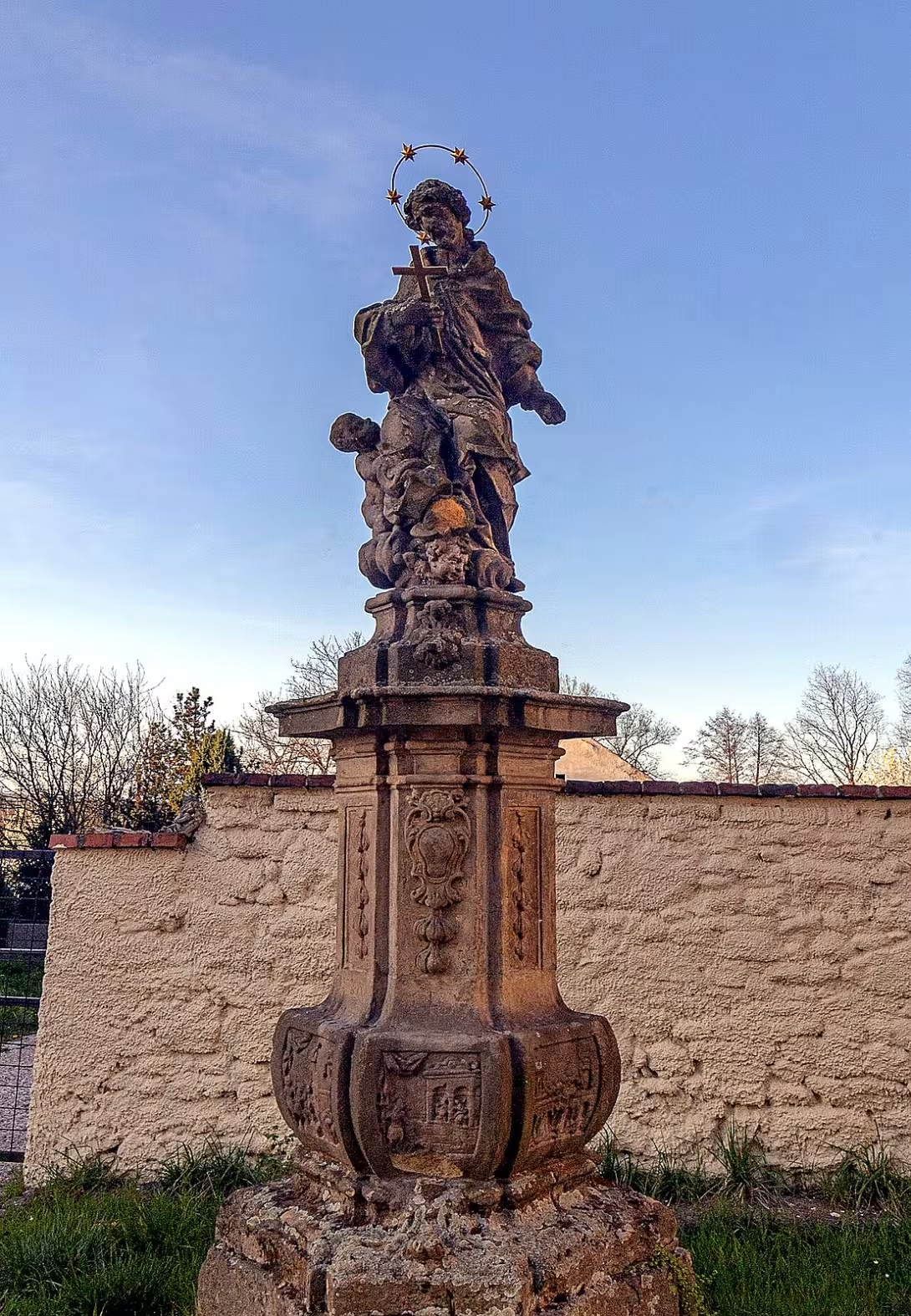
The Baroque sandstone statue of St. John Nepomucký in Bakov nad Jizerou in the district of Mladá Boleslav dates back to 1731 and has been protected since 1958 as a cultural monument of the Czech Republic. The work, probably by the sculptor Josef Jelínek, represents an important proof of baroque work in the region and is located in the area near the parish church of St. Bartholomew.
The statue was created in the first half of the 18th century, when Baroque creation in Czech countries reached its peak. This style was strongly influenced by the anti-reformation and emerging cult of St. John Nepomuk. This saint became a symbol of Catholic renewal, which led to the placing of his statues on public spaces, roads and bridges.
The statue is carved out of sandstone and stands on a six-sided bent suspect. Stylout heel is decorated with acanth. On three front parts, the monument is embossed with images of the world's legend, which depict torture, confession of the queen and overthrow of the Vltava. The upper part of the front of the blade is embossed cartouche with feston and 1731. The base is finished with a ledge head and a smaller six-sided plinth, also decorated with acanth. The statue of a sublife saint itself is made in traditional clerics and is carried by clouds. Jan Nepomucký looks up to the raised cross, standing at his feet an angel and winged head. The head of a saint with long hair is uncovered while the biret rests on the cloud.
Originally, the statue was placed outside the city by the road of the Boloslav. Her transfer to the church of St. Bartholomew took place in 1926. There are inscriptions on the back of the statue, namely the monogram AH and the name Hradisky Ioann. The author of the work is attributed to Josef Jelínek, who is also attributed to the creation of a triple column in the Bakovska Square.
Today, this Baroque monument is freely accessible near the parish church of St. Bartholomew. Visiting this place offers the opportunity to look at detailed sculptures, which is a valuable testimony about religious culture and artistic sensations of the 18th century in Bakov nad Jizerou.
Historical milestones
- 1731
- The creation of the statue of St. John Nepomuk.
- 1926
- Moving the statue to St. Bartholomew's Church.
- 1958
- The statue was declared a cultural monument of the Czech Republic.
Architectural development
The statue is carved from sandstone and placed on a richly decorated six-sided plinth. The village contains embossed scenes of torture, confessions of the queen and overthrow into the Vltava. The original location was changed in the 20th century when the monument was moved near the parish church.
Historical events
1731: The creation of the statue and its location by the Bloslav road. 1926: Moving the statue to the church of St. Bartholomew for the construction of the falcon house.
Points of interest
- Socha svatého Jana Nepomuckého v Bakově nad Jizerou is protected as a cultural monument of the Czech Republic since 1958.
- The statue is carved out of sandstone and stands on a six-sided bent suspect.
- On three front parts, the monument has embossed images from the world legend.
- There are inscriptions on the back of the statue, namely the monogram AH and the name Hradisky Ioann.
- The statue was originally placed outside of the city by the Boloslav road.
Guide
Show guide text
This text was created by artificial intelligence and has not been editorially reviewed. It may contain inaccuracies.
Welcome to Bakov over Jizera. You just stopped at one of the most important and beautiful points this place has to offer. In front of your eyes is the statue of St. John Nepomuk and right now you have a unique opportunity to look at it not only with your eyes but also with your heart. Feel the presence that has been here for almost three centuries. This statue is not just a piece of stone, it is a living witness to history that stands here and watches the surroundings while you walk through the city. Feel the atmosphere of peace and nobility floating around this baroque splendour.
Let us now look together at how this work was created and what its history is. This statue, which you are now observing, was created in 1731. This was the time when the Baroque style was in its greatest strength and when artists were looking for ways to express deep faith and emotions through movement and shapes. The author of this work is Josef Jelínek, a master who was able to bring not only shape but also spirit into the sandstone. This whole work is carved out of sandstone, which is a material that is prone to the effects of time, but at the same time carries incredible depth and ability to capture subtle details. This statue stands here as a symbol of continuity and endurance.
Now pay attention to the very character and details you have right in front of you. Look at the saints. It is depicted in traditional clerics, which is his spiritual garment, which gives him dignity and clearly defines his role. Notice his attitude and, above all, his view. The saint is not in motion towards you, but his eyes are pointing upwards, in the image of the cross. This detail is crucial because it expresses deep devotion and spiritual search. It's a moment of stopping, a moment of prayer carved into stone by an artist.
If you look down at his feet now, you'll see other fascinating elements. There's an angel and a winged head. These small figures complement the overall composition and supply it with softness and celestial dimensions. This whole statue is based on a very interesting foundation. She's a six-sided suspect who's not a simple, flat block of stone. She's got this twisted shape that gives her dynamics and elegance. This geometry allows the statue to work more alive as if it were part of the surrounding space, not just a static object.
Now I want to invite you to try to perceive the part of the work that tells the story. If you start to move slowly around the statue, you will notice that on the three front parts of this six-sided suspect are carved embossed images. These reliefs are like an open book. They're scenes from the legend of St. Jan Nepomuk. Although you may not know every word of this legend, these carved images allow you to visually monitor the events that defined the life of this saint. Each relief is carved into a sandstone with great care, so that every visitor who comes near it can tell his story through the shapes and shadows that create light on the stone.
Did you know that this statue has undergone interesting changes over the years? Even though she seems to be here today, her path to this place has not been straightforward. In 1926 an important event occurred when the statue was moved to the church of St. Bartholomew. This transfer helped the statue find its present, dignified location near the spiritual center. And maybe one more thing that underlines her uniqueness will interest you. This statue is not just an ordinary work of art, it is the treasure of our nation. Since 1958, this monument has been officially declared and protected by the state as a cultural monument of the Czech Republic. This means that its value is recognised as an irreplaceable part of our common heritage.
Looking at the sandstone from which the statue is carved, you can realize how much time has passed since 1731. Every crack, every change in the color of the stone is proof of the years this object survived. Yet the statue preserved its beauty and ability to induce emotion. It is a fascinating combination of human art and natural material that resists all the unpleasantness of weather and human oblivion.
I hope that this brief view of the statue of St. John Nepomuk was an asset to you and that you could imagine the world in which it was created. This monument is just one of many stories that Bakov nad Jizerou hides. It's an invitation to discover again, to walk again and to find beauty in the details surrounding us. Don't forget to visit other local attractions that this region offers. Thank you for spending this moment with us, and we wish you a beautiful and inspiring next trip around. Goodbye.
Tips for visitors
The best time to visit the statue of St. John Nepomuk is in the morning or evening when the light is ideal for photography.
The location is also available by public transport.
Bring the camera and the telelens with you to capture the details of the statue.
In the surroundings is worth visiting the parish church of St. Bartholomew and the trio column in the square.
Frequently asked questions
Can the monument be visited?
This is a structure in a public space that can usually be seen from outside free of charge. We have not verified that this particular one is freely accessible.
Where is the monument?
Location: Bakov nad Jizerou. The map on this page shows the exact spot.
Why is the monument protected?
It is listed in the Central List of Cultural Monuments of the Czech Republic as a cultural monument (register no. 1000137009).
Businesses nearby
Do you run a restaurant, accommodation, shop, museum, rental, wellness or other visitor service near this monument? Show yourself directly to the people heading to it — this is how they will see you in the app and on the web:
Events nearby
Zdroj akcí: otevřená data měst a obcí ČR (Národní katalog otevřených dat) a kalendář akcí Národního památkového ústavu.
Nearby
Farní kostel svatého Bartoloměje v Bakově nad Jizerou, trojiční sloup na náměstí.
Accommodation nearby
Themed route
Thematic cruise route from Bakov nad Jizerou
1. Statue of St. John Nepomuk - Type: Historical statue - Why is it worth visiting: This famous statue is one of the famous icons of the region and represents an important historical symbol. It is located in the heart of the city where cultural events are often held.
2. St. Bartholomew's Parish Church - Type: Church - Why is it worth a visit: This Baroque church is an architectural work with a rich history. Its interior and decoration attract visitors who are interested in history and art.
3. Triple Column in the Square - Type: Column - Why is it worth a visit: This triple column is an important monument that reminds of historical events and provides a view of local architecture. It's an ideal place to relax and think.
Visiting order: - Start with the statue of St. John Nepomuk, which is the center of the city. - Then move to the parish church of St. Bartholomew, which is close and offers a view of historical architecture. - By delaying the route, visit the triple column in the square, where you can enjoy a quiet moment and look around.
This route offers a view of the historical and cultural heritage of Bakov nad Jizerou.
Seasonal recommendations
Spring: In the spring, the statue of St. John Nepomuk in Bakov nad Jizerou appears in a strange atmosphere when flowering trees and bushes of surrounding parks fertilize the view. The sun rays shining between the leaves create live lighting that emphasizes the details of the statue. This is an ideal time to visit, because nature is awakening and the surrounding landscape has been colored by spring flower. We recommend visiting the morning or Wednesday of the day when the light is best for photography. Put on a suitable suit with the possibility to add top garment, because temperatures can be variable.
Summer: Summer brings long sunny days and high temperatures, making a visit to the statue of St. John Nepomuk in Bakov over Jizera a special experience. The sun illuminates the statue from morning to evening and the trees offer a shadow that is a friendly refuge during hot days. Light clothing and sun protection such as a hat and sunflowers are recommended.
Autumn: In autumn, the statue of St. John Nepomuk in Bakov above Jizerou grows romantic atmosphere, when the leaves of the trees colour the surrounding landscape and the sun's rays shining between the leaves provide a soft light effect. This season is ideal for nature lovers because it is a time when the surrounding parks turn into a full-fledged variety of colors. Visit the statue at the beginning of the day or later in the evening to enjoy quiet moments without too many crowds. Dress in warm leather and with suitable clothes for cooler autumn air.
Winter: The winter visit to the statue of St. John Nepomucký in Bakov nad Jizerou offers a unique atmosphere where the surrounding landscape is covered with snow coats and sun rays reflected on snowy trees. This time of year may be ideal for those who love a calm and quiet environment because it is likely that you will encounter a smaller number of visitors. Visit the statue at the beginning of the day or in the forecast hours when the light is best for photography and shading is minimal. Due to cold temperatures, we recommend durable clothing with leather and head protection.
Visualizations and artistic views

The visualisations are generated by artificial intelligence and serve as inspiration.
Photos from the area
Real photos taken near the monument

Zdroj a licence jsou uvedeny u každého snímku.
Tips from visitors
No tips yet. Be the first!
Log in and add your tip.
Sources and literature
Photos: VitVit / CC BY-SA 4.0 — Wikimedia Commons. The author and licence also appear when you hover over the image.
Faktickým podkladem tohoto textu byl článek na Wikipedii, jehož autory jsou přispěvatelé Wikipedie. Článek je dostupný pod licencí CC BY-SA 4.0.
Location on the map
More monuments – Bakov nad Jizerou
Show all in the municipality
Příběhy a pověsti
Legendy, pověsti a příběhy spjaté s touto památkou
Fotografie návštěvníků
Zatím žádné fotografie. Buďte první, kdo přidá fotografii z návštěvy!
Log in a přidejte svou fotografii nebo hodnoťte.
Za ověřenou návštěvu v aplikaci získáte víc bodů — poznáme podle GPS, že jste na místě.
Reviews and comments