



Socha svatého Jiljí Statue
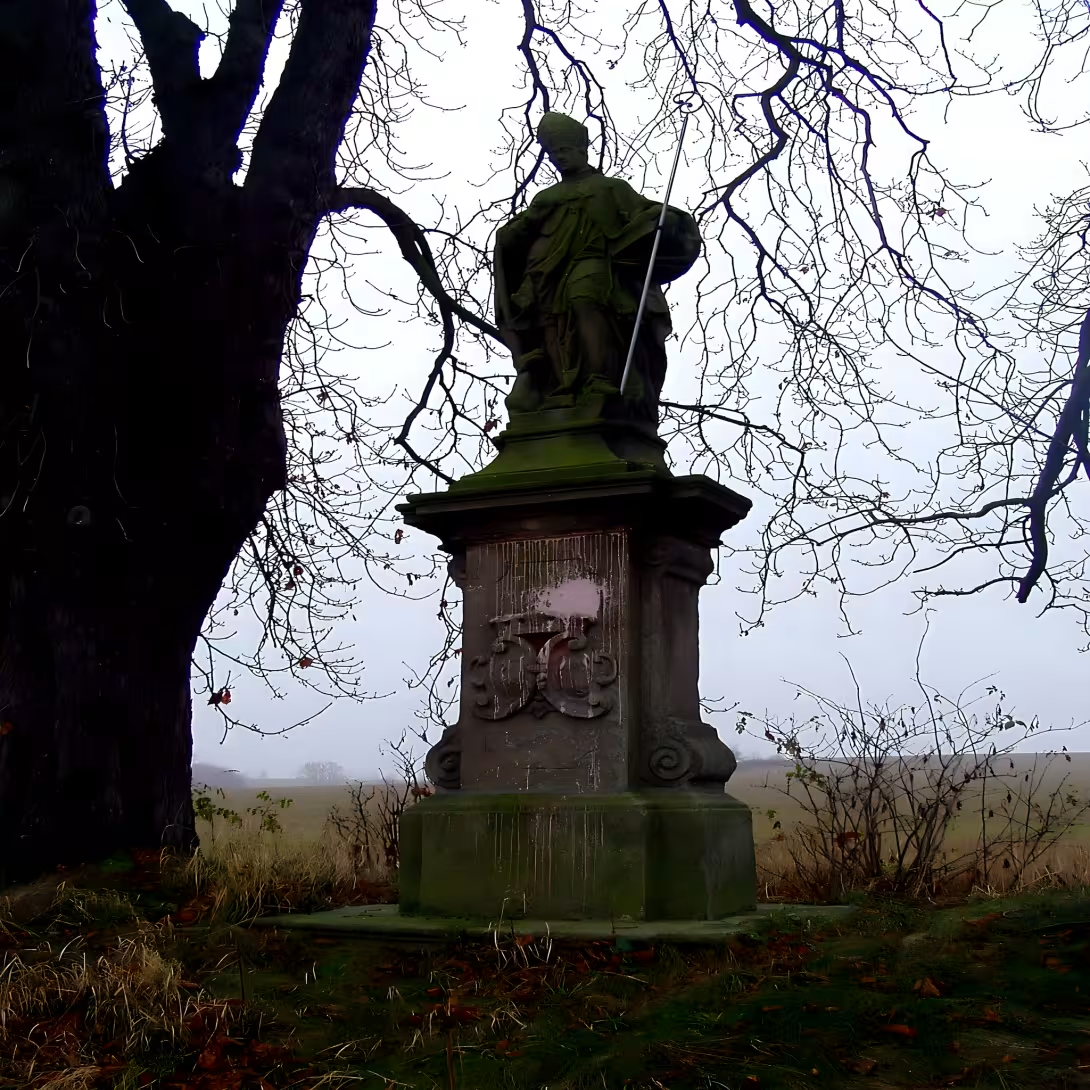
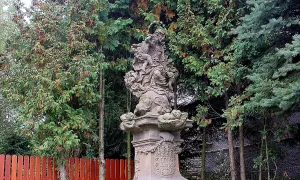
Socha svatého Jiljí, located on the road to Sebuč in the village Chvalkovice in the district of Náchod, is a protected cultural monument and represents an important example of baroque art from the second half of the eighteenth century. It was created in 1782 by C. Devotta, co-worker of Matyas Bernard Braun, and is remarkable in its architectural quality and historical context.
The creation of the statue was related to the development of artistic traditions in Czech countries during the eighteenth century, the period characterized by the transition from Baroque to Classicism. This historical context is also reflected in the statue of St. Gilya, which is the embodiment of the maturation of the highest baroque in regional production at that time.
Architecturally it is made as a three-piece plinth with volute decoration on sides and characters in the middle. The statue, which is slightly larger than life size, was made from coarse sand, probably rich. In his left hand, the saint holds a bishop's staff, stressing his spiritual standing.
The statue is recorded as a cultural monument and listed in the catalogue of monuments under register number SAR 33469 / 6-1621. This status protects the statue from disruption and allows it to be preserved for future generations.
Today it is easily available to visitors who want to discover the historical and cultural wealth of the village Chvalkovice. Its location on the road to Sebuč makes it easily visible and accessible to anyone interested in baroque art and the history of the Czech countries.
The visit offers a unique view of period artistic traditions and reminds of important personalities that influenced the cultural development of the region. It is not only a monument of historical value, but also an inspiration for anyone interested in art and heritage of past generations.
Socha svatého Jiljí is therefore an important cultural monument worth visiting. Its historical context and architectural quality are an important part of the cultural heritage of the village Chvalkovice and the whole Czech countries.
Historical milestones
- 1782
- The creation of the statue of St. Gilji in the village Chvalkovice.
- around 1750
- Development of baroque artistic traditions in Czech countries.
- end of 18th century
- The transition from Baroque to Classicism in Construction and Art.
Architectural development
Socha svatého Jiljí has a three-piece plinth with volute decoration and characters in the middle. It is made from rough-grained sandstone, probably rich, in a slightly larger size.
Points of interest
- Socha svatého Jiljí is a protected cultural monument and represents an important example of baroque art from the second half of the eighteenth century. - It was created in 1782 by C. Devott, co-worker of Matyas Bernard Braun. - The statue is a three-piece plinth with volute decoration and characters in the middle part, made of rough grain sandstone, probably rich. - It is registered as a cultural monument under the register number SAR 33469 / 6-1621. - The location by the road to Sebuč makes it easy to see and accessible to visitors who want to discover the historical and cultural wealth of the village Chvalkovice.
Guide
Show guide text
This text was created by artificial intelligence and has not been editorially reviewed. It may contain inaccuracies.
Welcome! You are faced with a unique monument of Czech art and history - the statue of St. Jilje, who is proud to be here in Sebuč in the village Chvalkovice. This monumental object, protected as a cultural monument, awaits you with a fine composition and rich history.
Socha svatého Jiljí was created in 1782. It is a time when Baroque artistic traditions reached their peak in Central European countries, and it is in this context that this sculpture has appeared. The author belongs to C. Devotti, who collaborated with the renowned Matyas Bernard Braun. This important artistic contribution is the result of the development of baroque style, which began to be promoted in the Czech countries around 1750 and which was reached in the second half of the eighteenth century. The end of this century then brought a gradual transition from Baroque to Classicism, which also affected other artistic production.
Look up at the statue and notice its three-piece plinth. This detail is characteristic of Baroque style, which often used complex volute decoration. In the central part of the statue you will find characters that give the part additional depth and symbolism. This architectural element is now particularly remarkable to you because it represents a typical Baroque aesthetic.
Although there are not many marks on specific historical figures associated with this statue, the work itself shows the importance and artistic commitment of its creators. C. Devotti, who participated in the creation of the statue, was part of the artistic circle around Matyas Bernard Braun, which shows its importance and ability.
The interesting thing about this monument is that the statue of St. Gilji represents an important example of baroque art from the second half of the eighteenth century. This is proof of how regional creators were able to integrate wider European trends into their work and thus create immortal art monuments.
Now that you've become acquainted with this fascinating work, we invite you to explore other parts of Chvalkovice and discover other hidden pearls of regional history. Enjoy every moment of your journey and remember to keep your memories of this beautiful statue. Goodbye, we hope to see you here again!
Tips for visitors
For the best experience we recommend a visit on bright days, ideally in the afternoon, when the sun creates pleasant shadows and highlights the Baroque shapes of the statue. The light at this time looks softer and the photographs will look more natural.
You can reach the monument by car or public transport. Please check the current connection and transport options in the search engine.
Bring drinking water and clothes suitable for outdoor conditions. Since the statue stands by the road, we recommend shoes that are suitable for walking around the landscape.
For photography are the best positions right at the statue, which allows to capture its detail and overall appearance. The best light for scanning details of baroque work is in mild cloud weather, which prevents too strong shadows.
Families with children should pay extra attention to the tour because the statue is near the road. The walk around is quiet, but safety comes first.
Frequently asked questions
Can the monument be visited?
This is a structure in a public space that can usually be seen from outside free of charge. We have not verified that this particular one is freely accessible.
Where is the monument?
Location: Chvalkovice, Královéhradecký kraj. The map on this page shows the exact spot.
Why is the monument protected?
It is listed in the Central List of Cultural Monuments of the Czech Republic as a cultural monument (register no. 1000145114).
Businesses nearby
Do you run a restaurant, accommodation, shop, museum, rental, wellness or other visitor service near this monument? Show yourself directly to the people heading to it — this is how they will see you in the app and on the web:
Events nearby
Zdroj akcí: otevřená data měst a obcí ČR (Národní katalog otevřených dat) a kalendář akcí Národního památkového ústavu.
Nearby
🏰 Historic sites (119)
- Muzeum Boženy Němcové 4.2 km web
- Textilní muzeum 4.2 km
- Maloskalická tvrz 4.3 km
- Barunčina škola 4.6 km
- Památník Boženy Němcové 4.7 km
- Julius Zeyer 4.8 km
- Muzeum Magie 5.3 km +420 603 794 832 web
- Zámek Ratibořice 5.5 km +420 491 452 123 web
- Rýzmburk 6.0 km
- pomník Boženy Němcové 6.0 km
- 1866 6.1 km
- Pomník Michala Silodara Patrčky 6.1 km
- Rentzovo muzeum 6.2 km web
- hospitál Kuks 6.3 km +420 499 692 161 web
- Spící lev 6.6 km
- Morový sloup 6.6 km
- Muzeum motocyklů Šestajovice 6.9 km +420 774 903 530 web
- Městské muzeum - Wenkeův dům 7.0 km
- Pomník Pochodu smrti 7.1 km
- Obětem světových válek 7.3 km
🍽️ Restaurants and dining (217)
- Restaurace U Pitašů 2.2 km
- Restaurace U Vagonu 2.3 km
- Ruchadlo Zájezd 3.0 km
- Větrník 3.1 km
- Motorest Zájezdní dvůr 3.5 km
- Pizzerie Mája 4.5 km +420608470407 web
- pizza simo 4.7 km +420723417435
- Tropický bufítek 4.7 km
- Restaurace U Konvalinků 4.7 km
- Pohostinství Hořičky 4.8 km
- Formanka 4.8 km
- Školní restaurace Eurest 5.0 km
- Občerstvení Pod Mostem 5.1 km
- Ronox 5.2 km web
- U Slunce 5.3 km
- Vila Barbora 5.3 km +420491420724;+420725386677 web
- Restaurant & Café Zahradní 5.4 km
- Sokolovna 5.4 km web
- Na bojišti 5.4 km
- Kiosek U Zámku 5.5 km
🏨 Accommodation (67)
- Vila Barbora 5.3 km web
- Areal Pauli 5.4 km
- Jakubův Nový dvůr 5.8 km
- Hotel Rýzmburk 5.8 km web
- Autocamping Rozkoš 6.1 km web
- Hotel Rozkoš 6.1 km +420 491 452375 web
- Letní tábor Běluň 6.4 km
- Wakesurf Rozkoš 6.5 km web
- Hotel 28 6.7 km web
- Stellplatz Rozkoš 7.1 km web
- Pension Kohoutov 7.2 km web
- Grand hotel 7.3 km web
- Penzion Expanze 7.4 km web
- Pension Doctor 7.5 km web
- Minicamp Pension Doctor 7.6 km
- Šporkův mlýn 7.6 km +420 777 876 095 web
- Edison 7.7 km
- Autokemp Nesytá 7.7 km
- Penzion a Kemp Wolf 7.7 km
- Pension Wunsch 7.7 km web
🚲 Rentals and sport (37)
- Jízdní kola Jaroslav Plíštil 4.2 km +420 604668516
- Posilovací stroje 4.9 km
- Hřiště 6.5 km
- Plavecký bazén 7.0 km
- sportovní hala 7.1 km
- Jachtklub Slavia 7.2 km
- Veloservis Potocký 7.4 km +420 603840877 web
- Odysseus Jachtklub molo 7.6 km
- ACTIVESport cz, s.r.o. 7.8 km
- Požární nádrž - koupaliště 8.0 km
- Hokej 10.4 km
- Sportovní areál 10.4 km
- Ogar 11.6 km Manželů Burdychových 1230
- Cykloservis TP 11.7 km +420 724 620 968 web
- Sportisimo 11.8 km
- Petr - Bike 12.0 km
- TJ Sokol Zábrodí 12.3 km
- football stadium 12.3 km
- sokolovna 12.3 km
- SPOŠ - sportovní hala 12.3 km
🥾 Hiking and nature (181)
- U Příčné cesty 4.0 km
- Vinice 4.1 km
- Na Kopci 4.2 km
- Vinice 4.3 km
- Zvolský vrch 4.4 km
- Poustka 4.6 km
- Vrchy 4.7 km
- V Bažantnici 4.8 km
- Bílý kopec 5.3 km
- Barunčina vyhlídka 5.3 km
- Na Vartě 5.4 km
- Pramen Haničky 5.6 km
- Staré bělidlo 5.7 km
- Prášilka 5.8 km
- Mandl 6.0 km
- Rudrův mlýn 6.0 km
- Ptačinec 6.2 km
- Na Šancích 6.3 km
- Hromobitka 6.5 km
- Hromobitka 6.6 km
Accommodation nearby
Themed route
Thematic cruise route from the village Chvalkovice
1.Socha svatého Jiljí - Type: Historical statue - Why is it worth a visit: This statue is a central symbol of the village and attracts attention with its history and artistic execution. It is the starting point for knowledge of local culture and traditions.
2. Chapel - Type: Religious monument - Why is worth a visit: Chapel is a place of peace and shelter that offers a view of the surrounding countryside. It's the perfect place to relax after exploring the statue of St. Gilji.
3. Local rectory - Type: Religious object - Why is it worth a visit: Fara is rich in historical elements and provides insight into the spiritual life of the village. Its architecture and interior are fascinating for anyone interested in history and art.
4. Built-in area of the village - Type: Cultural walk - Why is it worth a visit: Walk on the streets of Chvalkovic offers the opportunity to discover local architecture and the atmosphere of a small Czech town. It's an ideal way to learn better about the people's lives.
5. A stop at the traditional pub - Type: Cultural experience - Why is it worth visiting: The pub is a place where you can try traditional Czech food and drink. It is also an opportunity for meeting the locals and sharing experience about your visit.
This route offers a comprehensive view of the cultural and historical life in Chvalovice, starting with the statue of St. Gilje and ending with a stop at the pub.
Seasonal recommendations
Spring: In the spring season, the statue of St. Gilya is surrounded by flowering shrubs and trees that shine with countless colored flowers. The sun rays light the statue gently and create attractive shadows, giving the monument a unique atmosphere of revival. At this time more visitors can appear who enjoy the beauty of nature and warm weather. It is recommended to visit in the early afternoon time to avoid the largest crowds. Short coat is suitable for cold morning and evening.
Summer: In the years of the statue of St. Gilya stands in the full maturity of nature, where dense vegetation and flowering grass are revived by the surrounding landscape. The sunlight illuminates the statue in the most attractive shade, which increases its beauty. Due to the warm weather, large crowds of tourists may appear, especially in Sunday mornings and mid-day. It's good to come early in the morning or later in the afternoon to avoid crowd noise. Don't forget the head guard and enough drinking water.
Autumn: In autumn, the surrounding area of the statue of St. Gilji is coloured with yellow, pink and red tree leaves. Sun rays turn into a warm glow that illuminates the statue in a nostalgic light. This period is suitable for a peaceful visit because the crowds are less numerous than during the summer. It is recommended to visit in the afternoon when the temperature is pleasant and leaves on the ground provide a romantic look. A short jacket or a long sweater will help keep the heat up.
Winter: The winter statue of St. Gilji is surrounded by snow, which adds purity and peace to its line forms. The sun rays falling on the snowy landscape create beautiful shading, giving the monument a magical look. At this time the opening time is usually shorter and the number of visitors is decreasing considerably, so it is advisable to visit in late afternoon time. It is important to have warm clothes - a shirt with long sleeves and a quality jacket as well as protective shoes for a cool surface.
Visualizations and artistic views

The visualisations are generated by artificial intelligence and serve as inspiration.
Photos from the area
Real photos taken near the monument

Zdroj a licence jsou uvedeny u každého snímku.
Tips from visitors
No tips yet. Be the first!
Log in and add your tip.
Sources and literature
Photos: Addvisor / CC BY-SA 3.0, rozlišení zvýšeno umělou inteligencí — Wikimedia Commons. The author and licence also appear when you hover over the image.
Faktickým podkladem tohoto textu byl článek na Wikipedii, jehož autory jsou přispěvatelé Wikipedie. Článek je dostupný pod licencí CC BY-SA 4.0.
Location on the map


Příběhy a pověsti
Legendy, pověsti a příběhy spjaté s touto památkou
Fotografie návštěvníků
Zatím žádné fotografie. Buďte první, kdo přidá fotografii z návštěvy!
Log in a přidejte svou fotografii nebo hodnoťte.
Za ověřenou návštěvu v aplikaci získáte víc bodů — poznáme podle GPS, že jste na místě.
Reviews and comments