



Sousoší svatého Jana Nepomuckého (Benešov nad Černou) Sculptural group
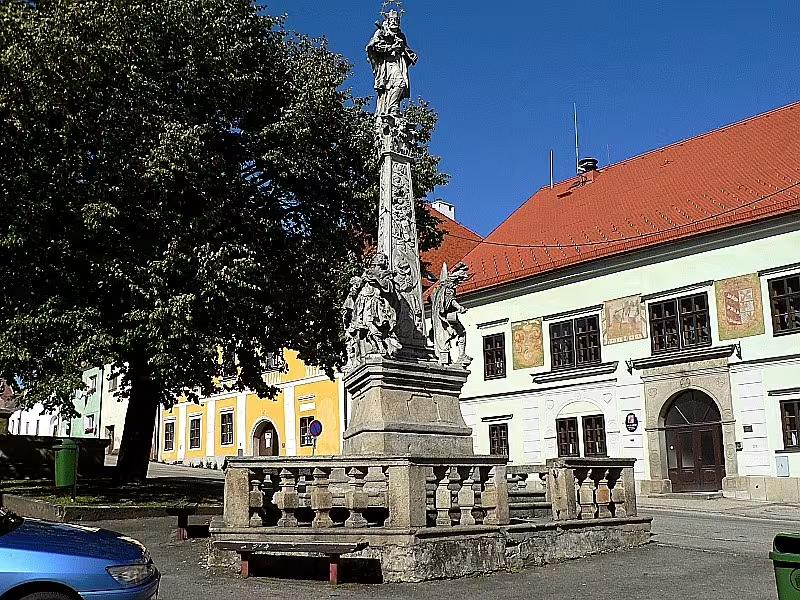
The statue of St. John Nepomucký in Benešov nad Černou is a Baroque plague column from 1726, which forms the dominant part of the local square. The memorial shows respect for St. John of Nepomuk and also reminds us of the latest plague epidemic of 1714. The building is located in the South Bohemia district of Český Krumlov. It is listed in the Central List of Cultural Monuments of the Czech Republic under number 2355.
The rise of the column in 1726 was related to the emerging cult of St. John Nepomuk. He was declared blessed by Pope Innocent XIII five years earlier. The emergence of the monument was also motivated by the tragic experience of the plague epidemic of 1714.
The structure is dominated by a three-sided pillar in the shape of a needle that symbolizes the Holy Trinity. The foundation of the building is made of granite, while the statues themselves are drawn out of limestone. The column ends with a baroque stylized Corinthian warhead with plant motifs and the heads of three putti. On top is a statue of St. John Nepomuk. It is facing the east side of the square, where the church of St. Jacob the Greater is located.
On the far corners of the larger pedestal are placed statues of St. Roch, St. Shebestian and St. Florian. It was Saint Florian who had a special significance in Benesov over Montenegro, because the city often struck fires in the past. The sides of the triangular column complement the reliefs of St. Dominic, St. Leonard and the painting depicting the murder of St. Wenceslas.
The base carries three Latin inscriptions. In the middle is text LATAEQVE IN POPVLO ADAVGENDAE SANCTI ROSARII DEVOTIONI. The right side contains the inscription BENESCHOVIENSIVM SANCTE INDVSTRIA PIETAS POSVIT ET RENOVATA, followed by dates of renovation: 1775, 1803, 1853 and 1904. The left-hand side bears the words "DEIPARAE TVM RELIQVIS TVELARIBVS SANCTIS HONORI 'from 1990.
In addition to protection as a separate cultural monument, the sculpture is part of the urban monument zone Benešov nad Černou. This was established by the Order of the Ministry of Culture of the Czech Republic in 1995.
This Baroque monument is a valuable testament to the region's religious and social history. It allows visitors to observe detailed limestone sculptures and mediates the atmosphere of the historic city centre.
Historical milestones
- 1714
- Last plague epidemic in the area
- 1721
- Declaration by John Nepomuk for the Blessed
- 1726
- Baroque pestilence column
- 1775
- First recorded renovation of the monument
- 1990
- Adding the inscription to the left side of the base
- 1995
- Determination of urban monument zone
Architectural development
The column takes the form of a three-sided needle with a Corinthian head and plant motifs. The foundation is granite, while statues of saints are made of limestone. The base bears Latin inscriptions that indicate subsequent repairs and renovations.
Historical events
1714 - the last plague epidemic in the country that motivated the formation of the pillar; 1726 - pestilence in the square.
Points of interest
- It's a Baroque plague column from 1726, which resembles an epidemic from 1714. - A three-sided pillar in the shape of a needle symbolizes the Holy Trinity. - The foundation is granite and the statues are made of limestone. - The statue of St. Florian was of special importance in the city because the site was often hit by fires. - The base contains three inscriptions in the ancient Roman language.
Guide
Show guide text
This text was created by artificial intelligence and has not been editorially reviewed. It may contain inaccuracies.
Welcome to Benesov over Montenegro. Right now, you're standing in front of one of the most important symbols of this city. In front of you stands the statue of St. John Nepomuk, a wonderful example of baroque art, which carries deep sadness, but also hope and faith. If you look at it, you'll see a tall column that attracts the attention of all passers-by in its form and decoration. It's a place where the history of the city meets the spiritual dimension, and I will now guide you through his story.
Let us first stop at why this monument was created. To understand its meaning, we need to go back a few centuries in time. Imagine Benesov in the early eighteenth century. In this year seven hundred and fourteen areas hit the last great wave of plague epidemic. It was a terrible time when fear of illness took over every street and many families lost their loved ones. Such disasters have left deep wounds in people, but at the same time have aroused a strong need to give thanks for surviving and begging for protection for future generations.
It is for this reason that seven hundred twenty-six of these baroque pestilence columns were erected in the year. It was not only an aesthetic addition to the square, but above all a show of deep respect for St. John Nepomuk. At that time, faith in his power was very strong, as is also confirmed by the fact that only five years before the post was built, in the year seven hundred twenty-one, Jan Nepomuký was officially declared blessed. The townspeople wanted to have their protector right here, in the heart of their city, to guard them against further disasters.
Now please pay attention to the architecture itself and the details you see right in front of you. Look up at the main part of the monument. The dominance is a three-sided column that is shaped like a needle. This specific shape is not random. Tripartite symbolises the Holy Trinity, which was a very common way of encoding basic Christian truths in stone in the Baroque era. Feel the line that rises up to the sky, and think about how this element in the times of its construction had to affect people who were much smaller in height than we are today.
Now when you start your view below, notice the materials from which the work is made. The foundation of the monument, i.e. its solid foundation, is made of granite, which is a very durable and hard stone, which was intended to ensure the stability of the entire building for centuries to come. On the contrary, the statues decorated by the monument are made of limestone. Limestone is a softer material that allows carvers to create finer details and more charming shapes that are so typical of Baroque style. Notice also the left side of the base where you will find the inscription. He is relatively new here, he was added only in the year one thousand nine hundred and ninety to help today's visitors better understand the importance of this place.
Now, let's talk about the characters involved in this place. Besides the main Saint John Nepomuk, you will find a statue of St. Florian. You may ask why he's the one who's been hit here. The answer lies in the history of Benesov himself. The city has often been hit by fires that have been as devastating to people as the epidemic mentioned. Saint Florian is known as a protector of fire, and therefore his presence on this pillar for the people of the city was of special and very important importance. It was a symbol of safety and a request that flames never destroy their homes again.
It is fascinating to realize how this monument has been maintained over time. The first recorded renovation took place seven hundred seventy-five in the year, about fifty years after its creation. This shows that the city has respected its monument from the beginning. Later, in the year one thousand nine hundred ninety-five, the entire area around the column was established as a town monument zone. This ensured that this unique piece of history would be preserved in the original context and not threatened by modern construction.
Stay at the memorial for a while and try to imagine the atmosphere of the square 300 years ago. Imagine people in period clothes coming here with prayers and candles to thank for the end of the plague or beg for rescue from the fire. This column is not just a pile of stone, it is the embodied memory of a city that tells about people, their fear, hope and courage to rebuild. He's a silent witness to all the events that took place in Benešov over Montenegro.
Today, when you look at this baroque piece of art, you see the result of the work of unknown architects and carvers who may not have left their names in anals, but their craftsmanship is still visible in every detail of limestone statues and in the precision of granite foundation. It is a beautiful reminder that even anonymous work can last centuries and serve as a bridge between the past and the present.
Now that you've come to know the story of this sculpture, I suggest you slowly bypass the monument around and from different angles to observe how the game of light and shadows on its surface changes. Feel the calm of this place in the middle of urban activity.
This concludes a short tour of St. John Nepomuk's sculpture. I hope this trip to history has helped you feel the spirit of Benešov over Montenegro better. The city still has many other secrets and beautiful corners that await your discovery. I invite you to continue your walk and be inspired by other monuments that surround you. Thank you for your attention and I wish you a pleasant rest of the day in our beautiful city. Goodbye.
Tips for visitors
The best time to visit is early morning or shortly before sunset. At these times the light is soft, which will highlight the details of baroque carving and the surface of the monument.
We recommend travelling by car or public transport to the place; Check the specific transport options and the location of the vehicle to be postponed in local guides or search engines.
You don't need any special equipment to search, you just need comfortable shoes to walk around the square. If you want to study the details of St. John Nepomuk, it may be useful to have a small telescope with you.
For the best photos we recommend an angle from the south side to illuminate the details of the sun. The architecture of the square will stand out in the background.
During a short walk in the surrounding area, visit the church of St. Jacob the Greater, which stands in the immediate vicinity on the eastern side of the square. Families with children can use the free space in the square to relax briefly and search together for various symbols on the pestilence column.
Frequently asked questions
Can the monument be visited?
This is a structure in a public space that can usually be seen from outside free of charge. We have not verified that this particular one is freely accessible.
Where is the monument?
Location: Benešov nad Černou. The map on this page shows the exact spot.
Why is the monument protected?
It is listed in the Central List of Cultural Monuments of the Czech Republic as a cultural monument (register no. 1000144119).
Businesses nearby
Do you run a restaurant, accommodation, shop, museum, rental, wellness or other visitor service near this monument? Show yourself directly to the people heading to it — this is how they will see you in the app and on the web:
Nearby
V bezprostřední blízkosti na východní straně náměstí stojí kostel svatého Jakuba Většího.
Accommodation nearby
Trips and activities nearby
Guided tours, tickets and activities nearby from GetYourGuide
Affiliate link: if you buy from the partner, we may receive a commission. The price for you does not change.
Search tours and activities →Themed route
Here is a proposal for a thematic walk:
1. The statue of St. John Nepomuk (memorial) - Main stop of the trip, where you can see the detailed processing of this religious work. 2. Church of St. Jacob the Greater (Temple) - Located in the immediate vicinity of the east side of the square and offers space for silence and admiration of architecture.
Seasonal recommendations
In spring, the surroundings of the monument awaken to life and the lush green creates a gentle contrast to the surface of the statue. We recommend a visit in the morning when the light is soft and pleasant. Due to the variable weather, it is advisable to choose layered clothes and moisture resistant shoes.
Summer months bring sharp sun that highlights the details of the sculpture, but also hot days. It's best to come early in the morning or at dusk to avoid the greatest heat.
The autumn dominates the atmosphere of calm and golden colors of leaves in the surrounding area, which give the place a melancholy touch. The walks are very pleasant during this period, especially in the afternoon at low sun. We recommend a light jacket or coat that protects against the colder wind.
In winter, the statue can be covered with snow, which gives it a clean and dreamy look. The atmosphere is quiet and quiet, especially during the Advent period. It is necessary to wear warm winter clothes, gloves and tight shoes with anti-slip soles to keep walking in the surroundings safe.
Visualizations and artistic views

The visualisations are generated by artificial intelligence and serve as inspiration.
Photos from the area
Real photos taken near the monument


Zdroj a licence jsou uvedeny u každého snímku.
Tips from visitors
No tips yet. Be the first!
Log in and add your tip.
Sources and literature
Photos: Lovecz 10:10, 24 September 2006 (UTC) / Public domain — Wikimedia Commons. The author and licence also appear when you hover over the image.
Faktickým podkladem tohoto textu byl článek na Wikipedii, jehož autory jsou přispěvatelé Wikipedie. Článek je dostupný pod licencí CC BY-SA 4.0.
Location on the map
More monuments – Benešov nad Černou
Show all in the municipality
Příběhy a pověsti
Legendy, pověsti a příběhy spjaté s touto památkou
Fotografie návštěvníků
Zatím žádné fotografie. Buďte první, kdo přidá fotografii z návštěvy!
Log in a přidejte svou fotografii nebo hodnoťte.
Za ověřenou návštěvu v aplikaci získáte víc bodů — poznáme podle GPS, že jste na místě.
Reviews and comments