



Topičův salon Gallery
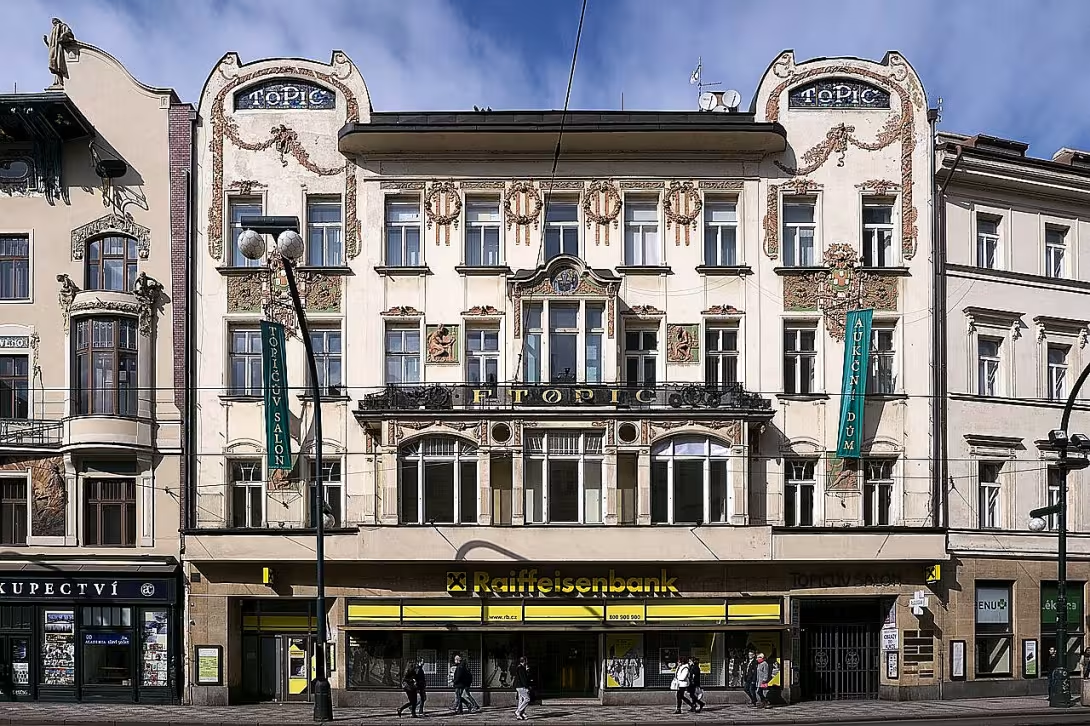
Topičův salon, located in Prague's Old Town on Národní třída, is a historic gallery with roots tracing back to 1894. Established as part of František Topič's publishing business, it became the longest-running private gallery in Prague. The building, designed by architect Jan Zeyer, features a distinctive glass roof that allowed natural lighting for exhibitions. Over its history, the salon hosted numerous art exhibitions and played a significant role in promoting modern artistic movements such as symbolism and Art Nouveau.
The origins of Topičův salon are closely tied to František Topič's publishing business, which began with a bookshop in 1883 and expanded into a publishing house by acquiring František Šimáček’s legacy. By 1886, the enterprise had broadened its offerings to include artistic products and sheet music. The salon itself was inaugurated as part of Topič's business on Národní třída in 1894, within a building designed by Jan Zeyer. This period marked a cultural renaissance in Bohemia, with significant developments in art and literature, including the rise of Art Nouveau across Europe.
Architecturally, the salon was notable for its two-wing structure and glass roof, which provided innovative natural lighting for exhibitions. The building underwent a significant Art Nouveau adaptation at the beginning of the 20th century, enhancing its aesthetic appeal. This design choice not only facilitated better display conditions but also aligned with the modern artistic movements that Topič sought to promote.
Ownership and administration of Topičův salon saw several transitions over the years. Initially managed by František Topič until 1899, it later became part of Společnost F. Topič. The gallery experienced various phases of operation, each marked by different owners and purposes, reflecting its adaptability to changing cultural landscapes.
Throughout its history, Topičův salon hosted significant events that underscored its importance in the art world. Notably, in 1896, it was the venue for the Exhibition of Graphic Arts, featuring prominent European artists such as Toulouse-Lautrec. The gallery consistently showcased modern artistic movements and supported Czech artists, contributing to the cultural fabric of Prague.
Today, Topičův salon continues to be a site of historical and cultural significance. While its original function as a private gallery has evolved, it remains an integral part of Prague's art scene. Visitors can appreciate its architectural beauty and rich history, making it a worthwhile destination for those interested in the intersection of art and architecture.
Topičův salon stands as a testament to the vibrant artistic heritage of Prague. Its legacy as a pioneering venue for modern art movements invites exploration and appreciation from both art enthusiasts and historians alike. A visit to this historic site offers a unique glimpse into the cultural evolution of one of Europe's most storied cities.
Then and now
Drag the slider to compare how the landmark may have looked when it was built with the view today.
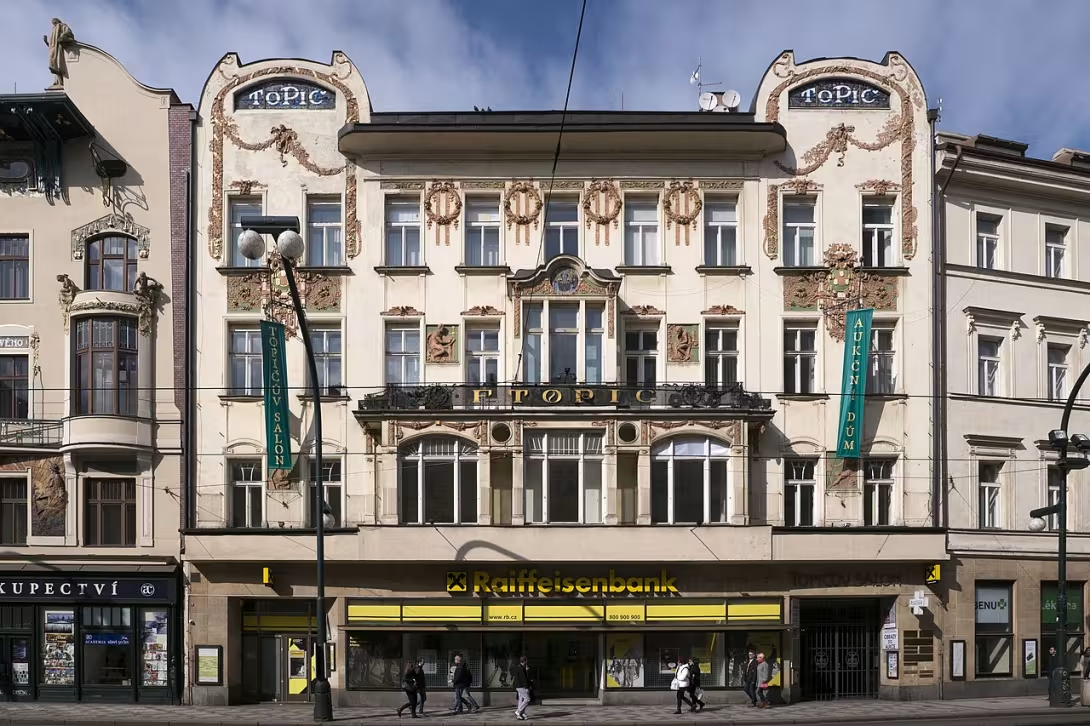

The historical appearance on the left is an AI-generated visualisation and serves as inspiration only.
Historical milestones
- 1894
- Topičův salon opened as a gallery and exhibition space.
- 1896
- Hosted the Exhibition of Graphic Arts featuring European artists like Toulouse-Lautrec.
Architectural development
Originally built in 1894 with a two-wing structure and glass roof by Jan Zeyer, the building underwent a significant Art Nouveau adaptation at the beginning of the 20th century. It served as a gallery until 1949-1950 before being transformed into the Exhibition Hall of the Czechoslovak Writer.
Historical events
Opened as a gallery in 1894, becoming a prominent venue for art exhibitions.
Hosted significant events such as the 1896 Exhibition of Graphic Arts featuring notable European artists.
Owners
František Topič (1883-1899), Společnost F. Topič (post-1899), various owners until its current use by the National Gallery of Prague.
Points of interest
– Despite its reputation as a private gallery, Topičův salon was temporarily transformed into a cinema in the 1950s, reflecting the shifting cultural priorities of post-war Prague.
– The building's glass roof, while primarily intended for natural lighting, reportedly inspired local architects to incorporate similar designs in other public buildings across Prague, influencing the city’s architectural evolution.
– In its early years, Topičův salon was a hotspot not just for art exhibitions but also for secret literary gatherings where banned works were discussed and circulated among intellectuals during periods of censorship.
– The salon once hosted an exhibition featuring only artworks created by left-handed artists, showcasing the diversity in artistic expression and challenging traditional norms within the Bohemian art community.
– During World War II, Topičův salon served as a temporary shelter for valuable manuscripts from Prague’s libraries, highlighting its role beyond just an art venue during times of crisis.
Guide
This guide is narrated by a synthetic voice generated by artificial intelligence.
Show guide text
This text was created by artificial intelligence and has not been editorially reviewed. It may contain inaccuracies.
Welcome in front of the Topič Salon, one of the most significant galleries in Prague. You are standing before a unique building that symbolizes cultural and artistic activity in our beautiful metropolis.
Let's step back into the past. In 1894, František Topič founded the Topič Salon as a gallery and exhibition space. He was an important Prague publisher and patron of the arts. It became one of the longest-running private galleries in Prague.
Now, pay attention to the building itself. Take a look at the glass roof that allows natural lighting for the exhibition spaces. This is truly a unique architectural detail that gives the space its distinctive atmosphere.
The Topič Salon was more than just a gallery. It hosted a series of significant artists and art exhibitions. For example, in 1896 it held an exhibition of graphic arts featuring artists like Toulouse-Lautrec.
Notice that Topič's building has more value than just artistic significance. It is also a witness to historical events. In the 1950s, the building was even converted into a cinema, which is a notable testament to the shifts in cultural priorities after World War II.
Besides history and architecture, there are plenty of interesting details here as well. For instance, how local architects were inspired by the glass roof to design similar elements in other buildings.
Now you can return to the present and explore other parts of Prague. Thank you for your attention, and I hope you enjoyed the Topič Salon.
Tips for visitors
The best time to visit Topičův salon is during the late spring or early fall when the weather is pleasant, allowing you to comfortably explore both the gallery and its surroundings. These seasons offer mild temperatures and fewer crowds, enhancing your experience of this historic site. Additionally, visiting on weekdays can provide a more tranquil atmosphere compared to weekends.
When visiting Topičův salon, it's recommended to bring comfortable footwear as you may want to explore nearby areas on foot. A camera is also advisable for capturing the architectural beauty of the gallery and its surroundings. Since photography inside might be restricted in some parts, checking ahead with the gallery staff can ensure compliance with their policies.
The best spots for photography at Topičův salon include the exterior facade, which offers a stunning view against Prague's skyline, especially during golden hour when the light is soft and warm. Inside, look for areas where natural light illuminates exhibits or architectural details. For families with children, consider visiting nearby cultural landmarks such as the National Museum or St. Vitus Cathedral, both within a 30-minute walk, offering educational and engaging experiences.
For families with children, Topičův salon provides an enriching experience with its historical significance and artistic exhibits. Nearby attractions like the Old Town Square and Charles Bridge offer additional activities that are enjoyable for all ages. These sites provide opportunities to learn about Prague's history while also allowing kids to explore and play.
Frequently asked questions
Can the monument be visited?
Some buildings of this kind are open for guided tours, others serve another purpose or are privately owned. We have not verified whether and when this monument is open – please ask the operator.
What are the opening hours and admission?
We have not verified the opening hours or admission. Current information is published by the operator. Official website: http://www.topicuvsalon.cz
Where is the monument?
Location: Praha 1, Hlavní město Praha. The map on this page shows the exact spot.
Why is the monument protected?
It is listed in the Central List of Cultural Monuments of the Czech Republic as a cultural monument (register no. 1000150851).
Businesses nearby
Do you run a restaurant, accommodation, shop, museum, rental, wellness or other visitor service near this monument? Show yourself directly to the people heading to it — this is how they will see you in the app and on the web:
Events nearby

Zdroj akcí: otevřená data měst a obcí ČR (Národní katalog otevřených dat) a kalendář akcí Národního památkového ústavu.
Nearby
Located on Národní třída, the area is known for its historical significance and proximity to other cultural landmarks in Prague's Old Town.
Accommodation nearby
Trips and activities nearby
Guided tours, tickets and activities nearby from GetYourGuide
Affiliate link: if you buy from the partner, we may receive a commission. The price for you does not change.
Search tours and activities →Themed route
Trasa: 1. Národní dům (historické místo) - stojí za návštěvu pro svou historickou a kulturní významnost v Praze. 2. Národní divadlo (kulturní instituce) - známé svou architekturou a operními představeními. 3. Pražský orloj (historické místo) - pozoruhodný astronomický a technický vynález. 4. Staroměstská mostecká věž (historické místo) - dominantou Staromestskeho náměstí a pozoruhodná architektura. 5. Topičův salon (galerie) (kultura) - známá galerie s bohatou sbírkou uměleckých děl.
Seasonal recommendations
Jaro: In the spring season, Topičův salon is characterized by gentle lighting and a pleasant atmosphere. Suitable attire for visiting the gallery includes comfortable shoes and clothing appropriate for walking tours.
Léto: During the main summer season, Topičův salon is very popular, so it's best to visit in the morning hours to avoid crowds. Suitable attire includes comfortable shoes and clothing appropriate for walking tours.
Podzim: In the autumn season, Topičův salon is characterized by a pleasant atmosphere and romantic lighting. Suitable attire for visiting the gallery includes comfortable shoes and clothing appropriate for walking tours.
Zima: In the winter season, Topičův salon is characterized by warmer lighting and a calm atmosphere. Suitable attire for visiting the gallery includes warm clothing and shoes.
Visualizations and artistic views


The visualisations are generated by artificial intelligence and serve as inspiration.
Photos from the area
Real photos taken near the monument


Zdroj a licence jsou uvedeny u každého snímku.
Tips from visitors
No tips yet. Be the first!
Log in and add your tip.
Sources and literature
Photos: Thomas Ledl / CC BY-SA 4.0 — Wikimedia Commons. The author and licence also appear when you hover over the image.
Faktickým podkladem tohoto textu byl článek na Wikipedii, jehož autory jsou přispěvatelé Wikipedie. Článek je dostupný pod licencí CC BY-SA 4.0.
Location on the map
More monuments – Praha 1
Show all in the municipality

Příběhy a pověsti
Legendy, pověsti a příběhy spjaté s touto památkou
Fotografie návštěvníků
Zatím žádné fotografie. Buďte první, kdo přidá fotografii z návštěvy!
Log in a přidejte svou fotografii nebo hodnoťte.
Za ověřenou návštěvu v aplikaci získáte víc bodů — poznáme podle GPS, že jste na místě.
Reviews and comments