



Václavíkův mlýn Mill
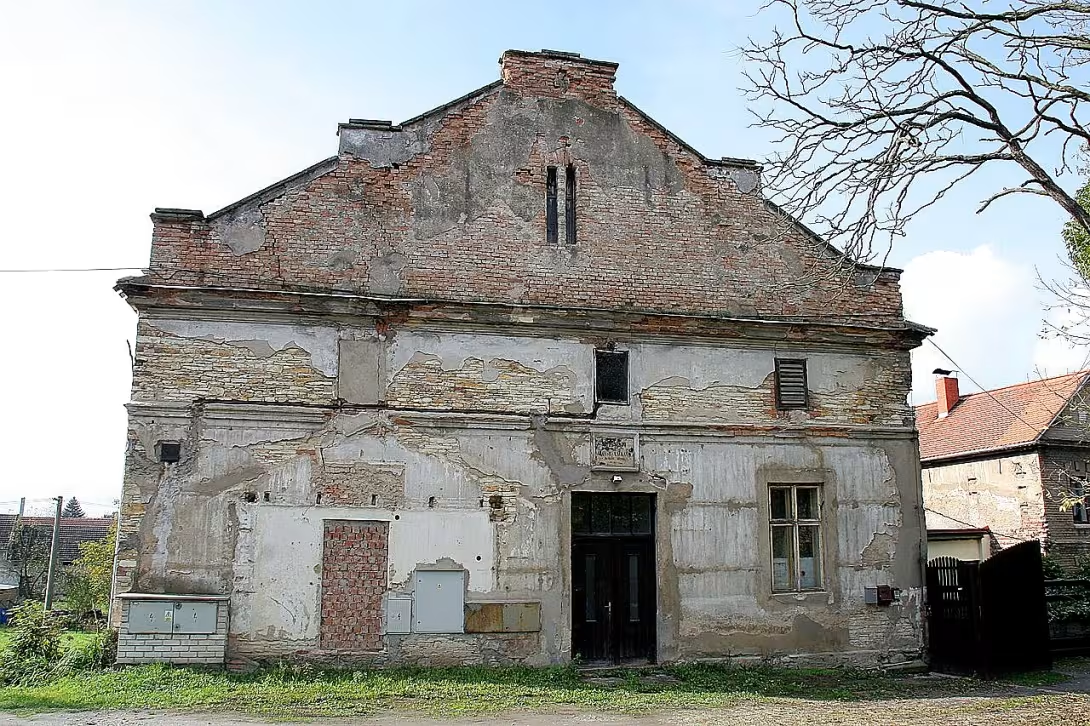
Václavíkův mlýn, also known as Žehuň or Žehuň motor mill, is a walled building of the former water mill in the village Žehuň on the river Cidlina. The building has since been a cultural monument of the Czech Republic and is an important historical whole of the local region.
There was another building at today's site before 1787. This was purchased in that year by the miller Josef Václavík from the House of Pohořelecký. In 1819 the monument burned down and its restoration to its present form took place in 1857 under the guidance of Joseph's son Alois. This reconstruction took place during the sharp expansion of industry and technical buildings in Czech countries. At the same time a water saw was created with the new mill.
The building has a rectangular floor plan, is two storey with a soil half-floor and is covered by a saddle roof. He's leveling the west side of the basement for the slope. Under the common roof was the residential part and the mill itself. The masonry consists mainly of optics, while the shields are made of bricks. The facade shows an utilitarian nature and the fracturing is only a plinth along with the ledge. The entrance portal is located in the main eastern facade. On the south wall there are still clear remains of the inscription WAL MILLEN.
The property belonged to the Václavík family from 1787 to 1956. In 1930 he held the property of Zdeněk Václavík. It modernized the original milling system consisting of three water wheels on top of the water by installing Francis' 50-horsepower turbine. After 1956, the campus was nationalized, and the school with the school team was located in the interior. In 1991, the relatives recovered the property in restitution proceedings together with the adjacent Wenceslas villa. Today, the property is owned by the descendants of the original family, the Solomon family.
Since 2000, the mill, including land, has enjoyed the status of protected cultural heritage. According to the available reports, the site has remained abandoned and without use since 2017.
Václavíkův mlýn is a valuable document of technical history and regional architecture. The stop at this place provides a view of the history of miller craft and building development.
Historical milestones
- 1787
- The miller Josef Václavík purchased the original mill from the family Pohořelecký.
- 1819
- The mill burned down.
- 1857
- Alois Václavík rebuilt the mill into today's form and a water saw was created.
- 1930
- Zdeněk Václavík modernized the milling plant and installed Francis' turbine.
- 2000
- The building was declared a cultural monument of the Czech Republic.
Architectural development
The site of the current mill stood since 1787 an older building which was completely destroyed after the fire in 1819. He took today's form in the reconstruction in 1857, led by Alois Václavík. The masonry is mainly opal, while the shields are brick and the facade has an utilitarian character.
Historical events
In 1819 the mill burned down. In 1857, the reconstruction took place today. The Francis turbine was modernized and installed in 1930. In 2000, the building was declared a cultural monument.
Owners
The mill family Pohořelecký (until 1787), the family Václavíky (1787- 1956), the Czechoslovak state (1956- 1991), the family Václavík or their descendants the family Šoltys (since 1991).
Points of interest
- The former water mill building in the village Žehuň has since been a cultural monument of the Czech Republic and is a significant historical whole of the local region. - The monument burned down in 1819 and its renewal took place in 1857 under the guidance of Alois, son of miller Josef Václavík. - The property belonged to the Václavík family from 1787 to 1956 and after 1956 the premises were nationalized. - Zdeněk Václavík modernized the original grinding system in 1930 by installing a 50-horsepower Francis turbine. - According to the available reports, the building has been abandoned since 2017 and without use.
Guide
Show guide text
This text was created by artificial intelligence and has not been editorially reviewed. It may contain inaccuracies.
Welcome to Václavík's Mill. Right now, you are standing in the very heart of the village Žehuň, where history meets the constant stream of water of the Cidlina river. If you look around you, you will see a building that is not just an ordinary house, but a living witness to the many years that have passed by. Feel the atmosphere of peace and stability that this walled building radiates. It is a place that carries alternated lottery tickets and difficult moments, yet it still stands here and reminds us of its important role for the whole region.
Let us now return to the past together to understand how everything began. This whole story, which takes place right before your eyes, has its beginning in a thousand seven hundred and eighty-seven. At that time the miller Josef Václavík purchased this original mill from the family Pohořelecký. Imagine that time when working in the mill was the basis of life for the entire community. But history is unpredictable and not always kind. In the year one thousand eight hundred nineteen something happened that could have ended this story. The mill was hit by a devastating fire and burned. The place where life used to work was nothing but emptiness and ashes. But it was at these difficult times that the power of the people who loved this place showed up.
Now pay attention to the architecture of the building you are currently observing. Notice its bright and practical shape. The whole object has a rectangular plan, which gives the building a feeling of strength and balance. It's a two-storey building that's filled with space in the form of a half-floor, and it's all covered by a classic saddle roof. When you look at the overall structure, you realize one very interesting thing. This building was designed to connect two completely different worlds under one roof. One part of the building served as a residential part, a home for the family, while the other part was the mill itself, where it was constantly working. A water saw was attached to this whole in the past, making it the real centre of the local craft.
This story of renewal and endurance is closely linked to the names of several Wenceslas. After the tragic event when the mill burned down, the Alois Václavík set in. He was the son of the original miller Joseph, and in the year one thousand eight hundred fifty-seven mills he rebuilt and brought him to his present form. Thanks to his efforts and courage, a water saw could be created here again and life in the mill could continue. The family tradition and efforts to improve continued in other generations. In the year one thousand nine hundred thirty brought another fundamental change to Zdeněk Václavík. He decided to upgrade and install the so-called Francis turbine into the mill. Imagine the technological revolution that came at the time, which allowed the mill to work even more efficiently and more modern.
You might find one interesting thing that gives this place even more weight. Although it may seem to be just an old house by the water, Václavíkův mlýn is seen as an extremely important historical unit for the whole local region. Its value was so high that in the year two thousand, the Ministry of Culture of the Czech Republic officially declared it a cultural monument. This means that this object is not only part of the village, but is protected as a treasure of our heritage. It is proof that even when the world is changing, even when new times and new technologies are coming, certain points in the landscape remain the fixed anchor of our history.
Look at these walls and imagine all the human destinies that have passed here. Imagine the noise of water, the sound of grinding stones and the movement of people who spent their days here. This mill is not just a walled-up building, it is a record of human labour, family commitment and ability to rise again even after a major disaster.
I hope you enjoyed this short journey through Václavíkův mlýn. Now you know much more than what you see at first sight. Please continue to walk around the Cidlina River and feel the beauty of this place. Maybe if you look at this building again, you'll see even more details that you missed before. Thank you for your time and read again in the spirit of the history of these walls. Goodbye.
Tips for visitors
To visit the Wenceslas Mill in the village Žehuň it is ideal to choose the spring or autumn period when the surrounding nature around the Cidlina River offers unique views of historical architecture without a large number of people. The location is available by car and public transport, while check the current connection in the connection search engine. Take your comfortable shoes to walk around with you and your camera to capture the beauty of the countryside.
For photography lovers, the central part of the village Žehuň and the banks of the Cidlina River offers great conditions especially in the morning, when the sunlight ideally illuminates the facade and details of the wall building of the former water mill. The best shots can be obtained when you capture the entire building with a rectangular plan, which has two floors with a floor and a saddle roof. Use the views from different angles along the water stream to capture the authentic atmosphere of this historic place.
In the immediate vicinity of the Wenceslas Mill, you can also visit the monument protected Wenceslas Villa in the village Žehuň, which forms a harmonious whole with the mill. Walk around the Cidlina River directly in the village Žehuň will please all fans of quiet quivers, while the whole area provides enough visual stimuli for admirers of old buildings and technical monuments.
Families with children appreciate the quiet environment of the village Žehuň, where small visitors can see the running water on the river Cidlina and the old building. The walk around the Václavík Mill and the secondary monument protected Václavík Villa is easy and suitable for all ages, and you can bring children closer to how water structures and mills on rivers used to work.
Frequently asked questions
Can the monument be visited?
This is a technical monument. Some are open as exhibitions, others are out of use or on private land. We have not verified whether this one is accessible.
What are the opening hours and admission?
We have not verified the opening hours or admission. Current information is published by the operator.
Where is the monument?
Location: Žehuň. The map on this page shows the exact spot.
Why is the monument protected?
It is listed in the Central List of Cultural Monuments of the Czech Republic as a cultural monument (register no. 1000163268).
Businesses nearby
Do you run a restaurant, accommodation, shop, museum, rental, wellness or other visitor service near this monument? Show yourself directly to the people heading to it — this is how they will see you in the app and on the web:
Nearby
Mlýn stojí přímo v obci Žehuň na řece Cidlina a v jeho bezprostřední blízkosti se nachází památkově chráněná Václavíkova vila.
Accommodation nearby
Trips and activities nearby
Guided tours, tickets and activities nearby from GetYourGuide
Affiliate link: if you buy from the partner, we may receive a commission. The price for you does not change.
Search tours and activities →Themed route
Thematic cruise route to Žehňa
1. Václavíkův mlýn (mill) This historic mill stands right on the Cidlina river and is one of the main heritage of the village Žehuň. The mill was a key part of the local industry in the past and still fascinates its architecture and history.
2. Václavík's villa (monument protected object) In the vicinity of the mill there is a monument protected Václavík villa, which is an example of regional architectural art. Her history and design are the reason she's worth visiting. While walking you can enjoy a quiet surroundings and a beautiful view of the natural landscape.
3. Municipality of Žehuň (local centre) Explore the village itself, which offers quiet streets and the opportunity to enjoy local cafes or restaurants. Žehuň is an ideal place to relax after visiting monuments.
This route allows you to immerse yourself in the history and nature of the village Žehuň while enjoying the peace and beauty of the region.
Seasonal recommendations
Spring in Žehuni brings awakening nature around the water stream, where fresh green grass contrasts with old wooden beams of the historical mill. Sun rays penetrate at a low angle early in the afternoon and create ideal lighting conditions for exterior photography. During this period you will appreciate fixed and waterproof shoes because the field roads in the surrounding area are drenched in tidal and spring rain. The best time for a peaceful walk without disturbing influences is in the morning, when the landscape is still rising and the morning fog slowly rises from the water level.
Summer months offer lush vegetation, which partly surrounds the whole technical structure and gives it a shady corner full of peace. The sun burns sharpest around noon, which is why it is best to visit the surrounding area late afternoon, when the temperature falls and golden light nicely depicts the details of the historical masonry. Wear light breathable clothes and don't forget the headgear and effective remedy against the difficult insects that naturally occur in the water on warm days. In the main summer season you will meet more cyclists and dogmen in nature, so take a tour early in the morning.
The autumn atmosphere at the Václavík Mill is characterized by colorful leaves in the surrounding trees, falling leaves and frequent morning fog, which give the whole place a slightly mysterious character. The light is dampened by a gray sky, which amplifies the historic atmosphere of an old water work. For this part of the year, choose warmer layered clothes, windbreaker and fixed shoes into fallen and often wet leaves. The best time for admiring the autumn landscape is around noon, when the fog breaks sometimes and briefly shows the autumn sun.
Winter covers the whole area in silence and snow sheets, which calms the surrounding landscape and makes the technical shapes of the building stand out under the bare sky. The day is very short and the sunlight has a cold touch, with early dimming coming already in late afternoon. The need is quality winter clothes, warm gloves and tight shoes with anti-slip soles, because access roads can freeze and slide. The best time for a short winter walk is the right noon, when the outside is the hottest and the surrounding landscape is best lit by a weak daylight.
Visualizations and artistic views

The visualisations are generated by artificial intelligence and serve as inspiration.
Photos from the area
Real photos taken near the monument


Zdroj a licence jsou uvedeny u každého snímku.
Tips from visitors
No tips yet. Be the first!
Log in and add your tip.
Sources and literature
Photos: Petr1888 / CC BY-SA 4.0 — Wikimedia Commons. The author and licence also appear when you hover over the image.
Faktickým podkladem tohoto textu byl článek na Wikipedii, jehož autory jsou přispěvatelé Wikipedie. Článek je dostupný pod licencí CC BY-SA 4.0.
Location on the map






Příběhy a pověsti
Legendy, pověsti a příběhy spjaté s touto památkou
Fotografie návštěvníků
Zatím žádné fotografie. Buďte první, kdo přidá fotografii z návštěvy!
Log in a přidejte svou fotografii nebo hodnoťte.
Za ověřenou návštěvu v aplikaci získáte víc bodů — poznáme podle GPS, že jste na místě.
Reviews and comments