






Vejnarova motorová elektrárna Power plant
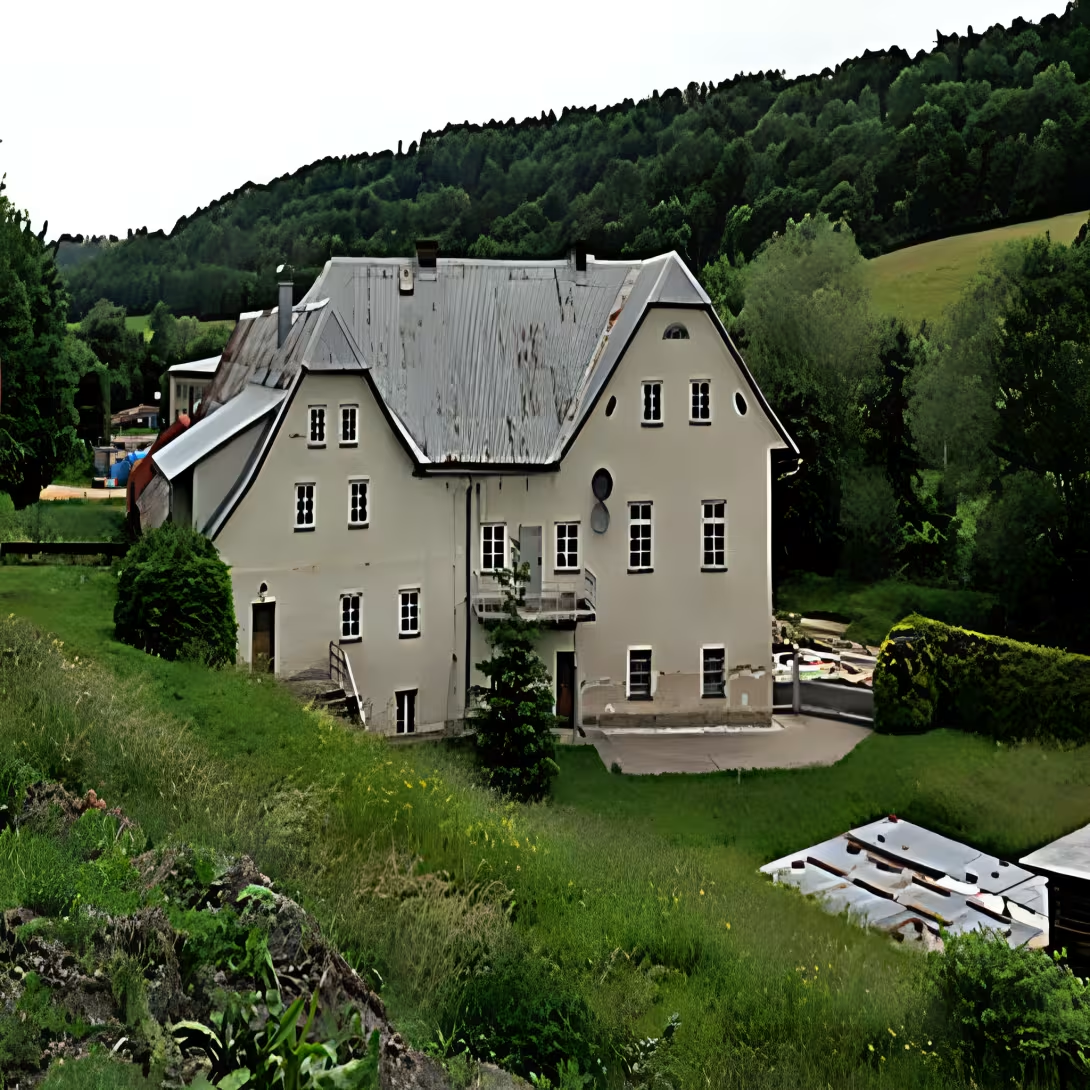
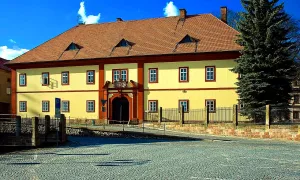
The Vejnar Power Plant, originally the Empire Mill, is a technical monument in Hrabacov, part of Jilemnice in Semily district in the Liberec Region. The history of the object dates back to the 16th century. In 1912 the building underwent a major reconstruction into a hydroelectric power plant, which from the following year supplied electricity to the whole of Jilemnice.
The first written mention of the mill in this place dates back to 1543, when the building is listed in the town hall. During the 18th century the mill was owned by the miller Zajíček, who divided it into two parts. He subsequently managed these parts together with Václav Koudelka from Víchov nad Jizerou. On 30 August 1814 Koudelka sold his share to Josef Šubrt, the innkeeper of Arnoštov, for 9100 francs. Since 1826, the Vejnar family became the owner, whose name the power plant still bears today.
The current building dates back to the beginning of the 19th century and bears signs of the Empire style. In 1912 the construction was subject to extensive adaptation and technologically converted into a hydroelectric power plant. During the 20th century, however, the building underwent a series of insensitive modifications which disrupted its original architectural expression. Despite these interventions, the construction has been included in the list of cultural monuments since 3 May 1958.
The operation of the power plant was provided by P & P Vejnar, founded by Petr and Pavel Vejnar. In 1912, negotiations were held between the company and the city of Vysoké nad Jizerou on the introduction of electricity, which was not successful. Since 1913, the power plant has become a key source of energy for Jilemnice and its surroundings, making a major contribution to local modernisation. After World War II, the enterprise was nationalised under the 1946 Decree.
Vejnar Power Plant is an important document of technical development and industrial electrification of Czech cities in the early 20th century. Visiting this place offers insight into the history of the region, which is closely linked to the development of energy and the transformation of traditional craft structures into modern industrial objects.
Then and now
Drag the slider to compare how the landmark may have looked when it was built with the view today.
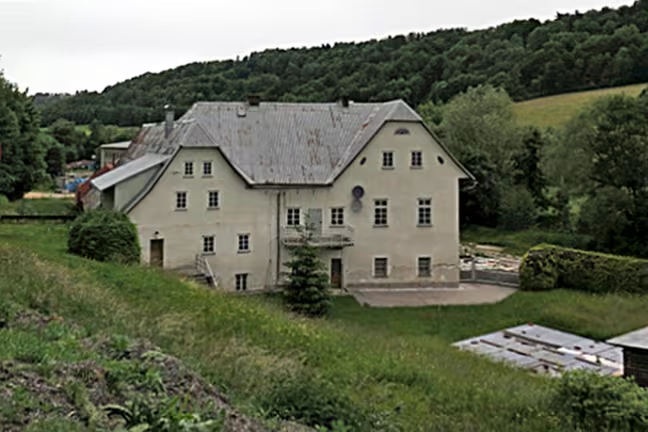
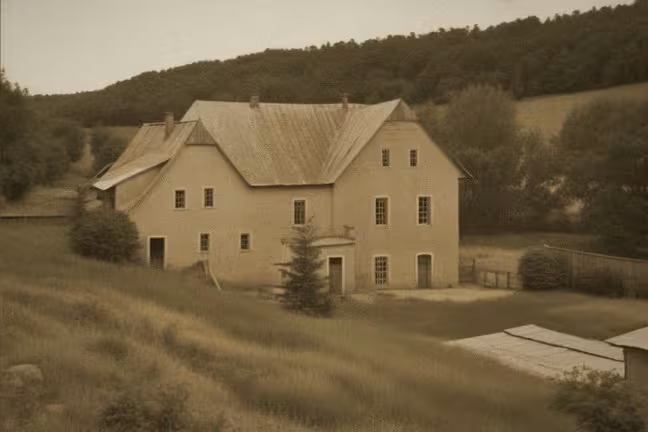
The historical appearance on the left is an AI-generated visualisation and serves as inspiration only.
Historical milestones
- 1543
- First written mention of the mill in the urbarian.
- 1826
- The object is being transferred to the Vejnar family.
- 1912
- Reconstruction of the mill to the hydroelectric power plant and establishment of P & P Vejnar.
- 1958
- The construction is declared a cultural monument.
Architectural development
The original Empire mill was adapted to the operation of the hydroelectric power plant in 1912. During the 20th century, the building was subjected to insensitive reconstructions which disrupted its original architectural expression.
Historical events
1543 first written mention of the mill, 1912 conversion to power plant, 1913 start of electrification Jilemnice, 1946 nationalization of the company.
Owners
The Bunny family (18th century), Václav Koudelka, Josef Šubrt (from 1814), the Vejnar family (from 1826).
Points of interest
The history of the object dates back to the 16th century. - Originally it was a mill which was converted into a hydroelectric power plant in nineteen hundred and twelve. - Since 18 hundred and twenty-six, the Vejnarov family has become the owner, after which the building bears its name. Since nineteen hundred and thirteen, the power plant has been supplying electricity to all of Jilemnice and its surroundings. - The construction has been registered in the list of cultural monuments since 3 May.
Guide
Show guide text
This text was created by artificial intelligence and has not been editorially reviewed. It may contain inaccuracies.
Welcome to Potato Head. You are standing in front of one of the most important technical objects in this region, a building that carries the incredible power of time and constant movement. The Vejnarova motorová elektrárna stands before your eyes, but this building is much more than just a building full of machines. It's a living story about how human effort and technological progress have changed over the centuries. If you look at it now, try to imagine how many generations of people have stopped here, how many times people's work and the very essence of what this place has to offer changed here. Feel the atmosphere of a place that once was the heart of production and which later became a source of light for the whole area.
Let's go back deep into the past together to understand where this story really started. The history of this place is not short, because it dates back to the sixteenth century. The first written mention of this mill appears in documents already in the year 15-45. Imagine that time when the world moved much slower, when all work was dependent on the power of nature and human hands. This mill was then a key point for the local community, a place where the grain was processed and where the basic viability was formed. It was an era when water was the main engine of everything that was going on around here.
But over time, the fate of this place began to change. One of the most fundamental breakthroughs occurred in 18 hundred and twenty-six. That was the year the object went into the hands of the Vejnar family. This family became not only the owner, but above all the guardians of this place. Their name became synonymous with stability and development, and it was through their decision and vision that this object became what it is today. The Vejnar family brought energy into place, which moved it from the simple mill to something much more modern and important.
Now pay attention to what happened during the period that brought about the world revolution in technology. Break your thoughts to nineteen hundred and twelve. That was the year this object witnessed one of the greatest changes in its history. The old mill, which has served the people for centuries, has undergone a major reconstruction. It wasn't just a grain mill anymore. The building turned into a modern hydroelectric power plant. This transformation was a huge step forward, requiring courage and huge investment in a new type of technology. In this period P and P Vejnar were also created, which became a symbol of a new age.
This change has had an immediate and tangible impact on the lives of people around here. Since nineteen hundred and thirteen, the power plant has started to perform its new, exciting role. It started supplying electricity directly to the city of Jilemnice. Imagine the amazing moment when for the first time in the history of the city, lights started to shine, not from the fire, but from the current of water and the power of machines in this building. This power plant was the engine of modernization that brought light to households and energy to factories. It was a revolution that changed the daily life of thousands of people.
Now when you look at the construction itself, pay attention to its structure and how it fits into this environment. Even if you look at the building today as a historical object, feel its rugged. It's a building that must have been able to carry the water and the power of the machines that once rumbled here. Feel how its shapes and its overall form reflect its functions. Even if you can't see every detail at this point, we can feel the strength and stability that the builders and owners put in. It is an architecture that serves a purpose, an architecture that is firmly linked to the energy that was created in it.
But it is the people who are behind all this success and development. The history of this place is not only about stones and machines, but about personalities who had the courage to change the world. We must remember here names such as Petr Vejnar or Pavel Vejnar, which were linked to the development of this place and to the family heirlooms they left behind. Their work and their visions have allowed this object to survive for centuries and become such an important monument. We must also remember the name Josef Šubrt, which is also part of this rich history. These people were movers of change, people who believed in progress and the power of technology.
It's fascinating how this object managed to adapt to all these changes. It's like the building has the ability to change its soul without losing its essence. The mill that used to grind became a power plant that supplied light. It is a fascinating idea that a place that was once perceived as traditional and old became the epicenter of modern age. This ability to adapt is one of the greatest mysteries and at the same time the greatest admirable qualities of this place.
Today, this building is perceived quite differently than a hundred years ago. Since 25: 8, this building has been officially declared a cultural monument. That gives us a clear signal that what you see before you is of enormous value. It's not just an old house, it's a monument to human ingenuity and technical progress. It is proof of how we can change and adapt to new challenges.
Before you go on your next trip and continue to explore the area, stop for a moment. Feel the silence that rules here now, while earlier there was the rumbling of machines and the current of water. Feel this peace and realize that you are standing in front of a place that has defined a modern era for this whole city. Thank you for sharing this story with us. We wish you a wonderful journey to discover the beauty of this region and other historical secrets.
Tips for visitors
The best time to visit is during the sunny morning, when natural light beautifully highlights historical masonry and technical elements of the building. Due to the technical nature of the monument, we recommend choosing days with favourable weather for comfortable movement around.
You can easily reach the monument by car, parking is possible in the nearby area. Use the local connection to Jilemnice to travel by public transport and then to the part of Hrabachev; Check the exact connection in the current connection search engine.
For photography we recommend to capture detailed images of the technical equipment and exterior of the building, which best excels during side lighting. Don't forget to wear fixed shoes because the terrain around historical buildings can be uneven.
In the immediate vicinity you can visit the historical center of Jilemnice, explore the exposition in the Giant Museum or walk along the river Jizerka, which offers a pleasant diversification of the trip.
For families with children the location is suitable as a stop when exploring the technical history of the region. Walk to the river Jizerce is easy and suitable for smaller visitors who appreciate the outdoor stay in combination with history.
Businesses nearby
Do you run a restaurant, accommodation, shop, museum, rental, wellness or other visitor service near this monument? Show yourself directly to the people heading to it — this is how they will see you in the app and on the web:
Nearby
Město Jilemnice s historickým centrem, Krkonošské muzeum, řeka Jizerka.
Accommodation nearby
Themed route
Historical Center Jilemnice Type: City Monument Zone. Why is it worth a visit: The preserved Baroque and Classicist houses with decorations create a cozy atmosphere full of historical details, which are an excellent introduction to the region.
Krkonose Museum Type: Regional Museum. Why is worth a visit: It offers a rich exhibition dedicated to nature, history and folklore Giant Mountains, which will provide an important context for understanding the surrounding landscape and technical monuments.
Vejnarova motorová elektrárna (mill) Type: Technical monument. Why is it worth a visit: A unique preserved example of a motor power plant from the beginning of the 20th century shows the history of local energy and industrial water-powered production, its interior and machines are exceptional technical evidence.
Jizerka River Type: Natural and recreational element. Why is it worth a visit: Provides the possibility of relaxation and beautiful views of the surrounding countryside, is an ideal place to end the trip and rest after visiting historical and technical attractions.
Seasonal recommendations
Seasonal recommendations for visiting historical monuments Memorial: Vejnarova motorová elektrárna (mill), Jilemnice Condition: satisfactory
In spring nature wakes up around the old mill and trees start to green. The morning sun gently lights the brick walls and the air is fresh. We recommend you take several layers of clothing because the weather is usually variable. In this period they are not yet at the sights of the crowd, so it is best to come in the morning for maximum peace.
The summer season offers intense sunshine and rich vegetation that surrounds the historic area. The atmosphere is warm and alive. Due to the main summer season we recommend you come as early as possible in the morning to avoid the biggest rush of people and heat. Dress lightly and don't forget to protect yourself from the sun.
Autumn brings gold colours and orange shades of leaves that create a beautiful contrast with technical construction. The morning mist above the water gives the place a nostalgic atmosphere. It is advisable to carry with you stronger shoes because of wet soil. The best time to see the light is this afternoon.
Zimą is covered in snow and frost, highlighting its rugged appearance. The atmosphere is quiet and lonely. Due to low temperatures and shorter time of day bring very warm clothes and plan a visit around noon when the lights are most.
Visualizations and artistic views


The visualisations are generated by artificial intelligence and serve as inspiration.
Photos from the area
Real photos taken near the monument

Zdroj a licence jsou uvedeny u každého snímku.
Tips from visitors
No tips yet. Be the first!
Log in and add your tip.
Sources and literature
Photos: Sovicka169 / CC BY-SA 4.0, rozlišení zvýšeno umělou inteligencí — Wikimedia Commons. The author and licence also appear when you hover over the image.
Faktickým podkladem tohoto textu byl článek na Wikipedii, jehož autory jsou přispěvatelé Wikipedie. Článek je dostupný pod licencí CC BY-SA 4.0.
Location on the map

Příběhy a pověsti
Legendy, pověsti a příběhy spjaté s touto památkou

Fotografie návštěvníků
Zatím žádné fotografie. Buďte první, kdo přidá fotografii z návštěvy!
Log in a přidejte svou fotografii nebo hodnoťte.
Za ověřenou návštěvu v aplikaci získáte víc bodů — poznáme podle GPS, že jste na místě.
Reviews and comments