






Venkovský dům (Heřmanovice, 1000147083) House
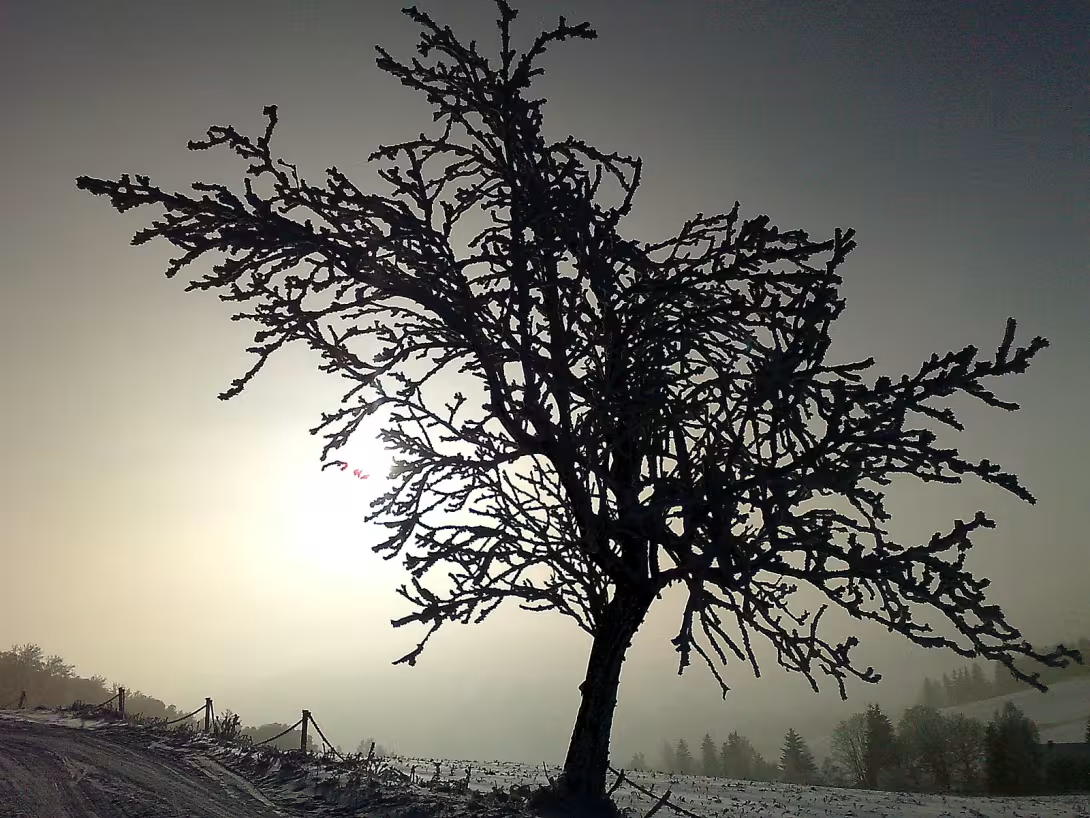
The rural house No. 290 in Heřmanovice is a typical example of the Jesenice rural house from the 19th century. Located in the heritage reserve of Hømanovice, which keeps the authentic rural character of the area. It is a ground-floor grafted building with a chamber-sty layout, which is characterized by typical architecture and decorative elements characteristic of the region.
The house is a protected cultural monument, but its original appearance was damaged after the reconstruction of 2009. Heřmanovice, located in Bruntál district, is part of a village monument reservation that retains the original rural character.
The construction is ground floor, grafted, on a low suspect with a rectangular plan. The saddle roof is covered with eternity, while the shield is painted with wooden lats with refine in the clutches. At the bottom of it are decorative arches that give houses a characteristic look. The entrance facade has a rectangular entrance, while the windows are placed in frames decorated with a cut. The layout of the house is chamber-sty, i.e. a combination of living spaces with stables and chambers. A rainshed is attached to the house, which is part of the overall arrangement.
Although the 2009 reconstruction failed to preserve the original character, the house retains some typical features of the Jesenice house. Heřmanovice offers visitors the opportunity to learn about preserved rural architecture, supplemented by forests and meadows that strengthen the historical nature of the village.
House No. 290 is now open to the public, although its condition after reconstruction is not ideal. Yet it represents an interesting example of rural architecture and part of the monument reservation. For lovers of history and architecture, it is an exemplary object that illustrates the life of the countryside in the 19th century. The visit allows you to understand the development of rural houses and their characteristic features.
Historical milestones
- around 1750-1800
- The creation of the original grafted structure typical of Jesenice rural architecture
- 19th century (approximately 1830-1880)
- Completion of the main part of the house with chamber-sty layout and typical regional elements
- around 1900
- Completion of the adjacent rainshed as part of the rural economic complex
- 2009
- Reconstruction that damaged the original appearance and authenticity of the house
Architectural development
The house was built as a ground-floor grafted building on a low suspect in the 19th century. It was originally built as a typical rural house with a chamber-sty layout. The roof is saddled with eternity, the shield is decorated with wooden lats with lining. A rainshed was added to the house. A reconstruction was carried out in 2009 which affected the original appearance and quality of the building.
Points of interest
- House No. 290 in Heřmanovice is an example of a typical Jesenice rural house from the nineteenth century.
- The construction is ground floor, grafted and has a rectangular plan on a low suspect.
- The saddle roof is covered with eternity, while the shield is painted with wooden lats with bedbugs.
- The entrance facade has a rectangular entrance and the windows are in frames decorated with a cut.
- The house is part of the village heritage reserve Hømanovice, which retains the original rural character.
Guide
Show guide text
This text was created by artificial intelligence and has not been editorially reviewed. It may contain inaccuracies.
Welcome to Hermanovice. You are standing in front of just one of those houses that make up the true soul of this region and allow you to look into the long-lost way of life of our ancestors. In front of your eyes is country house number two hundred ninety. At first glance, you may find it a simple, quiet building, but believe me, in every wooden edge, in every beam and in every detail of its appearance, there is a hidden story of several generations of people living here, working and building their destiny in the arms of the Jesenice mountains.
Let's go back together to when everything started. The roots of this place go deep into the past, specifically to the end of the eighteenth century. Around seven hundred and fifty to eight hundred, the first grafted building started to be built here, which was absolutely typical of the rural architecture in this area. It was a foundation on which the entire history of this house was later built. Later, in the nineteenth century, approximately between eight hundred thirty and eight hundred eighty, the house was rebuilt and completed in the form that we still recognize at its core. At that time, it became a classic example of the Eastern supremacy type, which was absolutely essential and characteristic for these mountains.
But now take a closer look at what is right in front of you. Notice how the house is built. It's a ground-floor building that's built on low suspicion. This foundation gives it stability while gently raising it above the very surface of the earth. The main body of the house has a rectangular plan, which is very practical and typical for this type of rural residence. Watch the wooden walls. These are grafted structures that were the best option at the time to protect against the cold and wind that often rolls over these mountains.
Raise your eyes to the top of the house. See that saddle roof? It's covered with a material called eternit, which is a later addition. But what should really interest you is the house shield. Look at the lattes that wrap it. It's a painted lattes that create an interesting rhythm on the facade. And now look down to the bottom of this shield. See those decorative arches? This is precisely the detail that gives the house its own face and shows that even rural people were able to express their appetite for beauty and craftsmanship through these tiny but important elements.
There's a shed right near the house. It is also rainy and forms a whole with the house. Around nineteen hundred were completed as part of the entire economic complex. Think of it as one connected survival unit - a house for people and a shed for everything that was necessary for the rural economy.
When you look at this whole building, try to imagine how it lived inside. This house is one of the so-called chamber-sty types. This means that the space was divided very practically and according to the needs at the time. In one part there was a residential part with chambers where food and household-important things were kept and in another part there was a barn for cattle. At that time, it was not possible to separate a man's life from work and from animals which were absolutely necessary for each farm. Everything was connected to one functional and logical whole.
Now I must draw your attention to one thing that may be a little sad for history lovers. If you look at the details, you might feel that something isn't exactly what it should be. In two thousand and nine, the house went through a major reconstruction. Unfortunately, this work has not been done as skillfully as the historical monument deserves. This renewal damaged the original appearance and the genuine, genuine authenticity that the house radiated over centuries. It is a reminder of how hard it is to protect history and how easily we can lose the true soul of the place if we look at it only with our eyes, not with deep respect for the original craft.
Despite these imperfections, this house is still an important witness to the past. It is a living proof of how people in Jeseníky adapted their housing to the needs of their everyday life. Allow yourself to drift through the atmosphere of this place. Take a look around, feel the silence and try to reconstruct in your spirit the times when the sound of the axe returned to the wood and the smoke was floating from the chimney to the sky. I wish you a pleasant walk around the history of Hømanovice and enjoy the further discovery of this beautiful region.
Tips for visitors
The best time to visit the rural house in Hømanovice is in spring or autumn when the weather is pleasant outside and nature around the house is in full beauty. In summer it can be hot in the surroundings and in winter some roads or walkways are covered with snow, which may make the visit difficult. During these periods, it is appropriate to check in advance whether the house is accessible and whether there are traffic problems in the vicinity.
Parking is possible in the vicinity of the monument because it is located in the village monument reservation. Transport is possible both by car and public transport. If you arrive by car, find a suitable parking near the house or in the centre of Hermanovice. If you prefer public transport, find the current connection to Heřmanovice using the transport search engine. It is recommended to arrive at the place sufficiently in advance as there may be limited parking space in the surrounding area.
When visiting a country house, wear comfortable shoes because it is a historic building with possible inequalities and a stone suspect. It is also appropriate to take a map or navigation with you to help you navigate around. If you are planning to take pictures, bring a camera with you with sufficient zoom, because some details of the house may be interesting in detail. Also remember the camera guard if the weather is unfavourable.
The best places for shooting are the facade of the house and its surroundings, especially in the morning or afternoon, when the light is softer and creates pleasant shadows. Detailed images of the grafted walls and historical elements of the house can also be interesting. If you want to capture the overall impression, go for a short walk around the village and take photos of other preserved rural houses and historical buildings nearby.
In the vicinity of Hermanovice, within 30 minutes drive, you can visit natural beauty as forests and meadows that are typical of this area. These natural elements offer options for short walks, nature observation or picnics. If you are interested in history, you can see other preserved rural houses and historical buildings in the Heřmanovice landmark reservation. It is advisable for families with children to take advantage of the opportunity to explore nature and historical monuments in a safe environment.
For families with children, visiting a rural house in Hømanovice is a great opportunity to explore history and nature. Children can see the typical rural house and its availability, which can help them better understand rural life in the past. It is possible to play in meadows or in forests which are at a safe distance. It is also recommended to take some small toys or laptops with you so that children have something to do during the visit. Parents can use the opportunity to explain the historical details and stories associated with the house.
Businesses nearby
Do you run a restaurant, accommodation, shop, museum, rental, wellness or other visitor service near this monument? Show yourself directly to the people heading to it — this is how they will see you in the app and on the web:
Nearby
V okolí se nachází vesnická památková rezervace Heřmanovice s dalšími zachovanými venkovskými domy a historickými stavbami. Do 5 km je možné najít přírodní prvky jako lesy a louky, které jsou typické pro tuto oblast.
Accommodation nearby
Themed route
Thematic cruise route: Rural life in the landmark reservation Heřmanovice
1.Venkovský dům (Heřmanovice, 1000147083) Type: historic country house Base point of the trip. The house is a typical example of folk architecture with traditional elements such as vaulted cellars and shield facade. It shows how people here lived centuries ago.
2. Neighborhood rural houses in a monument reservation Type: historical buildings Walk around nearby houses in the booking reveals similar architectural details. Every house has its little differences that tell about the lives of individual families.
3. Louka u Hřmanovice Type: natural space A short stop in the meadow around the village offers peace and opportunity to observe local flora and fauna. The ideal place to relax and breathe in the countryside.
4. Forest path to the pond (approximately 1 km from the center) Type: natural trail A small walk through the forest leads to a small pond, which was formerly part of the economic background of the village. A suitable place for a short relaxation at the water.
Seasonal recommendations
Spring Spring in Heřmanovice offers soft, sunny days with blooming meadows and forests that wake from winter sleep. The light is fine, scattered clouds add a fine shadow to the landscape, while the air smells of wet ground and first flowers. The atmosphere is calm, but alive - birds are heard in the woods, first ploughs are heard in the field. In this period, the country house is surrounded by greenening nature, where the first spring flowers appear between the old walls and gardens. The ideal time for visiting is from April to the beginning of May, when the outdoors is pleasant and the crowds are still not disturbed. I recommend light but protective clothing - sunglasses against bright light, light jacket for evenings and comfortable shoes for walking in the fields.
Summer Summer brings hot, sunny days with intense light, which warms the stone walls of the house and surrounding fields. Nature is lush, fields are green, trees are full of leaves and air smells of grass and flowers. The atmosphere is alive - there are mosquitoes in the area, clouds in the sky that move quickly from bright sun to short but strong downpour. In the main summer season, especially in July and August, the rural house is often visited, therefore it is best to come early in the morning or on the evening after when there are fewer crowds. Light, airy clothes, a hat or a sun scarf and insect repellent are suitable. Remember enough water - temperatures often exceed 30 degrees.
Autumn Autumn in Hermanovice is magical - the air is cold, but the sun is still bright, creating golden and red shades of leaves that cover fields and forests. Light is softer than summer, but shadows are longer, which gives the landscape a mysterious atmosphere. The air smells of burnt leaves and wet ground, while the first clouds appear on the horizon to herald the coming rain. At this time the country house is surrounded by colorful nature, where fallen leaves are scattered between the old walls and gardens. The best time to visit is September when it's still warm, but the crowds aren't as big as summer. I recommend warmer clothes - sweater or jacket because evenings are cold, and comfortable shoes for walking on forest trails.
Winter Winter brings peace and quiet, when the country house stands in a white landscape covered with snow. Light is weaker, but bright when the sun shines over clouds that often cover the sky. The atmosphere is quiet, only occasionally the crispy snow under the shoes or the distant sound of wind between the trees. Nature is sleeping but beautiful - fields are white, trees without leaves and the air is clean. In December and January the opening hours are often limited, so it is best to visit the house in the morning. Hot clothes - jacket, warm gloves and caps are suitable because temperatures often fall below zero. Don't forget the warm coffee or tea that will warm up your walk around the snow covered monuments.
Visualizations and artistic views

The visualisations are generated by artificial intelligence and serve as inspiration.
Photos from the area
Real photos taken near the monument

Zdroj a licence jsou uvedeny u každého snímku.
Tips from visitors
No tips yet. Be the first!
Log in and add your tip.
Sources and literature
Faktickým podkladem tohoto textu byl článek na Wikipedii, jehož autory jsou přispěvatelé Wikipedie. Článek je dostupný pod licencí CC BY-SA 4.0.
Location on the map

Příběhy a pověsti
Legendy, pověsti a příběhy spjaté s touto památkou
Fotografie návštěvníků
Zatím žádné fotografie. Buďte první, kdo přidá fotografii z návštěvy!
Log in a přidejte svou fotografii nebo hodnoťte.
Za ověřenou návštěvu v aplikaci získáte víc bodů — poznáme podle GPS, že jste na místě.
Reviews and comments