



Větrný mlýn (Chvalkovice) Windmill
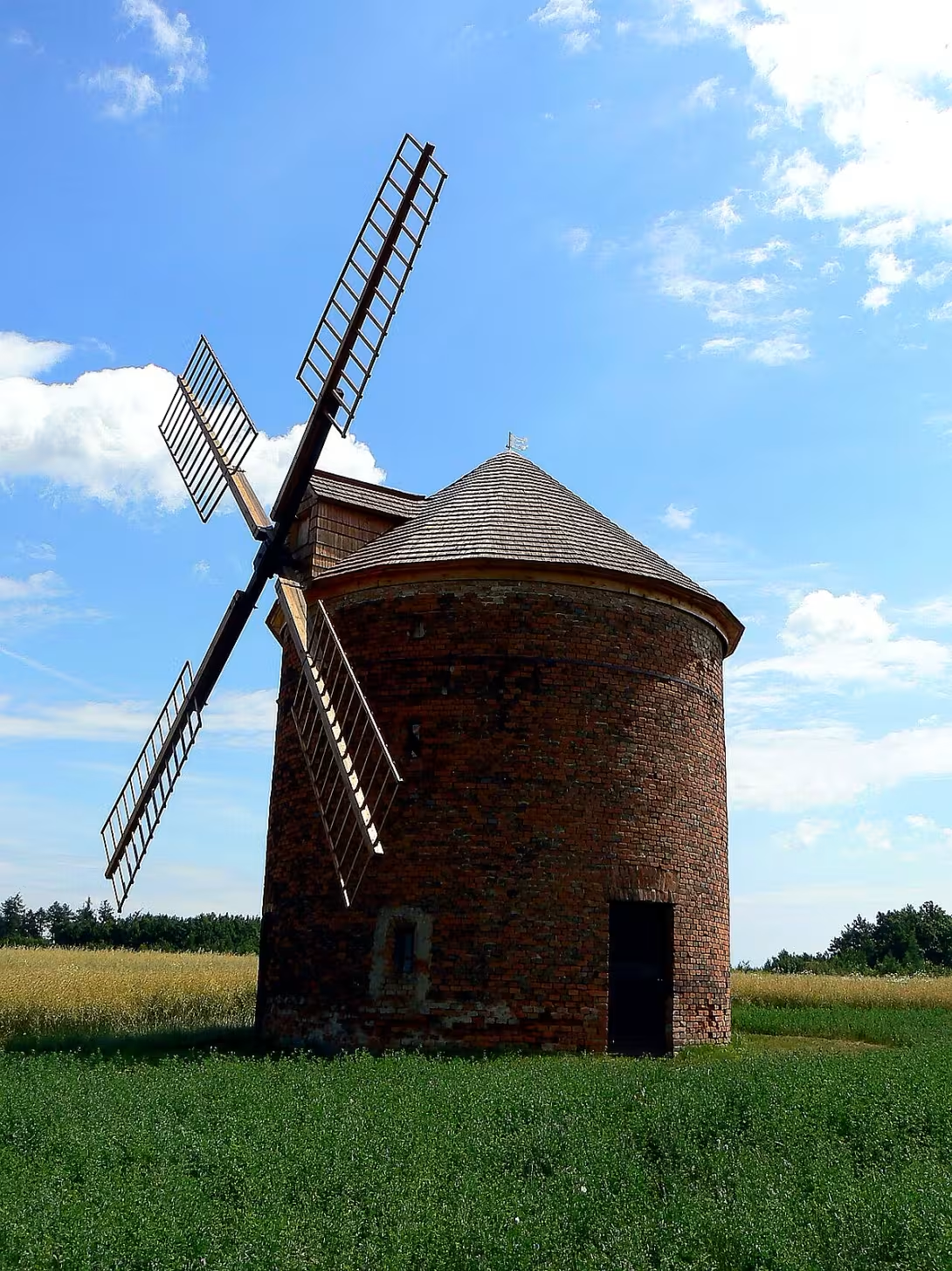
The windmill in Chvalkovice in Vyškovsk is a walled technical monument of the Dutch type from 1873. The building is registered in the central list of cultural monuments of the Czech Republic. It represents a proof of technical maturity of the 19th century milling mill, where the mill was equipped with two grinding compounds and later modernized by steam drive.
The construction was built in 1873 on a hill southwest of the centre of the village at an altitude of 380 metres. Its construction dates back to the 1970s, when Czech countries went through an era of rapid industrial development and the flowering of technical buildings, which was accompanied by the influence of historism in architecture.
The building takes the form of a cylindrical brick building eight metres high with a diameter of 7.7 metres. The force of the perimeter walls is 0.80 meters. The roof is made up of a 16-sided needle 3, 15 metres high, covering the shindle. Two rectangular entrances lead to the mill and small window openings with oblique tiles are broken in the mantle. The original wind wheel had a diameter of 13.2 metres and the area of one wing was 8.2 square metres.
The first owner and builder was Josef Vítek. In 1920 he took over the mill his brother Jan Vítek, who carried out a major modernization of operation. The interior was fitted with cylindrical grinding stool, peeling and rope lift for bags. After the First World War, the mill was completed with a steam engine. This progressive adjustment allowed operation even under unfavourable wind conditions. The operation of the mill was definitively terminated in 1941 on the basis of the order of the protectorate offices and was not renewed after World War II.
Two grinding structures have been preserved inside. The tread diameter of 0.91 metres was 0.44 and 0.18 meters. At full power, the circumference speeds were 5.67 meters per second, or 5.38 meters per second, respectively, corresponding to 119 or 113 rpm. There are currently repairs on the building, which are conducted by the right-hand man of the last miller; he also secured a new shingles roof.
This monument represents valuable evidence of the development of agricultural technology in the Drahanské učina area. Visiting the site offers the opportunity to become acquainted with the history of the mill trade and the technical skills of our ancestors in an authentic environment.
Then and now
Drag the slider to compare how the landmark may have looked when it was built with the view today.
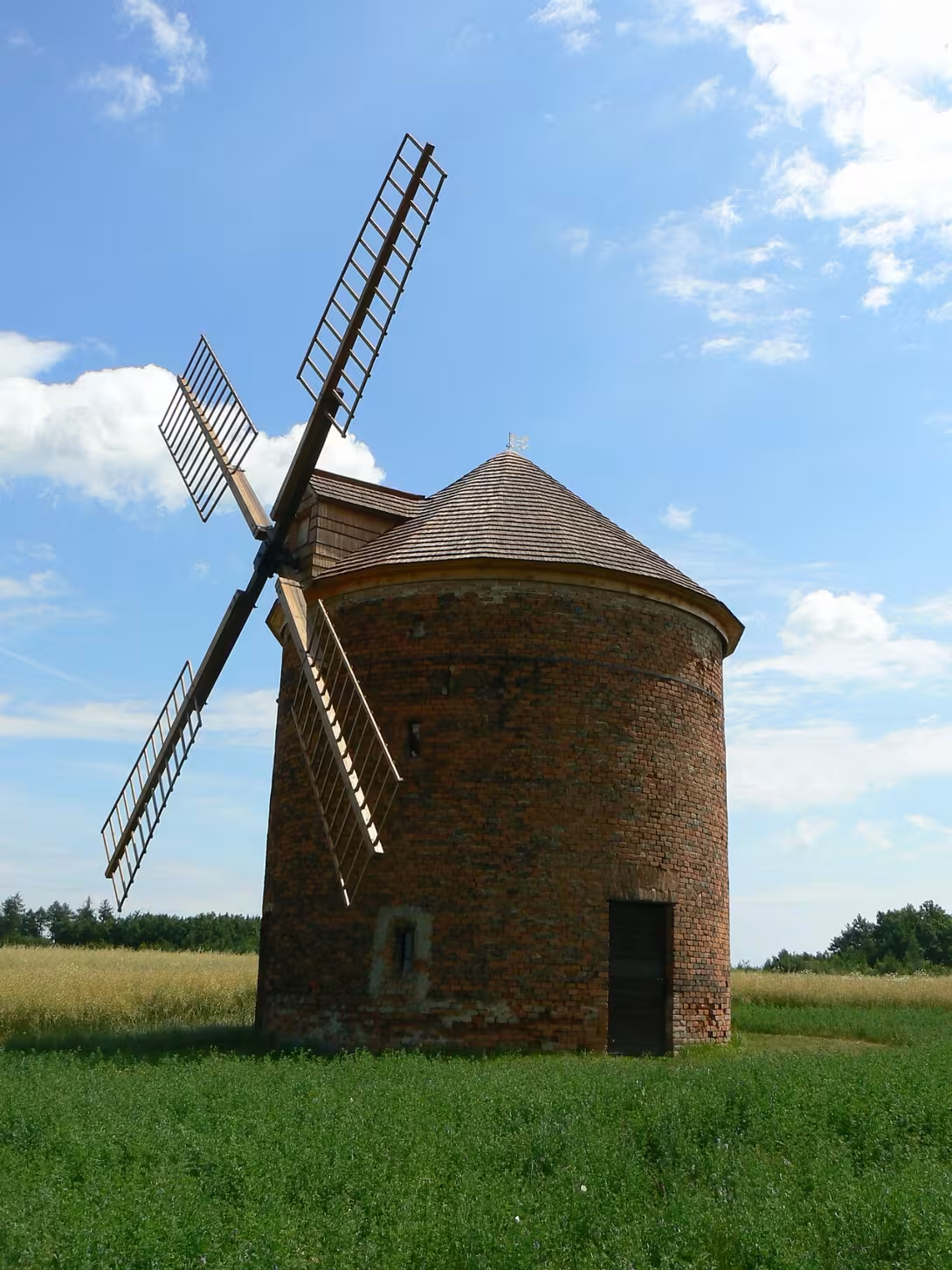
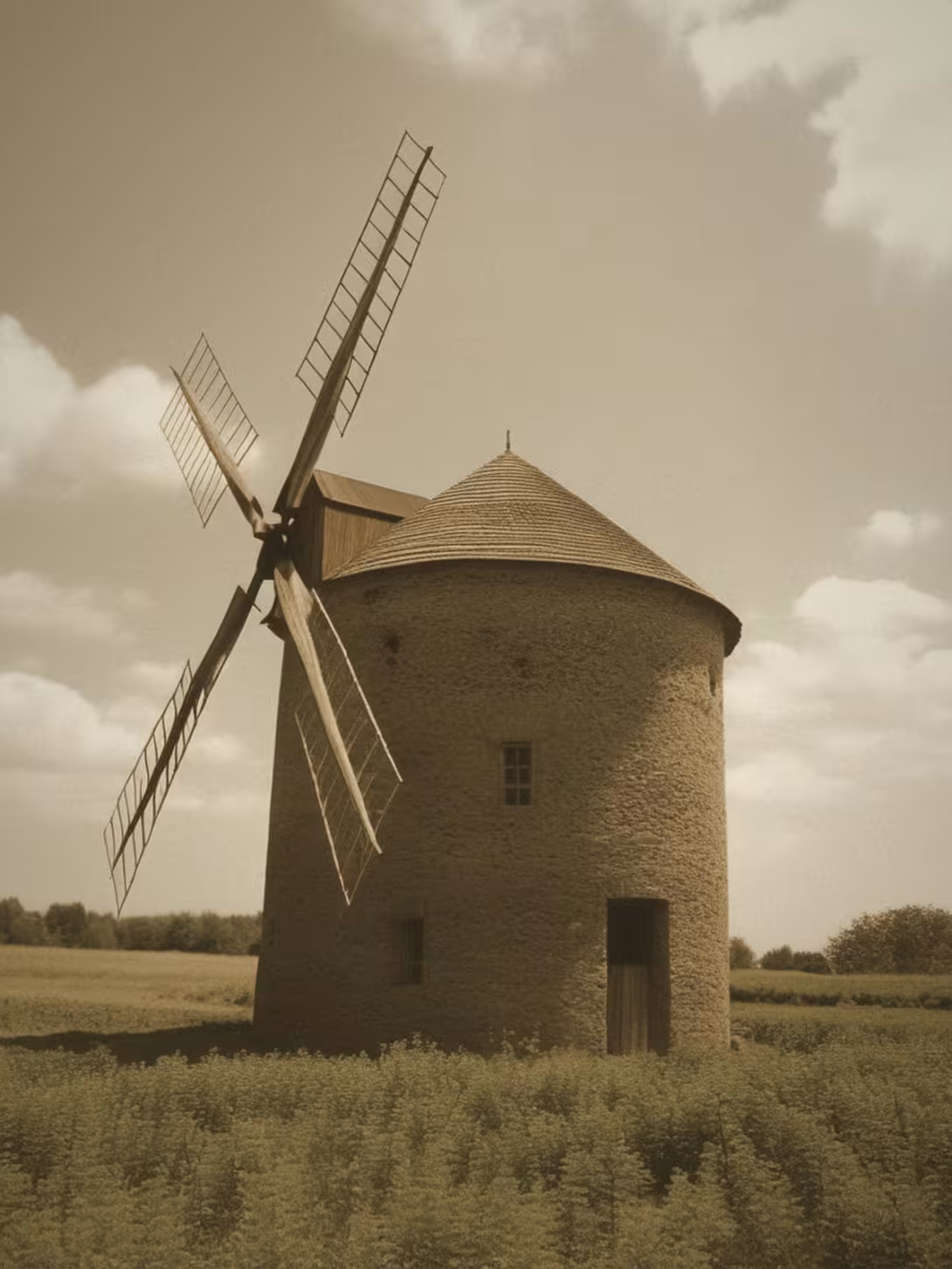
The historical appearance on the left is an AI-generated visualisation and serves as inspiration only.
Historical milestones
- 1873
- Construction of the mill by miller Josef Vitek.
- 1920
- Modernization of the mill by Jan Vítek and installation of new technological equipment.
- 1941
- Forced closure of the mill by the protectorate authorities.
Architectural development
The original walled building of the cylindrical type was supplemented by steam drive after the First World War. In 1920, modernization took place involving installation of cylindrical milling stool, peeling machines and rope lift. The roof is made up of a 16-sided needle covered with shingles.
Historical events
1873: Construction of the mill by miller Josef Vitek. 1920: Modernization of the mill by Jan Vitek. 1941: Termination of operations under the Order of the Protectorate.
Owners
Josef Vítek (since 1873), Jan Vítek (since 1920).
Points of interest
- The windmill in Chvalkovice is a walled-up technical monument of the Dutch type from 1873. The building is registered in the central list of cultural monuments of the Czech Republic. - The construction takes the form of a cylindrical brick building eight meters high with a diameter of 7.7 meters. The force of the perimeter walls is 0.80 meters. - The original wind wheel had a diameter of 13.2 meters and the area of one wing was 8.2 square meters. - After the First World War, the mill was completed with a steam engine, which enabled operation even under unfavourable wind conditions. - The activity of the mill was definitively terminated in 1941 on the basis of the order of the protectorate offices and was not renewed after World War II.
Guide
Show guide text
This text was created by artificial intelligence and has not been editorially reviewed. It may contain inaccuracies.
Welcome to Chvalkovice. At this moment, you are facing one of the most significant technical monuments in this area. In front of you is a windmill that immediately attracts the attention of anyone who comes up this hill. The first thing you'll notice is a very specific shape. It's not just an ordinary building, it's a robust cylindrical object built from red bricks. Look up where the building ends with a conical roof, which is covered by a traditional shingles. This whole look is typical of the so-called Dutch-type mills, which means that the body of the mill itself remains firmly anchored in the ground and only the top of the roof mechanism can rotate so that the blades always face wind, no matter where it is blowing.
Let us now return together in time more than 150 years ago. It is 1873 and at this time it is this building that is being built here. Its creator and founder was miller Josef Vítek. At the time, the construction of such a mill was not only a matter of craft, but also a strategic decision. The choice of this particular place on the hill was not random. Vitek knew precisely that it was here that the wind would be strong and stable enough to spin the heavy mechanisms and drive the grinding of cereals. In the nineteenth century, mills were at the heart of the rural economy and this mill in Chvalkovice was a symbol of the progress and prosperity of local agriculture.
Now pay attention to the architecture itself and the details that you can observe right in front of you. Notice how massive the brick wall is. If you imagine the thickness of the walls, you'll find that the circumference walls have a force of 80 centimeters. This massiveness was not just for show, but it was absolutely necessary for the building to withstand the enormous vibrations and pressures created by the rotation of the millstones and the movement of heavy wooden beams inside. The entire object reaches a height of eight meters and its diameter is seven and seven tenths of a meter. This compactness, combined with cylindrical shape, ensured maximum stability against strong wind impacts that are common on the hill. Take a look at the surface of the bricks and see the atmosphere of the place where dust from flour has been mixed with the smell of the surrounding nature for decades.
Speaking of this place, we can't forget the people who inhaled his life. The first one was already mentioned Josef Vítek, which built the mill. However, the family tradition of milling continued in this building. A few decades later, in 1920, the Jan Vítek mill took over. Jan wasn't just the manager, he was the visionary. At a time when the world was changing quickly and the technique went forward, the mill decided to modernize. It put new technological equipment into operation to increase the efficiency of grinding and facilitate work. Thanks to his efforts, the mill remained competitive even when the first industrial mills started to appear.
Unfortunately, history has brought darker chapters. If you stop and think about the silence at the mill today, remember 1941. It was this year that the mill was forced to shut down. The decision to stop work was not in the hands of the miller, but it came from the protectorate's offices. It was a painful end to the era when the mill served the community and fed people. Since then, the mill has become a silent witness to history, which has never been fully operational in the original sense, but has become a valuable piece of our cultural heritage.
Now invite you to think about one very interesting detail that is not visible from the outside, but is crucial for understanding the value of this building. In the interior the mill preserved two grinding composition. Those are the mechanisms that made the mill from the building. The fact that these facilities have been maintained is extraordinary because they demonstrate the high technical maturity of the mill industry at the time. Imagine those huge rocks that turned against each other and crushed grains on fine flour. Thanks to these details and the overall condition, the windmill in Chvalkovice is registered in the Central List of Cultural Monuments of the Czech Republic. It is an official recognition that this brick building is not just an old building but a unique technical work that deserves protection for future generations.
Now, when you look around, see this mill as a bridge between the past and the present. It's fascinating how one building can tell the story of one man's ambitions, family continuity, technical progress, and tragic policy interventions. That feeling when you're standing by a wall that has lasted over a century is irreplaceable. Note how light is reflected from old bricks and how naturally the mill fits into the landscape of Vyškov district.
Now that you know the story of this place, I suggest you rewind the mill around and from different angles to observe how its silhouette changes depending on your perspective. Feel the connection between the brick body and the shingles roof, which is a detail we rarely see in the landscape today. Let yourself be absorbed for a moment by the idea of what the mill looked like in 1873 when it first started working, and how the noise of grinding stones sounded, which had to be heard throughout the surrounding landscape.
Thank you for accompanying me on this short journey through the history of the mill. I hope you are interested in this trip in time and that you will leave with a sense of respect for the work of the Miller of the House of Vitek. Now you are left with space for your own exploration and silent observation of this beautiful monument. I wish you a pleasant rest of the day and many other discoveries during your travels to history. Goodbye.
Tips for visitors
The best time to visit is the late afternoon during sunny days when the setting sun lights up the brick wall of the mill and creates ideal conditions for shooting details of the building.
You can easily get to the memorial by car. If you choose public transport, find the current connection to the village Chvalkovice in the respective connection search engine.
We recommend to wear fixed shoes because the road to the mill on the hill leads through the terrain. Do not forget the headgear and plenty of fluids, as the mill is located in an open agricultural landscape without natural shade.
In the immediate surroundings you can enjoy a walk through the agricultural landscape of the Drahanská Highlands, which offers a quiet environment for relaxing and observing nature around the village Chvalkovice.
For families with children the trip is suitable as a short stop when travelling in Vyškovsk. Children can admire the historical technical structure and surrounding hilly terrain, which is ideal for easy walking in nature.
Frequently asked questions
Can the monument be visited?
This is a technical monument. Some are open as exhibitions, others are out of use or on private land. We have not verified whether this one is accessible.
What are the opening hours and admission?
We have not verified the opening hours or admission. Current information is published by the operator.
Where is the monument?
Location: Chvalkovice, Jihomoravský kraj. The map on this page shows the exact spot.
Why is the monument protected?
It is listed in the Central List of Cultural Monuments of the Czech Republic as a cultural monument (register no. 1000141801).
Businesses nearby
Do you run a restaurant, accommodation, shop, museum, rental, wellness or other visitor service near this monument? Show yourself directly to the people heading to it — this is how they will see you in the app and on the web:
Nearby
Obec Chvalkovice v okrese Vyškov, zemědělská krajina Drahanské vrchoviny.
Accommodation nearby
Trips and activities nearby
Guided tours, tickets and activities nearby from GetYourGuide
Affiliate link: if you buy from the partner, we may receive a commission. The price for you does not change.
Search tours and activities →Themed route
1. Municipality of Chvalkovice, village. It's a good place to start your journey. 2. Agricultural landscape Drahan Highlands, natural surroundings. This area offers a walk through vast fields. 3. Wind Mill, Historical Mill. The main destination of the trip, which represents an interesting element in this landscape.
Seasonal recommendations
Spring brings freshness and awakening nature around the mill. Green grass and the first flowers create a pleasant environment for observing the old building. Light is soft in this period and very suitable for image capture. We recommend wearing layered clothes because the morning cold can still smell. This is a very good time to visit, because crowds are not yet present.
In the summer months the area of the mill is filled with strong sun and warm heat. The landscape is full of life and high temperatures. Due to the greater interest of visitors, we recommend that you come early in the morning to avoid the biggest crowds and the most intense heat. Don't forget the headgear and enough water to drink.
Autumn offers a calm mood accompanied by golden colours of leaves and morning fog. The sun is lower at the horizon, which creates interesting shadows on the wooden body of the mill. It is advisable to carry a waterproof jacket and shoes with good grip in case of wet surface. It's mostly quiet at the monument this time of year.
Winter gives the mill a rough and peaceful look, especially if the landscape is covered with snow. Days are short, and light is usually gray, which creates a serious mood. It is necessary to take very warm clothes and good shoes against freezing. Visit the place soon after noon to use as much daylight as possible.
Visualizations and artistic views


The visualisations are generated by artificial intelligence and serve as inspiration.
Photos from the area
Real photos taken near the monument

Zdroj a licence jsou uvedeny u každého snímku.
Tips from visitors
No tips yet. Be the first!
Log in and add your tip.
Sources and literature
Photos: P.matel / Public domain — Wikimedia Commons. The author and licence also appear when you hover over the image.
Faktickým podkladem tohoto textu byl článek na Wikipedii, jehož autory jsou přispěvatelé Wikipedie. Článek je dostupný pod licencí CC BY-SA 4.0.
Location on the map



Příběhy a pověsti
Legendy, pověsti a příběhy spjaté s touto památkou
Fotografie návštěvníků
Zatím žádné fotografie. Buďte první, kdo přidá fotografii z návštěvy!
Log in a přidejte svou fotografii nebo hodnoťte.
Za ověřenou návštěvu v aplikaci získáte víc bodů — poznáme podle GPS, že jste na místě.
Reviews and comments