






Větrný mlýn (Dolní Sklenov) Windmill
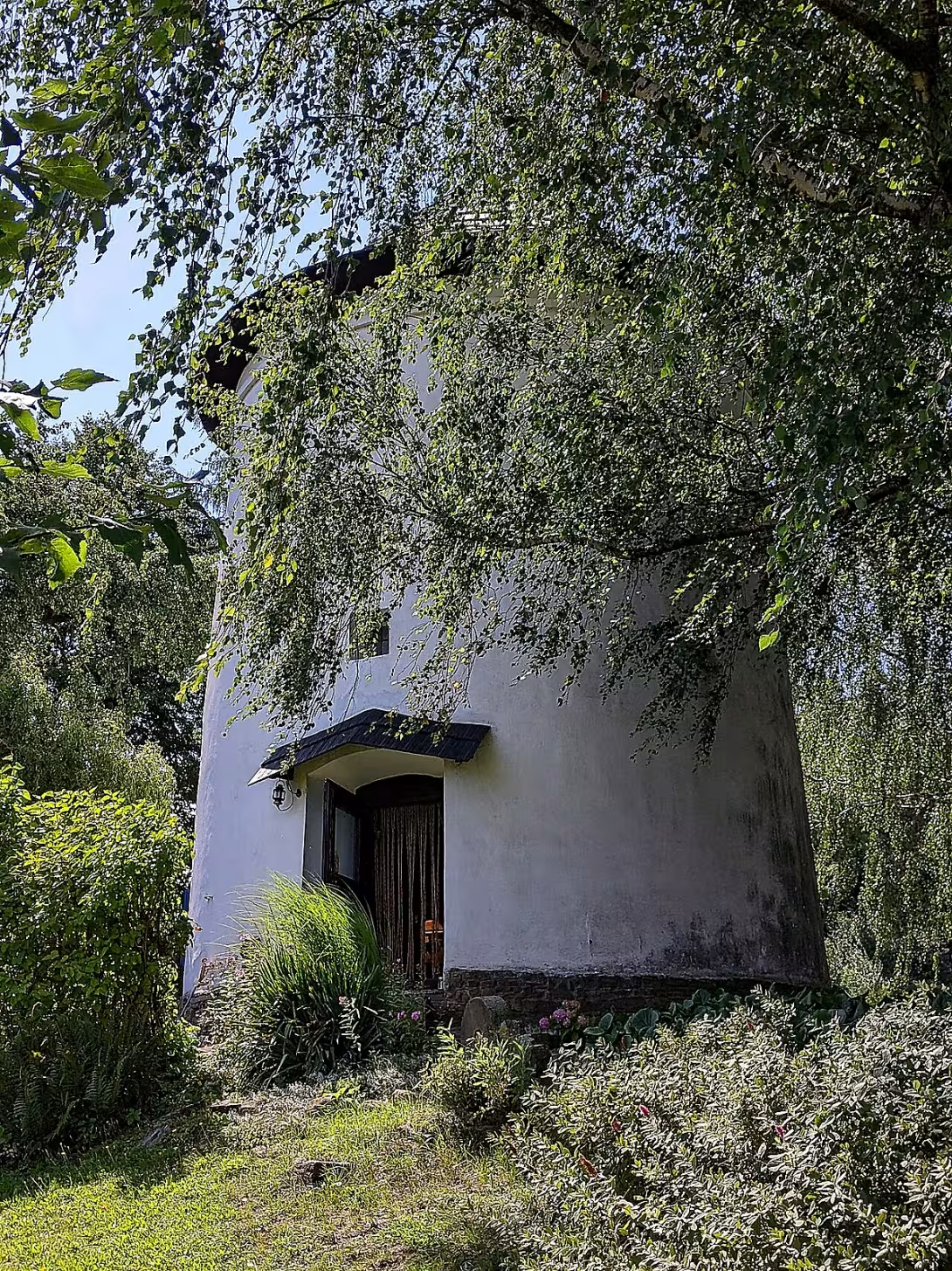
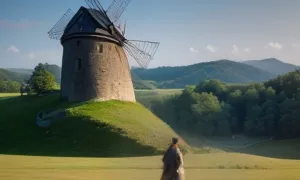
The Dutch-type windmill in the part of Dolní Sklaov in the village Hukvaldy is a four-storey brick building made of quarry stone. It is listed in the Central List of Cultural Monuments of the Czech Republic. The building stands on the hillside of the hill Peak at an altitude of 330 meters. It is important for its architecture and its transformation from a grinding plant to a residential house.
Several data have been retained on the oldest history of this place. In 1787, the Josephine cadastre presents a wooden windmill called Klečák. In 1804 there was already a brick object on the slope of the hill.
The architecture of the mill is characterized by a circular plan in the shape of a chamber cone. The construction measures 11 metres, the outer diameter is 7.5 metres and the inner 5 metres. The construction of the quarry stone is equipped with plaster. The building ends with a high conical roof covered with shingles. The inner space consists of four floors. The ground floor was used for housing, the first floor as a warehouse, the second was made up of a mill with grinding stones and the third was equipped with a drive device with a pallet wheel.
The mill was operational until the end of the 19th century. They then removed the grinding equipment, cut off the windwheel shovels and modified the construction for housing. After World War II, the object was desolate. In 1953, the Monument Institute requested a local national site to secure the mill against theft. In 1960 the mill was bought into private ownership and subsequently converted into a recreation centre.
Key technical events include installation of a revolving roof in 1830. It is unique that despite his function as a windmill he had on the third floor a drive device with a pallet wheel.
Currently the mill is privately owned and serves for recreation. This monument in Frýdek-Místek district represents a technical building with a variable function. It is advisable to visit it to see its architecture and historical development of local miller.
Historical milestones
- 1787
- In the Josephine cadastral there is a wood mill Klečák.
- 1804
- There was already a walled windmill.
- 1830
- Installation of revolving roof.
- 1960
- The mill has been bought into personal property and adapted to a recreation centre.
Architectural development
Originally there was a wooden mill, which was replaced by a walled construction made of quarry stone. The roof for turning was modified in 1830. Later, the construction was converted from a milling plant to a residential and recreational building.
Historical events
In 1787 the wood mill Klečák is listed in the Josephine cadastral. In 1804 there was already a brick mill. In 1830, a revolving roof was installed on the building.
Owners
In 1960 purchased into personal property.
Points of interest
- It's a four-story brick construction of the Dutch type. - In 1787 there was a wood mill called Klečák. - The building has a circular floor plan in the shape of a chamber cone and measures 11 meters. In 1830, a revolving roof was installed. - Unique is the drive device with a pallet wheel on the third floor.
Guide
Show guide text
This text was created by artificial intelligence and has not been editorially reviewed. It may contain inaccuracies.
Welcome to the hillside of the hill, in the picturesque village of Dolní Sklaov. Right now, when you're standing here listening to this voice, you have something really special ahead of you. Stop for a moment, feel the surrounding air and look straight ahead at this massive stone structure. It is a windmill that, by its presence, controls this corner of the landscape. The first impression you're likely to think of is its unusual shape. It's not a common house with a slant roof you know from other places. This building resembles rather a massive, stone-shaped cone, which stands firmly in the ground and heads towards the sky with its tip. It's a work that carries the power of nature and of human art.
When you look at his walls, notice the material from which it was built. This whole building is made of quarry stone. These stones that you see here carry a trace of earth and time. Each piece of stone has contributed to making this construction resist decades, maybe centuries, wind and rain. This building is not only 11 meters tall, it is a symbol of endurance.
To understand why this mill is standing here, we need to go back deep into the past, to a time when life was turning differently. The history of this place is not short. If we go back to 1787, to the time of the Josephine cadastral, you won't find this stone colossus. At that time, there was a completely different object. It was a wood mill that people called the Knob. Imagine the sound of the wood that was carried in that land. It was a simple, wooden machine that served people, but time and need came with new demands.
Already in 1804, things changed. There was already a walled windmill in this place, as its foundations remind us today. The transition from wood to solid stone was a sign of stability and growth. This mill was not only built for beauty, but had a clear, practical purpose. Served as a grinding machine. Imagine those times when people had to come here to get flour from their grain for their bread. It was the center of the village, a place where work and survival were met.
Now pay attention to the construction itself and the way it's done. This mill belongs to the Dutch type. What does that mean for you, who are watching him right now? It means a specific structure and the way the whole building has to look and act. It's a four-story building and its floor plan is perfectly circular. It is this circular shape and the shape of the chamber cone that gives him this strange, almost cosmic geometry.
If you look up, you might start to realize how complex his design must be. In 1830, one of the most important technological improvements occurred. The rotational roof was installed in the mill. That was a big deal at the time. Thanks to the ability to rotate the upper part of the building, the mill was better able to use wind power from different directions. The roof had to move so the blades would always face the current of air. It's a fascinating idea that this stone mass must be able to react to the invisible movement of air.
If you had the opportunity to look inside, especially the third floor, you would encounter something quite unique. There is a drive device with a pallet wheel. This wheel is the heart of the machine. It's a mechanical heart that converts wind movement into motion that can crush grains. Even though the mill no longer works for the grain, this technique still carries the echo of the old craft.
Over the years, the fate of this mill has changed as well as the fate of the people who lived around it. After the period he served for grinding, his function gradually changed. He became a place to live. People settled into his stone walls and made a home there. But history is relentless. After World War II, the mill went into a difficult period. He let go, he left, and his insides probably took over the silent emptiness.
Anyway, the story didn't stop. There was a major turnover in 1960. The mill was bought into personal property and its direction changed completely. Instead of hard work and grinding, he became a recreation center. Instead of the noise of grinding stones, peace and rest began to spread here. What used to be the livelihood of the body began to be the rest of the soul.
The interesting thing that may interest you is the connection between his origin and the present. Even though the mill is now seen as a place for rest, its architecture still yells about its industrial and agricultural past. It's like you hear the silence that carries the echo of old grain and spinning wheels. The invisible force that once fueled his life is still felt in his massive walls.
You are standing in front of a monument that has survived wooden beginnings, a period of decline and change in political age. It's a stone he remembers.
Now, please, continue your walk. Look at the mill from different angles. Try to look at his base and then raise your eyes to the top again. Feel the height, feel the weight of the stone. It may seem to you that the wind current, which is blowing so strongly here on the hill of the hill, is still looking for a way to respin the old mechanical heart on his third floor.
Thank you for spending this moment with us and paying attention to this mill. We wish you a nice trip around and many other interesting experiences. We'll say goodbye and wish you the rest of the day.
Tips for visitors
The best time to visit is in the spring or autumn season when the weather is more pleasant and the mill can appear in a beautiful green garden. This time of the season also offers the most favourable conditions for photography, when light is finer and shadow effects add the beauty of images.
For those travelling by public transport, it is appropriate to take a look at the availability of connections from the city of Bruntál or other neighbouring sites nearby. Current information about routes and times can be found online.
When visiting, it is advisable to take with you sun protection clothes, shoes suitable for walking on hilly terrain and luggage for drinking water. If you are planning a photo shoot, you should bring a camera or a mobile phone with good photographic skills.
For families with children the surroundings are suitable for short walks and exploring nature. Children can be interested in the history of the mill and its architectural style. Moreover, the proximity to Hukvalds offers the opportunity to explore other interesting places around.
Frequently asked questions
Can the monument be visited?
This is a technical monument. Some are open as exhibitions, others are out of use or on private land. We have not verified whether this one is accessible.
What are the opening hours and admission?
We have not verified the opening hours or admission. Current information is published by the operator.
Where is the monument?
Location: Hukvaldy, Moravskoslezský kraj. The map on this page shows the exact spot.
Why is the monument protected?
It is listed in the Central List of Cultural Monuments of the Czech Republic as a cultural monument (register no. 1000146951).
Businesses nearby
Do you run a restaurant, accommodation, shop, museum, rental, wellness or other visitor service near this monument? Show yourself directly to the people heading to it — this is how they will see you in the app and on the web:
Nearby
Mlýn se nachází na úbočí kopce Vrchy v blízkosti obce Hukvaldy.
Accommodation nearby
Themed route
1. Municipality of Hukvaldy (municipality) - Suitable starting point for the entire cruise route. Here you can prepare for subsequent output. 2. Highlands (hill) - The road leads along the slope of this hill. It's a natural connection between the village and the mill. 3. Větrný mlýn (Dolní Sklenov) (mill) - Main destination of the visit. It is a unique building located in a beautiful landscape.
Seasonal recommendations
Seasonal recommendation for visiting the historical monument. Monuments: Větrný mlýn (Dolní Sklenov), Hukvaldy Status: Good
Spring: In the spring the area wakes up and the mill is surrounded by a fresh green meadow. Light is soft and rough in this period, which is ideal for taking images. The mood is fresh and full of hope thanks to blooming flowers. I recommend wearing layered clothes because the morning cold can still feel. The road to the memory is quiet at this time and you will avoid the largest groups of people.
Summer: Summer months bring intense sun and warm winds to the landscape. Nature is in full bloom and the surrounding hills are deep green. Due to high temperatures, it is best to come early in the morning when the air is even colder and avoid the biggest crowds. Don't forget the headgear and plenty of fluids. In the main summer time there are more visitors on the road than in other times.
Autumn: Autumn season offers the most impressive colours when forests turn into golden and brown seas. The morning mist gives the mill a mysterious and a little sad mood. You need to prepare stronger shoes because the road can be slippery or muddy because of the rain. The best time to visit is in the morning, when the sun can still shine through the trees and highlight the colour of the leaves.
Winter: In winter the landscape turns into a quiet and white wasteland, which is very distant around the old mill. The lighting is weak and the days are short, so plan a visit around noon to use the biggest daylight. The necessity is very warm and waterproof clothes. During this period, the least people are present, which guarantees peace and the possibility of seeing history in solitude.
Visualizations and artistic views


The visualisations are generated by artificial intelligence and serve as inspiration.
Photos from the area
Real photos taken near the monument


Zdroj a licence jsou uvedeny u každého snímku.
Tips from visitors
No tips yet. Be the first!
Log in and add your tip.
Sources and literature
Photos: MartinVeselka / CC BY-SA 4.0 — Wikimedia Commons. The author and licence also appear when you hover over the image.
Faktickým podkladem tohoto textu byl článek na Wikipedii, jehož autory jsou přispěvatelé Wikipedie. Článek je dostupný pod licencí CC BY-SA 4.0.
Location on the map
Příběhy a pověsti
Legendy, pověsti a příběhy spjaté s touto památkou
Fotografie návštěvníků
Zatím žádné fotografie. Buďte první, kdo přidá fotografii z návštěvy!
Log in a přidejte svou fotografii nebo hodnoťte.
Za ověřenou návštěvu v aplikaci získáte víc bodů — poznáme podle GPS, že jste na místě.
Reviews and comments