



Větrný mlýn (Hodslavice) Windmill
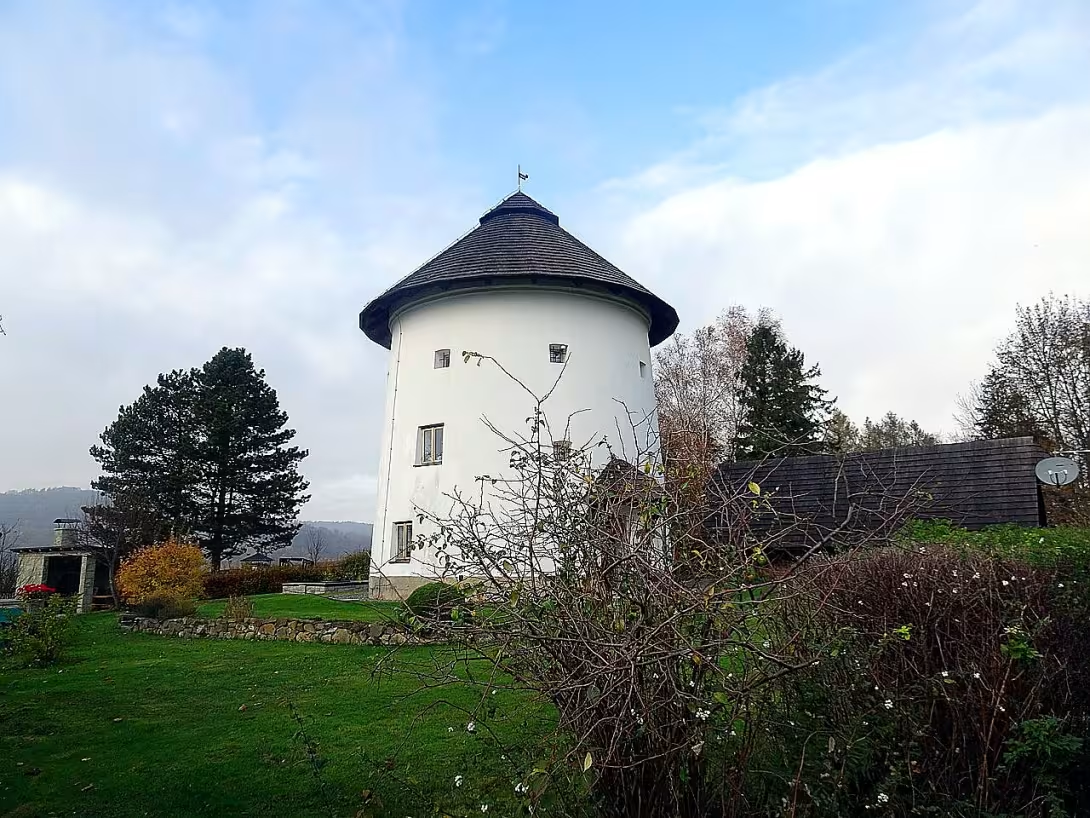
The windmill in Hodslavice in Novojicinsko is a brick construction of the Dutch type from 1864. Today it is registered in the Central List of Cultural Monuments of the Czech Republic. The building has undergone a transformation from the mill to the residential house and then to the holiday home. It represents an important document of technical history in the foothills of Beskyd.
The construction was built on a hill in 1864 at an altitude of 360 metres by farmer Josef Bartoň. The creation of the mill falls into the 1960s, the era of industrial expansion and national renewal. In the wider European context, this was the time when the development of new technologies gradually began to push traditional windmills out of their original economic role.
Architecturally, it is a three-storey brick structure on a circular floor plan, which is partially undercut. The mill reaches a height of eight metres and its diameter is 8,3 metres. The original construction was finished with a low conical roof 3, 15 metres high, covered with shingles. There is a rectangular entrance to the building with sandstone lining and segmented enchantment. An extension was added to the west side of the building over the years.
The first owner was the founder of Josef Bartoň, from whom the mill bought rodina Davidova in 1876. The operation affected the storm in 1929, which caused the breaking of the wings. Subsequently, the milling plant was removed in 1931 and the building was adapted to the residential building in 1939. In this form he served for living until 1954. After the fire in 1962, only a torso was left of the mill. This was purchased in 1972 by a new owner and subsequently repaired for recreational purposes.
Today, this monument-protected building is evidence of changes in the use of technical objects in time. The Hodslavic visit offers the opportunity to see the torso mill, which shows the history of milling and subsequent adaptation to modern housing. The preservation of this building is an important contribution to preserving the region's cultural heritage.
Historical milestones
- 1864
- Construction of the mill by farmer Josef Barton.
- 1929
- The storm caused the mill to break off its wings.
- 1939
- Adaptation of the mill to the residential building.
- 1972
- Purchase and repair of torza mill by new owner.
Architectural development
Originally walled construction on a circular plan was finished with a conical roof covered with shingles. In 1939 it underwent a major internal reconstruction into a residential space. After the fire in 1962, the building's torso was reconstructed for recreational use.
Historical events
In 1929, a windstorm broke the wings of the mill. In 1939, the building was adapted to a residential building. The mill burned down in 1962.
Owners
Josef Bartoň (from 1864), rodina Davidova (from 1876), private owner (from 1972).
Points of interest
- The windmill in Hodslavice is a walled-up construction of the Dutch type from 1864, located at an altitude of 360 metres. - The building has undergone a transformation from the mill to the residential house and then to the holiday home. - The construction has a circular plan, reaches a height of eight meters and its diameter is 8,3 meters. - Operation of the mill affected the whirlwind in 1929, which caused the breaking of the wings. - After the fire in 1962, only a torso left of the mill, which was repaired in 1972 for recreational purposes.
Guide
Show guide text
This text was created by artificial intelligence and has not been editorially reviewed. It may contain inaccuracies.
Welcome to this historic place, which is a witness to the past and monument to the traditional life of our ancestors. You are standing in front of a windmill in Hodslavice - a unique monument that boasts its history and architecture of the Dutch type. Take a look up at this three-storey structure of a circular plan with a diameter of 8.3 meters and a height of eight meters. Notice its solid wall structure, which stands as a reflection of past times.
Let's dive into the history of this place. In 1864 this mill was built by farmer Josef Bartona. Originally used to grind grain, which was necessary for the then rural population. In 1929, however, the whirlwind caused its wings to break off and the mill was then removed. The mill then turned into a residential building, which brought new chapters into its history.
Now pay attention to the architecture of this building. Its circular plan and walled construction are typical of Dutch mills, which makes it a rare example in our landscape. Note also that it is located at an altitude of 360 meters, giving it a unique perspective and atmosphere.
The key character associated with this place is, of course, the Josef Bartoň that built this mill. His efforts and visions left permanent clues in this place. The David family also played an important role in the administration and maintenance of this building, which contributed to its preservation for future generations.
An interesting feature is the conversion of this mill from industrial plant to residential house and then to holiday home. This transition from technical function to home use is a fascinating example of the adaptation of historical structures to modern needs.
In conclusion, this windmill in Hodslavice offers not only a view of the past, but also an inspiration to think about the transformations and adaptations that history often includes. I urge you to take a closer look at him and let his story resonate with you. I hope this guide was informative and inspiring for you. Thank you for your visit and have a nice day!
Tips for visitors
The best time to visit is during bright days, especially in the afternoon, when the sun lights up the circular mill. For photography are the best places right on the hill, from where you can capture the mill against the background of the landscape in the foothills of Beskyd.
You can reach the mill by car or use public transport.
Take with you enough drinks and comfortable shoes, because the road leads on the hill.
For families with children, walking to the mill is a pleasant activity in nature.
In the surroundings you can explore the village Hodslavice and the beauty of the landscape in the foothills of Beskyd.
Frequently asked questions
Can the monument be visited?
This is a technical monument. Some are open as exhibitions, others are out of use or on private land. We have not verified whether this one is accessible.
What are the opening hours and admission?
We have not verified the opening hours or admission. Current information is published by the operator.
Where is the monument?
Location: Hodslavice, Moravskoslezský kraj. The map on this page shows the exact spot.
Why is the monument protected?
It is listed in the Central List of Cultural Monuments of the Czech Republic as a cultural monument (register no. 1000139082).
Businesses nearby
Do you run a restaurant, accommodation, shop, museum, rental, wellness or other visitor service near this monument? Show yourself directly to the people heading to it — this is how they will see you in the app and on the web:
Nearby
Obec Hodslavice, okres Nový Jičín, krajina v podhůří Beskyd.
Accommodation nearby
Themed route
Thematic cruise route Hodslavice
1. Main objective: Větrný mlýn (Hodslavice) - Type: Historical landmark - Why is it worth a visit: This windmill is one of the few preserved examples of traditions that have been used in the past for the drying of grain. It's a beautiful example of technical art and the history of local crafts.
2. Church of St. John the Baptist - Type: Religious monument - Why is worth a visit: This church is an important part of the local community and offers a view of architecture from the time of its position. Its interior contains interesting artistic elements that reflect the history of the village.
3. Local forests - Type: Natural space - Why it is worth a visit: Forests around Hodslavic offer an opportunity for short walks and relaxation in nature. They are an ideal place to observe local fauna and flora, which allows a relaxed delay on the way.
4. Local Market - Type: Cultural place - Why is worth visiting: Market is the center of local life where various events and meetings take place. It is a great way to learn more about the cultural heritage of the village and make contact with the locals.
5. Stop at the local cafe - Type: Cultural stop - Why is it worth a visit: The cafe offers an opportunity to relax and taste local dishes. It is an ideal place to exchange views with other tourists or participate in small cultural events.
This route offers a comprehensive view of the history and present of the village Hodslavice, allowing you to enjoy both the cultural and natural wealth of the region.
Seasonal recommendations
In spring the mill will surround the fresh green and blooming meadows, creating an optimistic atmosphere. Soft spring light is ideal for capturing construction details. We recommend to wear more layers of clothing because the weather is variable, and visit the place in the morning when it is quieter here.
The summer season brings bright sun and golden tones of surrounding fields that complement the appearance of the historic mill. The air is usually hot and there are the most visitors in the season. It is advisable to come first thing in the morning to avoid the biggest crowds and heat, and not forget light clothes and plenty of fluids.
In the autumn, the landscape around the monument is colored in orange and yellow tones, while morning fog gives the place a mysterious mood. The atmosphere is calmer and more focused on reflection. Practical is moisture-resistant shoes and a visit in the afternoon when the low sun highlights the texture of wood and stone.
In winter, the mill can look quieter, especially if the landscape is covered with snow and there is absolute silence. White contrast with dark construction is very impressive. It is necessary to wear warm winter clothes and to verify in advance the shortened opening times, while the best is to plan the trip around noon.
Visualizations and artistic views


The visualisations are generated by artificial intelligence and serve as inspiration.
Photos from the area
Real photos taken near the monument

Zdroj a licence jsou uvedeny u každého snímku.
Tips from visitors
No tips yet. Be the first!
Log in and add your tip.
Sources and literature
Photos: Palickap / CC BY-SA 4.0 — Wikimedia Commons. The author and licence also appear when you hover over the image.
Faktickým podkladem tohoto textu byl článek na Wikipedii, jehož autory jsou přispěvatelé Wikipedie. Článek je dostupný pod licencí CC BY-SA 4.0.
Location on the map
Příběhy a pověsti
Legendy, pověsti a příběhy spjaté s touto památkou
Fotografie návštěvníků
Zatím žádné fotografie. Buďte první, kdo přidá fotografii z návštěvy!
Log in a přidejte svou fotografii nebo hodnoťte.
Za ověřenou návštěvu v aplikaci získáte víc bodů — poznáme podle GPS, že jste na místě.
Reviews and comments