



Větrný mlýn (Město Libavá) Windmill
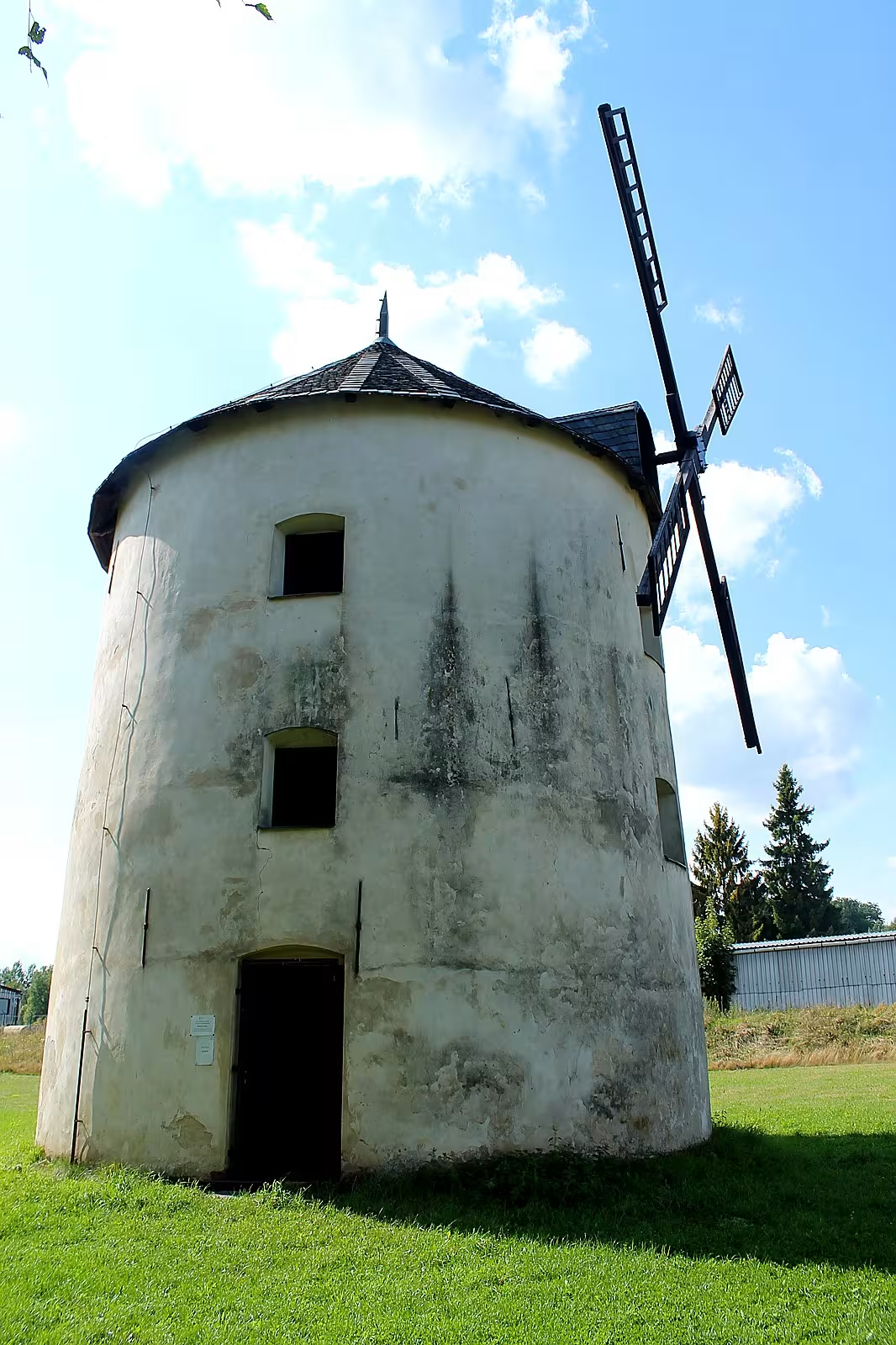
The windmill in the town of Libavá in Olomouc is a unique technical monument of the Dutch type. It is the last preserved object from the original 24 mills which were located in the territory of the military escape. This three-storey structure of quarry stone, whose history dates back to at least 1875, underwent extensive reconstruction in the 1990s and is now a cultural monument.
The exact date of origin of the mill is unknown. The first written mention dates back to 1875, when the building was registered as Sidler Mill. In the second half of the 19th century, Dutch-type windmills represented a more modern alternative to traditional wooden structures and reflected the expansion of agriculture and industry in the Czech countries. In 1930, the mill was technologically modernized by installation of a diesel engine, which served as an auxiliary drive for cases of no wind.
The construction has a circular plan with a diameter of nine metres and reaches a height of approximately 12,5 metres. The quarry stone object has a slightly conical shape and is covered by a shale roof with a shale cover. The current shape of the roof is supplemented by a fixed replica of a four-blade wind wheel.
The property is owned by the Army of the Czech Republic, but the mill is on the property of the village Město Libavá. In the second half of the 20th century, the monument was significantly lost, which was confirmed by the report of the Heritage Institute in 1955. After 1990 the state of the building was displeased; The roof was missing, the floors were broken, and the interior walls were covered in cyrillic inscriptions. The break became May 3, 1994, when the mill was declared a cultural monument under number 10297 / 8-3791. Subsequently, in August 1996, repairs began, which returned to the construction of its current good technical condition in the second half of the 1990s. The Ministry of Culture of the Czech Republic supported the restoration of the monument in 2017.
The mill is located on 9 May in the western part of the village Město Libavá, at an altitude of approximately 550 metres. It is located approximately 250 metres from the local square and 150 metres from the Church of the Holy Cross. The administration is provided by the Lubaja local embellishment association, which seeks to create a regional museum exhibition focused on objects found in the area of military escape.
This mill represents a unique testimony about the technical history of the region, which has been significantly influenced in the past by the military. Visiting this monument offers an opportunity to become familiar with the history of the only preserved building of its kind in the area and to support efforts to preserve regional cultural heritage.
Historical milestones
- 1875
- First written mention of the mill as Sidler's mill.
- 1930
- Installation of diesel engine as auxiliary propulsion.
- 1994
- Entry of the building into the central list of cultural monuments.
- 1996
- Start repairs of the degraded object.
Architectural development
The building is a three-storey circular structure made of quarry stone with slightly conical shape. In 1930, the wind drive was supplemented by a diesel engine in case of no wind. The roof is currently supplemented by a fixed replica of a four-blade wind wheel.
Historical events
1875: First written mention of the mill. 1994: Declaration for cultural heritage. 1996: Start of reconstruction of the building.
Owners
Czech Army
Points of interest
- It's the last preserved object from the original 24 mills that were located in the military territory. - In 1930, the mill operation was technologically modernized by the installation of the diesel engine, which served as an auxiliary drive for cases of wind. - The construction has a circular plan with a diameter of nine meters and reaches a height of approximately twelve and a half meters. - The property is owned by the Army of the Czech Republic, but the mill is on the property of the village Město Libavá. - In the second half of the twentieth century, the monument was decaying significantly and after 1990 the roof was missing and the floors were broken.
Guide
Show guide text
This text was created by artificial intelligence and has not been editorially reviewed. It may contain inaccuracies.
Welcome to Libava Town. You've just stopped at something that is absolutely extraordinary and stands as a quiet, lonely witness to the ancient times in this country. Before your eyes is a windmill that is much more than just a simple building made of stone and wood. He's a survivor. It is the only army of mills that once surrounded this area, which today can tell us its story. You stand before an object that has resisted time, relentless changes, and the decision to end an entire military retreat. Feel the atmosphere of peace and a mild mystery surrounding this building.
Look at this structure and try to imagine what this landscape looked like earlier. To understand why this mill is so rare, we need to look at the surroundings. Once this area was much more lively and fuller in human life. There were twenty-four mills, which were an important part of the local economy and the everyday existence of people. But time and change in the surroundings, especially the emergence of a military retreat, have changed everything. Most of these mills were removed, destroyed or simply destroyed in oblivion. This mill is the only survivor. It's the last of the original group to tell us how it used to be before the landscape changed so radically.
Now pay attention to the very structure you see right in front of you. Notice his strange face. It is a Dutch type of mill, which means that its technical solution and the way it was designed carry us far to northern Europe. The construction has three floors and its shape is conical, i.e. one which gradually narrows towards the top. This whole object is made of quarry stone. If you look closely at it, you can feel the weight and strength of the natural material that has resisted wind and rain for decades. This stone gives the mill its unique character. This whole circular base has a diameter of nine meters, which gives a good idea of its dimensions and stability.
And now, please look your eyes to the highest part of the mill. Look up at that unusual roof. She has an interesting needles shape. Her greatest secret, and at the same time the most important feature is that she can turn around. This was absolutely necessary so that the mill could effectively capture the wind from any direction. This rotating roof is covered with shale. Notice how the dark cover perfectly contrasts with the color of the stone. Slate is very resistant to all weather effects and gives the mill its dignified and a little serious look.
When we talk about history, we have to go back to when this place is first written about. The first written mention of this object dates back to one thousand eight hundred seventy-five. At that time, this mill was referred to as Sidler's Mill. The name Sidler is closely linked to the history of this place. Even though the world has changed and the people who lived here are long gone, this name reminds us of the human presence and work that has been going on here for centuries. The mill was not just a machine, it was part of the life of specific families and communities.
But there is one other thing that may interest you very much, which shows how people tried to overcome the inaction of nature. The mill has always been dependent on the wind, but the wind is unpredictable. In order for the work to continue to take place even when the air is completely stationary, there was a major modernization in the year one thousand nine hundred thirty. A diesel engine was installed in the mill. This engine was used as an auxiliary drive. Imagine the technological change - the mill that was built for the power of the wind, became a machine that could work in complete peace thanks to the power of this engine. That was a big news at the time that brought certainty and stability.
This mill also went through a very difficult time. After years of no one taking care of him and gradually dissolving his condition, his fate seemed lost. But history has its own will and people have decided to save this precious object. In the middle of the second century of the 20th, the situation began to change, and in the year one thousand and nine, ninety-six, a thorough repair started, which saved this object from complete disintegration. One year later, in the year one thousand and nine, ninety-six, the mill was officially listed in the central list of cultural monuments. This has provided him with the protection and recognition of his high value for all of us.
There's one other thing that might interest you. You may be wondering why this mill is the only survivor of the 24-year-old. It's basically a mystery of fate and also a consequence of the history of a military escape. While other buildings were removed within military needs, this mill remained a lone witness. It's like time stopped at this very spot. When you look at his strong wall, you feel the weight of time and the relentless power of history that was going on here.
Now that you know his secret, his technical details and his sad and winning story, I suggest you stop for a while and just keep your eyes open. Feel the wind around you, and imagine how the same wind touched these shale roofs over 150 years ago and fueled work in this mill. It's a place where nature's power meets human ingenuity and determination.
Thank you for taking the time and for taking this short journey through history with us. We hope that this view of the windmill has brought you new views and that you will enjoy the rest of your walks in this beautiful and quiet landscape. Goodbye.
Tips for visitors
The best time to visit is the late afternoon during sunny days, when the low sun beautifully depicts the structure of the quarry stone and allows you to take impressive pictures of the historical building.
You can easily get to the memory with your own car.
We recommend fixed shoes suitable for field movements and own supplies of drinking and food, as you will find no catering facilities in the immediate vicinity of the mill.
The best shots are obtained from a slight view of the adjacent meadow, which allows you to capture the mill throughout its profile against the sky. It is ideal to use a wide-angle lens to emphasize the mass of stone walls.
For families with children, the place is an interesting lesson in open-air history. In the vicinity you can visit the nearby Church of the Holy Cross, which complements the historical nature of the village, and explore the close limits of the military escape.
Frequently asked questions
Can the monument be visited?
Some buildings of this kind are open for guided tours, others serve another purpose or are privately owned. We have not verified whether and when this monument is open – please ask the operator.
What are the opening hours and admission?
We have not verified the opening hours or admission. Current information is published by the operator.
Where is the monument?
Location: Město Libavá, Olomoucký kraj. The map on this page shows the exact spot.
Why is the monument protected?
It is listed in the Central List of Cultural Monuments of the Czech Republic as a cultural monument (register no. 1000118503).
Businesses nearby
Do you run a restaurant, accommodation, shop, museum, rental, wellness or other visitor service near this monument? Show yourself directly to the people heading to it — this is how they will see you in the app and on the web:
Nearby
Kostel Povýšení svatého Kříže ve Městě Libavá, území Vojenského újezdu Libavá.
Accommodation nearby
Trips and activities nearby
Guided tours, tickets and activities nearby from GetYourGuide
Affiliate link: if you buy from the partner, we may receive a commission. The price for you does not change.
Search tours and activities →Themed route
1. Church of the Ascension of the Holy Cross in the City of Libavá (Temple) - The trip begins at this sacral building, which forms the spiritual center of the village. 2.Větrný mlýn (Město Libavá) (mill) - The main destination of the journey, where you can admire traditional architecture and the principles of grinding grain. 3. the territory of the Military Departure Libava (Region) - The final part of the route offers knowledge of a specific landscape with military history.
Seasonal recommendations
Spring: In the spring season, the windmill in the town of Libavá is revived by flowering nature, when fields and forests are green and surrounding meadows are decorated with colours. Sunny days and mild temperatures are ideal for walking around the mill, creating a calm and friendly atmosphere. At the beginning of spring it is recommended to visit the morning hours when there are fewer people and nature wakes up from winter sleep. Clothes should be variable according to weather - from warm clothes in colder mornings to light suits for sunny days.
Summer: For years, the mill takes its greatest attendance when nature is in full power and temperatures are high. The sun lights the roof of the mill with long rays, increasing its beauty. This season it is recommended to arrive early in the morning or later in the evening to avoid the peak of the midday rush of tourists. The important thing is to wear light clothes and enough drinking water to enjoy walking even on warmer days.
Autumn: In autumn, a special shiny tone grows around the mill, when tree leaves turn into hot colors. The sunny days and mild cool rooms are ideal for visiting, while the atmosphere is calm and soothing. This season it is recommended to visit the mill in the morning or evening light when the lighting is romantic and nature offers beautiful experiences. Clothes should be slightly warm, with the possibility of clothing layers for the morning colder days.
Winter: Winter visit to the mill offers unique views of the covered snow landscape, where the atmosphere is calm and quiet. Sunshine joins the snow field around the mill in fine colours. This season it is recommended to come at noon when the sun is at the highest level and can provide warm lighting. It is important to wear warm clothes, shoes with good elasticity for snow soil and perhaps even protective equipment against cold, because winter day is shorter and the opening time of the monument can be limited.
Visualizations and artistic views


The visualisations are generated by artificial intelligence and serve as inspiration.
Photos from the area
Real photos taken near the monument


Zdroj a licence jsou uvedeny u každého snímku.
Tips from visitors
No tips yet. Be the first!
Log in and add your tip.
Sources and literature
Photos: Harold / CC BY-SA 3.0 — Wikimedia Commons. The author and licence also appear when you hover over the image.
Faktickým podkladem tohoto textu byl článek na Wikipedii, jehož autory jsou přispěvatelé Wikipedie. Článek je dostupný pod licencí CC BY-SA 4.0.
Location on the map

Příběhy a pověsti
Legendy, pověsti a příběhy spjaté s touto památkou
Fotografie návštěvníků
Zatím žádné fotografie. Buďte první, kdo přidá fotografii z návštěvy!
Log in a přidejte svou fotografii nebo hodnoťte.
Za ověřenou návštěvu v aplikaci získáte víc bodů — poznáme podle GPS, že jste na místě.
Reviews and comments