



Větrný mlýn Partutovice Windmill
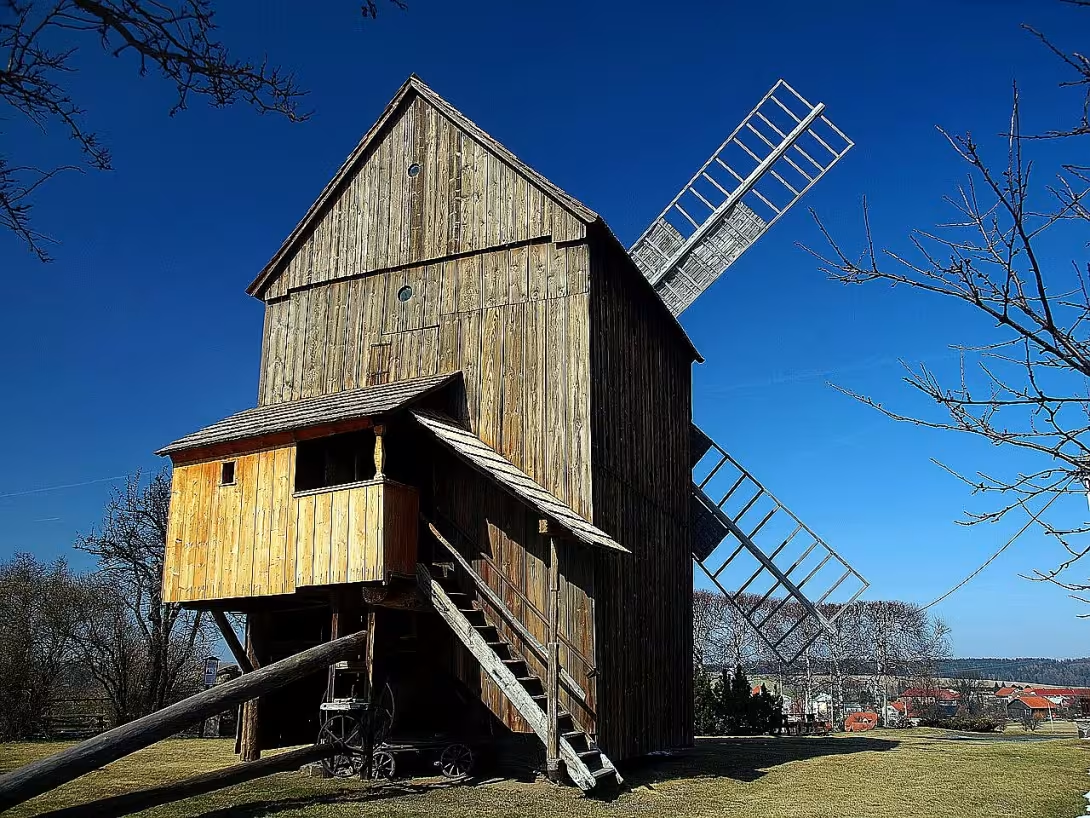
The windmill in Partutovice in Přerovsk is a technical cultural monument and the most preserved wooden pillar mill of German type in the Czech Republic. The building dates back to 1837 and thanks to the fully functional internal equipment it represents a unique document of historical milling.
The estimated year of construction is 1837. Older building elements were used in the construction, as demonstrated by the 1783 beam. The creation of the building falls within the period of national renewal and industrial revolution, when European society was transformed towards modern capitalism.
The construction is made as a wooden pillar mill of German type. In the 1950s, the building was moved to its current location at Grunderb, where it was reassembled and operational. This is the last preserved specimen of three windmills that were originally registered in Partutovice.
In the 1950s, Franz Motzky and Martin Hincica's families owned the mill. The fundamental change occurred on 11 October 1897, when the object was acquired by the family of Benedict Marshal on the basis of the purchase contract. Since then the mill has been maintained as a family heirloom and remains in the possession of the descendants of this family.
The mill is exceptional by fully retaining the original milling plant, which is still operational. Currently, the building also serves as a private museum that brings visitors closer to the history of miller craft.
This monument represents valuable evidence of technical maturity and means of livelihood in the agricultural landscape of the Oder hills. The visit offers a unique opportunity to see the authentic preserved technology, which is still functional thanks to the long-term care of the Maršálková family.
Then and now
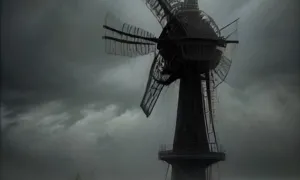
Drag the slider to compare how the landmark may have looked when it was built with the view today.
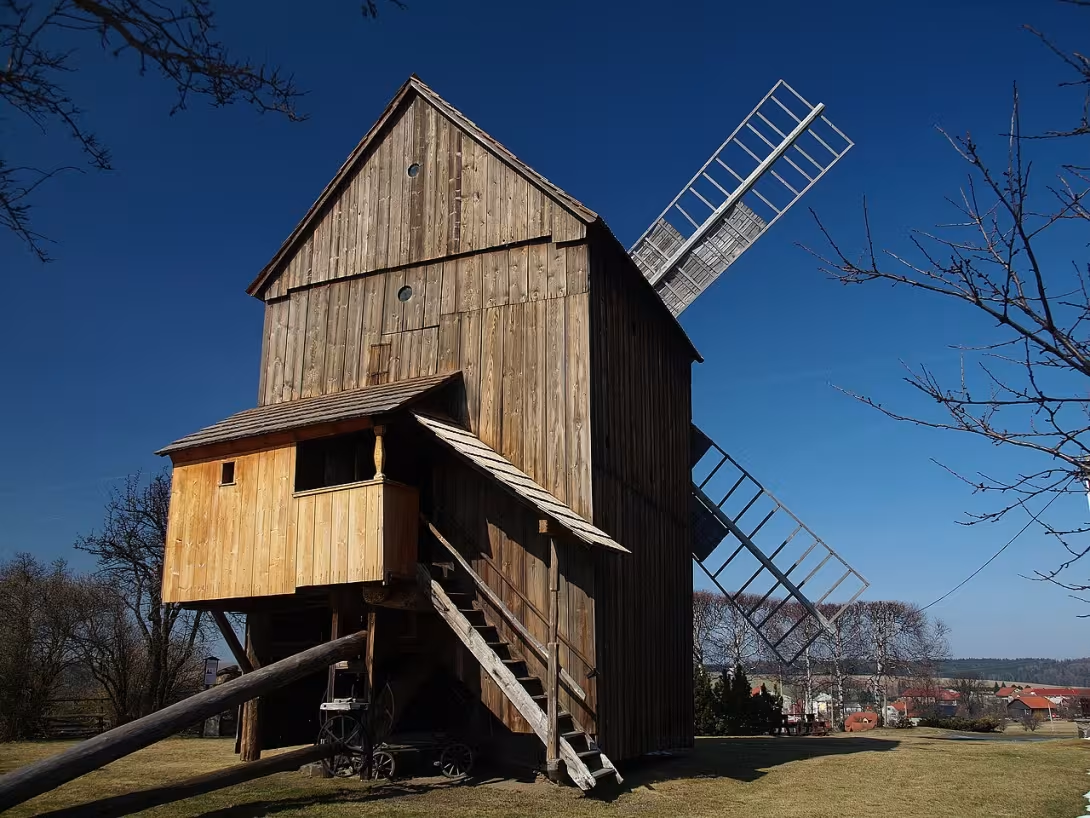
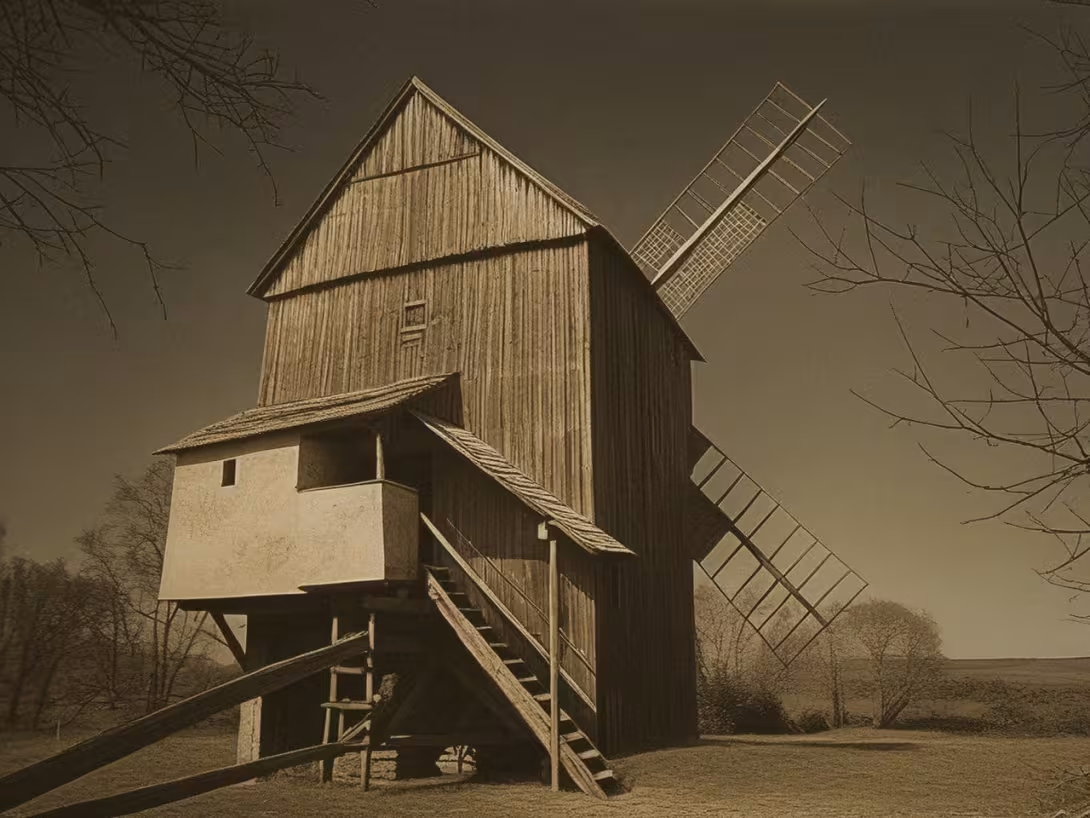
The historical appearance on the left is an AI-generated visualisation and serves as inspiration only.
Historical milestones
- 1783
- The dating on the beam used in the construction of the mill.
- 1837
- Estimated year of construction of the mill.
- 1897
- The purchase agreement under which the mill was obtained by the family of Benedict Marshal.
Architectural development
It is a wooden pillar construction of the German type, the construction of which also used older building elements, namely the beam with dating 1783. The mill was moved to a new place in the 19th century, where it was reassembled and operational.
Historical events
1837: probable mill construction. 1950s: moving the mill to its current location. 1897: The mill is transferred to the family of the Marshal.
Owners
Franz Motzka and Martin Hincica families (from the 1950s), the Benedikt Marshal family (from 1897).
Points of interest
- It is the most preserved wooden pillar mill of German type in the Czech Republic. - Older elements were used in the construction, as demonstrated by the 1783 beam. - In the 1950s, the object was moved to a current place called Grunderb. - The mill is the only preserved specimen of the three that were originally registered in the village. - The building has retained its original grinding machine, which is still operational and serves as a private museum.
Guide
Show guide text
This text was created by artificial intelligence and has not been editorially reviewed. It may contain inaccuracies.
Welcome to the windmill in Partutovice. You are standing in a location called Grunderb, and one of our country's most valuable technical monuments rises before you. Look up. You see a massive wooden body that appears to be mounted on only one strong pole stand. This is the sign of the German-type pillar mill - the whole body of the mill can turn according to the direction of the wind. The cords, which are now calmly hanging in the room, are ready to catch even the most beautiful wind. Do you feel the specific von of wood, cream and old wood that has been on the line for centuries? It's the one in history that's settled in every record.
Let's go back in time to understand how this wooden industry got here. The year 1837 is reported as a probable construction date. At that time the mill was probably built in a different place, closer to the village. Why was he moved here to Grunderb in the 1950s? The answer is simple - wind. The miller always looked for the best currents, and this hill offered them ideal conditions. Replacing such a huge wooden object at the time was an incredible task. Imagine this: the mill was dismantled into individual pieces, transported by horses in the chariots and reestablished in a new place. And yet - and this is the greatest gift for us today - he kept his original heart.
Now, if you look at the structure, notice a massive central column rising from the depth to the roof. It's a so-called royal column, the nose of the entire structure. The whole body revolves around him. Look at the nut - the long shaft that comes out of the mill on the side against the cripples. It was with him that the miller turned the whole building around so that it stood right in the wind. It's brilliant in its simplicity. The wood from which the mill is built tells its own story. If you could take a closer look at the supporting beams, you would encounter 1783. That's 50 years older than the mill itself. It means the builders used wood from an even older object. The old beams, which were once used for grinding, were given here a second, even a third life. This is typical of folk architecture - nothing came out, everything was used again.
Now move towards the entrance. Although the mill looks like a compact wooden box on the outside, there is a full flour factory inside. This mill is unique in the Czech Republic by fully retaining its internal milling plant and still being able to operate. When you go inside - and I hope you can do that, if it's open - you'll see two pairs of grinding stones. The upper, running stones revolve over the lower, lying. Huge wooden gears, gears and cylinders transfer power from the wind shaft down to the stones. Notice exactly how the gearing is carved manually. No machines, just a clogs and an eye. When the mill goes, the whole structure lives, shakes, hum and sings a song about grain and bread. It's a living organism, not a dead exposure.
The story of this place is the story of people who put their jobs and lives here. The names Franz Motzka and Martin Hincica are returned in archives as owners or miller workers who took care of the building in the middle of the nineteenth century. It was men who knew the wind was an unreliable servant, and could handle it. But probably the most important name for today's mill is Benedikt Maršálek. In 1897 he bought a mill and became the founder of a family that has been taking care of the memory for over a hundred years. The sales agreement of 1897 is proof that the mill was not only a source of livelihood but also a duty for the marshals. They kept it operational, repaired it, protected it from the destruction of time and wars. Today, when we look at the most preserved wooden pillar mill of the German type in our country, we owe it to their determination to let it stand, even when the world was changing around.
And now something that might surprise you. The 1783 on the beam isn't just a detail. It's the key to the mystery. The mill you see now was built in about 1837, but its bones are older. What was that mill where the beam came from? Was he standing on this hill, too? Or was he transported from far away? And why was this type - the German pillar mill - so successful in Partutovice that it remained the only preserved specimen in the whole Republic until today? The others disappeared, burned, disintegrated, replaced by steam engines, and later electricity. This one stayed. Maybe it's because Grunderb's not quite on the road, maybe it's because the marshals loved him more than profit. When you stand by the nut and move it lightly, you feel resistance to wood that remembers hundreds of thousands of turns. It's a tangible link to generations of miller.
Now let's get out of the door and go around the mill. Look at the facade from a distance. Note the roof covered with wooden shingles as they copy the shape of the body. Look at the windows - small, functional, designed for light and ventilation, not for beauty. And then look at the wings. Even in peace, they speak of strength. It's not just the boards and the canvas, it's the shoulder that the mill was referring to the grain. When the wind blows, you hear the sound of the wood, the screws and the ridges. It's music that no instrument plays, just wind and wood.
You have an extraordinary opportunity here to see a technique that has worked without change for centuries. The mill in Partutovice is not a museum exhibit behind glass. It's a machine waiting for the wind. When he comes, he runs. The stones spin, the flour gets buried in the bellows. And you can stand here, at the pillar mill on Grunderba, and be a part of that moment when history comes to life.
Thank you for stopping by. I hope that the wind will bring you a pleasant cold and that you will carry a picture of this wooden branch that is standing here, turning to the wind and refusing to disappear. Have a nice day, and let the wind blow into your covers. Goodbye.
Tips for visitors
The best time to visit is during sunny days in the period from spring to autumn, when the beauty of the wooden structure of the mill and surrounding agricultural landscape stands out. In these months there is also a higher chance that the object will be accessible for interpretations.
The best way to remember is by car, which can be parked in Partutovice.
For photography I recommend to use soft light during the morning or late afternoon, when the sun highlights the texture of wooden walls of the mill. The best images are taken from a slight distance to capture the entire structure silhouette in the context of the surrounding fields.
When visiting with children, it is advisable to carry with you fixed shoes suitable for the field and plenty of liquids because there are no shops in the immediate vicinity of the mill. Children will certainly be interested in the design of the mill itself, which is a unique example of folk technology.
In the vicinity of the mill there is a picturesque agricultural landscape of Oderské vrhy, which is ideal for easy walks. The whole area of the village of Partutovice offers a quiet environment for trips where you can admire the natural character of the landscape in the Přerov district.
Frequently asked questions
Can the monument be visited?
Some buildings of this kind are open for guided tours, others serve another purpose or are privately owned. We have not verified whether and when this monument is open – please ask the operator.
What are the opening hours and admission?
We have not verified the opening hours or admission. Current information is published by the operator. Official website: https://www.partutovice.cz/index.php/clanek/vetrny-mlyn/
Where is the monument?
Location: Olomoucký kraj. The map on this page shows the exact spot.
Why is the monument protected?
It is listed in the Central List of Cultural Monuments of the Czech Republic as a cultural monument (register no. 1000153264).
Businesses nearby
Do you run a restaurant, accommodation, shop, museum, rental, wellness or other visitor service near this monument? Show yourself directly to the people heading to it — this is how they will see you in the app and on the web:
Nearby
Obec Partutovice v okrese Přerov, okolní zemědělská krajina Oderských vrchů.
Accommodation nearby
Themed route
Village Partutovice - historical keryro - type: village square. Why: This is where the local atmosphere, the old houses and the first landmark before the entrance to the mill meet.
Větrný mlýn Partutovice - type: historical mill. Why: a preserved 19th-century wooden mill, the possibility of a tour of the inner spaces and examples of traditional grinding.
Agricultural landscape of Oder hills - circular trail - type: natural path. Why: a quiet walk between the fields and meadows, a view of the large fertile areas and characteristic peaks of Oder hills.
Traditional farms of Oderské vrče - type: farmhouses. Why: the opportunity to look into old agricultural techniques, meet local farmers and taste regional products.
Western edge of Partutovic - view of Oderské vrchy - type: sightseeing spot. Why: panoramic view of the interplay of the village, mill and surrounding hills, ideal for final rest.
Seasonal recommendations
In spring, the area of the mill wakes up along with nature. Fresh green and blossoming flowers create fresh sets for the tour. The light is delicate and rough in this period, which gives the construction a very pleasant look. We recommend arriving early in the morning when the air is the cleanest and there are not so many people around. Prepare your clothes because the morning cold can be accompanied by sudden rain.
Summer months bring strong sun to the surroundings and long days of warmth. The atmosphere is alive and the landscape is flooded with bright, golden light. Due to the increased interest of visitors in the main summer season, we recommend arriving as soon as possible after opening to avoid the largest groups of people and the highest heat. Don't forget the headgear and plenty of fluids.
Autumn turns the surroundings into a colorful landscape full of orange and brown shades. Morning fog gives the mill a mysterious and calm mood. The sun is already lower in the sky, creating beautiful shadows on the wooden structure. It is advisable to wear firmer shoes because of the damp surface of the ground and warmer upper clothing. The best time to observe the colors is in the morning.
Zimą makes the mill very lonely in the landscape, especially when everything is covered with snow or freeze. The day is short and the light is very weak, so plan a visit around noon when the most light is. Dress very warm and well, because the wind at the windmill can feel sharper. In this period there is a shorter time when the monument is accessible.
Visualizations and artistic views


The visualisations are generated by artificial intelligence and serve as inspiration.
Photos from the area
Real photos taken near the monument


Zdroj a licence jsou uvedeny u každého snímku.
Tips from visitors
No tips yet. Be the first!
Log in and add your tip.
Sources and literature
Photos: Milos Pospa / CC BY-SA 3.0 — Wikimedia Commons. The author and licence also appear when you hover over the image.
Faktickým podkladem tohoto textu byl článek na Wikipedii, jehož autory jsou přispěvatelé Wikipedie. Článek je dostupný pod licencí CC BY-SA 4.0.
Location on the map
Příběhy a pověsti
Legendy, pověsti a příběhy spjaté s touto památkou
Fotografie návštěvníků
Zatím žádné fotografie. Buďte první, kdo přidá fotografii z návštěvy!
Log in a přidejte svou fotografii nebo hodnoťte.
Za ověřenou návštěvu v aplikaci získáte víc bodů — poznáme podle GPS, že jste na místě.
Reviews and comments