



Vila Marianum Villa
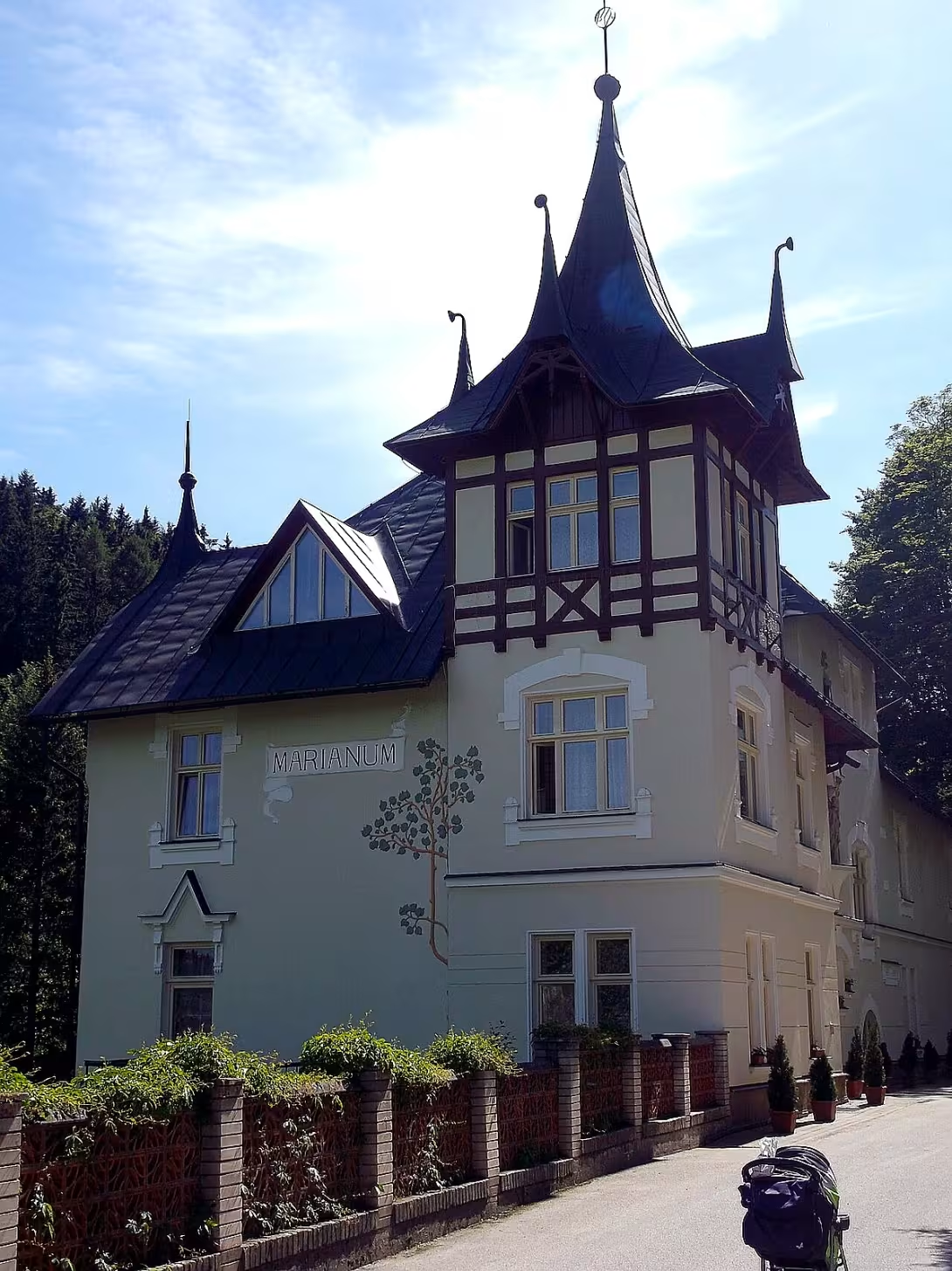
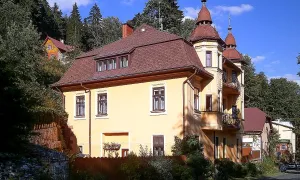
Vila Marianum is an Art Nouveau villa from the beginning of the 20th century in Janské Lazne, originally built as a sanatorium for sick priests. It is an important architectural monument with a dominant tower and rich stucco decoration. Today it serves as a guesthouse and diocesan center.
The building was built on the basis of a decision of the bishop's consistor of the royal hradec diocese in 1903. Building land near the church of St. John the Baptist, on the way from town center to Rudolph Valley, donated Hugo Wihard. He supported the construction and delivery of building materials and his wife Helena Wihardová personally donated 20,000 bricks. The construction itself took place between 1904 and 1905.
The villa is a brick building built in the slope, which makes the elevated ground floor even on a high basement. The building is oriented towards the south side and is dominated by a three-storey corner tower with a tent roof with a bow, the top of which ends with a turret. The rugged roof of the saddle is carried by the ventilator with turrets. The total height of the building is 13 meters.
The bright facade is supplemented with white decorative elements and shampoos. The architectural details are grafted at nothing above the main entrance, where the sandstone statue of the Virgin Mary is located. There is also a belt label called Marianum on the facade, embossed stucco decoration in the shape of a tree and details of the construction time.
Since its inception, the villa has served for the recreational residence of priests, nurses and church staff, which also results from the existence of its own prayer house. The Royal Hradec Bishops took over the building. In July 1909 the King's Hradec Bishop Josef Doubrava hosted here.
Since 1992, Marianum Villa has been protected as a monument. Since 1998 there is a diocesan center and the building serves for recreation as a pension with a total capacity of 53 beds.
Vila Marianum represents a valuable example of Art Nouveau architecture with significant sacral context. Its visit offers the possibility to see detailed craft processing of the facade as well as unique buildings available in the slope.
Historical milestones
- 1904
- The beginning of the building of the Art Nouveau villa.
- 1905
- Completion of building construction.
- 1992
- The building was recognised as a protected building.
- 1998
- Establishment of a diocesan centre.
Architectural development
Walled building in the slope with high basement and three-floor corner tower with tent roof. The facade is decorated with relief stucco, engraved Marianum and sandstone statue of the Virgin Mary above the main entrance. The roof is a saddle-shaped roof with a formatted roof and ventilating skylights.
Historical events
1903: Decision on the construction of a sanatorium; 1904- 1905: Villa construction; 1909: The residence of Bishop Josef Doubrava; 1992: Declaration of Memorial Protection.
Owners
The King's Hradec Bishop
Points of interest
- Vila Marianum is an Art Nouveau villa from the early 20th century built as a sanitarium for sick priests. - It is an architectural monument with a dominant tower and rich stucco decoration, today serving as a guesthouse and diocesan center. - The building plot was donated by Hugo Wihard, which supported construction and delivery of building material; His wife Helena Wihardová donated 20,000 bricks. - The villa is a walled building built in a slope with a three-storey corner tower, whose top ends with a poppy tree; the total height is 13 metres. - Since 1992 it has been protected as a monument and since 1998 there has been a diocesan centre offering recreation with a capacity of 53 beds.
Guide
Show guide text
This text was created by artificial intelligence and has not been editorially reviewed. It may contain inaccuracies.
Welcome to the beautiful Janan Spa. Right now, when you're standing right in front of this beautiful building, I believe you can feel the strange, noble atmosphere of a place where the calm of nature and the elegance and art of the last century are united. The Vila Marianum stands before your eyes. It is a building that immediately captures your view with its richness and its chosen style. Before you go on your next trip, I suggest you stop for a while, take a deep breath and just watch. Feel the beauty that surrounds you right now. This villa is not just an ordinary house or building for accommodation. It is a living witness of ancient times when architecture sought harmony, beauty and expression of something higher through detail.
Let us now return together to the time when the first stones of this building began to lay down. More than one hundred and twenty years ago, precisely in the year one thousand and nine hundred and four, construction began to take place, which was to fundamentally change this place. The aim of the then builders was not only to build a beautiful mansion, but above all a place of treatment, peace and rest. The villa was designed and built as a sanatorium, a place intended for healing and care of the sick priest of the royal hradec diocese. Imagine those times when people were looking for shelter from diseases in these quiet and clean areas. The whole construction process was very fast and effective, the following year, i.e. in the year one thousand nine hundred and five, the whole building was completed. Since then, the villa has undergone many changes, but its original spirit and character have remained intact. Its importance to our heritage is so great that, since the year one thousand nine hundred ninety-two, this building has been recognized as a monument which must be strictly protected for future generations, so that the beauty and the work that you see right in front of you today is not lost.
Now pay attention to what you see right in front of you on the very body of this building. Look up and look at the facade. Vila Marianum is an excellent and clean example of Art Nouveau style, which was so extremely popular and sought after at the beginning of the twentieth century. This style, often referred to as Art Nouveau, is known for loving smooth, organic lines and rich, almost playful decoration. Notice this dominant tower that's standing in the corner of the building. The tower gives the whole object a sense of grandeur, strength and orientation in space. It is she who makes this villa so easily recognizable even from far away and who gives it the right, majestic look. And then look at the amazing details on the walls. See the rich stucco decorations? These decorative elements, which are formed directly on the facade, are typical of this period. They are fine shapes that give the building depth, richness and movement. Every detail, every line and every decorative form that you are now observing has its meaning and creates the overall impression of luxury and immense care with which the whole building was invented and realized.
Every such important building has its own people behind it, and even though the names of the architects themselves who drew these lines remain unknown in history, we can learn about the people who made this villa possible at all. One of the most important names in the story of this villa is Hugo Wihard. That wasn't just an ordinary contributor. He donated the very building site on which this beautiful villa stands. However, its support did not only end with a gift of land; He helped with his generosity to supply everything needed for the actual implementation of the construction. Without his decision and support, this place would probably never look the way you see him today. In the history of this place there are also other names associated with it, such as Josef Doubrava or Helena Wihardová. These people are deeply associated with the spirit of this place and its development in time.
Perhaps you are now interested in the fascinating transformation this object has undergone over decades. Imagine how priests once moved here looking for healing and peace for their soul and body. The place that was originally established as a closed area for treatment and care of a selected group of people became something completely different over time. In the year one thousand nine hundred eighty eight, a diocesan centre was set up here and today the villa serves the wider public as a guesthouse. It is a fascinating idea how a place that was once intended for a very specific purpose opened up to all people looking for accommodation, comfort and peace in this beautiful environment. This transformation from a healing sanatorium to a place for guests shows how architecture can remain alive and useful despite changes in social conditions.
I hope that this brief insight into the history and details of Marianum Villa has at least interested you a little bit and helped you better understand what you are looking at. Vila Marianum is the real treasure of the Janské Spa and its beauty is a clear proof of the art and effort of the ancient masters. Before you go on your next trip and continue to search this place, I suggest you try again to perceive the harmony between this building and its surroundings. Feel the beauty that surrounds you. I wish you a very pleasant and beautiful walk and many other interesting experiences in this wonderful city. Goodbye.
Tips for visitors
The best time to visit Villa Marianum is in spring and autumn months when the weather is pleasant and not so hot sunlight. This period offers ideal lighting conditions for shooting architecture with penetrating colors and fine shadows that highlight Art Nouveau elements of the building.
We recommend checking the current connection before visiting.
When visiting Villa Marianum, bring a hat or hat to protect yourself from sunlight. It is also important to have a guide or mobile device to track the map if you plan to explore the surrounding areas and especially the Church of St. John the Baptist.
The best place for photography is to enter Villa Marianum from the northeast side, where the building flows into the surrounding park. The morning or late afternoon light offers the sweetest shadows and colours to capture architectural beauty. Photography in the church of St. John the Baptist is also very interesting, especially when an open door is reflected on its walls.
In the vicinity of Villa Marianum you can visit Rudolph Valley, which offers beautiful walks and is also suitable for families with children. Children can enjoy the natural landscape and play in nature. Plus, it's a place where you can relax your mind and enjoy a quiet moment.
Frequently asked questions
Can the monument be visited?
This is a residential or farm building, not a museum with opening hours. Please view it from public space and respect the owners' privacy. We have no information about access to the interior.
Where is the monument?
Location: Janské Lázně, Královéhradecký kraj. The map on this page shows the exact spot.
Why is the monument protected?
It is listed in the Central List of Cultural Monuments of the Czech Republic as a cultural monument (register no. 1000119114).
Businesses nearby
Do you run a restaurant, accommodation, shop, museum, rental, wellness or other visitor service near this monument? Show yourself directly to the people heading to it — this is how they will see you in the app and on the web:
Nearby
Kostel svatého Jana Křtitele, Rudolfovo údolí.
Accommodation nearby
Themed route
Thematic cruise route from the village Janské Lázně
1.Vila Marianum (villa) Type: historical villa Why is it worth a visit: Vila Marianum is a beautiful representation of architecture in the late 19th century, located in a picturesque place with a view of the surrounding mountains. It is an ideal place for those who want to know the history and culture of the Janské Spa region.
2. Church of St. John the Baptist (Church) Type: religious object Why is it worth visiting: This church is an important spiritual and architectural monument that attracts attention to its history and wealth of interior. It is ideal for those interested in religious structures and their importance to the local community.
3. Rudolph Valley (Natural Area) Type: natural area Why is worth a visit: Rudolph Valley offers beautiful landscapes and is an ideal place for relaxing and walking in nature. It is a place where you can enjoy the peace and sight of the natural beauty of the Janské Spa area.
This route offers a combination of historical knowledge, spiritual reflection and natural use in one small urban environment.
Seasonal recommendations
Spring: During the spring season, Marianum Villa is fertilized by flowering nature, which includes various kinds of flowers and trees in full bloody colour. Sunshine complements the beauty of the environment, making the visit comfortable even for photos. At this time more people may appear visiting natural parks and health stations a popular place, so it is advisable to arrive early in the morning or later in the evening. Sufficient sun protection and light coat for a cooler afternoon are recommended.
Summer: For years, Marianum Villa is a popular place for visitors looking for comfort from heat and relaxation. The day is long, which allows extended opening times of the monument. The presence of a larger number of visitors requires an early arrival to save waiting and ensure sufficient time to explore all attractions. Getting into a local liquor store or cafe is a good way to relax and enjoy cold drinks. Warm clothing suitable for the sunny time of the day is recommended.
Autumn: In autumn, Marianum Villa offers a quieter atmosphere and beauty of coloured leaves, which brings a unique view of the memory. Sunshine days are still common, but cooler afternoon and evening hours are beginning to appear. At this time, there are fewer people than in the summer, which makes it more comfortable to explore the memory. It is advisable to prepare for colder weather and wear more layers of clothing. Beautiful light at this time is ideal for photography.
Winter: The winter visit to Marianum Villa offers a quiet atmosphere where fewer people are present and the monument is mirrored in ice beauty. Short days require early arrival in order to be able to explore the site as much as possible during open hours. Hot clothes are key here, including fur and wind protection to prevent cold. The view of the memory covered by snow can be very interesting for winter scene lovers.
Visualizations and artistic views


The visualisations are generated by artificial intelligence and serve as inspiration.
Photos from the area
Real photos taken near the monument


Zdroj a licence jsou uvedeny u každého snímku.
Tips from visitors
No tips yet. Be the first!
Log in and add your tip.
Sources and literature
Photos: JiriMatejicek / CC BY-SA 4.0 — Wikimedia Commons. The author and licence also appear when you hover over the image.
Faktickým podkladem tohoto textu byl článek na Wikipedii, jehož autory jsou přispěvatelé Wikipedie. Článek je dostupný pod licencí CC BY-SA 4.0.
Location on the map


Příběhy a pověsti
Legendy, pověsti a příběhy spjaté s touto památkou

Fotografie návštěvníků
Zatím žádné fotografie. Buďte první, kdo přidá fotografii z návštěvy!
Log in a přidejte svou fotografii nebo hodnoťte.
Za ověřenou návštěvu v aplikaci získáte víc bodů — poznáme podle GPS, že jste na místě.
Reviews and comments