



Vodní mlýn (Salavice) Water mill
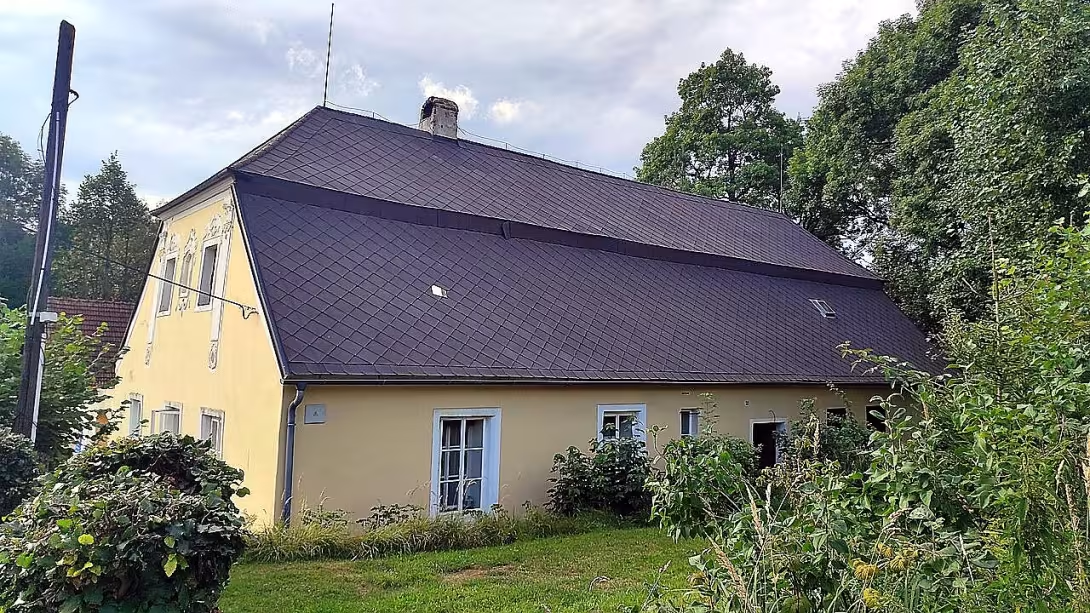
The salavický mill, located in Savavavice near Trešt in Jihlava district, is a water mill built in 1741. It is located in the centre of the village on the Třešť stream and thanks to its historical and architectural value it is protected as a cultural monument of the Czech Republic. The construction is an example of the Baroque era when industrial innovation and agricultural reforms developed in Europe.
The year of construction, 1741, corresponds to the time of the Baroque, in which many technological advances occurred in the Czech Republic. This period was characterised by the growth of urban centres and agricultural reforms, which also affected the construction of these mills.
Architecturally, the Salavický mill boasts a ground floor residential building with a storey mill covered with a mansard roof. The facade is decorated with stucco stucco ornaments, which give the construction aesthetic value and show artistic trends of the time. Originally, there was a wooden object attached to the mill, behind which was a barn perpendicular to the main access road.
In 1930, a file and Francis turbine were recorded in the mill. These technologies were used to make more efficient use of hydroenergy, reflecting the progress made at the time in the field of energy systems.
Today the Salavický mill is protected as a cultural monument and deserves a visit not only because of its history but also thanks to architectural details. The mill is an important example of the Baroque period and its technological innovations.
The visit to the Salavický mill offers a unique opportunity to explore part of the history of the Czech Republic. Its preservation and historical value attract not only historians but also tourists from all over the world. The mill shows how technological innovation shaped life in the past and how their legacy still affects our current environment.
Historical milestones
- 1741
- Formation of the mill
Architectural development
The mill has a ground-floor residential building with a storey mill and was once supplemented by a wooden object. The water to the water wheel was driven by a drive and a drain channel returning to the river.
Historical events
- 1930
- During the mill was recorded saw and Francis turbine with certain performance.
Points of interest
- The mill was built in 1741 and its facade decorated with rococo stucco ornaments which show the artistic trends of that time. - In 1930 there was a file and a Francis turbine in the mill, which served to make more efficient use of water energy. - Originally, there was a wooden object attached to the mill, behind which was a barn perpendicular to the main access road.
Guide
Show guide text
This text was created by artificial intelligence and has not been editorially reviewed. It may contain inaccuracies.
Welcome to the Salavice, in this quiet corner of Treště, where time seems to be stopped for a while. Right now, you're standing in front of a building that is a silent witness to centuries of local life and work. In front of you is the Salavicka Mill, a building that dominates the centre of the village with its presence and reminds us of the time when the rhythm of human being was closely connected to the flow of water and the rotation of the mill wheel. Stop for a moment, take a deep breath and feel the atmosphere of this place. Do you hear the sound of the Třešť creek? This water ribbon is the heart of the whole complex and the reason why the mill was built here. Without the tireless power of water, this building would be just an ordinary house, but thanks to the stream it became a center of energy and livelihood for the whole surrounding countryside.
Let's now look at how this monument was created. The Salavice Mill was built in the year of tyre seven hundred forty one. Imagine the world almost 300 years ago. It was a time when new, lighter and more playful directions were being promoted in architecture and art. The mill was not only a practical grain milling workshop at the time, but also an expression of a certain social status and aesthetic taste. Although we do not know exactly who was the author of the project today, it is clear that the builder wanted the building to be elegant and representative. At that time, mills were key points in the landscape to which people from nearby farms flowed, and it was therefore important that the mill radiated both stability and prosperity.
Now, please pay attention to the architecture of the building in front of you. Look at the overall composition. The mill consists of a combination of two functions that are connected in one construction. Notice the ground floor residential area where the grinder and his family spent their days and nights. It's a home area that was close to the job. The residential part is adjacent to the storey mill, which was the technical core of the whole operation. It was here that machines were found that turned the energy of water into the movement of ground grains.
Look up now, to the top of the building. Your eyes should be covered with a mansard roof. This type of roof, which is characterized by its propensity, was very popular in the eighteenth century and supplied certain charm and a sense of grandeur to buildings. But the most interesting thing is waiting for you on the front. If you look closely at the facade details, you'll notice the stucco stucco ornaments. These are fine, elegant decorative elements that are typical of the rococo style. These ornaments are not just decoration, they are a trace of a particular epoch and show us that the Salavický mill was to be a truly beautiful and modern work at the time of its creation. It is fascinating to think that these fine lines of stucco have survived decades of winds, rains and changes in the surrounding landscape so that today they can tell their story to you.
When we think about the history of this place, we have to realize that the mill was not a static structure but a living organism that had to evolve. Although we don't know the names of the particular personalities that worked here, we can imagine generations of millers who spent their lives here. The miller was a respected figure in the village, a man who understood water, technology and nature. Imagine the morning fog over the Třešť stream, the sound of cracking grain and the constant noise of machines filling the space of the mill.
Let's move forward in time now, until the year one thousand nine hundred thirty. At that time the mill underwent technical modernization, which fundamentally changed the way it used the power of water. This year's records show a file and a Francis turbine in the mill. These names may not tell you anything, but for the time being, it was the peak of technology. The Francis turbine has made the use of water more efficient than the old water wheels. The water was no longer just pushing the wheels, but it was flowing through the turbine, which increased the performance and reliability of the whole process. It's a fascinating contrast when we realize that a building with fine rococo ornaments from the eighteenth century later hid in it modern machines of the twentieth century. It's a symbol of how tradition meets progress.
There is also a little mystery, or rather a trace of what you will not see today. If you look at the area around the mill, try to imagine that a wooden object was originally attached to it. This wooden port was probably part of the storage or auxiliary space necessary for the operation of the mill. Today it is gone, but in our spirit we can complete the overall picture of the complex, as it looked in the time of its greatest glory, when the mill was surrounded by smaller buildings and the constant movement of wagons full of grain.
The Salavický mill is today protected as a cultural monument of the Czech Republic and it is very valuable. Thanks to this, we can still admire the combination of practical use of hydroenergy and high aesthetics of the rococo era. Now, when you look around, see this mill not only as a building of stone and wood, but as a memory of human work and ingenuity. It is a place where the force of nature in the form of a stream has joined with the human desire for beauty and efficiency.
Now I'm leaving you to look at the details of the facade in peace, see the fine stucco ornaments again, and maybe try to return in spirit to the year one thousand seven hundred forty-one. Take a walk around the building, listen to the water and let the atmosphere of this extraordinary place consume you. I hope this short journey over time has helped you see the Salavicka Mill in a new light. I wish you a pleasant continuation in discovering the beauty of Třeště and its surroundings. Goodbye.
Tips for visitors
The best time to visit is the spring and summer season, when the surrounding nature is in full bloom and the curved water in the Třešť stream works most alive. The view of the historical building in accordance with nature is the most beautiful in these months.
You can reach the mill by car or use public transport. Please check the current traffic links in internet search engines.
For lovers of photography are the best places near the flow where you can capture the glare of light on the water surface. The best light for images of historical architecture is during the morning hours or shortly before sunset. Don't forget to bring comfortable shoes suitable for nature walks.
For families with children the visit is very pleasant thanks to the quiet atmosphere and proximity of the water. Since there are no other specific objectives in the surrounding area in the attached information, we recommend paying attention to the tour of the mill itself and its historical importance.
Frequently asked questions
Can the monument be visited?
This is a technical monument. Some are open as exhibitions, others are out of use or on private land. We have not verified whether this one is accessible.
What are the opening hours and admission?
We have not verified the opening hours or admission. Current information is published by the operator.
Where is the monument?
Location: Třešť, Kraj Vysočina. The map on this page shows the exact spot.
Why is the monument protected?
It is listed in the Central List of Cultural Monuments of the Czech Republic as a cultural monument (register no. 1000149109).
Businesses nearby
Do you run a restaurant, accommodation, shop, museum, rental, wellness or other visitor service near this monument? Show yourself directly to the people heading to it — this is how they will see you in the app and on the web:
Nearby
🏰 Historic sites (111)
- Památník osvobození 1945 0.1 km
- padlým ve světových válkách 0.1 km
- Pomník Antonína Podhorského 0.2 km
- Expozice Městyse Dolní Cerekve 2.4 km
- svatý Jan Nepomucký 2.7 km
- Muzeum Tesla 3.8 km +420 608 464 947 web
- Panna Maria 4.1 km
- Hrdinům 1938-45 4.3 km
- Obětem válek 4.3 km
- Památce Michala Břízy 4.3 km
- Muzeum Vysočiny Jihlava - pobočka Třešť 4.3 km Rooseweltova 462 web
- Pomník padlým občanům za I. světové války 4.4 km
- Šimon Partlic ze Špicberka 4.4 km
- Panna Marie s Ježíškem 4.4 km
- Památnim 90 obětem národního odboje 1939-1945 4.4 km
- Padlím při obraně města 5.3 km
- Panna Maria 5.9 km
- Památce Františka Pulicara 5.9 km
- Expozice železniční tratě Kostelec - Slavonice 6.7 km web
- Karel Havlíček Borovský 6.8 km
🍽️ Restaurants and dining (218)
- Horal 3.1 km
- Stop Cafe 3.5 km
- Zámecká restaurace 4.2 km Dr. Richtra 234/6 web
- Gram Café 4.3 km
- Pizza Muja 4.3 km
- U Špinarů 4.3 km
- Klub labužnických pohodářů - Klubovna 4.3 km
- Svět 4.5 km web
- Plzeňská restaurace U Kapra 4.5 km nám. T. G. Masaryka 17/7 +420 602 741 451 web
- Plzeňská restaurace U Kapra 4.6 km nám. T. G. Masaryka 17/7 +420 723 390 634 web
- Kavárna U Ferdinanda 4.6 km Revoluční 1298/4 +420 567 215 567 web
- Kebab House 4.7 km
- TJ Cejle 4.8 km
- Fialka 5.0 km
- Krčma Čeřínek 5.7 km
- U Tatara 5.8 km
- U Billa 6.1 km
- Hospůdka U vleku 6.4 km
- Stop Cafe 6.6 km
- Hodice 6.9 km
🏨 Accommodation (43)
- Hotel Horal 3.1 km web
- Zámecký hotel Třešť 4.1 km Dr. Richtra 234/6 +420 567 211 800 web
- Apartmány David 4.3 km
- Harmony 4.3 km web
- Chata Nad Lípou 5.5 km web
- U Tatara 5.8 km
- Turistická chata Čeřínek 6.0 km
- Mlýnhotel 2 6.5 km
- Rekreační chata Okrouhlík 6.5 km web
- Mlýnhotel 6.6 km
- Samota Sturpik 7.2 km web
- Penzion Stodola 7.5 km web
- Hotel Vivaldi 8.3 km
- Penzion Dyje 9.0 km 567 224 485 web
- Wellness Medličky 9.5 km
- Hotel Villa EDEN 9.9 km +420 567 120 000 web
- dena 10.0 km
- Harmonie 10.0 km
- Penzion Třeštický Mlýn 10.1 km web
- Zlatá hvězda 10.2 km Masarykovo náměstí 32
🚲 Rentals and sport (28)
- Sportbowling 4.0 km
- Přírodní koupaliště Malvíny Třešť 4.1 km
- Prodej kol 4.7 km
- Motokrosová a enduro trať GreenRacing Vílanec 5.5 km web
- Sportisimo 8.5 km
- Svět hor 9.5 km Žižkova 89 +420567210091 web
- Školní hřiště 9.9 km
- Bazén Evžena Rošického 9.9 km
- Hipp cycles 10.1 km
- Moravia 10.2 km Jiráskova 2430/94 +420 567 308 924 web
- Velosport HB 10.2 km Benešova 14 +420567301296 web
- Lezecké centrum Jihlava 10.2 km web
- KOLOFIX 10.3 km Brtnická 2531 800010101 web
- Sport 2000 10.3 km Masarykovo náměstí 49
- Hervis 10.3 km web
- Adidas 10.3 km
- Sportovně relaxační centrum Český Mlýn 10.5 km web
- SH Teniscentrum 10.7 km
- SH Teniscentrum 10.7 km
- Sportisimo 10.9 km
🥾 Hiking and nature (296)
- Vlčí vrch 1.1 km
- V Horách 1.2 km
- Půvold 1.2 km
- U břízy 1.5 km
- Kamenný kopec 1.6 km
- Bažantnice 1.9 km
- Malý Špičák 2.0 km
- Jezdovické rašeliniště 2.0 km
- Vršek 2.2 km
- Špilberk 2.3 km
- Díly 2.5 km
- Bukovské rybníčky 2.7 km
- Popický vrch 2.7 km
- Velký Špičák 2.9 km
- Korunní kopec 3.0 km
- Kostelecký vrch 3.2 km
- Pod Klučím 3.5 km
- Na Vršku 3.5 km
- Velké Javoří 3.6 km
- Kaz 3.9 km
Accommodation nearby
Trips and activities nearby
Guided tours, tickets and activities nearby from GetYourGuide
Affiliate link: if you buy from the partner, we may receive a commission. The price for you does not change.
Search tours and activities →Themed route
1. Mill building (exposition): A tour of the inner spaces where the history of grinding and working the mill will be presented. 2. Water wheel (technical device): Watching the fascinating movement of water and mechanism that brings strength to the machine. 3. The mill (outdoor area): Walk through the premises, which allows you to perceive the overall architecture of the building. 4. Flood and trough (water work): Visit the place where the water flows into the wheel and forms a natural sound background mill.
Seasonal recommendations
In spring the mill will surround the awakening greenery and intense colors of flowering trees. The water in the stream is sharper and louder due to the melting snow, which gives the whole place dynamism and freshness. We recommend moisture-resistant footwear because the surrounding roads can be filled with rain. The best time to visit is in the morning when the air is the cleanest.
The summer months bring thick shade of leafy trees and bright, sharp light that highlights the details of historical architecture. The atmosphere is relaxed and full of life, typical of vacation. Due to the high season, it is advisable to arrive immediately after opening to avoid the largest groups of visitors. Don't forget light clothes and plenty of fluids.
The autumn season turns the landscape around the mill into a mosaic of gold and red colours, while morning fog above the water creates a mysterious and melancholic mood. The light is softer, which is ideal for capturing the details of the construction on the photographs. It is practical to dress in more layers to protect you from changing weather and cold wind. We recommend a visit in the afternoon.
In winter the monument is peaceful and quiet, especially if it is covered by a layer of snow and freezing crystals on the edges of the roof. The atmosphere is nostalgic and the space acts chamber. It is necessary to wear warm termial clothes and a firm sole to threaten to slip on a frozen path. Pay attention to the shorter opening times that are typical of this cold time.
Visualizations and artistic views


The visualisations are generated by artificial intelligence and serve as inspiration.
Photos from the area
Real photos taken near the monument


Zdroj a licence jsou uvedeny u každého snímku.
Tips from visitors
No tips yet. Be the first!
Log in and add your tip.
Sources and literature
Photos: Koutne1 / CC BY-SA 4.0 — Wikimedia Commons. The author and licence also appear when you hover over the image.
Faktickým podkladem tohoto textu byl článek na Wikipedii, jehož autory jsou přispěvatelé Wikipedie. Článek je dostupný pod licencí CC BY-SA 4.0.
Location on the map

Příběhy a pověsti
Legendy, pověsti a příběhy spjaté s touto památkou
Fotografie návštěvníků
Zatím žádné fotografie. Buďte první, kdo přidá fotografii z návštěvy!
Log in a přidejte svou fotografii nebo hodnoťte.
Za ověřenou návštěvu v aplikaci získáte víc bodů — poznáme podle GPS, že jste na místě.
Reviews and comments