



zámek Svatý Hubert Hunting lodge
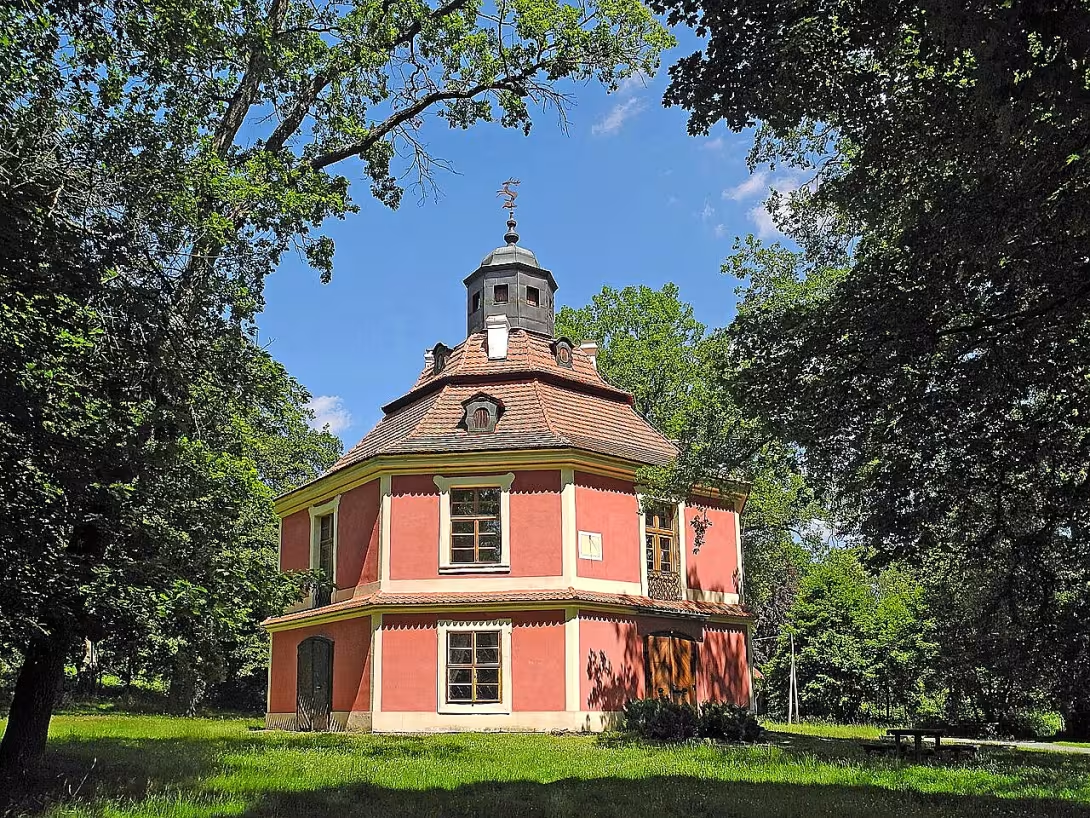
The hunting castle of Saint Hubert is a baroque one-storey building with a characteristic octagonal plan. It stands in the settlement of Saint Hubert in the village Drahouš in the district of Rakovice. The building was established in the early 18th century and served as the centre of the hunting grounds in St. Petersburg. Since 1965, it has been protected as a cultural monument.
The castle was built by the Chernines of Chudenice, then owners of St. Petersburg. The construction was created during the peak of Baroque in Czech countries. At that time, the usual setting up of hunting castles as centres of administration was the field and places for the social life of nobles. There was a major decomposing around the building.
Architecturally it is a building with a regular octagonal plan, which ends with a bell roof with lantern. The castle was strategically located in a place where eight symmetrically divided sections of the field were collected. There was a rudder on the lantern. It was used to determine the direction in which the hunted animals last moved. On the first floor there are residential rooms with interior decorated with hunting trophies.
The castle remained in the property of the Chernín family until 1945 when it was nationalized. The facade and roof were renovated in 1975. Currently an object is owned by state forests and serves for recreation.
Major events connected to the building include stays of poet Jaroslav Vrchlický from 1872- 1875. During visits to parents in Pure, the author wrote some of his poems.
A road from the village Drahouš leads to the castle in the direction of the Great Chmelistnná. For tourists, the object is available after the yellow mark from Jesenice to Velka Chmelická or after the blue mark from Kosoboda to Smrk.
The hunting castle of Saint Hubert presents a unique example of Baroque architecture with a very specific function. It's a place where the history of a noble hunter connects to a literary tradition. A visit to this building offers the opportunity to see a rare plan and touch the history of St. Petersburg.
Then and now
Drag the slider to compare how the landmark may have looked when it was built with the view today.
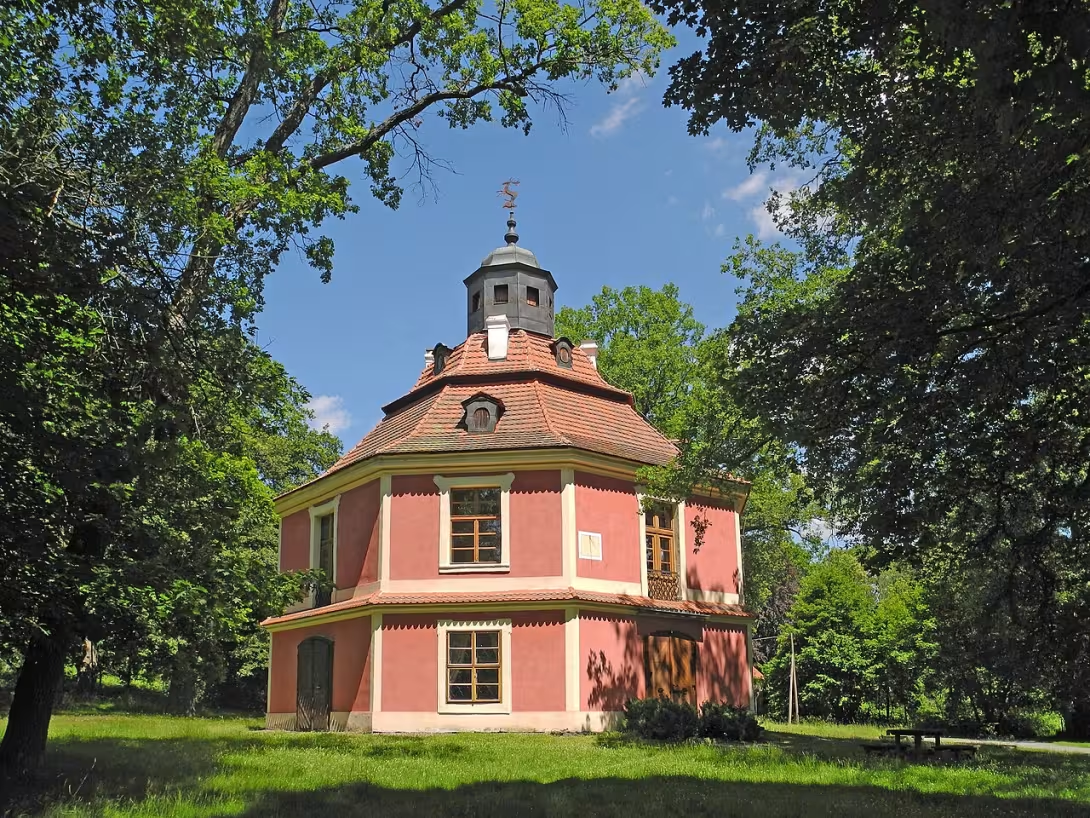
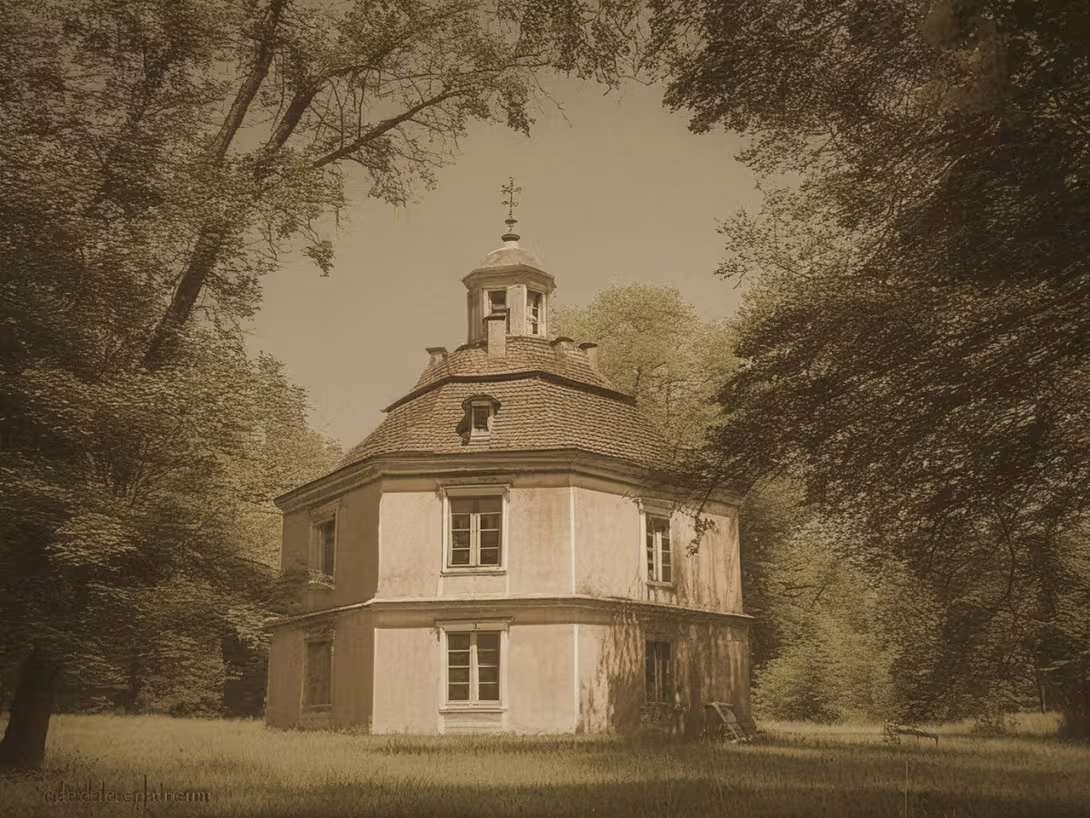
The historical appearance on the left is an AI-generated visualisation and serves as inspiration only.
Historical milestones
- 1872- 1875
- Jaroslav Vrchlický wrote some of his poems while staying with his parents in Clean.
- 1945
- The castle was nationalized.
- 1965
- The building was declared a cultural monument.
- 1975
- The roof and facade were reconstructed.
Architectural development
It is a baroque building with a regular octagonal plan and bell roof with lantern. On the first floor there are living rooms whose interior is decorated with hunting trophies. In 1975, the facade and roof were repaired.
Historical events
1945: nationalization of the castle, 1965: publication of a cultural monument, 1975: reconstruction of the roof and facade
Owners
Chernínové z Chudenice (until 1945), State (since 1945), State forests (present)
Points of interest
- It is a baroque one-story building with an octagonal plan and bell roof with lantern. - The castle was built by the Chernines of Chudenice in the early 18th century as the centre of the hunting grounds. - There was a bead on the lantern that determined the direction of the game's movements. - In 1872-1875 there was a poet Jaroslav Vrchlický who wrote some of his poems. - The building has been protected as a cultural monument since 1965.
Guide
Show guide text
This text was created by artificial intelligence and has not been editorially reviewed. It may contain inaccuracies.
Welcome to Drahouši. You are standing in front of one of the most original corners of this country, which is the hunting lodge of Saint Hubert. The first impression of this building is very strange and charming. Look at the building in front of you and notice its unusual shape. It's not a classic rectangular house, which we're all curious about, but a building with an octagonal plan. This geometric purity combined with one floor gives the whole object lightness and a certain playfulness that is typical of this type of building.
Let us now stop at how this building was created and why it is standing here. Let us move in our minds to the beginning of the eighteenth century. At that time, the family of the Chudenians ruled here. It was they who decided to build the centre of their hunting grounds in St. Petersburg. At that time, hunting was one of the main activities of the nobles, not just as a way of obtaining food, but above all as a social event and expression of power. This small chateau was therefore not intended for permanent housing of whole families, but it served as a resting place, a gathering place for hunters and an administrative centre for the surrounding area, which originally spread around the building. So imagine this place in the time of its greatest glory, surrounded by dense forest and the sounds of the game, where society was gathering in its period clothing, ready to hunt.
Now pay attention to the architecture itself, which is performed in Baroque style. The Baroque loved dynamics and unusual shapes, which is what you see on the said octagonal. Please look up on the roof. Notice its specific shape, which we professionally call the bell roof. It is a shape that resembles a bell and elegantly closes the whole building. The top of the whole building is a lantern, a small extension at the very top of the roof, which complements the overall balance of the building. Even though the authors of this project are unknown, their work shows high craftsmanship. Notice how harmonically each side of the building fits together. The facade you see today went through nine hundred and seventy-five reconstruction in the year to remain in good condition, as well as the roof itself.
If you look at the building like that, you might wonder who was here besides the hunters. This place also has a deep connection with Czech culture and literature. Between the years eight hundred seventy-two and a thousand eight hundred seventy-five spent time here Jaroslav Vrchlický. The famous poet stayed here during his visits to his parents in the nearby Clear. Imagine him in the silence of this neighborhood, perhaps in one of these rooms or in the surrounding nature, looking for inspiration and writing his poems. It is fascinating to think that the walls of this hunting grounds were witnessed by the birth of some of his poetic works. Vrchlický brought a different energy to this place than the hunters who sought victory over the animals here, he sought the beauty of the word and peace for his creation.
Now, I want to take you to one of the really interesting little things that is going on with the lantern we were looking at earlier. The lantern may seem to serve only as an ornament or for better ventilation, but in the past it had a much more practical function. There was a rudder on the lantern. But it was no ordinary flag. This rudder was designed to determine the direction of the game's movements. Hunters could see where the animals were going from a distance, so they could better plan their progress in the field. It is a fascinating example of how architecture was linked at the time to the specific functions and needs of people who worked and lived in the place.
But the history of the building wasn't just about hunting and poetry. In the year nine hundred forty-five the castle was nationalized, which meant that it stopped being privately owned and went under state control. This was a time of great change that affected many similar monuments throughout the country. Fortunately, however, the building has been preserved. In the year nine hundred and sixty-five, the building was officially declared a cultural monument, which gave it legal protection and recognition of its historical and architectural value. This allows us to stand before this building today and admire its beauty. At present, the castle is no longer a hunting centre or a state office, but it serves for recreation, which is probably the best way to use this space nowadays. Instead of the tension of hunting here, one can now find peace and rest.
Now, when you look around, feel the atmosphere of this place. Even though the original industry in its full size no longer exists, you still feel the proximity of nature and history. The contrast between the Baroque elegance of the octagonal house and the wilderness of the surrounding region creates a unique feeling. It is a place where human ambition meets to build something beautiful and functional with the natural rhythm of the forest.
I suggest you now slowly bypass the entire building. Try looking at it from different angles to fully appreciate the octagonal shape. Watch how the view of the building changes, how the shadow breaks on its edges and how the bell roof in the landscape dominates. Note the details of the facade and think about how many generations of people have passed through here, from the nobles of the Black family to the poet Vrchlický to today's visitors.
Saint Hubert, whose name bears this castle, is the patron saint of the hunters, and it is this spirit of protection and respect for nature that still persists. I hope this short trip to history has helped you better understand why this small structure is so important. It is a small piece of the baroque world that has survived for centuries and today tells us stories about hunting, poetry and architecture.
That concludes our description of St. Hubert's hunting lodge. It's up to you now. Take a walk around, take a breath with clean air in Drahouši and enjoy the silence of this historic place. If you are interested in this monument, I recommend continuing to explore the surrounding landscape, which certainly hides other secrets. Thank you for your attention and we wish you a pleasant rest of the day when you discover the beauty of our country.
Tips for visitors
The best time to visit is late spring or autumn, when the colors of surrounding nature best complement the Baroque look of the building. Transportation to the Drahouš settlement is possible by car and public connections, check the specific path in the maps. Pack comfortable shoes in your pocket suitable for the field, because in the surroundings you can go to nature. For best photos, use the morning or late afternoon light to highlight the unusual octagonal shape of the building. With the children you will appreciate a walk along the tourist signs towards the Great Chmelistný or the Smrk, which is a great way to combine history with movement in the forest.
Frequently asked questions
Can the monument be visited?
Some buildings of this kind are open for guided tours, others serve another purpose or are privately owned. We have not verified whether and when this monument is open – please ask the operator.
What are the opening hours and admission?
We have not verified the opening hours or admission. Current information is published by the operator.
Where is the monument?
Location: Drahouš. The map on this page shows the exact spot.
Why is the monument protected?
It is listed in the Central List of Cultural Monuments of the Czech Republic as a cultural monument (register no. 1000126880).
Businesses nearby
Do you run a restaurant, accommodation, shop, museum, rental, wellness or other visitor service near this monument? Show yourself directly to the people heading to it — this is how they will see you in the app and on the web:
Nearby
Zámeček leží v osadě Svatý Hubert v obci Drahouš, v okolí vedou turistické značky směr Velká Chmelištná a Smrk.
Accommodation nearby
Themed route
Here is the design of the cruise route:
1. St. Hubert Castle (Castle) - The main destination in the village of Saint Hubert. It's a beautiful building that serves as the starting point of the trip.
2. Great Chmelistnná (village) - Target of travel by tourist sign. The place is suitable for continuing the nature walk.
3. Spruce (mountain) - Peak available on marked paths. It offers a beautiful view of the surrounding countryside.
Seasonal recommendations
In spring the surroundings of the castle awaken to life and landscape around Drahouš green. The snow disappears and begins to bloom the first flowers, creating a fresh atmosphere. We recommend shoes suitable for wet soil and visit in the morning when the light is fine and nature is the cleanest.
Summer brings full sun and rich colors of surrounding gardens and parks. The building in bright light looks the most distinctive and the days are long, allowing for walking even late evening. It is advisable to choose light summer clothes and look for shade under the trees so that the heat does not overpower you.
Autumn turns leaves into golden and red shades, which gives the memory a melancholy touch. The fog in the valley creates a mysterious mood and the light is softer. It's practical to bring with you a waterproof coat and a warm sweater because morning and evening cold can be felt.
Zimą is usually quiet and often covered with a white layer of snow, which gives the castle a dream look. The atmosphere is calm and raw, typical of cold months. Very warm clothes, solid winter shoes and a visit around noon when the most daylight is.
Visualizations and artistic views


The visualisations are generated by artificial intelligence and serve as inspiration.
Photos from the area
Real photos taken near the monument

Zdroj a licence jsou uvedeny u každého snímku.
Tips from visitors
No tips yet. Be the first!
Log in and add your tip.
Sources and literature
Photos: SchiDD / CC BY-SA 4.0 — Wikimedia Commons. The author and licence also appear when you hover over the image.
Faktickým podkladem tohoto textu byl článek na Wikipedii, jehož autory jsou přispěvatelé Wikipedie. Článek je dostupný pod licencí CC BY-SA 4.0.
Location on the map
More monuments – Drahouš
Show all in the municipality
Příběhy a pověsti
Legendy, pověsti a příběhy spjaté s touto památkou
Fotografie návštěvníků
Zatím žádné fotografie. Buďte první, kdo přidá fotografii z návštěvy!
Log in a přidejte svou fotografii nebo hodnoťte.
Za ověřenou návštěvu v aplikaci získáte víc bodů — poznáme podle GPS, že jste na místě.
Reviews and comments