



zvonice (Brno-Slatina) Belfry
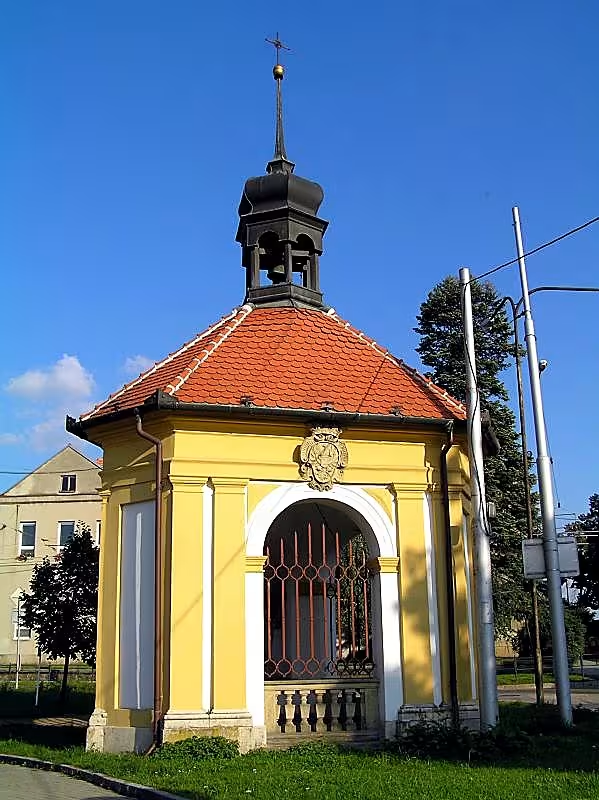
The bell tower in Brno-Slatina is a Baroque tower from 1703, which stands on the eastern edge of Přemyslová Square. The building is remarkable with its unique open construction and currently serves as a symbol of this city area.
The creation of the building was triggered by a request from local citizens. It was financed by the owner of the Lischean estate Norbert Leopold Libštejnský z Kolovrat according to the project of the builder Domenico Martinelli. The implementation took place in 1703 when the foundation stone was laid on June 28 and the tower was consecrated on October 4. The construction was created during the period of the high Baroque, when architecture in the Czech countries was under the considerable influence of Italian builders.
From the point of view of architecture it is an open building with a floor plan of a triangle with cut corners. The space is surrounded by lunnets and above its centre is a lantern with a bell. There are three life-size statues in the nobodies of corner pylons, which represent St. Florian, St. Wenceslas and St. Leopold.
Over the years the tower has undergone several repairs and changes. In 1803 the bell tower was restored and the original bell was replaced by a new one. 1846 was marked by a storm that damaged the building. The bell was subsequently cast in 1876. Since 1964, the building has been officially protected.
Among the attractions are the fact that the bell tower is often wrongly referred to as the chapel of St. Florian. At present, the bell is only used as a dying man to ring the dead on their last journey. Due to the location in the road pull by Slatina and the high traffic frequency, the object is not used for liturgical purposes. The inside of the tower is protected by a grid that serves as a defense against vandals.
This building represents a valuable example of Baroque architecture and reminds of the historical links of the village to the Líšín estate. Her visit offers the opportunity to see the unique work of Domenico Martinelli right in the city space.
Historical milestones
- 1703
- laying of the base stone on 28 june and consecration on 4 october
- 1803
- restaurant and replacement of original bell new
- 1846
- damage to the bell tower during storm
- 1876
- over the bell
- 1964
- opening of monument protection
Architectural development
It is an open Baroque building with a triangular plan and lunette vaults. There is a lantern above the centre with a bell. Three life-sized statues are placed in the corner pylons.
Historical events
1803: restaurant and changing the bell; 1846: storm damage; 1964: declaration of monument protection.
Owners
Norbert Leopold Libštejnský z Kolovrat (1703)
Points of interest
- The unique open construction from 1703 serves as a symbol of the city area. - The construction was financed by Norbert Leopold Libštejnský z Kolovrat according to the Domenico Martinelli project. - The tower has a plan of a triangle with cut corners and contains statues of St. Florian, Wenceslas and Leopold. - The bell tower is often incorrectly referred to as the chapel of St. Florian. - The bell is now only used as a dying man and the construction is not used for liturgical purposes for transport purposes.
Guide
Show guide text
This text was created by artificial intelligence and has not been editorially reviewed. It may contain inaccuracies.
Welcome to Brno, Part Slatina. Stop for a moment, take a breath and look in front of you. Right now, you're facing one of the most striking and fascinating silent witnesses in local history. In front of you is a baroque bell tower that immediately attracts the attention of anyone passing by it. You might wonder why this building looks so different than the ordinary towers you know from other towns or villages. It is precisely her uniqueness that makes her the real jewel of this area. Feel her presence in space and try to imagine how this building affected people's lives centuries ago even today.
Let us now return together in time, so that we can be clearer about how it was created. Imagine the beginning of the eighteenth century, namely the year seventeen hundred and three. At that time the bell tower was not only a practical place for the bell, but it served as an important reference point, a warning system and a community symbol. It was the local citizens of Slatina who felt a great need to have such a structure with them, so they made a request to build it. However, their wishes required substantial funds that the people could not provide themselves. Here comes a person whose name is closely linked to this construction. The construction was financed by the owner of the Líšín estate, a nobleman named Norbert Leopold Libštejnský z Kolovrat. Thanks to his generosity and support, the dream of this tower could become reality. Historical records tell us exactly that the base stone was laid on June 17th, 17 hundred and three, and the whole building was festively consecrated shortly afterwards, on October 4th of the same year.
I now ask you to pay full attention to the architecture itself. Look again at the overall form of the tower. Note that this is not a closed space you could enter as a house. It's a unique open construction, which is very rare in our region. If you could look at the ground plan of the structure from a bird's-eye perspective, you would see that the bell tower is shaped like a triangle. But watch out, it's not an ordinary triangle. Its corners are cut off, which creates a very specific and harmonious appearance. This architectural intention was not random. The project was followed by the recognized creator Domenico Martinelli, who brought his expertise and Baroque feel for space and geometry into the work.
Try to lift your eyes up and focus on the details that decorate this construction. Notice the corner pylons, the vertical support parts. In them are located niche, which are such semi-circular niche in the wall. It is in these nobodies that you will find three stone figures that have been here for years. They're statues of saints who had deep meaning to people at the time. You will see Saint Florian here, who is traditionally perceived as a protector of fires, which was absolutely crucial at the time of wooden buildings. Next to it is depicted St. Wenceslas, the national patron, symbol of stability and protection. And the third is Saint Leopold, whose presence here probably refers to the name of the generous founder, Norbert Leopold. These statues are not just an ornament, but they are part of the spiritual and historical context of the whole place.
As you stand before this tower, you may feel that its history is calm and undisturbed. The truth is, however, that the bell tower had to face various tests over the years. It's a story about care, but also about fighting nature. Let's follow her fates in the next decades. Exactly a hundred years after its construction, in the year eighteen hundred and three, the bell tower passed through a large restaurant. At that time it was decided that the original bell was no longer in good condition and was replaced by a new one. The sound of the bell was the only message to the people at the time that connected them, announcing time, holiday or danger.
Unfortunately, history has brought tough times. In 1846, a devastating storm struck the Slatina. Natural elements were relentless and the bell tower was damaged in this event. Imagine the fear of the people when they saw their symbol suffer. However, construction care has not stopped. A few decades later, in the year eighteen hundred and seventy-six, it was necessary to intervene again and the bell was rolled so that it could sound again over the city. This constant rescue effort shows how important this building was to local people. In the year one thousand nine hundred sixty-four, the bell tower was officially included in the monument protection, which ensured that its unique form would be preserved for future generations, including what you are today.
It is fascinating to realize that this open construction from the year seventeen hundred and three survived three centuries of history. While the world was changing around it, the architecture of the surrounding houses was changing and generations of people were changing, this tower remained a fixed point. It's more than just a building made of stone and mortar. It's a symbol of the city of Slatina. When you look at it today, you see not only a baroque memory, but you see the proof of human desire for beauty and faith, you see the generosity of one nobleman and the endurance of the entire community, which did not let its bell tower die even after devastating storms.
The interesting thing that might interest you is the combination of geometry and symbolism. A triangle with cut corners creates a sense of stability and lightness, which is typical of the best works of baroque times. It's an architectural puzzle that forces us to circumvent construction from different sides to fully understand its shape. You try it now. Walk slowly around the bell tower, see how the perspective changes and how the statues of saints look at the surrounding landscape from different angles.
Now that you know the story of this unique tower, its founder of Norbert Leopold Libstein of Kolovrat and her architect Domenico Martinelli, look at it for the last time as a whole. This bell tower is a bridge between the past and the present. He is a silent witness to everything that happened in Slatina, and at the same time welcomes everyone who comes here today.
Thank you for accompanying me on this short trip to history. I hope this visit helped you see more than just an old tower in this building. Now, let's invite you to further explore the area. Slatina still has many hidden corners and stories waiting for its discovery. We wish you a pleasant continued journey and enjoy the rest of your day in Brno. Goodbye.
Tips for visitors
For the best observation of Baroque architecture bell tower we recommend a visit during bright days. The best light for taking pictures can be found in the morning or late afternoon hours when the sun creates interesting shadows on the construction site.
Transport to the place is possible by car and by public transport; Please check the current connection and stop options before travelling in the search engine or on the pages of the transport company.
Bring drinking water and comfortable shoes for possible walks around.
For families with children, the visit is suitable as a short and easy stop during outdoor walks around the monument.
In the nearby area you can take a short walk to Přemyslová Square, which is located close to this historic building.
Frequently asked questions
Can the monument be visited?
This is a structure in a public space that can usually be seen from outside free of charge. We have not verified that this particular one is freely accessible.
Where is the monument?
Location: Slatina, Jihomoravský kraj. The map on this page shows the exact spot.
Why is the monument protected?
It is listed in the Central List of Cultural Monuments of the Czech Republic as a cultural monument (register no. 1000146601).
Businesses nearby
Do you run a restaurant, accommodation, shop, museum, rental, wellness or other visitor service near this monument? Show yourself directly to the people heading to it — this is how they will see you in the app and on the web:
Events nearby


Zdroj akcí: otevřená data měst a obcí ČR (Národní katalog otevřených dat) a kalendář akcí Národního památkového ústavu.
Nearby
Přemyslovo náměstí v Brně-Slatině
Accommodation nearby
Trips and activities nearby
Guided tours, tickets and activities nearby from GetYourGuide
Affiliate link: if you buy from the partner, we may receive a commission. The price for you does not change.
Search tours and activities →Themed route
1. Přemysk Square - Square. The central location of the village, which serves as an ideal starting point for walks. 2. Area bell tower - outdoor area. The environment in the immediate vicinity of the tower, where the atmosphere of the monument can be seen in peace. 3. Bells (Brno-Slatina) - tower. The main destination of the trip, which offers the possibility of viewing the building itself and its bells.
Seasonal recommendations
Spring brings to this ancient tower in the urban part of Slatina awakening nature, when the surrounding greenery are only just beginning to grow stronger and the sun's rays create fine shadows on the old image. The atmosphere is very calm and quiet here in this period, ideal for the perception of the historic spirit of a place without disturbing influences. From a practical point of view, you will appreciate fixed shoes because the field roads in the surroundings can be wet and slippery after spring rains. You can only meet tourists here at a minimum, so you can enjoy the tour at your own pace anytime during the day. Suitable clothing should include a light jacket, as the wind (or rather wind) flowing from the open landscape at the edge of Brno can be cool, especially in the morning. Summer at the Slatinské belfry offers long famous days and sharp midday light, which makes every detail of the stone building stand out, while the surrounding field shines in the haze of warm air. The atmosphere is more lively because of the people who are coming for afternoon walks. The main practical advice for this period is to take a tour either early in the morning or in the late afternoon to avoid the strongest sun rays, because there is little natural shade around the tower. Don't forget to take enough drinking water and headgear. Put on breathtaking clothes and sunglasses, while crowds of people are not masses, but on weekends you will encounter more cyclists and families with children. Autumn turns the surroundings of this historic monument into a colorful landscape with typical morning fog that surrounds the top of the tower and gives it a mysterious character. Lighting is soft, often gilding, which creates excellent conditions for lovers of photography of old buildings. The practical recommendation is to monitor the weather forecast as autumn days are variable and windy. Put on a warm layer of clothing, preferably a windbreaker and neck, because the cold autumn air quickly penetrates through underrated clothing. Visiting frequencies are falling sharply at this time, which guarantees total peace for contemplating and admiring architectural details in the silence of decaying leaves. Winter covers the Latin bell tower into a freezing silence, often accompanied by a snow blanket that calms the whole area and creates a fabulous atmosphere with sharp, clean light on the snow. Practical advice for this season requires maximum caution as the surrounding surfaces can freeze and slide. The need is warm winter shoes with anti-slip soles, gloves, hat and thick jacket. Due to the short winter days, it is best to plan a visit to lunch hours, when the lights are the most and the temperatures are the most favourable. You will only meet people here at the absolute minimum, but staying outside because of the dripping weather and freezing, so it is a quick but very impressive stop.
Visualizations and artistic views


The visualisations are generated by artificial intelligence and serve as inspiration.
Photos from the area
Real photos taken near the monument


Zdroj a licence jsou uvedeny u každého snímku.
Tips from visitors
No tips yet. Be the first!
Log in and add your tip.
Sources and literature
Photos: The original uploader was Majkl82 at Czech Wikipedia. / CC BY-SA 3.0 — Wikimedia Commons. The author and licence also appear when you hover over the image.
Faktickým podkladem tohoto textu byl článek na Wikipedii, jehož autory jsou přispěvatelé Wikipedie. Článek je dostupný pod licencí CC BY-SA 4.0.
Location on the map


Příběhy a pověsti
Legendy, pověsti a příběhy spjaté s touto památkou
Fotografie návštěvníků
Zatím žádné fotografie. Buďte první, kdo přidá fotografii z návštěvy!
Log in a přidejte svou fotografii nebo hodnoťte.
Za ověřenou návštěvu v aplikaci získáte víc bodů — poznáme podle GPS, že jste na místě.
Reviews and comments