



Zvonice (Olšovec) Belfry
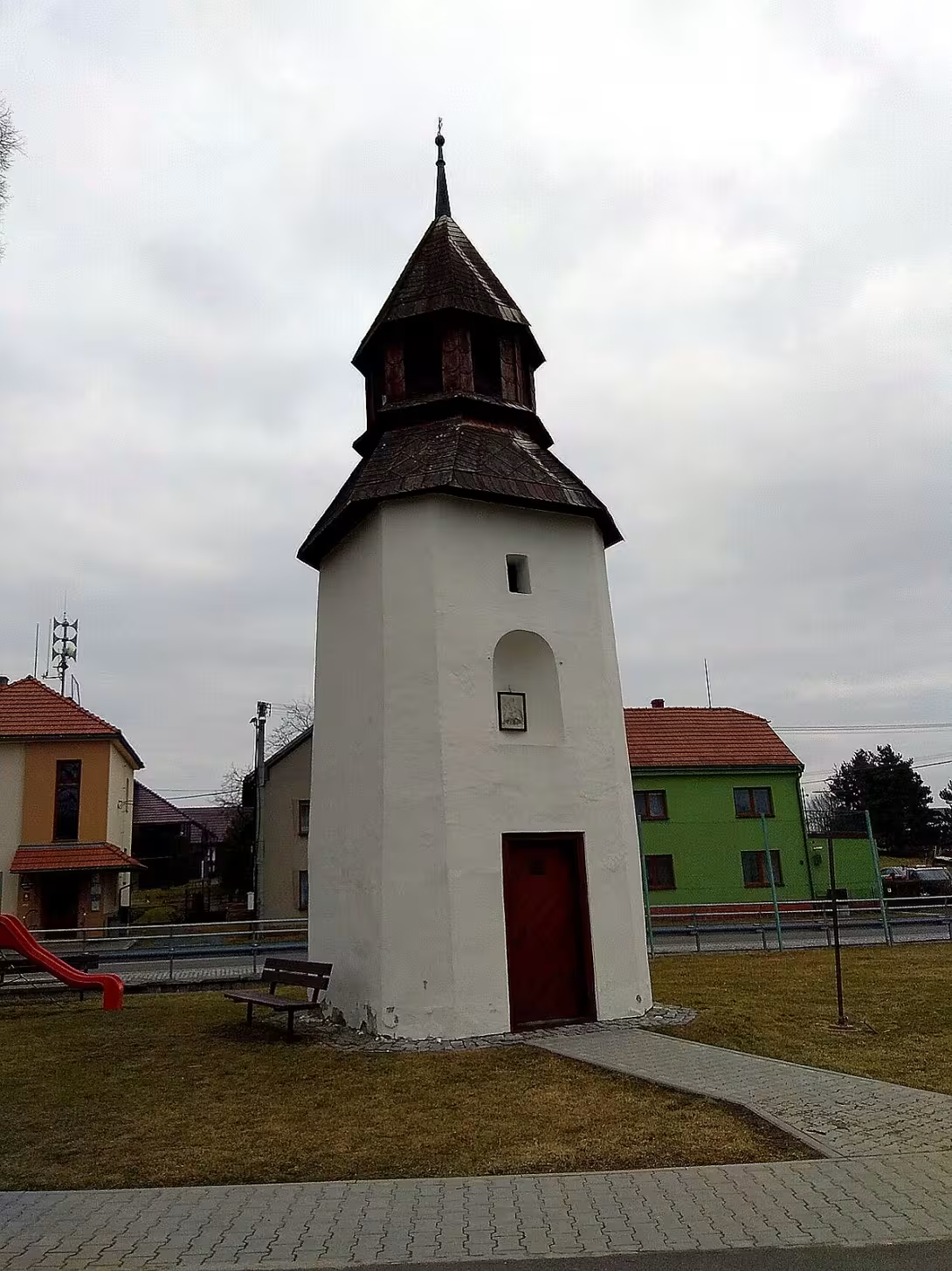
The bell tower in Olšovci is a baroque monument, which stands in the centre of the village on the bank of the freezer stream. This building attracts attention with its historical value and architectural design. Built in 1717, it is a protected cultural heritage of the Czech Republic and represents an important proof of Baroque folk architecture in the Přerov district. Its unique structure, which combines aesthetics with practical functionality, makes it not only a historical monument, but also a living part of the local environment.
The creation of this tower is closely linked to the development of Baroque culture in the early 18th century, when many sacral and lay buildings in the rural areas of the Czech Republic appeared in this style. The chimes were not only religious centres, but they also served as warning systems against fires or other dangers and helped to determine the daily rhythm of people's lives. In Olšovce, the bell tower was built in 1717, which reflects the typical needs of community and cultural buildings during this period.
Architecturally, the bell tower is built from quarry stone on the ground plan of a square with scaled corners. It is a two-storey brick building with a plastered facade, which excels with its symmetry and harmony. The entry rectangular portal is decorated with a nickel with a semi-circular enchantment of burnt bricks above which is a square window. Originally there was a carved Renaissance statue of St. Barbara, which is today stored in the City Museum in Hranice. The interior of the bell tower contains a wooden staircase illuminated by two slot windows, which allows comfortable access to upper spots.
The bell tower is interesting from 1732 with the inscription "Sanctus Maria" and "Sanctus Johanes." During World War II, this bell was reclaimed and taken to a collection site in Prague to Manina, but after the conflict it managed to return to the village. This story underlines not only the historical value of the bell itself, but also the determination of the community to maintain its cultural heritage.
Today, the bell tower in downtown Olšovka stands as a living reminder of the past and is available for visitors who want to know local history and architecture. Its preservation and protection as a cultural monument ensure that future generations can enjoy its beauty and importance. Visiting this Baroque bell tower is not only a way into history, but also an opportunity to appreciate the wealth of the cultural heritage of the Czech Republic.
The bell tower in Olšovc is therefore more than an architectural monument; It is a testament to the history, culture and determination of the local community. Her visit offers a unique opportunity to explore the region's rich heritage and appreciate its historical importance.
Historical milestones
- 1717
- The position of the Baroque bell tower in Olšovec.
- 1732
- Hanging a new bell with Latin inscriptions.
- 1939-1945
- Props of the bell for war purposes and his transport to Prague to Manina; After the war, the bell was returned to the village.
Architectural development
The two-story brick bell tower was built in 1717 from quarry stone. The entrance right-angled portal is supplemented by a niche with a semi-circular enchantment made of burnt bricks. The wooden staircase in the interior is lit by two slot windows. The roof is made of an occipital needle with lantern, poppy and cross.
Historical events
1717 - construction of bell tower; 1732 - acquisition of the bell; 1939-1945 - props the bell during world war ii and its return after the war.
Points of interest
- The bell tower in Olšovc is a Baroque monument built in 1717. - It is a protected cultural heritage of the Czech Republic and represents an important proof of Baroque folk architecture in the Přerov district. - The bell tower contains a bell from 1732 with the inscriptions "Sanctus Maria" and "Sanctus Johanes" which was recited during World War II but later returned. - Architectural construction is made of quarry stone with plastered facade and two slot windows for lighting the interior. - Originally there was a statue of St. Barbara, which is today stored in the City Museum in Hranice.
Guide
Show guide text
This text was created by artificial intelligence and has not been editorially reviewed. It may contain inaccuracies.
Welcome to our stop today. You are now facing a beautiful historical monument, which is a stand-alone Baroque bell tower in Olšovec. Raise your head and look around you. This building is located right in the centre of the village, on the very bank of the stream, which bears the name Freeznice. When you look at her, you see a solid and dignified building that has been the heart of this entire village for 100 years. Her presence gives this place a peaceful and festive atmosphere, so you can perceive a piece of living history that breathes upon you from every stone.
Now let's look into the past to see how this monument came to be. Her story began in a thousand seven hundred and seventeen. Back then, this baroque bell tower was built from a quarry stone. The names of its builders may not have been registered in history, but that does not make any difference to their work. The construction was created as a useful and essential element for the local population, for which it served to measure time, to report joyful and sad events and to protect against danger. Fifteen years later, in the year one thousand seven hundred thirty-two, this tower received a great gift in the form of a new bell. On this bell were engraved Latin inscriptions that resembled St. Mary and St. John. For decades, the bell has served its purpose faithfully and has become an integral part of the lives of all local people.
Now pay attention to the architecture itself and the details that you see before you at this very moment. This two-storey plastered building has a plan of a square whose corners are skillfully cut. Look up at the roof. You can see its manger shape at the very top carrying an octave lantern. Although the builders of this building remained unknown, they left us a valuable proof of baroque folk architecture. If you look at the facade a little bit closer, notice the nothingness above the main entrance. In the past, the Renaissance statue of St. Barbara stood in this niche, which symbolically protected the whole building. Stop for a moment and see the harmony of shapes and honest craft that people left behind 300 years ago.
This construction is also associated with moved fates that took place in much more recent times. If we move to the twentieth century, to the moving years of nineteen hundred thirty-nine to nineteen hundred forty-five, we will come across a dark chapter in history. During World War II, a rare bell from a thousand seven hundred thirty-two was forcibly removed for war purposes. He was then taken to Prague to Manina, where he was to be melted for military purposes. But the bell survived the war and was ceremonially returned to our village after it was completed. The people of Olšovka have thus regained their voice, which has spoken to them for generations.
Today, this alsovec bell tower is a strictly protected cultural heritage of the Czech Republic. It represents an absolutely exceptional proof of baroque folk architecture in the entire Transrov district. Her walls carry the memory of hundreds of people who walked past her, nursed her and defended her in times of confusion. It has humbled time, and today we can stand here and admire its timeless beauty.
Our stop today is slowly coming to an end. I believe the sight of this ancient building has enriched you. When you set out for more wandering around, remember the stories that the people of Olšovce had and the bell that was able to come back from their warways. Thank you for your attention, I wish you the rest of the day and I look forward to seeing you at another interesting place.
Tips for visitors
The best time to visit is late afternoon, when the sun's rays illuminate the baroque wall of quarry stone beautifully. At this time, the architectural details of the scaled corners and the overall historical atmosphere of the village will best stand out. You can easily reach the village by car or public transport. Please check the current connection with public funds in the Internet connection search engine. For photographers we recommend the shore of the freezer stream. It is from the water level that you get the most interesting shots that capture the bell tower in its natural environment. The best light for the images is during the so-called gold watch before sunset. As part of your trip, please visit the nearby town of Hranice. Here you can visit the Municipal Museum, which offers another view of the history of the region. For families with children, a walk around the creek and a subsequent visit to the museum in the neighbouring city is ideal for a common day.
Frequently asked questions
Can the monument be visited?
This is a structure in a public space that can usually be seen from outside free of charge. We have not verified that this particular one is freely accessible.
Where is the monument?
Location: Olomoucký kraj. The map on this page shows the exact spot.
Why is the monument protected?
It is listed in the Central List of Cultural Monuments of the Czech Republic as a cultural monument (register no. 1000157815).
Businesses nearby
Do you run a restaurant, accommodation, shop, museum, rental, wellness or other visitor service near this monument? Show yourself directly to the people heading to it — this is how they will see you in the app and on the web:
Nearby
Zvonice stojí v centru obce Olšovec na břehu potoka Mraznice. V těsné blízkosti se nachází město Hranice s Městským muzeem.
Accommodation nearby
Themed route
This thematic cruise route takes you to a picturesque area on the bank of the creek and its immediate surroundings. All points are connected in logical order.
1.Zvonice (Olšovec) Type: Historical construction Why is it worth a visit: This unique tower is located right in the center of the village of Olšovec on the bank of the freezer stream. It offers a view of traditional folk architecture and forms a picturesque heart of the whole site.
2. City Museum Type: Museum Why it is worth a visit: It is located in close proximity to the neighbouring city of Boundary. It brings visitors closer to the history and cultural heritage of this region.
Seasonal recommendations
Spring: In spring the bell tower is surrounded by flowering bushes and trees that create an attractive green paradise. The sun's rays illuminate stone structures, giving the memory of life and bright color. At this time, opening can sometimes be restricted for maintenance or repairs, so it is advisable to inform yourself before visiting. Spring is the time when the number of tourists is increasing, so we recommend visiting the exhibition area earlier during the day to enjoy a quieter atmosphere. Dress appropriately for suddenly changing weather - short gloves and hat are a good way to adapt to warm and colder works.
Summer: In the summer months, the visit to Olšovec bell tower is filled with long sunny days and warm air. The sun illuminates the tower in the best possible ways, creating ideal conditions for photography. Many visitors are expected this season, especially on Saturday and Sunday days, so we recommend arriving at the beginning of the afternoon when the crowd will potentially relax. Don't forget to take sun protection cream against strong sun and do not sow light suits for comfort during a long stay outside.
Autumn: In autumn, Olšovec Bell Bell offers a unique atmosphere with coloured leaves that turn yellow and red. The sun sets earlier, creating a romantic light, ideal for beautiful photos. This time of the year is usually less visited than summer months, so the visit offers a calmer experience. Due to colder night temperatures, we recommend wearing warm clothes and possibly a blanket, especially if you plan to stay on site for longer.
Winter: In winter the visit to Olšovec bell tower is comfortable thanks to short and cold days. The sun rays illuminating the tower are usually less intense, giving the monument a calm and quiet atmosphere. In this season it is necessary to have warm clothes such as leather and hat, and in addition we recommend wearing protective shoes to ensure comfort during cold days.
Visualizations and artistic views


The visualisations are generated by artificial intelligence and serve as inspiration.
Photos from the area
Real photos taken near the monument


Zdroj a licence jsou uvedeny u každého snímku.
Tips from visitors
No tips yet. Be the first!
Log in and add your tip.
Sources and literature
Photos: Martinekhonza / CC BY-SA 3.0 — Wikimedia Commons. The author and licence also appear when you hover over the image.
Faktickým podkladem tohoto textu byl článek na Wikipedii, jehož autory jsou přispěvatelé Wikipedie. Článek je dostupný pod licencí CC BY-SA 4.0.
Location on the map
Příběhy a pověsti
Legendy, pověsti a příběhy spjaté s touto památkou

Fotografie návštěvníků
Zatím žádné fotografie. Buďte první, kdo přidá fotografii z návštěvy!
Log in a přidejte svou fotografii nebo hodnoťte.
Za ověřenou návštěvu v aplikaci získáte víc bodů — poznáme podle GPS, že jste na místě.
Reviews and comments