



Zvonička (Královice) Other
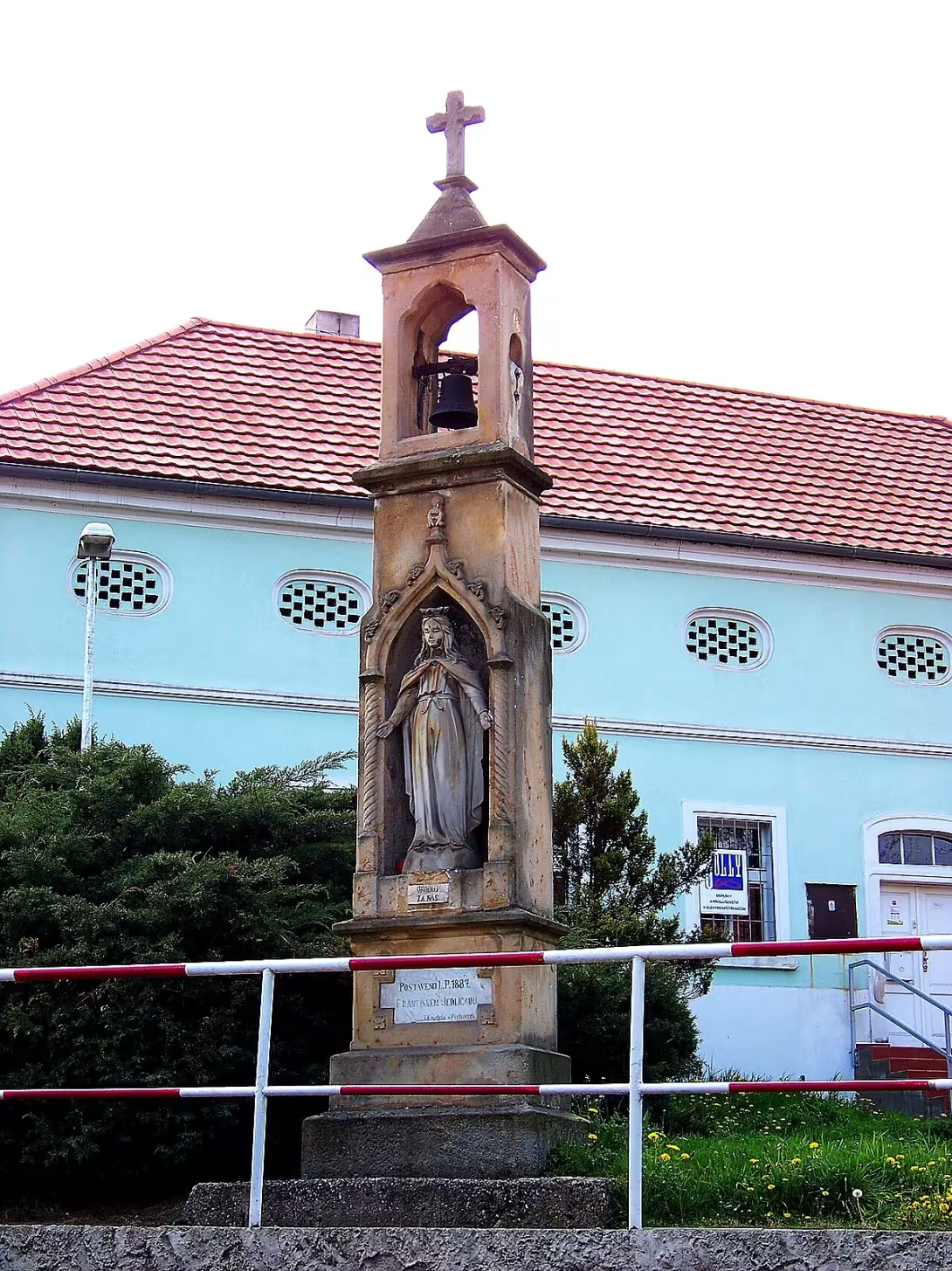
The bell in Královice in Prague stands in the centre of the village in the street It is protected as a real cultural monument of the Czech Republic. This small historical sacral building was built in 1887 and occupies its architecture in a historizing style which combines the use of granite and sandstone.
The foundation of the monument dates back to 1887 and it took the credit of František Jedlička. The historical context of this period in Czech countries defines the expansion of historism. In the architecture, he demonstrated his desire to return to earlier styles at the time of the development of national culture and community buildings. On the marble plate in the facade is the inscription POSTAVEN L. P. 1887 FRANTIŠKÝ EDIBLE V. KOUDEL IN THE PREVIOUS.
Construction architecture uses a combination of materials. A sandstone plinth is placed on the graduated granite base. The actual body of the bell tower is divided in the facade by a thick niche with a condom that is lined by torched columns. Nika is finished with an archive with a motif of donkey spine, crab and cross flower. Above it is a ledge, above which the attachment with the bell is receding. It is opened on the sides with holes shaped like a nun and ended with a stone roof and a cross. On the pedestal stands the sandstone statue of the Virgin Mary with open cloak and blending hair. It is made of finer sandstone than its own bell tower and in its pedestal is inserted a plate with the inscription ORODUE ZA US.
There is no mention of ownership changes or other persons other than the builder. The crucial moment in the modern history of the building was the installation of a new bell with the inscription L.P. 1947, which is located in the bell tower, but in itself is not a cultural monument.
Key documented events include the year 1887 as the date of creation of the whole building thanks to František Jedlička and 1947 when a new bell was installed. An interesting feature is the different fineness of sandstone used on the statue of the Virgin Mary compared to the material of the bell tower itself, as well as preserved inscriptions on the marble plate and in the pedestal.
Today, this monument-protected building is located in the centre of the village in Prague's Královice and is freely accessible in K Uhranev Street. This construction represents an example of period historism and community building activity in the late nineteenth century. Visiting this place offers a view of the detailed stone elements of small sacral architecture.
Then and now
Drag the slider to compare how the landmark may have looked when it was built with the view today.
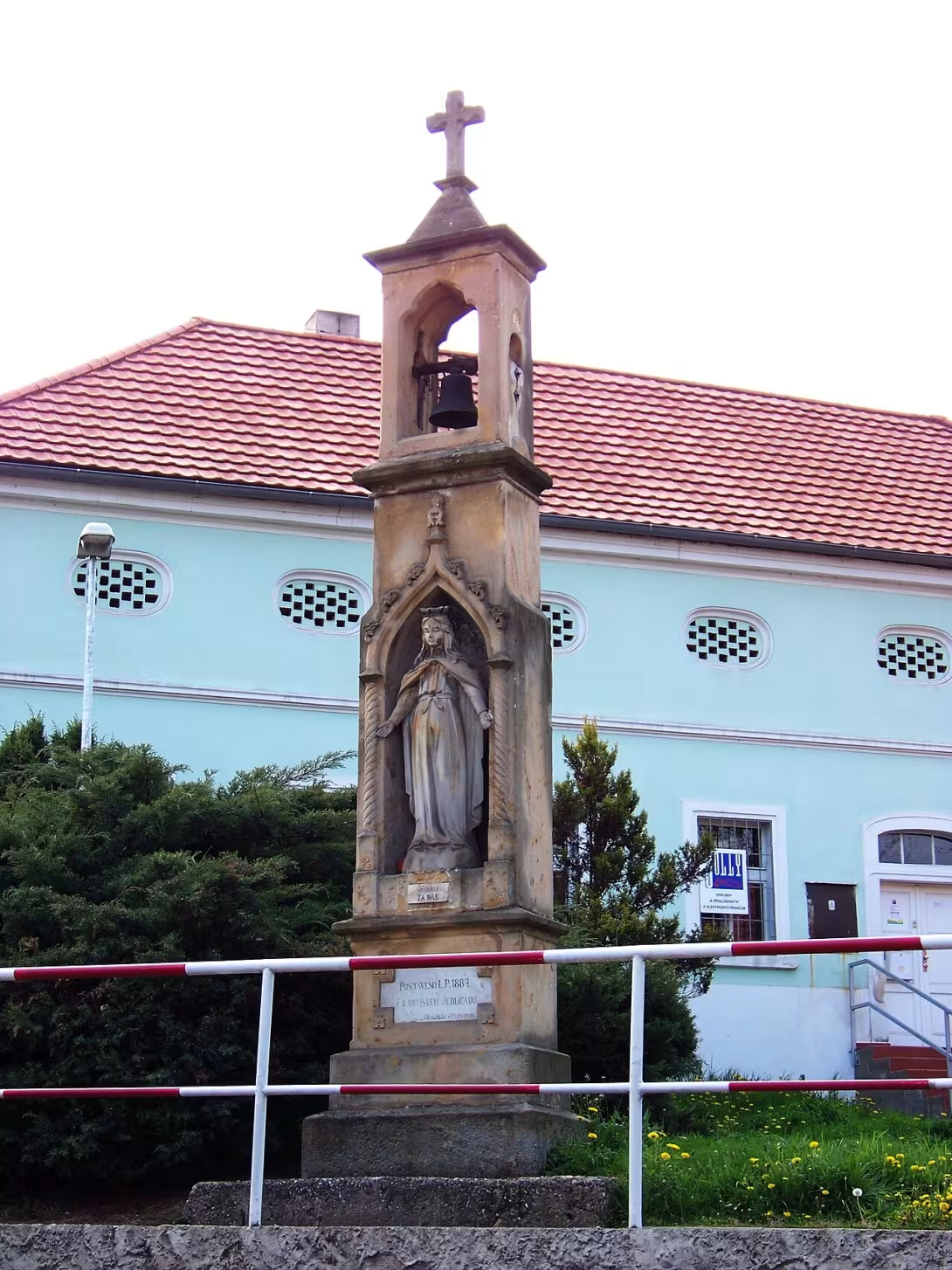

The historical appearance on the left is an AI-generated visualisation and serves as inspiration only.
Historical milestones
- 1887
- The creation of bell tower with statue of Virgin Mary thanks to František Jedlička
- 1947
- Installation of bell with L.P. 1947 inscription
Architectural development
The construction uses a combination of granite and sandstone. The architectural elements include torched columns, an architect with the motive of a donkey spine and a stone roof. The overall appearance is consistent with historical history.
Historical events
1887: The bell tower with the statue of the Virgin Mary was created thanks to František Jedlička. 1947: Plant a bell with the inscription L.P. 1947.
Points of interest
- A small historical sacral building in Královice was created in 1887 thanks to František Jedlice and is protected as a real cultural monument. - The architecture of the building in the historical style combines the use of granite and sandstone, while the sandstone used on the statue of the Virgin Mary is finer than on its own bell tower. - In the facade there is a marble plate with the inscription and inside the niche stands on the pedestal with the inscription ORODUJ ZA Sand statue of the Virgin Mary. - In modern history, a new bell was placed in the bell tower in 1947, which in itself is not a cultural monument.
Guide
Show guide text
This text was created by artificial intelligence and has not been editorially reviewed. It may contain inaccuracies.
Welcome to the Kings. Right now you are standing in the centre of the village in the street K Uhřonejsi and in front of your eyes stands a picturesque historical sacral building, a tiny local bell tower. Take some time, take a breath in the quiet atmosphere of this place and let the spell of her to resist the tooth of time.
Let's move forward in time and see how this monument came to be. The year is eighty-seven nineteenth century and behind the creation of this bell tower is the great merit of the local population František Jedlička. It is thanks to his initiative and efforts that these tiny structures enriched the royal village. Decades later, namely in nineteen hundred forty-seven, the bell tower was supplemented by a bell bearing the inscription of the year, thus gaining its other important layer over the centuries. Today, the whole building is rightly protected as a real-estate cultural monument of the Czech Republic, which underlines its historical and cultural value for the whole country.
Now pay attention to the architecture of the building itself and to the details you are seeing right now. The bell is built on a solid, graduated granite base on which is a sandstone plinth. When you look at her textures in more detail, notice the characteristic nothingness with a condom, which is supplemented by decorative tormented columns. The sandstone statue of the Virgin Mary is located in this niche. The architecture of the building in the historic style combines so skilfully the use of granite and sandstone. The interesting detail you can see is that the sandstone used on the statue of the Virgin Mary itself is finer than the one from which the bell is made.
When we think about the human story associated with this place, we have to go back to the figure of František Jedlička. It was he who, in the year eighteen hundred and eighty-seven, printed this form for the village. At a time when each such building was a great event for the local community, its initiative manifested itself as a permanent legacy for generations that came after it. The personality of František Jedlička still lives today in this small architectural jewel, around which people pass daily.
The interesting thing is that although it is a small historical sacral structure, its artistic design and choice of materials show a great deal of care with which it was built in the nineteenth century. The combination of sturdy granite and finely worked sandstone on the statue of the Virgin Mary shows the craftsmanship of the creators, whose names may have fallen to oblivion over the years, but whose work persisted to this day.
I believe that stopping by this royal bell has enriched you with a new view of the history and minor monuments of our landscape. When you continue your journey to the villages, let your steps continue and discover the other corners and stories that Královice offers to its visitors. Thank you for your attention, I bid you farewell and wish you the rest of the day.
Tips for visitors
The best time to visit the royal bell tower is early in the morning or in the morning when the centre of the village is quiet and the sunlight ideally illuminates sandstone plinth and detailed architecture of the building.
Transport to the place is possible by car and by public transport.
Take a camera or smart phone with you to a short stop, comfortable shoes to walk the villages and possibly drink, as it is a quick exterior stop.
For photography we recommend to focus on the detail of the poromatic noice with a condom and use the graduated granite base as the foreground of the frame; the best light to capture the structure of the stone is in the afternoons.
The centre of the village Královice in Prague, which offers a peaceful atmosphere of rural character within the capital, is worth visiting in the wider surroundings of the monument.
Frequently asked questions
Can the monument be visited?
We have not verified whether this monument is accessible. Please ask the owner or operator, or the local municipal office.
Where is the monument?
Location: Královice, Hlavní město Praha. The map on this page shows the exact spot.
Why is the monument protected?
It is listed in the Central List of Cultural Monuments of the Czech Republic as a cultural monument (register no. 1548098144).
Businesses nearby
Do you run a restaurant, accommodation, shop, museum, rental, wellness or other visitor service near this monument? Show yourself directly to the people heading to it — this is how they will see you in the app and on the web:
Events nearby
Zdroj akcí: otevřená data měst a obcí ČR (Národní katalog otevřených dat) a kalendář akcí Národního památkového ústavu.
Nearby
City center Královice in Prague.
Accommodation nearby
Trips and activities nearby
Guided tours, tickets and activities nearby from GetYourGuide
Affiliate link: if you buy from the partner, we may receive a commission. The price for you does not change.
Search tours and activities →Themed route
1. Royal Bell (Main Target) This historic building represents the dominant and heart of the whole site. It is worth visiting for its unique atmosphere and demonstration of traditional folk architecture right in the heart of the village.
2. City center Královice (District) This area forms the natural social and historical core of the place. Worth a visit for a peaceful atmosphere that can be enjoyed while walking the immediate surroundings of the main monument.
Seasonal recommendations
Spring in Královice brings the surrounding nature to a new life, which gives the bell bell a fresh and picturesque character. The surrounding trees are beginning to bloom and the morning sun creates a fine, pastel lighting that is ideal for peaceful photography without sharp shadows. The atmosphere is very quiet and thoughtful here at this time. As for practical advice, visitors should count on variable spring weather, so waterproof shoes are useful due to occasional wet soil in the surroundings and laminated clothing. You don't have to worry about tourist crowds in the spring months, you will find only occasional locals on a walk, and the best time to visit is the morning hours when possible morning herpes will disappear.
The main summer season at the royal bell tower is marked by lush green and warm rays of the sun, irradiating the memory from early morning to late evening. The golden hour before sunset offers absolutely great lighting conditions for lovers of aesthetic shots, the atmosphere is alive and the air smells hot in nature. Due to warmer weather and holiday periods, it is recommended to choose light breathable clothes, headgear and not to forget enough drinking water because there are no shady shelters in the immediate vicinity. Although it is a quieter location, in the summer there are a little more tourists on weekends, it is best to leave early in the morning or in the late afternoon, when we avoid the greatest heat in the morning.
Autumn brings a colourful palette of colours to the Kings, where the leaves of the surrounding trees turn yellow, orange and red, creating a wonderful contrast with historical construction. The lighting is often foggy and melancholic, especially in the morning, which creates an extremely impressive and mysterious atmosphere suitable for the perception of genius loci. The practical site requires a warmer coat, fixed non-slip shoes due to fallen and sometimes slippery leaves and possibly umbrella. The crowds of people hardly exist in autumn, so you will enjoy the memory in complete privacy, with the best time to visit is around noon, when the autumn sun passes through the cold air for a while.
The winter season gives the royal bell a distinctive charm, especially if the landscape is covered by a layer of snow that dampens sounds and gives the place a fairy tale. The lighting is very specific in winter due to the low sun that throws long shadows, and in the advent time or around the turn of the year the location has an unrepeatable, silent character. Quality winter clothes, warm gloves, hats and high snow or frost shoes are essential for the visit. Tourism is minimal at this time, you will meet few people here, which guarantees perfect peace. The best time for the tour is early afternoon before dark, when daylight is enough to draw details of the monument on the snow background.
Visualizations and artistic views


The visualisations are generated by artificial intelligence and serve as inspiration.
Photos from the area
Real photos taken near the monument


Zdroj a licence jsou uvedeny u každého snímku.
Tips from visitors
No tips yet. Be the first!
Log in and add your tip.
Sources and literature
Photos: ŠJů / CC BY-SA 4.0 — Wikimedia Commons. The author and licence also appear when you hover over the image.
Faktickým podkladem tohoto textu byl článek na Wikipedii, jehož autory jsou přispěvatelé Wikipedie. Článek je dostupný pod licencí CC BY-SA 4.0.
Location on the map
Příběhy a pověsti
Legendy, pověsti a příběhy spjaté s touto památkou

Fotografie návštěvníků
Zatím žádné fotografie. Buďte první, kdo přidá fotografii z návštěvy!
Log in a přidejte svou fotografii nebo hodnoťte.
Za ověřenou návštěvu v aplikaci získáte víc bodů — poznáme podle GPS, že jste na místě.
Reviews and comments