






Starý židovský hřbitov v Praze-Josefově Cemetery
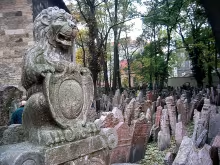
The old Jewish cemetery lies in the heart of the former Prague ghetto, in today's neighborhood Praha 1-Josefov. He was preceded by another cemetery called the Jewish Garden, which was located near the Vysehrad Road in the New Town of Prague. It was in operation until 1478 when, at the urgent request of the townspeople, the Czech king Vladislav II cancelled it. The exact date of the creation of the Old Jewish cemetery, which replaced the extinct burial ground, is not yet clearly documented.
The oldest preserved tombstone belongs to the Prague rabbi and poet Avigdor Kara and dates back to 1439. He was the one who wrote the Elements of all the tragedy of 1389, when in the pogrom in the Prague Ghetto the looting mob ravaged the existing cemetery, smashing up tombstones and digging up the dead - an event that Alois Jirásek also processed in the second piece of Trilogy between the currents. It is assumed that the Old Jewish cemetery was not yet standing at the time of this pogrom. The continuous series of graves then continues from the first half of the 15th century until 1787, when the last grave was dug for Moses Lipman Beck. The burial then stopped the enlightenment order of Josef II, published for health reasons three years before.
The cemetery was situated on the highest hill of the Jewish city at an altitude of 192 metres. The first written mention of it dates back to 1440, when the property was purchased from the brewery Hanuš. The largest expansion occurred in the 16th century, partly due to Mordechai Maisel. Since the first half of the same century, there have been two separate burial sites in the ghetto that only merged in the late 17th century. The last area for actual burial was obtained in 1630, and the last extension of the cemetery grounds dates back to November 10, 1768.
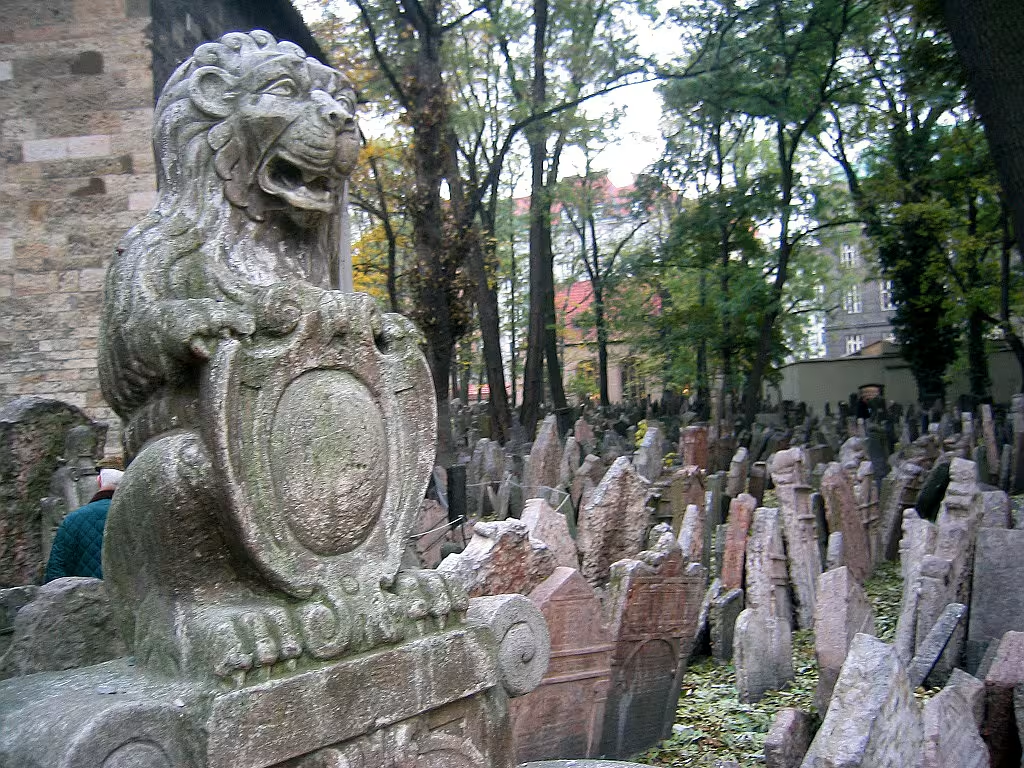
The extraordinary form of the cemetery was influenced by the Jewish burial tradition - halacha forbids to disturb graves and remove tombstones. Therefore, due to lack of space, layers of clay were attached to older graves and buried in them again; According to some researchers, up to ten burial layers were created above them. The tombstones have sometimes been removed and planted back on the newly created surface, which explains their characteristic build-up close together.
In the cemetery are buried the leading figures of the Prague Jewish community: Jehuda Liva ben Becalel called Rabi Löw (died 1609), Mordechaj Maisel (1601), David Gans (1613) and David Oppenheimer (1736).
At the time of the reign of František I there were proposals for the partial abolition of the cemetery, but they were mainly reflected by the categorical resistance of the Archbishop Václav Leopold Chlumčansky. However, there was a reduction in cemetery areas during the rendering of Old Town and Josef after 1903. After the closure of the cemetery in 1787, the Prague Jewish community switched to the originally pestilence cemetery in Žižkov, operated in 1680-1890, whose remains are now partly under the Žižkov TV tower. Since 1890, there has been a new cemetery in the area of Olšansky cemeteries.
Today the Old Jewish Cemetery is managed by the Jewish Museum in Prague. For a visitor who comes here, the cemetery is a silent reminder of the centuries-long presence of the Jewish community in Prague, as well as the extraordinary way in which this community dealt with limited space and commitment to its dead.
Then and now
Drag the slider to compare how the landmark may have looked when it was built with the view today.

The historical appearance on the left is an AI-generated visualisation and serves as inspiration only.
Historical milestones
- 1439
- The oldest documented tombstone (Avigdor Kara) and the likely start of the cemetery.
- 1478
- Cancellation of the previous cemetery (Jewish Garden) in New Town at the request of the Czech King Vladislav II.
- 1680
- The beginning of the use of the Plague Cemetery in Žižkov as another burial ground for the Jewish community.
- 1787
- The last funeral at the Old Jewish Cemetery.
Architectural development
The cemetery was based on the highest hill of the Jewish city and gradually expanded by purchasing more land, especially in the 16th century. Due to lack of space, burial was carried out in layers, with old tombstones sometimes being removed and replanted on a newly elevated surface. The cemetery was situated on an area of 1.5 hectares and its area gradually increased until 1768. The tombstone materials are mainly sandstone and marble, with typical Jewish symbols and inscriptions in Hebrew.
Historical events
- 1389
- Pogrom in the Jewish ghetto in Prague, where the previous cemetery (Jewish garden) was destroyed and the graves were looted. The oldest preserved tombstone in the Old Jewish cemetery comes from this period.
- 1440
- The first documented purchase of the plot for the expansion of the cemetery by the brewery Hanuš.
- 1787
- The last funeral in the cemetery for Moses Lipman Beck. The cemetery was then closed by decision of emperor Josef II.
Owners
Jewish Museum in Prague (from 20th century)
Points of interest
The oldest preserved tombstone dates back to 1439 and belongs to the rabbi and poet Avigdor Kara.
- The cemetery was founded on the highest hill of the Jewish city at an altitude of 192 meters above sea level.
- As a result of lack of space, older graves were attached to the layers of clay and buried again, creating up to ten burial layers.
- The last grave was reserved in 1787 for Moses Lipman Beck, then the cemetery closed the imperial order of Josef II for sanitary reasons.
Guide
This guide is narrated by a synthetic voice generated by artificial intelligence.
Show guide text
This text was created by artificial intelligence and has not been editorially reviewed. It may contain inaccuracies.
Welcome to the Old Jewish Cemetery in Prague-Joseph.
You are standing in a place that bears the testimony of the millennium of history. In front of you lies one of the oldest preserved Jewish cemeteries in Central Europe - a place where not only ordinary people rest, but also important rabbis, scholars and intellectuals whose names are linked to the Prague Jewish community. The air here carries a quiet seriousness as if time stood. Look around you - stone tombstones that stretch down the slope are like pages of a forgotten book. Some are damaged, others have been preserved in incredible purity, as if time had touched them lightly. Note how the cemetery is situated on a steep slope - it was founded in the highest place of the Jewish city, at an altitude of nearly two hundred meters. It gave the buried people symbolic meaning, as if their souls could ascend to heaven.
This cemetery was built probably in 1439, when Rabbi Avigdor Kara's tombstone was registered as the oldest preserved. The previous Jewish cemeteries in Prague, such as the Jewish Garden in New Town, were abolished at the command of the Czech Kings. The Jews had to find a new place to honor their dead. The cemetery served on Joseph until 1787 when it was definitively closed. During his existence he witnessed many changes - from the Middle Ages to period reforms. Note how the lifestyle of the time is projected here: there are often tombstones on older graves with Hebrew inscriptions that tell about the life and work of the deceased. Some of them are so old that their handwriting is almost illegible, but that is what gives the place its mysterious atmosphere.
Let's take a closer look at some of the most important personalities that are resting here. One is Rabbi Löw, also known as Rabbi Jehuda Liva ben Becalel, who lived in the 17th century. His name is linked to the legends of Golem, but also to his deep study of Tory and cabal. Another important figure is Mordecai Maisel, who was not only a rabbi, but also an important writer. His work * Sefer Mordecai * is still being studied. An interesting one is the tombstone of David Gansa, an astronomer and a mathematician who contributed to the development of Jewish science during the Renaissance. And then there's David Oppenheimer, the last great rabbi who was buried here in 1736. His tombstone is one of the last in the cemetery, which reminds me of the end of this era.
Now pay attention to one of the most interesting details - the oldest preserved tombstone from 1439. It belongs to Rabbi Avigdor Kar, who was not only a scholar, but also a poet. His tombstone is one of the few that were preserved in its original form. Notice how stone it is, with Hebrew inscriptions telling about his life. Avigdor Kara was buried earlier, but his tombstone was made later, which shows a tradition when tombstones were built after a certain time. It was a way to honor the deceased and remind him of his meaning.
Another interesting thing is the way the cemetery was used. With an increasing number of dead and limited space, layers of clay were attached to older graves and then buried again. That means that under some tombstones, people from several generations rest. This way of burying was common at a time when space was expensive and every inch of land had its meaning. Today, it reminds us of how history lay above itself, like the layers of the earth.
As you go through the cemetery, you may find there is a silence that is broken only by the rustling of leaves and air. But this is a deception - every tombstone has a story, every stone carries a trace of time. Here rest the people who formed the soul of the Prague Jewish community. Some were scholars, others were rabbis, but they were all part of this rich cultural tradition.
If you want to get to know this place in more detail, I recommend looking at some of the preserved tombstones with the most interesting inscriptions. Some of them are written in Hebrew, others in Yiddish, and they all tell about the life that ended here. Note also how different styles were mixed here - from medieval stone plates to later, more decorated tombstones.
Before you say goodbye to this place, stop at the oldest tombstone and think about how long the history that every stone carries is. The old Jewish cemetery is not only a monument to the deceased, but also to the life that took place here. It's a place that brings you back to the past and reminds us how important it is to remember those who lived before us.
Thank you for stopping by this place. Let yourself stay in his atmosphere for a while and remember that every tombstone is a page of a book that tells about our common heritage. May your visit bring you not only knowledge, but a moment of peace and reflection.
Tips for visitors
{'text': 'The best time to visit is early morning or late afternoon, when the cemetery is quieter and sunlight creates pleasant shadows on the tombstones. In the summer months it is ideal to avoid midday hours when it can be very hot in an open area. In this way visitors can relax to view the historical tombstones and enjoy the atmosphere of the place.'}
{'text': 'Parking is possible in the nearby area but public transport is recommended. The cemetery is located in the centre of Prahy-Josefov, where you can reach for example by bus or tram. The current connection and the nearest stops should be checked in the map search engine before the trip. If you arrive by car, search the parking lot nearby and count on the possibility of paid parking.'}
{'text': 'When visiting, take comfortable shoes and light clothes because the cemetery is located on a slightly steep terrain with rocky surface. I also recommend that you take a map or mobile application with navigation to make it easier for visitors to navigate between tombstones. It is also appropriate to take a small umbrella or sunglasses because the weather can be unpredictable.'}
{'text': 'Photography is permitted, but it is recommended to search places with plenty of natural light, for example early morning or late afternoon. It is best photographed at older tombstones with nice ornaments, which are well lit. When shooting, avoid flashing lightning to avoid damaging sensitive surfaces of stone tombstones.'}
{'text': 'There are several interesting places around the cemetery that are worth visiting. There is a Jewish Museum in Prague, which offers an exhibition about the history of the Jewish community in Bohemia. Another interesting thing is the Synagogue Pinkasova, which is only one kilometer away and served as a monument to Holocaust victims. Both of these places are easily accessible on foot
{'text': 'For families with children a visit to the cemetery is an interesting opportunity to get to know history and culture. Children can be intrigued by old tombstones and stories that relate to them. They are recommended to explain the meaning of individual symbols and inscriptions on tombstones. In the vicinity of the cemetery you can visit the Jewish Museum, where interactive exhibitions are often prepared for children.'}
Frequently asked questions
Is Starý židovský hřbitov v Praze-Josefově open to the public?
Yes, he's open to the public. Opening hours: 9: 00- 17: 00 (in winter period from 10: 00).
How do I get to the place by car / public transport?
The location is well available public transport, Staromestska metro station. By car you can park in the nearby area or use a public garage.
How much is the entrance fee and is it paid on the spot?
Payment takes place at the till before entry.
Is the tour suitable for children and seniors?
Yes, it's suitable for families with children and seniors. The tour can be done on foot or use wheelchair access.
How long does the tour take?
The tour takes approximately 1-2 hours, depending on the interest and attention of the visitors.
What are the opening times and booking is required?
Opening hours: 9: 00- 17: 00 (in winter period from 10: 00). Reservation is not required, but we recommend to check availability in advance.
What's interesting in the immediate vicinity?
The Prague Castle and the Old Town Hall are located in the immediate vicinity. The distance from the Jewish cemetery is approximately 10-15 minutes' walk.
For kids
Imagine going back 587 years to Prague, which was a small town with a white wall and open streets. It was a different time, but the Jewish district of Josefov was already home to many Jewish families.
How would people behave here? Jews were merchants, butchers, blacksmiths, artists... They had their own schools and synagogues. They were part of the Prague community, but they also had their own traditions and customs. Imagine being in their shoes, being a little Jewish boy trying to find his way to a strict rabbi to help him with his homework.
Businesses nearby
Events nearby
Zdroj akcí: otevřená data měst a obcí ČR (Národní katalog otevřených dat) a kalendář akcí Národního památkového ústavu.
Nearby
{'memories': [{\ 'Nazen': 'Jewish Museum in Prague', 'distance': 'within the premises, 100 meters', 'description': 'Museum is located in the historical synagogue and offers an exhibition on the history of the Jewish community in the Czech Republic.'}, {'Nazen': 'Synagogue Pinkasova', 'distance': '1 km', 'description': 'Synagogue served as a monument to the victims of the Holocaust and is part of the Jewish Museum', 'nazen': 'Vyšehrad cemetery', 'distance': '2 km', 'description': 'Historicist cemetery with many important Czech personalities'}, 'prikrady': [: ['Vlutava'
Accommodation nearby
Trips and activities nearby
Guided tours, tickets and activities nearby from GetYourGuide
Affiliate link: if you buy from the partner, we may receive a commission. The price for you does not change.
Search tours and activities →Themed route
Thematic cruise route: Jewish Praha - monuments and history
1.Starý židovský hřbitov v Praze-Josefově * Type: * History and memory. It is the oldest Jewish cemetery in Prague (from the 15th century), where over 12,000 tombstones were preserved. Its atmosphere and ancient epitaph are a unique testament to Jewish culture and history.
2. Jewish Museum in Prague * Type: * Museum exposition. It is located in the Old Jewish cemetery and offers an overview of the development of the Jewish community in Bohemia. Expositions are supplemented with rare objects and historical documents.
3. Pinkas' Synagogue * Type: * Memorial and artistic exhibition. It serves as a monument to Holocaust victims and is part of the Jewish Museum. The names of 77 000 Czech victims are engraved on the walls, which is an emotional and educational experience.
4. Vyšehrad cemetery * Type: * History and architecture. About 2 km from the centre, it offers a quiet atmosphere with graves of significant personalities such as Karel Čapek. Its romantic surroundings and historical tombstones are ideal for relaxing after visiting monuments.
The route is logically designed so that the visitor progresses from the oldest Jewish cemetery through museum exposition to the Holocaust Memorial and ends with a peaceful walk through Vyšehrad. All targets are interconnected and located in the vicinity.
Seasonal recommendations
Spring brings freshness to Joseph and the waking green that gently covers old tombstones. The atmosphere is full of hope and light is soft, which creates a pleasant contrast with stone monuments. I recommend wearing more layers of clothing because spring weather can be variable. Visit the place in the morning when crowds of tourists are still relatively small.
In the summer months, the cemetery is dominated by green and bright sun, which highlights the texture of the old sandstone. The air is hot and the space is very lively thanks to a large number of visitors. Light, breathable clothing and plenty of water are essential in the main summer season. To avoid the biggest clusters and heat, come right at the opening.
Autumn here creates a melancholy mood, complemented by golden leaves fallen into the cemetery. A misty wound gives the place a mystery and a special peace of mind. Suitable are waterproof shoes and lighter jackets for colder days. In this period the attendance is lower, so you can enjoy the space more in the afternoon light.
Winter reveals the strict architecture of the cemetery when bare branches of trees do not cover the view of layered tombstones. The contrast of the grey stone and any snow blankets is very steep and quiet. Don't forget the warm thermal clothing and headgear. In winter it is open for a shorter time, so I recommend checking the actual hours of operation in advance.
Visualizations and artistic views


The visualisations are generated by artificial intelligence and serve as inspiration.
Photos from the area
Real photos taken near the monument

Zdroj a licence jsou uvedeny u každého snímku.
View from the area
This animation was generated by artificial intelligence from a real photograph of the surroundings. The motion and details are not real footage of the location.
Tips from visitors
No tips yet. Be the first!
Log in and add your tip.
Sources and literature
Fotografie: Photo: Andreas Praefcke / CC BY 3.0 — Wikimedia Commons. The author and licence also appear when you hover over the image.
Faktickým podkladem tohoto textu byl článek na Wikipedii, jehož autory jsou přispěvatelé Wikipedie. Článek je dostupný pod licencí CC BY-SA 4.0.
Location on the map
More monuments – Praha
Show all in the municipality
Příběhy a pověsti
Legendy, pověsti a příběhy spjaté s touto památkou
Fotografie návštěvníků
Zatím žádné fotografie. Buďte první, kdo přidá fotografii z návštěvy!
Přihlaste se a přidejte svou fotografii nebo hodnoťte.
Za ověřenou návštěvu v aplikaci získáte víc bodů — poznáme podle GPS, že jste na místě.
Reviews and comments