



barokní most ve Žďáru nad Sázavou Road bridge
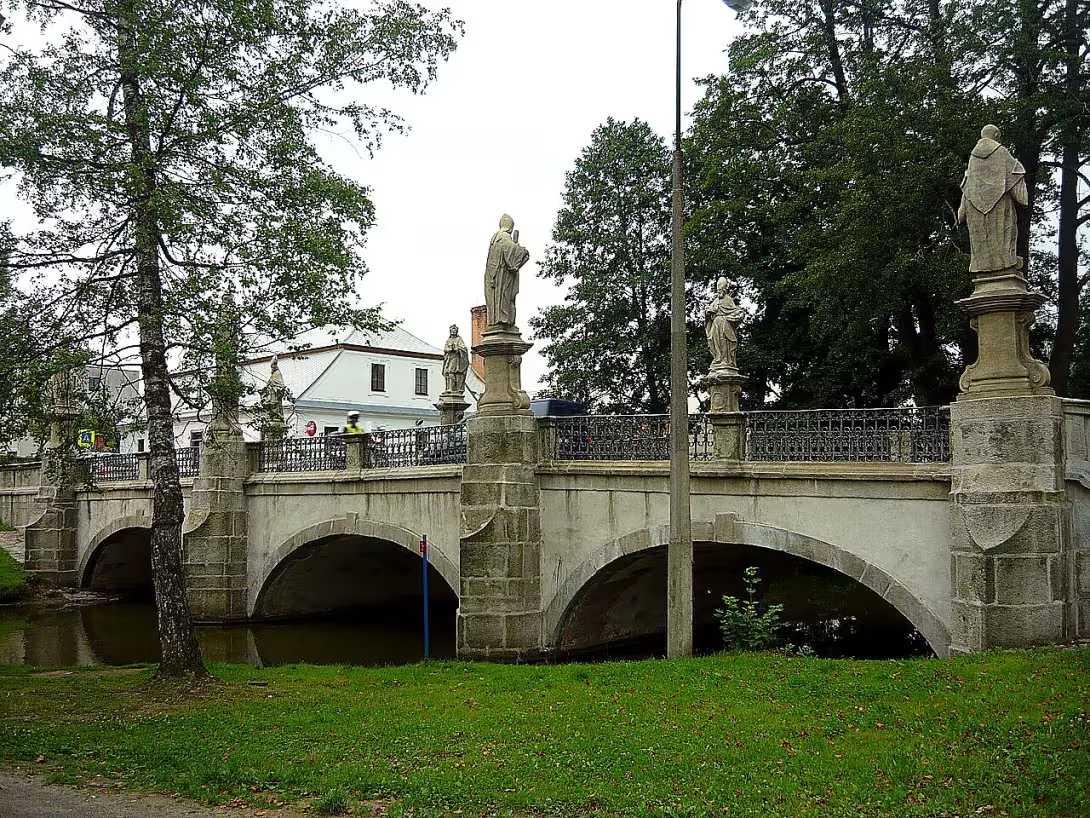
The Baroque bridge with statues in Zdar nad Sazavou is a cultural monument from the second half of the 18th century, which boasts its historical and architectural value. It is located in the village of Žďár nad Sázavou 2, via Sztranovský brook next to the monastery area and pilgrimage church of St. John Nepomucký. The bridge is known not only for its Baroque architecture, but also for eight statues of saints that give its appearance a unique character.
The bridge was built in 1761 by Abbot Bernard Hennet as a substitute for the original wooden bridge. The initiative to build it came after the destruction of an old bridge that didn't match the needs of the time. The abbot was inspired by the Charles Bridge in Prague and decided to have a Baroque style with rich sculpture decoration. The bridge was designed as a three-arc bridge from granite blocks whose arches range 9 + 9 + 9 meters and the bridge width is 6 meters. The thick pillars give the structure a distinctive character.
The architectural elements of the bridge are supplemented by eight baroque statues of saints, which stand on richly decorated billets with volutes. The statues are depicted by Slavonic visionaries Cyril and Methodius, the holy brothers John and Paul, St. Nicholas, St. Vojtěch, the founder of the order of the cisterns of St. Bernard of Clairvaux and the father of St. Benedict of Nursie. The location of the statues is symbolic and their selection reflects the spiritual values of the monastery community. At the last bridge repair in 2008-2009, the original statues were replaced with copies, while the originals were moved to the nearby Lower Cemetery.
The bridge has passed several stages of maintenance and repair. In 1947 the bridge was strengthened with a reinforced concrete plate, which was then considered an optimal solution. However, in the years 2008-2009, a comprehensive repair took place during which the vaults and pillars were reinforced by micropilots, the new road laid down and the drainage system introduced. This repair ensured long-term stability of the bridge.
Today a Baroque bridge with statues is a cultural monument that attracts visitors with its historical significance and architectural beauty. I / 37 road runs across the bridge, which ensures easy access to this monument. If you visit Zdar nad Sázavou, you should not forget this bridge, which is not only an important part of local history, but also a beautiful example of Baroque architecture. His visit will offer a view of the rich past and allow himself to enjoy a quiet moment around the monastery area and the pilgrimage church of St. John Nepomucký.
Historical milestones
- 1761
- The position of the bridge by the abbot Bernard Hennet.
- 1947
- Repair the bridge with a reinforced concrete plate.
- 2008
- The last repair and replacement of the statues with copies.
Architectural development
The bridge was built to replace the original wooden bridge. It is three-arc, made of granite blocks with thick pillars and equipped with 8 baroque statues of saints. During repairs in 2008-2009, the vaults and pillars were reinforced, the new road laid down and the original statues replaced by copies.
Historical events
- 1761
- The position of the bridge by the abbot Bernard Hennet.
- 1947
- Repair the bridge with a reinforced concrete plate.
- 2008
- The last repair and replacement of the statues with copies.
Points of interest
- Baroque bridge with statues in Zdar nad Sázavou is a cultural monument from the second half of the 18th century. - The bridge was built in 1761 by Abbot Bernard Hennet as a substitute for the original wooden bridge. - The architectural elements of the bridge are supplemented by eight baroque statues of saints, which stand on richly decorated billets with volutes. - At the last bridge repair in 2008-2009, the original statues were replaced by copies, while the originals were moved to the nearby Lower Cemetery. - The bridge went through several stages of maintenance and repair, including strengthening the reinforced concrete plate in 1947.
Guide
Show guide text
This text was created by artificial intelligence and has not been editorially reviewed. It may contain inaccuracies.
Welcome to Zdar nad Sazavou, where you are currently in front of one of the most characteristic and unforgettable places in this area. You're standing in front of a baroque bridge with its distinctive statues that almost seem to greet anyone crossing this historic pass. This bridge is not only a structural work of art, but also a witness to the rich history and traditions of this area.
Let us immerse ourselves in its origin and historical context. The bridge was built in 1761 by Abbot Bernard Hennet, who then led the monastery in Vejpek. The aim of this construction was to replace the original wooden bridge and ensure a more stable connection through the Sztranovský stream, which was necessary for the monastery community and the local population. This bridge has become a part of the historical area and it leads by I / 37.
Look up at the architectural similarity of this bridge with the Charles Bridge in Vienna. Although we are unable to name specific architects, you may notice rich decorations and eight statues of saints that are located on the bridge. These statues add moving Baroque elements that still fascinate visitors.
Bernard Hennet, the key personality associated with this monument, was the abbot whose decision was to create this bridge. His initiative not only strengthened the infrastructure of the area, but also contributed to the aesthetic wealth of the local monastery complex.
The interesting thing is that even after centuries this bridge has remained an important cultural monument. In 1947 the bridge was repaired with a reinforced concrete plate and later, in 2008, there was the last major modification during which the statues were replaced by a copy of them. These interventions have ensured the preservation of the bridge for future generations.
Now that you're ready to explore again, we'll invite you to go through the surrounding monastery gardens and resorts. Every step here can reveal new historical secrets or beautiful panoramic views of Zdar nad Sazavou.
Thank you for visiting this baroque bridge. We hope his history and architecture have reached out to you as well as many previous visitors. Remember to play this audio guide later if you want to relive this beautiful journey through time and architecture.
Tips for visitors
The best time to visit the Baroque bridge in Zdar nad Sázavou is in the spring or autumn period, when nature is in full beauty and light is not as intense as in summer. This time of year offers ideal conditions for photography when you can capture the bridge in a quiet environment with natural colors.
The location is easily accessible by car and public transport. For those travelling by public transport, it is advisable to verify the current connection with the search engine.
When visiting, take a photo or mobile device for a photo with you. The best places to photograph the bridge are from both sides of Szranov creek, where you can grasp the overall view of architectural beauty with surrounding statues. It is also advisable to use sunny afternoon hours for best illuminated images.
In the vicinity of the bridge there is a historical monastery of Zděr, which is part of the UNESCO World Heritage. Visit the pilgrimage church of St. John Nepomuk and explore the surrounding ponds of Bránský and Conventský, which provide a peaceful atmosphere and beauty of nature. These places are ideal for relaxing after a walk through the bridge.
For families with children a visit to the bridge is an interesting experience that combines history and nature. Children can be fascinated by architectural details and statues on the bridge. In addition, the surrounding monastery area offers possibilities for short walks, which is an ideal way to let the children move.
Frequently asked questions
Can the monument be visited?
This is a structure in a public space that can usually be seen from outside free of charge. We have not verified that this particular one is freely accessible.
Where is the monument?
Location: Žďár nad Sázavou 2. The map on this page shows the exact spot.
Why is the monument protected?
It is listed in the Central List of Cultural Monuments of the Czech Republic as a cultural monument (register no. 1000124208).
Businesses nearby
Do you run a restaurant, accommodation, shop, museum, rental, wellness or other visitor service near this monument? Show yourself directly to the people heading to it — this is how they will see you in the app and on the web:
Events nearby
Zdroj akcí: otevřená data měst a obcí ČR (Národní katalog otevřených dat) a kalendář akcí Národního památkového ústavu.
Nearby
Historický žďárský klášter
Poutní kostel svatého Jana Nepomuckého (památka UNESCO)
Rybníky Bránský a Konventský
Accommodation nearby
Themed route
Thematic cruise route: Baroque bridge and surroundings in Zdar nad Sazavou
1. Baroque bridge in Zdar nad Sazavou (bridge) This beautifully preserved Baroque bridge is our main destination. It crosses the river Sazavu and connects both sides of the city. It is a rare example of architecture from the time it was built and is worth visiting for its historical and aesthetic value.
2. Historical monastery (UNESCO monument) Around 10 minutes walk from the bridge we find this important monastery complex, which is part of the UNESCO World Heritage Site. The monastery served as a spiritual centre and has a rich history. Its architecture and artistic elements are essential for understanding the cultural development of the area.
3. The pilgrimage church of St. John Nepomuk About 15 minutes' walk from the monastery is this pilgrimage church, which is an important religious monument. He is famous for his beautiful Baroque architecture and dedicated to St. Jan Nepomuk, which attracts many visitors for spiritual and aesthetic reasons.
4. The ponds of Bránský and Conventský After exploring the church we return to the monastery, from which ponds are approximately 5 minutes walk. These ponds were an important part of the monastery's water system and provide a view of the historical way of managing water. They are an ideal place to relax and understand the environmental aspects of the region.
This route offers a comprehensive view of the cultural and historical heritage of Zdar nad Sázavou, each of which contributes to the overall understanding of the region.
Seasonal recommendations
Spring: In the spring season barokní most ve Žďáru nad Sázavou is revived by flowers and new leaves of trees, which brings a lively green atmosphere. Sunlight illuminates architectural details of the bridge, which is the perfect time for photography. It is recommended to visit in the morning or at noon when the sun is at the highest level and provides the best lit image of the monument. Clothing should be suitable for moderate temperature; a light jacket or sweater can be useful if it starts to cool.
Summer: In the summer, the atmosphere around the bridge is full of the sounds of nature and the loud roar of the river. Sunshine days can be very warm, so visiting in the morning or evening is preferable to avoiding extreme temperatures. It is recommended to wear light clothes and protective sunglasses. When visiting, notice how the sun illuminates the bridge differently than in other times of the year, which may add an interesting perspective.
Autumn: Autumn season offers beautiful coloured leaves and slightly colder temperatures. The sun's light is long at the end of the day, which provides ideal conditions for soft lighting photography. It is recommended to visit late afternoon and in weather without rain, when the atmosphere is calm and nature offers its most beautiful colors.
Winter: In winter, the bridge may seem almost magical in icy conditions, especially after snow. Sun rays illuminate a clean atmosphere and provide a clear view of architecture. Visiting in the morning is ideal due to warmer sun, but always remember protective clothes and shoes suitable for snow conditions when visiting.
Visualizations and artistic views

The visualisations are generated by artificial intelligence and serve as inspiration.
Photos from the area
Real photos taken near the monument

Zdroj a licence jsou uvedeny u každého snímku.
Tips from visitors
No tips yet. Be the first!
Log in and add your tip.
Sources and literature
Photos: Draceane / CC BY-SA 4.0 — Wikimedia Commons. The author and licence also appear when you hover over the image.
Faktickým podkladem tohoto textu byl článek na Wikipedii, jehož autory jsou přispěvatelé Wikipedie. Článek je dostupný pod licencí CC BY-SA 4.0.
Location on the map
More monuments – Žďár nad Sázavou 2
Show all in the municipality


Příběhy a pověsti
Legendy, pověsti a příběhy spjaté s touto památkou
Fotografie návštěvníků
Zatím žádné fotografie. Buďte první, kdo přidá fotografii z návštěvy!
Log in a přidejte svou fotografii nebo hodnoťte.
Za ověřenou návštěvu v aplikaci získáte víc bodů — poznáme podle GPS, že jste na místě.
Reviews and comments