

Bílá muka Wayside shrine
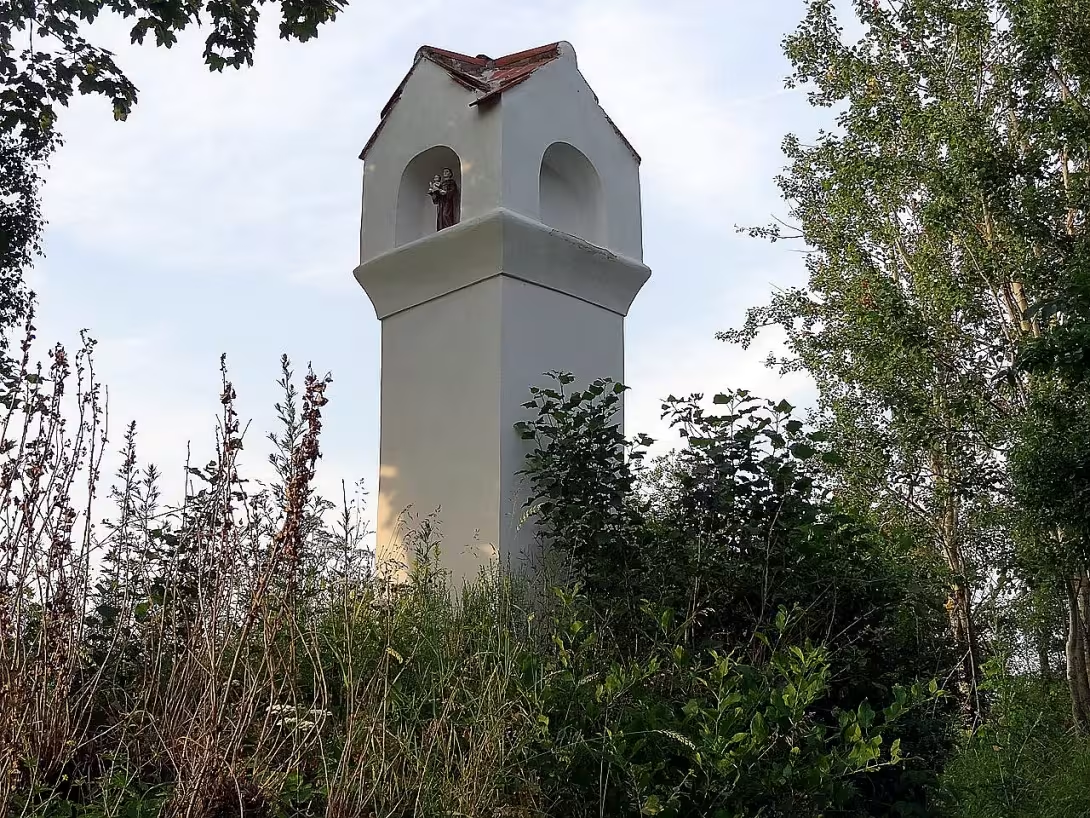
Bílá muka is a Baroque brick building from the first half of the 18th century. It is located at an altitude of 614 m on the hill above the former crossroads to Ratibor and Verusice. The monument lies approximately 1.5 km northwest of the village Žlutice in the district of Karlovy Vary and is listed in the list of cultural monuments of the Czech Republic.
The building was created in the first half of the 18th century according to the design of an unknown architect. A small statue of St. Anthony of Paduan is placed in one of the nines on the head of God's torment.
The first documented renovation took place in 1904. However, after the forced displacement of the German population at the end of World War II, the monument was no longer maintained. In 1963 Bílá muka was entered in the state list of cultural monuments under registration number 34810 / 4-1156. He is currently the owner of the Ludek Civlin building from Unhosti.
In the second half of the 20th century, the building tilted. It caused partial extraction of the hill and artificial expansion of the journey. Before 1993, a total renovation of the decrepit building took place. The last reconstruction was carried out in 2013 thanks to the activities of the Association of Ornamental Landlord, with the torture of God being newly plastered and painted.
Today Bílá muka serves as an important cultural and orientation element of the landscape around the village Žlutice. Its preservation suggests efforts to restore local historical details. Visiting this place offers a meeting with an authentic baroque element in natural terrain.
Historical milestones
- 1904
- A White Torture renovation.
- 1963
- Registration number 34810 / 4-1156.
- 2013
- The last reconstruction carried out by the Association of Decorative Landlord.
Architectural development
It is a brick Baroque building from the first half of the 18th century. In 1904 it underwent renovation and in the early 1990s, the whole renovation of the decrepit building took place. The last reconstruction was carried out in 2013, in which the torture was repainted and painted.
Historical events
In 1963, the monument was entered on the state list of cultural monuments. After the forced displacement of the German population at the end of World War II, God's torment was no longer maintained.
Owners
Luděk Civlin of Unhošt '
Points of interest
- It's a baroque brick building from the first half of the eighteenth century. - There's a little statue of St. Anthony of Paduan in one of the nobodies on the warhead. - In the second half of the twentieth century, the building tilted to take off the hill and expand the road. The first documented renovation took place in 1904. - The last reconstruction from 2013 included new plastering and painting.
Guide
Show guide text
This text was created by artificial intelligence and has not been editorially reviewed. It may contain inaccuracies.
Welcome to this silent and charming monument, which stands above the landscape as a silent witness of ancient times. You are standing before the White Torments that stand in this high place, on the hill above the former crossroads leading towards Ratibor and Verusice. The view from here is truly exceptional, you are located at an altitude of six hundred and fourteen metres, approximately a mile and a half northwest of the village Žlutice in the Karlovy Vary Region. Feel this atmosphere of peace and open space that surrounds this small but important building element.
Let us now stop at how this building was created and what its historical context is. Bílá muka dates back to the first half of the eighteenth century. At that time, it was customary to build similar God's torments at crossroads to serve as a place of prayer for pilgrims, as an aid for travellers in orientation or as an expression of gratitude for the survival of danger. Although we do not know the names of the builders or architects who designed this object, it is clear that it was the work of its time, which had a clearly defined function in the landscape. Today, this building is duly registered on the state list of cultural monuments of the Czech Republic, which confirms its irreplaceable value for our village and history.
Now pay attention to the architecture itself and to what you see right in front of you. It is a walled-up building in Baroque style. Look carefully at the top of it, the so-called warhead. Notice the niche placed in it, which are small depths in the wall. In one of these niche you can see a little statue of St. Anthony of Paduan, who is watching over the passengers. It is these details that give the construction its spiritual dimension. The whole object currently serves not only as a religious symbol but also as a very important landmark in the field.
When we look at the stories associated with this place, we find that even so small a building must fight against time and external influences. The history of White Torture maintenance takes us deep into the past. The first documented renovation took place in the year of a thousand and nine hundred and four, which shows that local people took care of the monument more than a century ago. Later, in the year one thousand nine hundred sixty-three, the construction was officially entered in the register of cultural monuments. The latest care for this building took place in the year two thousand thirteen, when the reconstruction was carried out thanks to the efforts of the Association decorating the Lord. It's nice to see the community come together to preserve this piece of history for future generations.
And now I'm going to lead you to one interesting thing that may not be obvious at first glance, but if you look closely, you might notice it. Notice the position of the structure. Something unexpected happened in the second half of the twentieth century. Bílá muka has started to lean. However, the cause of this phenomenon was not the aging of the masonry itself, but the intervention into the surrounding terrain. The hill on which the construction is built was partially extracted at the time and the road was extended. These changes in the landscape affected the stability of the subsoil and caused the monument to lose its original vertical axis. It is a fascinating reminder of how much historical buildings are linked to the landscape in which they were built, and how any change in the surroundings can leave a mark on the building itself.
This small Baroque building is so much more than just a walled-up column. It is a link between the past and the present, between faith and the practical need for orientation in space. It is proof of the care of the locals and also a reminder of how our landscape changes.
Thank you for stopping by the White Tortures. I hope you are interested in this short trip to history and that you will take a sense of peace from this beautiful miejska over Žluticemi. Now invited to further explore the surroundings, to walk through the field roads that once led the pilgrims here. I wish you a pleasant journey and a beautiful day spent in our region. Goodbye.
Tips for visitors
The best time to visit is late spring or autumn, when the surrounding field paths are in bloom or colour, which underlines the atmosphere of this Baroque object. You can find yourself in a car or on foot on the roads leading from the village Žlutice towards Ratiboř or Verusice.
For your trip, wear comfortable shoes suitable for the terrain, because the monument is located on the hill at an altitude of 614 meters. We also recommend you take enough water and a map of the surrounding area to easily navigate the landscape.
For the best photos we recommend to come in the morning or late afternoon light, when the sun of niedriga illuminates the walled walls of torture and creates depth in the landscape. The best angles are from the lowland, where you can see the entire building on top of the hill.
In addition to the object itself, you can explore the surrounding crossroads and roads towards the municipalities of Ratiboř and Verusice. For families with children is the place suitable for a short trip to nature and observing the landscape from an elevated point.
Frequently asked questions
Can the monument be visited?
This is a structure in a public space that can usually be seen from outside free of charge. We have not verified that this particular one is freely accessible.
Where is the monument?
Location: Žlutice, Karlovarský kraj. The map on this page shows the exact spot.
Why is the monument protected?
It is listed in the Central List of Cultural Monuments of the Czech Republic as a cultural monument (register no. 34810/4-1156).
Businesses nearby
Do you run a restaurant, accommodation, shop, museum, rental, wellness or other visitor service near this monument? Show yourself directly to the people heading to it — this is how they will see you in the app and on the web:
Events nearby
Zdroj akcí: otevřená data měst a obcí ČR (Národní katalog otevřených dat) a kalendář akcí Národního památkového ústavu.
Nearby
🏰 Historic sites (44)
- Mazanec 1.3 km
- Sloup Nejsvětější Trojice 1.6 km
- Zřícenina hradu Nevděk 2.6 km
- Štědrý hrádek 4.6 km
- Rohlerův Mlýn 5.0 km
- Hradiště Vladař 5.4 km
- sv. Barbora 5.5 km
- Tomšův Mlýn 6.9 km
- Doubský Mlýn 7.1 km
- Karel Čapek 7.1 km
- Panna Marie 7.4 km
- sv. Jan Nepomucký 7.8 km
- Památce padlým 8.6 km
- sv. Jan Nepomucký 9.0 km
- Hartenštejn 9.0 km
- Hungerberg 9.3 km
- Kostel sv. Jiří 9.6 km web
- Neuhaus 10.3 km
- sv. Jan Evangelista 10.3 km
- Panna Marie 10.3 km
🍽️ Restaurants and dining (18)
- Zámecký pivovar 7.2 km +420 728 948 868 web
- Stop Cafe 8.5 km
- Jídelna U Zlaté koule 8.9 km náměstí Míru 42
- Radniční sklípek 8.9 km náměstí Míru 1
- Restaurace Slunce 9.0 km náměstí Míru 35
- Hospůdka U Macháčků 9.0 km náměstí Míru 30
- Valečský dvůr 11.0 km
- Penzion Laura 12.1 km
- Hostinec u Kamenného mostu 12.2 km +420 603 223 618 web
- Četnická stanice 12.3 km +420 728 215 628 web
- Stop Cafe 13.0 km
- U Skálů 13.4 km
- Sázavan 13.7 km
- Zámecká restaurace Manětín 13.8 km web
- Hostinec Na Radnici 14.2 km +420739303558; +420373313132
- Hostinec u Kameného stolu 14.2 km web
- U Čapků 14.4 km
- Hospoda Na hřišti 14.5 km +420604675213 web
🏨 Accommodation (11)
- Pension Harmonie 1.2 km Žižkov 540 web
- Semtěš 5 3.5 km web
- U Devíti Vidlí 3.6 km web
- Karavanserai 5.3 km
- Zámecký penzion Chyše 7.2 km Chyše 54 +420353396336 web
- Penzion u Kapličky 8.7 km Kozlov 110 00420603145076 web
- Osada Šárka 10.2 km +420 725 813 526 web
- Plot 13.0 km
- penzion a restaurace U zámku 14.0 km
- U kaprů 14.5 km +420 604 741 337 web
- Bývalý špitál 14.9 km +420373313104 web
🚲 Rentals and sport (1)
- Sokolovna 12.3 km
🥾 Hiking and nature (222)
- Lamberk 0.8 km
- Hlínovec 1.5 km
- Holý vrch 2.0 km
- Nevděk 2.6 km
- Doubrava 2.7 km
- Krkavec 3.3 km
- Havraní vrch 3.4 km
- Nad hřbitovem 3.5 km
- Mlyňanský vrch 3.5 km
- Za transformátorem 3.9 km
- Žlutické Lurdy 4.1 km
- Ptačí vrch 4.2 km
- Na zadu 4.3 km
- Na Karlově 4.3 km
- Vraní vrch 4.4 km
- Pohořelec 4.7 km
- Na vršku 5.0 km
- Stubelka 5.5 km
- Vladař 5.5 km
- Nad ovčínem 5.5 km
Accommodation nearby
Trips and activities nearby
Guided tours, tickets and activities nearby from GetYourGuide
Affiliate link: if you buy from the partner, we may receive a commission. The price for you does not change.
Search tours and activities →Themed route
Here is a proposal for a thematic walk:
1. Žlutice - village. The starting point of the path where you can navigate before the tour. 2. Bílá muka - a monument. The main destination of the trip, located at the crossroads. 3. Ratibor - village. The destination of the road leading from the crossroads, suitable for a short walk through the countryside. 4. Verusice - village. The second alternative direction from the crossroads, which complements the circle around the monument.
Seasonal recommendations
In spring the surroundings of the monument awaken to life and green grass highlights the white color of the pillar. We recommend shoes suitable for wet terrain and visit in the morning when nature is the most fresh.
In the summer months the landscape is dominated by bright sun and rich colors surrounding vegetation. The monument stands out in a sharp light that highlights its details. The best is to come early in the morning or evening to avoid heat.
Autumn brings golden and brown shades to the landscape, which form a melancholy contrast to the white surface of torture. The atmosphere is quiet and the radiant heat changes the colder breeze. It is advisable to choose layered clothes and visit the place during sunny days when autumn light falls beautifully in memory.
In winter, the object can be surrounded by snow, which unifies the color of the building with the surrounding area and creates a minimalist image. The landscape acts dormant and cold, which gives the place some rigor. Hot shoes and waterproof clothing are essential, and the best time to visit is a clear winter day with clean skies.
Visualizations and artistic views


The visualisations are generated by artificial intelligence and serve as inspiration.
Photos from the area
Real photos taken near the monument


Zdroj a licence jsou uvedeny u každého snímku.
Tips from visitors
No tips yet. Be the first!
Log in and add your tip.
Sources and literature
Photos: MartinVeselka / CC BY-SA 4.0 — Wikimedia Commons. The author and licence also appear when you hover over the image.
Location on the map
Příběhy a pověsti
Legendy, pověsti a příběhy spjaté s touto památkou
Fotografie návštěvníků
Přidat fotografiiZatím žádné fotografie. Buďte první, kdo přidá fotografii z návštěvy!
Máte k místu vzpomínku nebo zajímavý příběh?
Log in a přidejte svou fotografii nebo hodnoťte.
Za ověřenou návštěvu v aplikaci získáte víc bodů — poznáme podle GPS, že jste na místě.
Reviews and comments
⭐ Byli jste tu? Ohodnoťte památku a pomozte dalším. Přihlásit přes Google →