



Brána fary ve Starči Gate
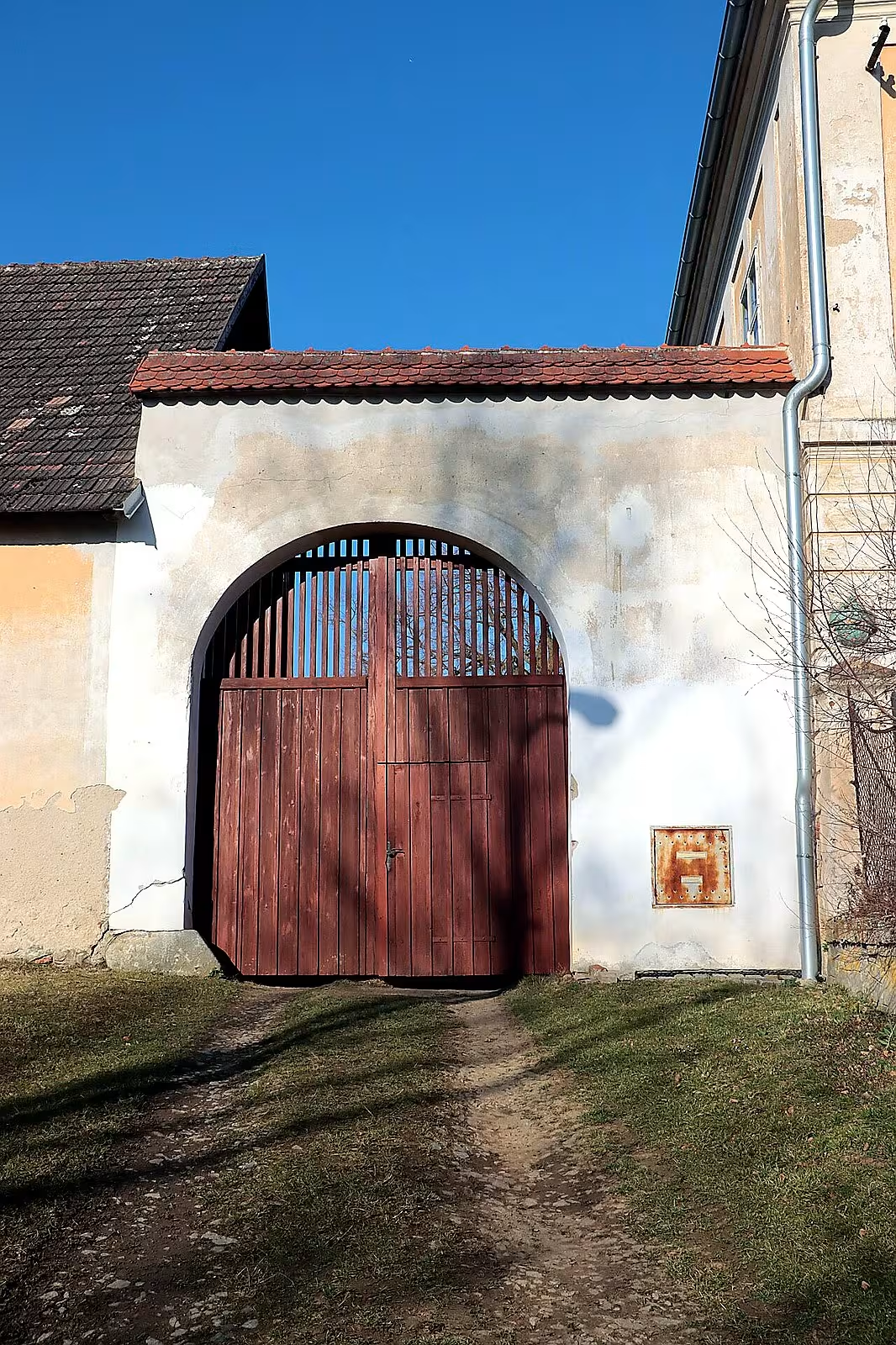
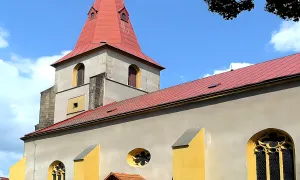
Brána fary ve Starči is a late Baroque entrance building with a arched passage located in Starč village in Třebíč district. As part of the protected parish area, it serves as an entrance to the fenced front garden and is located close to St. James's Church. This building is part of a cultural monument with registration number 21323 / 7-3056 and makes a significant contribution to the historical core of the village.
The gate is part of a late Baroque ensemble including the rectory and the church of St. James. The exact date of its creation is unknown, but its stylistic elements correspond to the period when demanding plastic facades and Mansard roofs were promoted in the Czech rural environment. It is a one-storey rectangular building with arched passage, which allows access to the parish grounds. The replacement and architectural solutions of the front garden distinguish it from the common rural gates.
It is especially valuable thanks to the individual facades and the Mansard roof. The material design is not described in detail, but it is typical for late Baroque buildings of the second half of the 18th century. The gate is part of a protected file and retains the historical form of the parish complex.
Today it is taken as part of a private property, probably a parish or a village of Starč. Public access is likely to be possible in particular during church tours or cultural events. The gate is an important element of the historical core of the village and offers the opportunity to know the architectural values of the late Baroque in Vysočina.
This gate is not only dominant but also witnessed the development of the village. It is an example of a carefully preserved rural ensemble, which shows how it was built in the past with regard to aesthetics and functionality. For lovers of history and architecture, Starč and his gate are an interesting destination.
Historical milestones
- around 1750
- The creation of the late Baroque parish gate in Starch as part of the complex of the parish and the church of St. James.
- 1784
- Josephine's reforms have abolished some parishes, but Starch has retained his parish structure and the church of St. James.
- 18th century (second half)
- Completion and modification of the parish area including the gate, typical of late Baroque architecture.
- 1958
- Registration of the parish grounds, including the gate, into the list of cultural monuments.
- 20th century (second half)
- The gate became part of a private property, probably a parish or the municipality of Starč.
Points of interest
- The gate is part of a late Baroque ensemble involving the rectory and the church of St. James.
- It is part of a protected parish area and has the register number of the cultural monument 21323 / 7-3056.
- It has a arched passage and a Mansard roof, typical of late Baroque buildings in the second half of the 18th century.
- It serves as an entrance to the fenced front garden in close proximity to St. James's church.
- It is part of private property, probably a parish or a village of Starch.
Guide
Show guide text
This text was created by artificial intelligence and has not been editorially reviewed. It may contain inaccuracies.
Welcome, dear visitors! You're standing in front of a beautiful historical monument that will charm you with its ancient appearance. In front of you is a late Baroque gate, which awaits you in a small town Stařeč in Vysočina. This gate is part of a protected area that connects the parish church of St. James.
Let's move on to the gate itself. It is an architecturally interesting building with a arched passage that allows you to enter this historic area. The border is a small garden that gives the place even more comfort and aesthetics. The Gate is part of a collection of monuments that is protected as a cultural heritage.
Look up at the top of the gate. Feel how remarkable decoration seems. Baroque stucco and decorated elements are very visible here and show us how architects tried to create not only functional but also beautiful work. The details here are evidence of the development of art at the time.
The creation of this gate is not exactly known, but it is likely that it was built during the late Baroque period, when many similar buildings developed in Czech countries. This style was characterized by rich decoration and symmetry. The gate was probably part of a parish area that served to protect and serve the church of St. James.
Now pay attention to what is behind the gate. There are other historical monuments near the church of St. James, which is part of the same protected area. You can imagine what stories could have been going on here - what prayers, what festivals, what events connected people in this area.
One interesting thing you might find is that, more precisely, the author of this gate or its first owners is not known much. That leaves room for legends and conjecture. You can imagine that there was ever a significant person standing here who had a place here, or that this gate was part of a significant event.
If you want to explore other parts of this protected area. It is also interesting to see the surrounding landscape, which offers a quiet environment and the possibility of relaxation. Get carried away by the atmosphere of the old cities and monuments that await your discovery.
Thank you for your attention and we wish you a pleasant exploration of this beautiful historical monument. Have a nice day and let yourself be inspired by stories that can be hidden here.
Tips for visitors
The best time to visit the gate of the rectory in Starč is in spring or autumn when the weather is pleasant and the surrounding nature is in full beauty. In summer it can be busy near the parish church, so choose time outside the main tourist clock to visit in warmer months. The gate is typical of the late Baroque architecture, so in a calmer time you can look at detailed decoration and arched passage without rush.
At these times there is also an ideal light for photography, which highlights architectural details and the color of the surroundings.
If you arrive by public transport, the stop should be nearby, but find the current connection in the traffic search engine. It is recommended to come to the place with enough time to take a walk and explore the surrounding countryside.
Take advantage of the possibility of walking along the surrounding roads, which will guide you through forests and field formations typical of the Highlands.
When visiting, wear comfortable shoes, as the surroundings of the rectory and the gate offer an opportunity for short walks. You can also bring a map or an application for navigation if you want to explore the surrounding landscape. If you are planning to photograph, take a macro lens to capture the details of the gate and its surroundings. Remember also the protective cream because the sun in the open spaces can be intense.
If you have children, bring something to entertain, such as books or small toys, so you can rest at the edges of the parish area.
The best places for photography are the front side of the gate with arched passage and its fenced front garden. It is recommended to photograph in the morning or afternoon light, when shadows are softer and colours are more vivid. If you want to capture a general view of the gate, just stand on the edge of the front garden. For detailed pictures of architecture it is worth focusing on arches and stone elements.
Avoid shooting in the shade because it can distort colors and reduce image quality.
The church of St. James, which is also a protected cultural monument, is especially worth visiting around the gate in Starč. This church is just minutes away from the gate and offers another opportunity to visit historical buildings. The surrounding landscape with forests and field formations is ideal for short walks and relaxation. If you have time, you can also see the surrounding villages and natural beauty Highlands, which are within 30 minutes of Starče.
The church of St.
For families with children, visiting the gate of the rectory in Starch is a great opportunity to explore history and nature. Children can see the architectural details of the gate and have fun around the parish area. You can also talk about the importance of historical buildings and how life changed in the past. For more comfort, prepare yourself some small activity, such as drawing or collecting stones, so that children have something to do during the visit. The surrounding forests and fields offer space for short adventure trips.
Take with you enough water and a light snack so that children have the energy to discover.
Frequently asked questions
Can the monument be visited?
This is a structure in a public space that can usually be seen from outside free of charge. We have not verified that this particular one is freely accessible.
Where is the monument?
Location: Horní 4, Stařeč, Kraj Vysočina. The map on this page shows the exact spot.
Why is the monument protected?
It is listed in the Central List of Cultural Monuments of the Czech Republic as a cultural monument (register no. 21323/7-3056). It is protected as part of a larger listed ensemble.
Businesses nearby
Do you run a restaurant, accommodation, shop, museum, rental, wellness or other visitor service near this monument? Show yourself directly to the people heading to it — this is how they will see you in the app and on the web:
Nearby
V okolí se nachází farní kostel sv. Jakuba, který je také chráněnou kulturní památkou. Okolní krajina je typická pro region Vysočiny s lesy a polními útvary.
Accommodation nearby
Trips and activities nearby
Guided tours, tickets and activities nearby from GetYourGuide
Affiliate link: if you buy from the partner, we may receive a commission. The price for you does not change.
Search tours and activities →Themed route
Thematic cruise route: Old man and his spiritual heritage
1. Brána fary ve Starči - The name of the historical gate of the parish complex, a symbol of the old religious tradition. Its stone structure retains the authentic character of the medieval church complex and is an important part of the cultural monument.
2. St. James's Parish Church - Name protected church with rich architecture and historical significance. In its surroundings there are chapel or other sacral buildings that underline the religious tradition of the village.
3. The surrounding area of the church - field formations and forest trails - the name of the surrounding area represents a quiet landscape with typical highlands and vast fields. The walk offers natural beauty and the possibility to observe the typical landscape of Vysočina.
4. Stadium of the parish area - Name of small, historically important place with stone walls and possibility to see the surroundings of the gate from a height. It is an ideal place for a short stop and knowledge nearby.
Recommended routes: - Classic way: Gate → Church → area with a walk on fields and forests (about 3 km). - Near surroundings: Tanks → gate → church (only area, about 1 km).
All points are connected naturally and offer a combination of history, religion and nature.
Seasonal recommendations
Spring - In spring days, the Gate of the rectory is covered in soft light, which penetrates through blooming leaves and creates golden reflections on stone columns. Nature wakes up, birds sing and the first flowers appear around the gate. We recommend arriving early in the morning when there are still few visitors and temperatures are pleasant; light jacket and comfortable shoes are sufficient, but prepare an umbrella for unpredictable showers.
Summer - In the summer months the sun shines on the stone facade so that the surface warms up and reflects bright light, which underlines the details of gothic niche. The surrounding meadows are in full bloom and insects fly around, which gives the place a lively atmosphere. The best time is early afternoon, when the crowds are not yet ready for the main entrance; wear a hat, sunglasses and light clothes, but don't forget enough water and sunscreen because the shade is limited.
Autumn - In autumn, the Gate of the rectory is covered in warm shades of orange and red, when the leaves of the trees under it change color and the falling leaves rustle under their feet. Colder air brings a quieter atmosphere and fewer tourists, which allows you to focus on historical details. Ideal is the afternoon after the rain when the air is fresh; Put on layered clothes, firm shoes and prepare a thermal drink because temperatures can drop quickly.
Winter - In winter, the Faroe Gate will be transformed under snow and ice gloss, creating an almost mystical impression; Sun rays reflect off white surfaces and highlight architectural features. Come late in the morning, when the sun will best disperse over the snowy region; warm clothes, hats, gloves and firm footwear with anti-slip soles are essential because the pavement can be slippery.
Visualizations and artistic views


The visualisations are generated by artificial intelligence and serve as inspiration.
Photos from the area
Real photos taken near the monument


Zdroj a licence jsou uvedeny u každého snímku.
Tips from visitors
No tips yet. Be the first!
Log in and add your tip.
Sources and literature
Photos: Jiří Sedláček / CC BY-SA 4.0 — Wikimedia Commons. The author and licence also appear when you hover over the image.
Location on the map


Příběhy a pověsti
Legendy, pověsti a příběhy spjaté s touto památkou
Fotografie návštěvníků
Zatím žádné fotografie. Buďte první, kdo přidá fotografii z návštěvy!
Log in a přidejte svou fotografii nebo hodnoťte.
Za ověřenou návštěvu v aplikaci získáte víc bodů — poznáme podle GPS, že jste na místě.
Reviews and comments