



Brána usedlosti čp. 12 Homestead
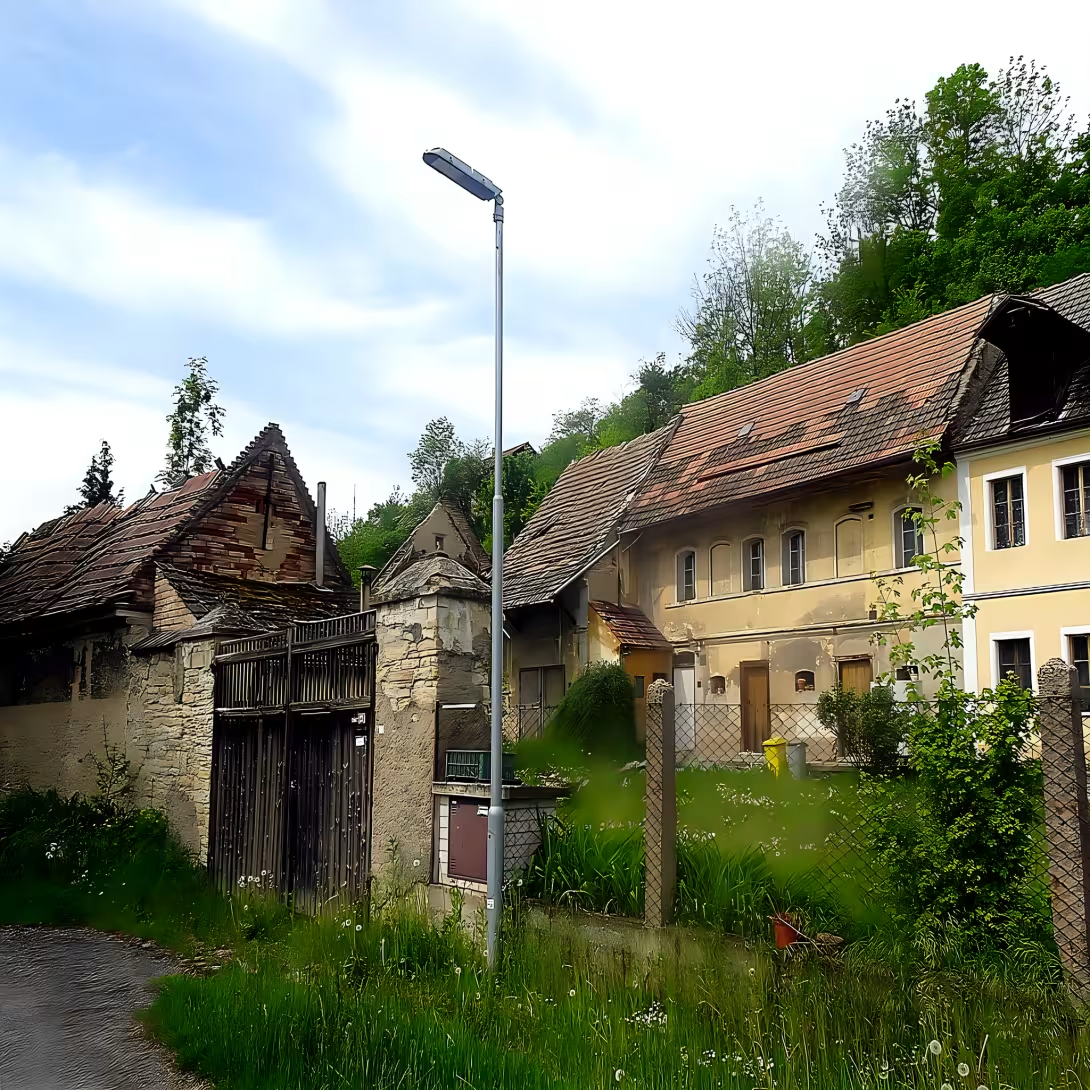
Brána usedlosti čp. 12 in Kyškovice is the only preserved remnant of the original building which completely disappeared after the flood in 2002. Located in the village Kyškovice, district Litoměřice, Ústecký kraj, and is protected as a cultural monument.
It is a wide rectangular gate with a pair of brick stone columns and concrete triangular roofs. It served as an entrance to the estate from the late 18th century. Today, it is particularly important as a witness to the destruction caused by the flood. It destroyed most of the original estate, and so the gate remained the only clear proof of its existence.
Architecturally, the gate is simple - stone posts and concrete roofs protect the door. The column material indicates that the estate was built from high-quality materials, which was common in the region for major economic objects. Concrete roofs probably replaced the original wood or shingles.
The flood destroyed the entire estate in 2002, and the gate became the only preserved remnant. It was preserved as a cultural monument because it documents its original form.
Today, the gate is open to the public. It is not as obvious as other monuments, but it is a rare proof of destruction and a reminder of flooding. For visitors who are interested in the history of rural settlements and their fate after catastrophic events, it can be an interesting place.
It is worth visiting this memory because it is a unique proof of how the natural forces affect the human settlement. Although the gate itself is not an architectural brilliance, it resembles the fragility of human structures before natural forces. For those who want to understand how rural life transformed after tragic events, it is a small but significant piece of history.
Historical milestones
- 2002
- The flood destroyed most of the estate No. 12, left only the gate.
Points of interest
- This is the only preserved piece of the original estate No. 12 which was destroyed by the floods in 2002.
- The gate served as an entrance to the estate from the late 18th century.
- It is protected as a cultural monument because it retains the form of the original estate.
- Stone columns and concrete roofs suggest that the estate was built from quality materials.
- The gate is open to the public and recalls the impact of natural disasters on human mansions.
Guide
Show guide text
This text was created by artificial intelligence and has not been editorially reviewed. It may contain inaccuracies.
Welcome to this mighty gate, which stands as the last witness in a place where the once vast estate No. 12 in Kyškovice laid its shadows. You stand before the only preserved part of the building that completely transformed the flood in the year two thousand and two. The water, which changed everything at the time, today offers us the opportunity to see what the gate itself looked like - as a separate, almost symbolic unit that broke out of the past and remained a monument to us.
Let's go back for a while. The manor No. 12, to which this gate belonged, was a common rural construction in Kyškovice, which many of them stood in these regions. But the flood of the year two thousand and two completely transformed it. The water that rolled from the mountains swept away everything that was built of wood, bricks and plaster. All that's left is this stone gate - a wide, rectangular, with a pair of massive brick columns that stand as guardians of the past. Above them today are concrete triangular roofs that replaced the original structures, but there remains the feeling that this object is telling something.
Look closely at her face. The gate is wide, almost like the entrance to another world, and its columns are made of stone, which after years holds its fortress. The concrete roofs above them, triangular shape, give the whole object a simple but dignified architecture. There is no rich decoration, no statues or paintings - just a clean line that talks about the hard-working hand that built it. Notice how the columns are narrowing upwards as if they want to carry as much sky as possible. And if you look closer, you'll see that the stone is sometimes worn out, as if time itself was leaving its mark.
Now pay attention to what this gate is hiding. She was part of the estate that stood in this place for centuries. Who lived in it? Who went through this entrance every day? Unfortunately, no written record will tell us the names of those who lived here. We don't know if it was the peasants who grew the grain here or the craftsmen who had their workshops here. But one thing is certain: this gate was the entry into their world, into their everyday life. And when we see it today in itself, as the last remnant of a ruined home, it reminds us how fragile everything people build is.
Now imagine what happened here in 2,000 two. The flood came quickly, like most disasters. The water rolled down from the mountains, flooded the fields, wiped out the bridges and houses. The farmhouse No. 12 stood in a place that happened right in the water path. The wood fell apart, the plaster rolled with mud, and from the entire building there was only this stone gate. It was as if nature itself wanted to preserve only what was the most permanent, the most resilient. And so here we stand, before this last witness, trying to understand what it all means.
The interesting thing is that this gate today serves as a reminder not only of the extinct estate, but also of the forces of nature. The flood that destroyed everything also saved what could otherwise be lost. If it hadn't been for that catastrophic day, we might not have had any sign of the manor number 12 today. But it was because the water took away everything else that left us this gate as a monument, which reminds us how quickly the fate of a place we thought could change, which we thought was unchangeable.
And now that you know what this gate represents, stay a while longer and get carried away by its atmosphere. You're standing in front of the last rest of the life that was here. It's like time stopped right here, in this place, and left us just this fragment of the past. If you look around, you might feel the water flowing back then, rolling and changing the landscape. But here, in front of this gate, you will find peace. You will find a memory that reminds us that even destruction can create something that will help us understand the past better.
Check her face again before you leave. Notice how the stone reflects light, how concrete roofs resist wind. This gate is more than just the rest of the wall - it is a symbol of resistance, a symbol that even of destruction can remain something that reminds us of how beautiful the estate was, the life behind it. And when you leave here, take the idea that every monument has a story. And now this story begins right here, in front of you.
Thank you for taking the time to stop at this gate. If you are interested in learning more about the history of Kyškovice or other monuments in the region, visit the local museum or contact the experts who take care of these heritage. And when you go through these landscapes, remember, even where nothing seems to be left, something always remains. Whether it's just a stone that tells a story that would otherwise be forgotten.
Tips for visitors
Best time to visit
It is ideal to visit the gate of the estate No. 12 in Kyškovice during spring or summer months when the weather is pleasant and the surrounding nature is green. There are also fewer people in the morning or late afternoon, so you can enjoy the tour more calmly.
It is recommended to use public transport as far as possible and to verify the current connection in the traffic search engine. The village lies in a relatively quiet location, so transport is not difficult.
What to take with you
When visiting, wear a comfortable shoe because the way to the gate can be on uneven terrain. It is also convenient to take a map or mobile device with navigation to make it easier to navigate around. If you are planning to take pictures, bring a lens that allows you to capture details of brick columns and concrete roofs. In the summer months, take plenty of water and sun protection.
Photography - best places and light
The best places for photography are, of course, in front of the gate itself, where you can see both stonewalled stone posts and concrete roofs. It is recommended to take a picture in the light, in the morning or late afternoon, when the light is not too hard. If you want to capture the gate in the context of the surrounding environment, go a little further and see if you can see the whole estate or surrounding landscape from any location.
What to visit in the area (within 30 minutes)
There is no other interesting place in the vicinity of Kyškovice, so you can concentrate on the tour of the gate itself and surrounding nature. If you have more time, you can visit nearby estates in the Ústí Region which offer other historical monuments or natural beauty. It is always good to find out in advance what the surroundings offer, whether they are museums, pavements or other historical buildings.
Tips for families with children
For families with children, the visit to the farmhouse gate No. 12 is suitable because children can see the old architecture and find out what the estate looked like in the past. You can talk to them about the history of the place and talk about the conditions at the time. If the children are active, you can play adventurers around the gate and look for details on walled columns or roofs. It is also appropriate to take with you some small reward, such as candy, for a successful tour.
Frequently asked questions
Can the monument be visited?
This is a residential or farm building, not a museum with opening hours. Please view it from public space and respect the owners' privacy. We have no information about access to the interior.
Where is the monument?
Location: č.p. 12, Kyškovice, Ústecký kraj. The map on this page shows the exact spot.
Why is the monument protected?
It is listed in the Central List of Cultural Monuments of the Czech Republic as a cultural monument (register no. 36236/5-4772).
Businesses nearby
Do you run a restaurant, accommodation, shop, museum, rental, wellness or other visitor service near this monument? Show yourself directly to the people heading to it — this is how they will see you in the app and on the web:
Events nearby


Zdroj akcí: otevřená data měst a obcí ČR (Národní katalog otevřených dat) a kalendář akcí Národního památkového ústavu.
Nearby
➜ Zobrazit interaktivní přehled okolí – restaurace, ubytování, půjčovny a další místa v okruhu 15 km.
Data: OpenStreetMap contributors, okruh 15 km.
🏰 Historické památky
- Vojtěch (3.6 km)
- Morový sloup (3.6 km)
- Památník Terezín (11.2 km)
- Magdeburská kasárna (11.6 km)
- Auto Muzeum (11.6 km)
- Kolumbárium (11.6 km)
- Židovská a křesťanská síň (11.7 km)
- Jevín (12.2 km)
🍽️ Restaurace a stravování
- Camp Zahrada (12.5 km)
- Na Krizovatce (13.1 km)
- U Červených vrat (13.5 km – 1)
- Vikárka (14.4 km)
- Radniční sklípek (14.5 km)
- Vinoteka (14.5 km)
- Robo (14.5 km)
- U Zlatého Bažanta (14.5 km)
🏨 Ubytování
- Sport Hotel "BK" Pod Lipou (3.0 km)
- Hotel Magnolia (3.6 km – Karlovo náměstí 20)
- SAM (4.7 km – Žižkova 706)
- Parkhotel Terezín (12.1 km)
- Hotel Aveco (12.5 km – Pod Kostelíčkem 121)
- Kemp Želízy (12.5 km)
- Penzion U Přemysla (12.6 km – Rumburská 72)
- Hotel Labe (14.2 km)
🚲 Půjčovny a sport
- Yachtklub Roudnice nad Labem (2.9 km)
- Roudnický bazén (3.0 km)
- Labe aréna Račice (3.3 km)
- bajk:a (3.4 km)
- Sportcentrum (5.1 km)
- Koupaliště Želízy (12.6 km)
- hřiště Martiněves (13.2 km)
- Yacht-klub Lovosice (13.9 km)
🥾 Turistika a příroda
- Rudný pramen (3.5 km)
- Studna (3.6 km)
- Roudnická vyhlídka (6.8 km)
- vyhlídka na České středohoří (západní část) (6.9 km)
- Mělnická vyhlídka (7.0 km)
- Říp (7.2 km)
- Restaurace - zahrádka (7.3 km)
- Pražská vyhlídka (7.4 km)
Accommodation nearby
Trips and activities nearby
Guided tours, tickets and activities nearby from GetYourGuide
Affiliate link: if you buy from the partner, we may receive a commission. The price for you does not change.
Search tours and activities →Themed route
1. Trailer tank Type: Residential area Why to visit: Here you can see the historical space around the building.
Brána usedlosti čp. 12 Type: Architectural element Why to visit: It is the main destination of your route.
3. Landscape garden Type: Outdoor space Why to visit: Offers a quiet place near the sights.
Seasonal recommendations
Spring During the spring, when nature awakens to life, the settlement gate No. 12 takes on the background of flowering trees and green meadows of special magic. The light of the sun, which extends, creates soft shadows on stone walls and highlights the details of the carving. The air is fresh, often slightly cooled by morning fog, which will disappear in later hours. It is recommended to visit early in the morning when the surrounding area is quiet and work activities have not yet started in the surrounding fields. Clothes should be layered - warm morning can turn into a pleasant afternoon. Watch out for rain showers that are common in this period, so wear a waterproof jacket.
Summer In the summer months, when the sun stands high and the day lasts the longest, the gate of homestead No. 12 appears to be a shady refuge from the heat. The surrounding landscape is dry, the crops are dry and the trees have a yellow shade. The best time to visit is early morning or late afternoon when the sun is not so hot and temperatures are more tolerable. Light but protective clothing - hat and sunglasses are recommended to minimise exposure to direct sunlight. In the main summer season the surroundings can be more visited, so prepare your patience for a short wait at the entrance. Drinking water is always a good supplement.
Autumn Autumn brings a rich variety of colours to the vicinity of the estate gate no. 12 - from golden leaves to dark red tones. The air is colder, often with a mild wind that moves deciduous leaves. The light is softer, the sun rises lower and the shadows extend, which gives the memory a more mysterious atmosphere. It is recommended to visit on dry days when nature is the most beautiful. Clothes should be warmer than in the summer, but still comfortable - shoes with good grip are suitable due to possible leaf travel. The evenings are cold, so wear a sweater or a jacket. In advent time the surroundings can be decorated but without specific events.
Winter Winter landscape around the gate of the estate No. 12 is quiet and covered with snow, which turns stone structures into a white statue. When the sun rises, it illuminates the memory from an angle that creates long shadows and gives the place a magical impression. The air is clear, but cold, often with a freezing wind. The best time to visit is in the afternoon when light is more pleasant and temperatures are less extreme. Clothes must be warm, laminated and protected from wind - gloves, hats and waterproof shoes are essential. A calm atmosphere and snow sheets make a visit an experience worth sacrificing the cold.
Visualizations and artistic views


The visualisations are generated by artificial intelligence and serve as inspiration.
Photos from the area
Real photos taken near the monument


Zdroj a licence jsou uvedeny u každého snímku.
Tips from visitors
No tips yet. Be the first!
Log in and add your tip.
Sources and literature
Photos: Global Fish / CC BY-SA 4.0, rozlišení zvýšeno umělou inteligencí — Wikimedia Commons. The author and licence also appear when you hover over the image.
Location on the map

Příběhy a pověsti
Legendy, pověsti a příběhy spjaté s touto památkou
Fotografie návštěvníků
Zatím žádné fotografie. Buďte první, kdo přidá fotografii z návštěvy!
Log in a přidejte svou fotografii nebo hodnoťte.
Za ověřenou návštěvu v aplikaci získáte víc bodů — poznáme podle GPS, že jste na místě.
Reviews and comments