






Budějovická Other
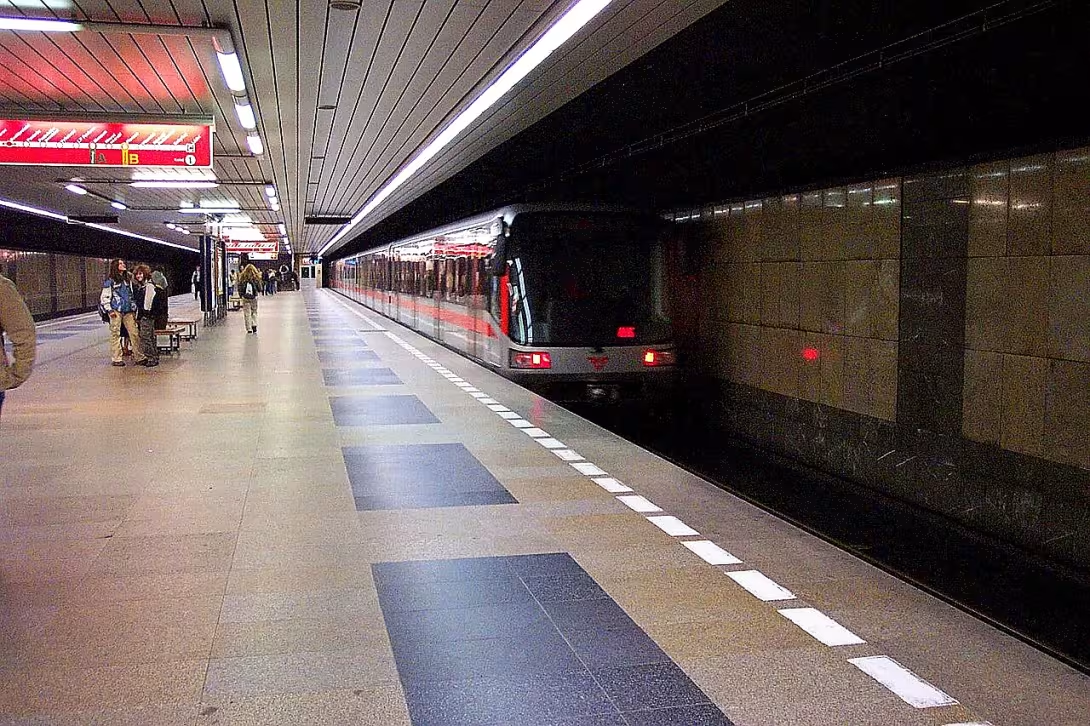
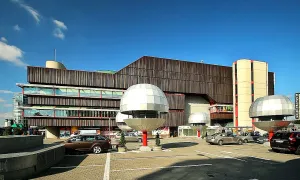
Budějovická is a major Prague metro station on the C route. It is located in Prague 4 below Budějovice Square and was festively opened on 9th May 1974 as one of the first stations of the new transport system in the metropolis. This object excels with its deep construction, implemented in an open pit, a spacious column-free platform and a unique tile made of large marble plates fixed by a dry method. The name is carried by České Budějovice, the name of Budějovice Square was also considered in the beginning.
The creation of this building falls within the first half of the 1970s, i.e. the period of normalisation in Czechoslovakia, when extensive modernization projects and infrastructure construction were taking place throughout the country. The event requested financial costs of CZK 140,2 million and companies from České Budějovice also participated in its implementation.
The construction site is a deep station built in an open, welded construction pit from May 1970 to June 1972. During work, 150,000 cubic meters of rock were extracted. The housing of the station was supported by a sliding tubular scaffold and a total of 18,000 cubic meters of concrete were stored. Most of the streets of Olbrachtova and Antala Stasek are made of prefabricated pieces. The stop itself is 286 metres long, 10.2 metres wide and 9 metres deep. The platform reaches a height of 3.15 metres and can be without support posts. For the first time on the I.C section, stone tiles from large marble plates were mounted by a new dry assembly method, which, together with other innovations, allowed a very fast construction pace.
The operation provides two outputs. The east has two escalators and leads to an open passage, while the outdoor escalators began to serve passengers in late 1980. The west exit is connected with the platform by a fixed staircase and mouth to Olbrachtov Street. Barrier-free access is provided by an elevator for immobile persons, which was launched on 30 June 2004.
The location history is linked to several documented events. On 19 January 2018, the southern entrance with escalators was closed due to the emergency state of the roof, which falls under the nearby House of Housing Culture. A few months later, on 26 March 2018, activists taped the inscription called the station to "Poznačená" in response to the statement by the then mayor Adriana Krnáčová on Prague citizens. In the close vicinity is in addition to DBK Budějovická also located the Budějovice Square and the Nusel cemetery.
This object still serves its original purpose as a frequent part of Prague public transport. When travelling by metro, it is worth stopping for a while, seeing the technical solution of the 1970s and looking at the historical details that formed the shape of the modern metropolis.
Historical milestones
- 1974
- Opening of the metro station on 9 May 1974.
- 2004
- Opening of the lift for immobile persons on 30 June 2004.
- 2018
- The closure of the south entrance in January 2018 and the replica of the sign of the activist in March 2018.
Architectural development
The station was founded in a bundled construction pit in the first half of the 1970s. Bedding was supported by sliding tubular scaffold and thousands of cubic meters of concrete were stored on the construction. Stone tiles were first mounted on the Prague subway by dry assembly. Thanks to these innovations, construction took place very quickly.
Historical events
On May 9, 1974, the opening of the metro station took place. On 30 June 2004 an elevator for immobile persons was opened. On March 26, 2018, activists re-glued the sign to Poznačná.
Points of interest
- The station was ceremonially opened on the ninth of May in nineteen hundred seventy-four as one of the first in the capital. - The platform is spacious and can be without support posts. - For the first time on this section, stone tiles from large marble plates were fixed by a new method of dry assembly. - In March, nineteen hundred and eighty-eight, activists overglued the inscription called the stop to Poznačná in response to the statement of the then mayor of local citizens.
Guide
Show guide text
This text was created by artificial intelligence and has not been editorially reviewed. It may contain inaccuracies.
Welcome to Budějovická Station. You are standing in a place that is absolutely key for the entire Krč district and for Prague transport. If you look around you now, you're probably seeing the dynamics of this place where hundreds of people's paths collide at any moment. There are four of you in the heart of Prague's district, and it is here that the different directions of movement of the people of the city are connected. Feel this atmosphere, feel this constant movement that is completely natural for this place.
Let us now return together in time and understand how this place came to be. In order to understand the importance of the station Budějovická, we need to look at the period when Prague was changing beyond recognition. It was the first half of the 1970s. At that time, there was a huge revolution in how people will travel the capital. Budějovická was not just an ordinary stop, it was one of the first pillars of the newly emerging underground transport system.
Imagine the moment when the gates of this station first opened. It was the ninth of May in nineteen hundred seventy-four. It was a festive day when this part of town officially joined the modern underground network. But the entire construction process was extremely difficult. The station didn't just happen. The whole building was in a huge open pit, which meant enormous challenges for the surroundings and for the workers themselves. This method required huge amounts of work and also substantial funds. It was not only a question of money, but also the huge involvement of many different regional companies, which put their knowhow and labour into this project. This whole process was proof of the effort at the time to develop infrastructure and modernise life in the metropolis.
Now pay attention to what you see right in front of you and what surrounds you. Even though the station has been in operation for decades, its architecture still tells the story of the technical maturity of its time. If you look at the platform space, notice the unusual tonnage. It's one of the most important properties of this place. Note that there are no large support columns that would obstruct your path or that would optically divide space into smaller parts. This absence of columns creates a sense of openness and freedom of movement, which is a very rare and highly valued property in underground areas.
Now look even closer at the surface of the walls and surfaces surrounding you. Notice the stone tiles. They're made of large marble plates. But what you see here is not just a simple stone laying. For the first time on this section, a completely new method was used, called dry assembly. Instead of the classic use of wet mixtures and mortar, these large plates were fastened in a way that enabled more accurate and cleaner work. This technical detail was a major innovative step at the time and you can still perceive the quality and stability of the material.
However, Budějovická is not just a static monument to the past. It is a living organism that must adapt to the needs of the people who use it. Although the station was built many years ago, it is still undergoing changes to make it more accessible and modern. Note, for example, how accessibility for all citizens has changed. In the year two thousand and four, namely late June, there was an important milestone. Lifts have been put in place to enable smooth movement for people with reduced mobility. It was a fundamental change that made the station a place open to everyone, regardless of their physical condition.
But the history of this place has been constantly written in recent years. It's not only about the great works of construction, but also about the small events that reflect the spirit of the time. In the year two thousand and eighteen events took place here with the closure of the southern entrance and also with the story of the activist who left his inscription. These events, even if they are smaller, show that the station is part of a living city where there are different views and where space is constantly changing.
If you continue your journey now, try to look at this place again, but this time with the knowledge of everything you've just heard. Feel the space without columns, look in those marble plates for a trace of the old, innovative method of assembly and realize that you are standing in a place that was one of the first steps towards modern movement of people in Prague.
Thank you for stopping by and paying attention to the history of this place. Budějovická is more than just a stop underground. He's a witness to the development of our city. We wish you a pleasant and peaceful journey in your other directions and hope that other parts of our metropolis will surprise you with their history and attractions. Have a good day.
Tips for visitors
The best time to visit the metro station Budějovická is early in the morning or late in the evening when there is a smaller stream of passengers and you can better see the overall architectural character of this historical space from 1974. For transport use the C line of Prague Metro, or you can get here by car, and we recommend that you check the actual parking possibilities in the vicinity of Budějovice Square. Take a camera or smart phone with you, comfortable shoes on a long walk on the vestibule and ID if you need it for personal use. For photography, choose the space of the underground vestibule and platform where you will best capture the industrial atmosphere and original tiles, with the best light for the images offering daily hours, when sunlight penetrates the glass entrances to the surface. In the vicinity within 30 minutes walk you can visit Budějovice Square, House of Housing Culture DBK Budějovická for shopping or quiet environment offered by nearby Nusel cemetery. For families with children, the visit is suitable as a short lesson in the modern history of transport in the capital, but take care of increased caution on moving stairs and in a crowd of hurrying passengers.
Businesses nearby
Do you run a restaurant, accommodation, shop, museum, rental, wellness or other visitor service near this monument? Show yourself directly to the people heading to it — this is how they will see you in the app and on the web:
Events nearby

Zdroj akcí: otevřená data měst a obcí ČR (Národní katalog otevřených dat) a kalendář akcí Národního památkového ústavu.
Nearby
Budějovické náměstí, Dům bytové kultury DBK Budějovická, Nuselský hřbitov
Accommodation nearby
Trips and activities nearby
Guided tours, tickets and activities nearby from GetYourGuide
Affiliate link: if you buy from the partner, we may receive a commission. The price for you does not change.
Search tours and activities →Themed route
1. Budějovice Square Type: Public spaces Why is it worth a visit: This area forms the natural center of the entire area and serves as a great starting point for our walk. You can admire the city and plan your next move.
2. Budějovická (others) Type: Main objective Why is it worth a visit: This main destination of our journey carries a unique atmosphere and history associated with the development of the territory. It offers an interesting view of local architecture and urban planning.
3. House of Housing Culture DBK Budějovická Type: Commercial and Cultural House Why is it worth a visit: This distinctive building represents an important example of the brutal architecture and business centre of the last century. Inside and out, he takes on his specific appearance.
4. Nusel Cemetery Type: Pieces place Why is worth a visit: The cemetery provides a quiet environment for silence and contemplation in the middle of the city arrest. It hides the graves of many prominent personalities and an ancient atmosphere.
Seasonal recommendations
Spring in Krči awakens the historic Budejovice Gate and its surroundings from winter sleep. Nature comes to life with green grass and blossoming trees that create fine shadows on an ancient wall. The sun's rays penetrate early in the morning through fresh leaves and provide a quiet, fresh atmosphere suitable for peaceful contemplation. During this period you will not meet many tourists, which guarantees an undisturbed experience. Put on a comfortable spring jacket and tight shoes because after rainy days the roads may be wet. The best time to visit is in the morning, when the surrounding still life is quietest.
Summer brings sunny days full of warm light to this Prague district, which radiates the stone details of the monument in all their beauty. The surrounding parks and greenery are fully developed and provide a pleasant shade under the crowns of grown trees. The atmosphere is alive, the air smells warm ground and lilac. During the main holiday months, more people are coming here, which is why it is best to come early in the morning or in the late afternoon to avoid the heat and the biggest crowds. Choose light breathable clothes, sunglasses and don't forget the drinking bottle.
Autumn transforms the whole area into a palette of yellow, orange and brown shades that contradict the dark stone beautifully. The lighting is usually mild, the sun stands below the horizon and creates long shadows and melancholy mood. The leaves rustle beneath the feet and the air is already noticeably colder. There are fewer visitors in this period, which will be appreciated by all lovers of quiet photography. The tour is best enjoyed around noon, when warm rays at least partially warm the cool atmosphere. Don't forget to wear a warmer sweater, long pants and waterproof shoes in case of showers.
Winter gives this place a mysterious character, especially when it attacks snow and covers historic mansions with a white blanket. Early dimming and dim light of street lamps create a romantic and almost fabulous atmosphere. In winter, few come here, so you can enjoy absolute silence. It is necessary to dress really warm, choose a winter coat, hat, gloves and high-quality shoes with anti-slip soles because on the frozen surface there is a risk of slipping. The best time to visit is early afternoon, before it gets completely dark and temperatures fall sharply below freezing.
Visualizations and artistic views


The visualisations are generated by artificial intelligence and serve as inspiration.
Photos from the area
Real photos taken near the monument

Zdroj a licence jsou uvedeny u každého snímku.
Tips from visitors
No tips yet. Be the first!
Log in and add your tip.
Sources and literature
Photos: User:Aktron / CC BY-SA 3.0 — Wikimedia Commons. The author and licence also appear when you hover over the image.
Faktickým podkladem tohoto textu byl článek na Wikipedii, jehož autory jsou přispěvatelé Wikipedie. Článek je dostupný pod licencí CC BY-SA 4.0.
Location on the map

Příběhy a pověsti
Legendy, pověsti a příběhy spjaté s touto památkou
Fotografie návštěvníků
Zatím žádné fotografie. Buďte první, kdo přidá fotografii z návštěvy!
Log in a přidejte svou fotografii nebo hodnoťte.
Za ověřenou návštěvu v aplikaci získáte víc bodů — poznáme podle GPS, že jste na místě.
Reviews and comments