






budova bubenečské farnosti Parish house
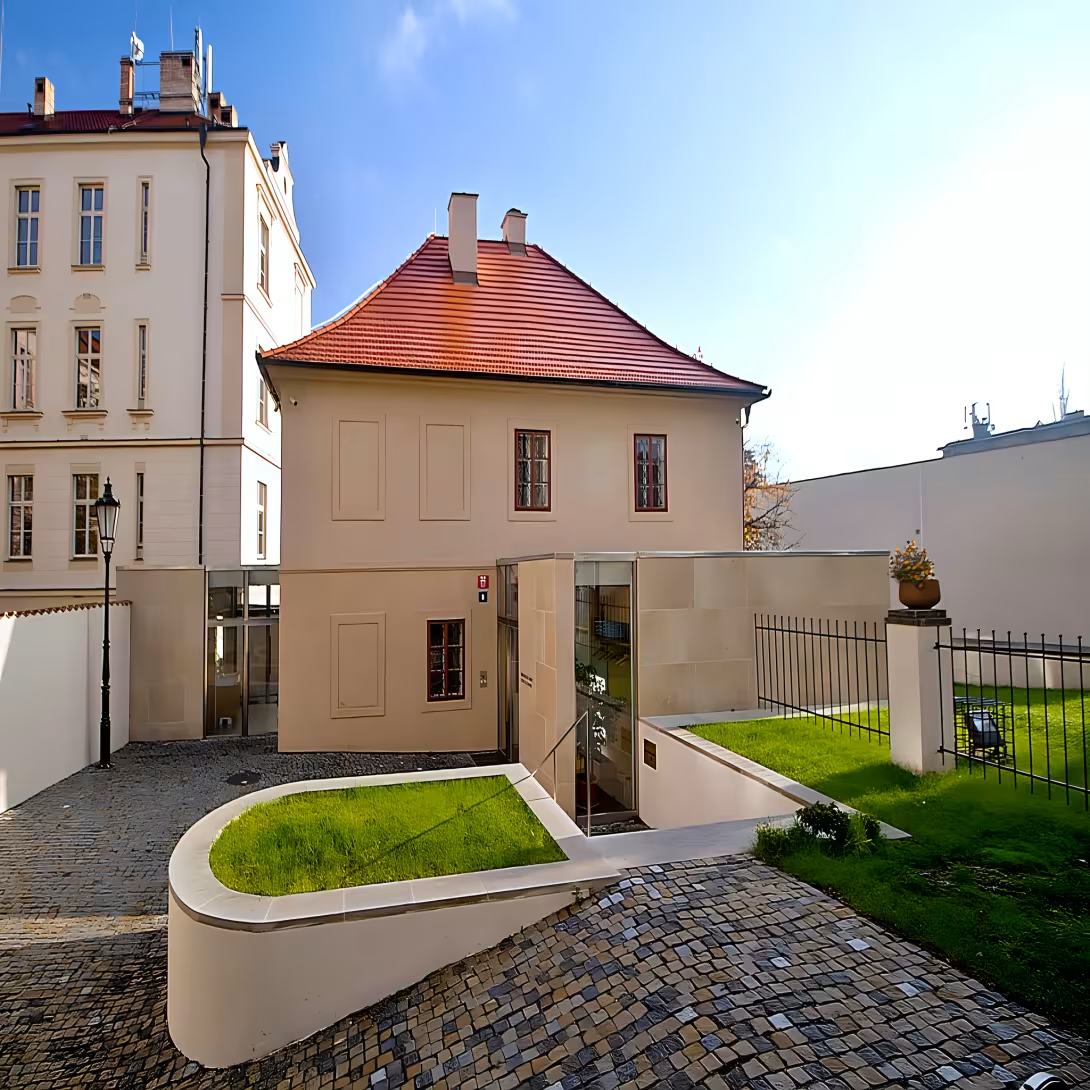
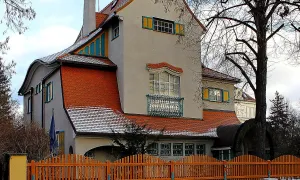
The building of the Bubenechs parish in Prague 6 in Krupkov Square is located east of St. Gothard's Church. It's a historical monument with rich history. The two-storey building on a rectangular plan with a valb roof is protected as a real cultural monument of the Czech Republic. Its importance lies in the history that dates back to the 18th century, when it was built after the church was separated.
The history of the building begins after 1787, when the Bubenek parish became a separate unit. The rectory was built as an administrative and religious centre for the local population. This move was part of the broader reforms of the then church administration. In 1823 there was another modification when the building was partially modernized. These changes reflected the need for adaptation to social development and religious practice.
The architecture of the building is simple, which is typical of many sacral buildings at the time. The facade only separates the windows in the belt shambles, which contributes to its simplicity and elegance. The Valb roof gives the building a traditional character and protects it from weather.
The building of the Bubenech parish has seen no dramatic changes in its property status. It is a consequence of its firm role as a religious centre. It was managed by the local church administration and remained an important part of the community.
Not only the historical importance of the building but also its strategic location is interesting. The location near St. Gothard's Church in Krupkov Square highlights its central role in local religious life.
Today, the building is open to the public. It is worth visiting for its historical value as part of the cultural heritage Bubeneče. Maintaining it allows visitors to feel connected to the past and to understand the importance the construction had for the local community.
The monument resembles an important period in the development of the Bubenek parish. Her visit offers a unique view of the history of the local church administration and an opportunity to explore architectural and cultural aspects of the past of Prague 6.
Historical milestones
- 18th Century
- Position of the building after the separation of the parish
- po 1787
- Separation of the Bubenek parish as a separate unit
- 1823
- Partial modernisation of the building
Architectural development
The rectory was built after the separation of the parish after 1787. In 1823 the building was partially modified in a modern way.
Historical events
After 1787 a separate Bubenechs parish was established, for which the parish was built. The building was modified in 1823.
Points of interest
- The building of the Bubenech parish is a historical monument with rich history dating back to the 18th century.
- The rectory was built after 1787, when the Bubenek parish became a separate unit.
- In 1823 the building was partially modernised as part of adaptation to social development and religious practice.
- The building is protected as a real-estate cultural monument of the Czech Republic due to its historical importance and architecture.
- Its strategic location near St. Gothard's church highlights its central role in local religious life.
Guide
Show guide text
This text was created by artificial intelligence and has not been editorially reviewed. It may contain inaccuracies.
Welcome to Bubeneči. You are standing in front of the building of the Bubenech parish, which, by its presence, defines the character of this place in a quiet but very dignified manner. If you look to the west now, you will see the church of St. Gothard, located in Krupko Square. This building, to which you are now drawing your attention, forms an integral whole with the church and creates an atmosphere of the historical centre that has evolved over the centuries into a quiet and balanced neighborhood. Feel the strange combination of calmness and historical weight floating here. This building is not just brick and mortar, it is a living thing of events that shaped this area.
Now let's go back to the past together to understand why this object is standing right here and why it's so important to us. To understand its origin, we need to look at the eighteenth century. This was the period when Bubeneč began to change and shape his own identity. The key moment for this building was 1787. That's when the Bubenek parish became a separate unit. Before, this area was dependent on other administrators, but now gained its own spiritual and administrative autonomy. This independence has brought about a new need - the need for its own background. The parish needed a place to serve as a centre for its administration, as a meeting place and as a home for those who took care of the spiritual life of the local people. The parish building was thus built as an expression of this new, separate existence. It is stone proof of how the local community began to organize and how the small settlement became a solid, separate unit.
Now pay attention to the very appearance of the building in front of you. Come a little closer and look at her face. The building has a two-storey structure and its floor plan is purely rectangular, which gives the whole building a sense of stability, balance and unwavering. Above your head is a wall roof, which is very typical of the construction of the time and gives the house a traditional, home character. If you look at the facade now, you will notice its distinctive simplicity. This building does not attempt to garnish or over-the-top luxury. Its beauty lies in something much deeper - its purity and in the rhythm it creates. Notice how the facade is broken down using windows. These windows are framed by so-called strip shamrans. These frames around the windows are not only a functional element, but create an interesting visual order on the walls. This rotation of wall surface and window geometry gives the building its current, balanced character. It is an architecture that seems credible and firm, as if it were part of the very country on which it stands.
Although the names of the particular architects who designed this project in the eighteenth century are not lost in our historical records, their vision and ability to create such a balanced object are clearly evident. Even though we don't know the names of the individual builders or the names of all the people who lived and worked here, we can imagine the constant movements in these areas. Imagine those who came here to solve their life problems, or those who worked here to flourish the parish. Although the names of particular personalities have been lost in the abyss of time, the importance of this building as the center of human life remains undeniable. Ironically, this anonymity of architects and residents gives a place for universality - this building belongs not only to one person, but to the entire community that built and maintained it.
But there is one other interesting thing that you might be interested in and that you might think about. The history of this building is not static, it has constantly evolved with people and society. In 1823 it was partially modernised. Why did this happen? It wasn't just a random hit or a simple fix. This modernization was part of a wider process of adaptation to then social development and new religious needs. The company was changing in the first half of the nineteenth century, people had different demands and the building had to be able to react to these changes in order to remain a functional center of the parish. It is a fascinating idea that this object is not only a non-solid stone, but an organism that had to breathe in the rhythm of the time and adapt to its changes. This ability to adapt is one of the reasons why the building has lasted centuries and is still standing here before you. Today, this building is protected as a real-estate cultural monument of the Czech Republic, which reminds us that its value is not only in material but in its ability to persist and remain part of our heritage.
I hope that this brief insight into the past has at least given you a little bit of interest and helped you better understand the place you're in right now. The building of the Bubenech parish is just one of many stories that we can find in Prague - a story about independence, about the community and about the ability to adapt to new times. I suggest you continue your walk around Bubeneče and pay attention to other details of this neighborhood. Every aisle and every historical object here has their own voice and their own story waiting to be revealed. Thank you for your time and I wish you a wonderful continuation in discovering history. Goodbye.
Tips for visitors
The best time to visit the building of the Bubenech parish is in the early afternoon when there are fewer people and sunlight brings beautiful shadows to architectural elements. This time also offers ideal conditions for photography.
Parking around the building can be limited, therefore we recommend the use of public transport. Local buses and trams will bring you near the location. The current connection can be verified in the traffic information search.
When visiting take a hat or protective clothing with you, especially during the summer season due to sunlight. Photographs can be taken from different angles around the building, but the best effects can be achieved when capturing the roof and surrounding church of St. Gothard.
In the vicinity there is a St. Gothard Church on Krupkov Square, which is suitable for a short walk or tour. For families with children it can be interesting to explore nearby parks and green areas where children can play.
Businesses nearby
Do you run a restaurant, accommodation, shop, museum, rental, wellness or other visitor service near this monument? Show yourself directly to the people heading to it — this is how they will see you in the app and on the web:
Events nearby

Zdroj akcí: otevřená data měst a obcí ČR (Národní katalog otevřených dat) a kalendář akcí Národního památkového ústavu.
Nearby
St. Gothard's Church in Krupkov Square.
Accommodation nearby
Trips and activities nearby
Guided tours, tickets and activities nearby from GetYourGuide
Affiliate link: if you buy from the partner, we may receive a commission. The price for you does not change.
Search tours and activities →Themed route
1. Building of the Bubenechs parish (building) - This historic building represents the main objective of your visit. 2. Church of St. Gothard (Church) - Visit this sacral monument that dominates the local landscape. 3. Krupkov Square (Square) - Walk around the church and observe the surroundings.
Seasonal recommendations
Spring: In spring, the area of the parish awakens into life, accompanied by fresh green and fine sunlight, which highlights the details of the historical building. The atmosphere is optimistic thanks to flourishing trees in the nearby area. We recommend wearing layered clothes because the morning cold air can still be felt. The best time for a tour is in the morning, when the light is purest and the traffic is only just beginning to increase.
Summer: Summer season brings to Bubeneče intense sun and rich vegetation, which cast shadows directly on the facades of buildings. In the main summer season the surroundings are more lively and the air is hot. For a more pleasant experience, it is advisable to come right after opening to avoid the biggest crowds and the most intense noon heat. Dress lightly and don't forget to protect yourself from the sun and plenty of fluids.
Autumn: Autumn moons offer melancholy beauty thanks to the golden and brown shades of leaves surrounding the parish. Morning fog gives the place mystery and fine autumn light is ideal for photography. It is advisable to wear a practical jacket and firmer shoes on reindeer because moisture can cause slippery surfaces. The best is to visit the memory in the afternoon, when the sun best highlights the colors of nature.
Winter: In winter, the building is quiet and almost lonely, especially if the surrounding area is covered with snow or frost. Light is weaker and gray in this period, which creates a very quiet and serious atmosphere. Due to lower temperatures it is necessary to choose very warm clothes, including caps and gloves. We recommend planning a visit around noon hours when daylight is longest, and always check in advance for changes in operation.
Visualizations and artistic views

The visualisations are generated by artificial intelligence and serve as inspiration.
Photos from the area
Real photos taken near the monument


Zdroj a licence jsou uvedeny u každého snímku.
Tips from visitors
No tips yet. Be the first!
Log in and add your tip.
Sources and literature
Fotografie: VitVit / CC BY-SA 4.0, rozlišení zvýšeno umělou inteligencí — Wikimedia Commons. The author and licence also appear when you hover over the image.
Faktickým podkladem tohoto textu byl článek na Wikipedii, jehož autory jsou přispěvatelé Wikipedie. Článek je dostupný pod licencí CC BY-SA 4.0.
Location on the map


Příběhy a pověsti
Legendy, pověsti a příběhy spjaté s touto památkou
Fotografie návštěvníků
Zatím žádné fotografie. Buďte první, kdo přidá fotografii z návštěvy!
Přihlaste se a přidejte svou fotografii nebo hodnoťte.
Za ověřenou návštěvu v aplikaci získáte víc bodů — poznáme podle GPS, že jste na místě.
Reviews and comments