



bývalá synagoga v Kojetíně Synagogue
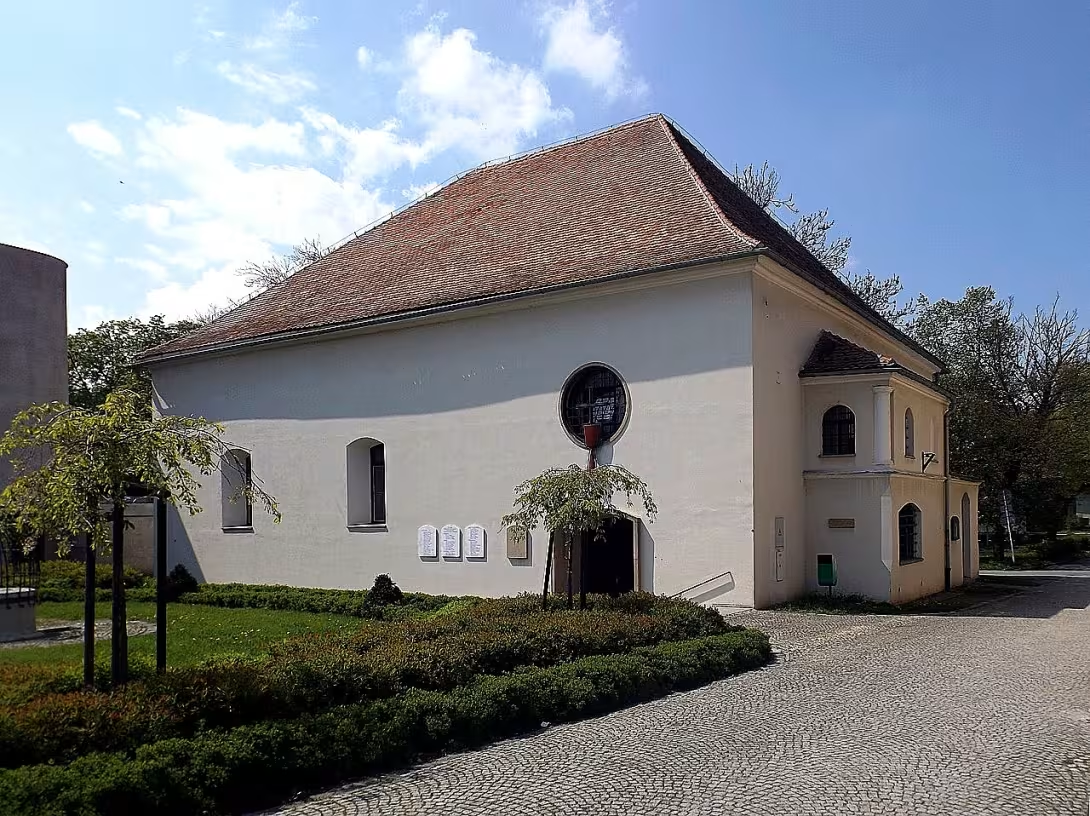
The former synagogue in Kojetín, located in the district of Přerov Olomouc Region, is one of the oldest in Moravia. Its beginnings date back to the mid-15th century and are protected as a cultural monument of the Czech Republic. This building with Baroque elements represents an important architectural and historical element of the region.
According to oral tradition, the prayer room was founded in 1454 when the first Jews began to settle in Kojetín. This makes the synagogue the oldest in Moravia and after the Prague Old Ones synagogue the second oldest construction of this type in the Czech Republic. The first written mention of the building dates back to 1614, when a thorough repair of the whole building, which was then built from stone and bricks.
The construction stands on a free rectangular plan with a valb roof covered with burnt bags. The coated walls are supplemented by window rectangles with segmented enchantments. There is a one-storey annex near the north wall with a cordon ledge and corner half columns. In the north corner of the building there is a valené arched vault, which today serves as a columbarium and belong together with the original ritual sink, kior, among the oldest and most valuable parts of the monument.
During the 30-year war, the synagogue suffered several fires, the most devastating of which in 1670 destroyed the roof and roof. Due to a lack of resources, the building remained without a roof for 50 years. The reconstruction took place in 1718-1726 thanks to the financial assistance of Hungarian Rabbi Samson Wertheim and the permission of the government. During this period, baroque elements were brought into the building, the vaults were modified, stucco decoration and external staircases were added.
In 1928 and 1936 there were further repairs of the roof and interior. During World War II, the building served as a warehouse and was damaged in liberation fighting. In 1953, the synagogue was adapted for the church of Czechoslovak Hussite according to the designs of architect Hubert Aust. The modifications included a wall of transparency in the prayer hall and a 180 degree rotation of the altar.
The synagogue is located in Husova Street, which was formerly Jewish Street. The first written mention of the settlement of Jews in Kojetín dates from the town hall of 1566- 1567. The street originally consisted of 59 houses, the number of which fell to 16 after the fires of the 30-year war and settled to 45 by 1834. In the building there were important rabbis, such as a follower of orthodox Judaism Eleazar David Flekales, author of Talmud studies Jakob Brüll, who worked here in 1843-1889, or David Kaufmann, author of works in the field of history, religion and philosophy.
Today the synagogue is dormant and since 25 June 1998 it has been officially protected as a cultural monument. To worship the memory of deported Kojetín Jews, commemorative plates with the names of the victims were placed here. This building is a unique testament to Jewish history in Moravia and its visit allows you to understand the transformation of the region's religious and social structure.
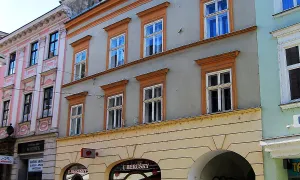
Then and now
Drag the slider to compare how the landmark may have looked when it was built with the view today.
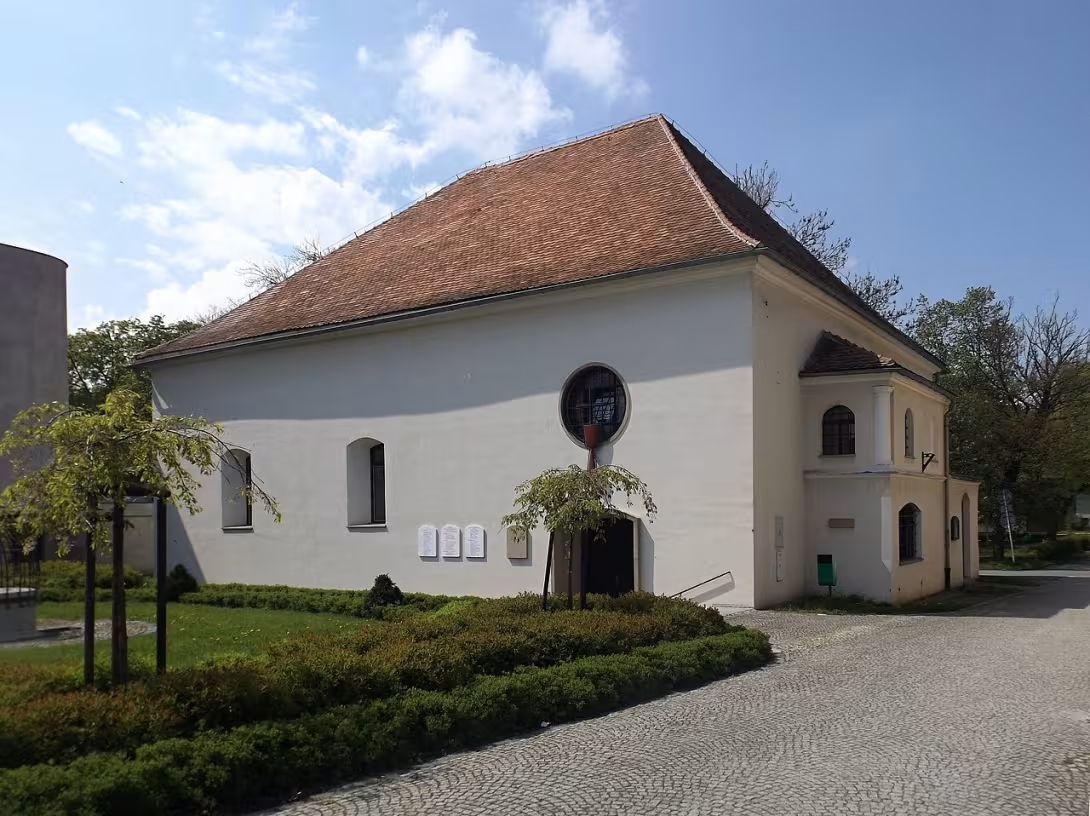

The historical appearance on the left is an AI-generated visualisation and serves as inspiration only.
Historical milestones
- 1454
- The establishment of the first prayer room.
- 1614
- A thorough repair of the synagogue.
- 1718
- Baroque reconstruction with addition of new elements.
Architectural development
The synagogue in Kojetín was originally established as a prayer space in the middle of the 15th century and has undergone several stages of reconstruction over time, especially after fires during the 30-year war. In 1718- 1726 the Baroque reconstruction took place with the addition of stucco decoration and external staircase.
Historical events
- 1614
- A thorough repair of the synagogue.
- 1670
- The most devastating fire destroyed the roof and roof.
- 1718
- Reconstruction with addition of baroque elements.
Points of interest
- The former synagogue in Kojetín is one of the oldest in Moravia and after the Prague Old Ones synagogue the second oldest construction of this type in the Czech Republic. - According to oral tradition, the prayer room was established in 1454, when the first Jews began to settle in Kojetín. - The first written mention of the building dates back to 1614, when a thorough repair of the whole building took place. - During the 30-year war, the synagogue suffered several fires, the most devastating in 1670 destroyed the roof and roof. - The reconstruction was carried out in 1718-1726 thanks to the financial assistance of Hungarian Rabbi Samson Wertheim, during which Baroque elements were introduced into the building.
Guide
This guide is narrated by a synthetic voice generated by artificial intelligence.
Show guide text
This text was created by artificial intelligence and has not been editorially reviewed. It may contain inaccuracies.
The Kojetín Synagogue belongs, according to oral tradition, to the oldest structures of its kind in the Czech lands. A prayer hall is said to have stood here already in the middle of the fifteenth century, when the first Jews settled in Kojetín. It would thus be the oldest synagogue in Moravia and the second oldest in the country after the Old New Synagogue in Prague. From that period comes a ritual washing basin, in Hebrew called a kior, and a barrel-vaulted room in the northern corner of the building. Both belong to the most precious parts of the structure.
The synagogue is first mentioned in writing in the year 1614. At that time it underwent thorough repairs and was built of stone and brick, similarly to synagogues in Strážnice or in Hustopeče.
During the Thirty Years' War, Kojetín often burned and fires affected the synagogue as well. The worst one in the year 1670 destroyed the roof and the timber framing. The impoverished Jewish community did not have the money for reconstruction, and so the building remained without a roof for another fifty years. Help was eventually promised by the Hungarian rabbi Samson Wertheim. Repairs took place from 1718 to 1726 and brought a baroque renovation of the vaults, stucco decoration, and an external staircase.
Further repairs took place in 1928 and 1936. During the Second World War, the building served as a storage facility and was damaged during liberation battles. In 1953, according to the designs of architect Hubert Aust, the congregation of the Czechoslovak Hussite Church renovated it. The altar was turned one hundred eighty degrees and the openings into the prayer hall were bricked up. The barrel-vaulted room in the northern corner now serves as a columbarium. On the fiftieth anniversary of the deportation of Kojetín Jews, the Olomouc Jewish community placed memorial plaques there with the names of those taken away. The synagogue has been a cultural monument since June twenty-fifth, 1998.
The building has a rectangular floor plan and a hipped roof of fired tiles. A single-story extension with a cornice rim and corner pilasters adjoins the northern wall.
The synagogue stands in the former Jewish street, today Husova. It is first mentioned in the urbary of the Kojetín estate from 1566 to 1567, which is also the first written report about Jews in Kojetín. Houses were built here in an arc along the western fortifications. Before the Thirty Years' War, there were fifty-nine of them, after it only sixteen. In 1834, their number stabilized at forty-five and most of them have been preserved to this day.
Important rabbis worked in the synagogue. The orthodox scholar and author of homiletic texts Eleazar David Flekeles served here for four years. Jakob Brüll, author of studies on the Talmud and father of the scholar Adolf Brüll, worked here from 1843 until 1889. David Kaufmann also worked here, author of numerous German and Hebrew works on history, religion, philosophy, and art.
Tips for visitors
The best time to visit the former synagogue in Kojetín is autumn or spring season, when the weather is pleasant and sunny light especially brilliantly refresh the interior. This time of year also offers fewer visitors and allows you to enjoy the peace and comfort of walking.
When visiting take with you suitable clothes according to weather as well as shoes for comfortable walking. It is also recommended to carry a map or use GPS on a mobile device in order to easily find the way to the synagogue.
Photography in the former synagogue offers unique places, especially the interior with its rich historical architecture. The best light for photography is usually in the afternoon when the sun illuminates the space in a special way.
In the vicinity of the synagogue there are several historical buildings and monuments that can be visited. For those who like cultural tours, it is advisable to explore the center of Kojetín with its old houses and streets. Families with children can use the opportunity to walk around the park or visit the local museum.
Frequently asked questions
Can the monument be visited?
Religious buildings are usually open mainly during services; at other times a visit is normally arranged with the parish or the operator. We have not verified specific times.
Where is the monument?
Location: Husova, Kojetín I-Město, Kojetín, Olomoucký kraj. The map on this page shows the exact spot.
Why is the monument protected?
It is listed in the Central List of Cultural Monuments of the Czech Republic as a cultural monument (register no. 50125/9-46).
For kids
About 572 years ago, a miracle was chosen in the small Czech town of Kojetín. In 1454, the first mosque was built for Jews who settled there. And now? Today I present to you this fascinating historical monument - the former synagogue on Jewish Street.
Businesses nearby
Do you run a restaurant, accommodation, shop, museum, rental, wellness or other visitor service near this monument? Show yourself directly to the people heading to it — this is how they will see you in the app and on the web:
Events nearby
Zdroj akcí: otevřená data měst a obcí ČR (Národní katalog otevřených dat) a kalendář akcí Národního památkového ústavu.
Nearby
ITEX Show interactive overview of the surroundings - restaurants, accommodation, rentals and other places within a 15 km radius.
Data: OpenStreetMap contributors, 15 km radius.
‡ Historical monuments
- Memorial to victims of St. (6.6 km)
- sv Jan Nepomucký (8.1 km)
- sv. Václav (8.4 km)
- sv Jan Nepomucký (8.5 km)
- Memory plate Louis Svobodyx (8.6 km)
- sv. Václav (8.6 km)
- Archbishop's castle Kromeriz (9.0 km)
- Archbishop's castle Kromeriz (9.0 km)
Restaurant and catering
- On the fare (8.5 km)
- Restaurant For hospitals (8.8 km - Havlickova 593 / 63)
- U Golden stopcock (9.0 km - Large square 21 / 3)
- Pizerie (9.1 km)
- Avion (9.1 km)
- New Bohemia- (9.1 km)
- Pod old library (9.2 km - Kollarova 528 / 1)
- Restaurant UNO (9.2 km - Vejvanovský 468 / 10)
Accommodation
- Brewery (0.2 km)
- Guesthouse Klarka (8.2 km)
- On the fare (8.5 km)
- Guesthouse Menšík (9.1 km)
- Hostel Leknín (9.3 km - Bílanská 2461 / 16)
- Excellent - hotel and restaurant (9.3 km)
- Hotel Octárna (9.5 km)
- Hotel Oskol (9.6 km)
› Rental and sports
- Lodenice (1.2 km)
- Cyclosport Chryny (4.8 km)
- swimming pool Bajda (8.6 km)
- Tennis Club Bajda (8.7 km)
- Tennis Club Bajda (8.7 km)
- Štrof department store (9.1 km)
- Adidas (9.3 km)
- Hidden swimming pool (10.2 km)
© Tourism and nature
- Shameless bridge (3.7 km)
- U shipyard (4.9 km)
- Minov bridge (6.0 km)
- Annín (7.3 km)
- Tovachev (lock, bar) (8.3 km)
- Bečva (new bridge) (8.5 km)
- Flower Gardens (8.6 km)
- Kozlovna (8.7 km)
Accommodation nearby
Trips and activities nearby
Guided tours, tickets and activities nearby from GetYourGuide
Affiliate link: if you buy from the partner, we may receive a commission. The price for you does not change.
Search tours and activities →Themed route
Thematic cruise route: Former synagogue in Kojetín
1. Former synagogue in Kojetín (synagogue) Type: Historical monument Why is worth a visit: This synagogue is one of the oldest preserved Jewish sacral structures in Moravia. It is located in the historical heart of the city and offers a view of the rich cultural and spiritual tradition that has shaped Kojetín for centuries.
2. Kojetín Castle Type: Historical residence Why is it worth a visit: The castle is one of the important historical monuments in Kojetín, which adds a touching background to the whole city with its architecture and location. Its origin dates back to the Middle Ages and the castle is open for visitors today, offering a valuable insight into the history of the region.
3. Church of St. Bartholomew Type: Cathedral Why is it worth a visit: This church is the oldest sacral building in Kojetín and represents an important cultural and historical point of the city. Its Gothic elements and rich interior offer visitors a view of the past that shaped Kojetín for centuries.
4. Kojetín Square Type: Public space Why it is worth a visit: The square is the centre of the city and offers beautiful panoramic views of surrounding historical monuments. It is an ideal place for relaxing and projecting memories from visiting other attractions of Kojetín.
5. City House Type: Historical residence Why is worth a visit: The city house is an example of Baroque architecture and served as a centre of city administration. Its history and architectural features reflect the rich past of Kojetín, which makes its visit interesting for everyone interested in local history.
This route offers a view of the most important historical and cultural points of Kojetín, all of which are located near each other, which ensures the smooth course of the journey.
Seasonal recommendations
Spring brings awakening nature and fine light, which pleasantly affects the facade of the building. The atmosphere is full of hope and freshness, which makes the visit a soothing experience. We recommend visiting the memory in the morning when the air is the cleanest. Due to the variable weather, it is advisable to bring a light jacket or jacket.
The summer season offers the most intense sun and rich green surroundings, creating a strong contrast with the architecture of the synagogue. Expect more visitors in the main season, so it is best to come first thing in the morning to avoid the biggest crowds and heat. Dress up light, breathable materials and do not forget enough fluids.
Autumn is a period of golden colours and melancholy mood, which is very good for the history of this place. Soft evening light highlights the details of the construction and surrounding parks. Practical recommendations are waterproof shoes and layered clothes to protect you from the cold wind. The ideal time for a tour is late afternoon.
In winter there is peace and quiet, possibly a snowy landscape, which gives the monument a yearbook look. The atmosphere is cramped and more intended, especially in advent time. Don't forget to wear very warm clothes and watch out for shortened opening times that are typical of colder months. Visit the place rather at noon when the most daylight is.
Visualizations and artistic views


The visualisations are generated by artificial intelligence and serve as inspiration.
Photos from the area
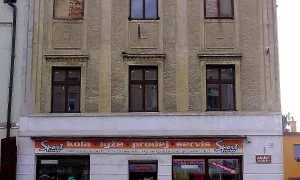
Real photos taken near the monument


Zdroj a licence jsou uvedeny u každého snímku.
Tips from visitors
No tips yet. Be the first!
Log in and add your tip.
Sources and literature
Photos: T.Bednarz / CC BY-SA 4.0 — Wikimedia Commons. The author and licence also appear when you hover over the image.
Faktickým podkladem tohoto textu byl článek na Wikipedii, jehož autory jsou přispěvatelé Wikipedie. Článek je dostupný pod licencí CC BY-SA 4.0.
Location on the map

Příběhy a pověsti
Legendy, pověsti a příběhy spjaté s touto památkou
Fotografie návštěvníků
Zatím žádné fotografie. Buďte první, kdo přidá fotografii z návštěvy!
Log in a přidejte svou fotografii nebo hodnoťte.
Za ověřenou návštěvu v aplikaci získáte víc bodů — poznáme podle GPS, že jste na místě.
Reviews and comments