



Červený dvůr (Jenišovice) Homestead
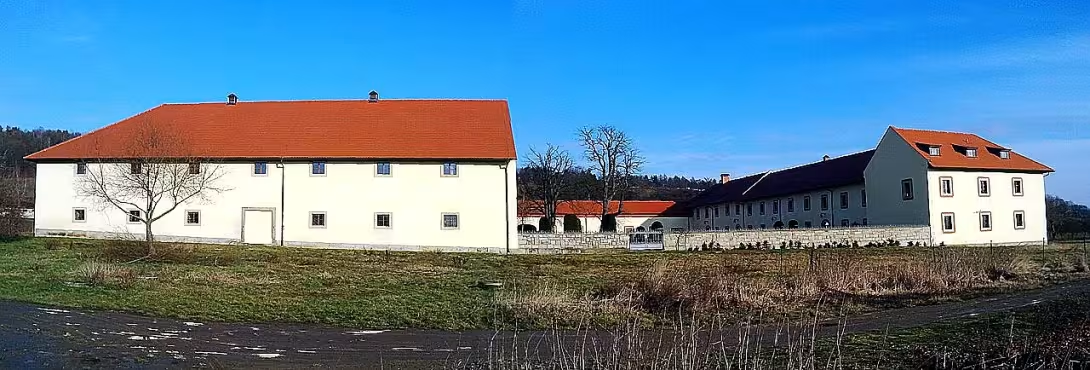
The Red Court of the village Jenišovice is a Baroque sailing farm with a rich history dating back to the 17th century. This monument-protected object was once the seat of the Earl of Des Fours, which founded it within the estate Hrubý Rohozec. After extensive reconstruction, a private company is based here today.
The history of the Red Court dates back to the Middle Ages, when the fortress of Chinov stood here. It was held by the flags from Chinov from 1322 to the mid-15th century. After the last mention of the village in 1653 there was a floating farm, which was named thanks to the red plaster of buildings. In the first half of the 18th century it underwent a Baroque treatment, which made it a representative agricultural object.
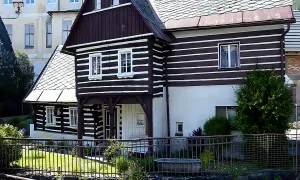
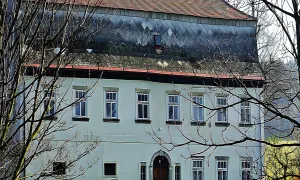
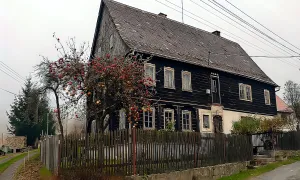
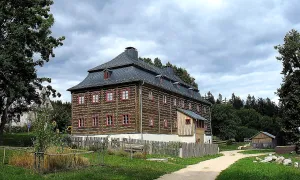
The architecture of the Red Court is characterized by walled-up building with saddle roofs, arranged in a square around the inner courtyard. The entrance gate on the north side, heading towards the road from Jenishovic to Turnov, forms a richly decorated Baroque portal with a lined ledge and carved sandstone coat of arms of the Des Fours family. The western part of the farmhouse is open and follows the fruit alley into the countryside.
The ownership of the Red Court has changed several times over the centuries. After the deaths of the flags from Chinov, the farm went into the hands of the digging Des Fours. They maintained it until 1945, when the property was confiscated along with the castle Gross Rohozec. After 1952, the JZD Družba Jenišovice took over the premises, but due to the lack of resources for building maintenance, they started to lose their way. In 1997 a private company bought the building, which subsequently completely renovated it.
The Red Court is also the subject of a legal dispute over the return of the property of the Des Fours family. The heiress, Karl Des Fours Walderod, Johana Kammerlander, seeks to defile confiscation on the basis of Benes' decrees. In this context, the Court deals with the question of the collaboration of Karl Des Fours with the Nazis. The family has already been granted a right to certain land.
Today, the Red Court is not only a protected building, but also the seat of a private company. Its history and architecture make it an interesting destination for all lovers of Baroque buildings and the history of the region. The visit offers an opportunity to explore the rich past and the architectural significance of this unique place.
The Red Court is not only a monument, but also a witness to many changes in ownership and territorial circumstances. His fates reflect the wider history of the Czech countries, especially the period after the 30-year war, when the reCatholisation and stabilisation of property relations took place. Today the area is accessible to visitors who want to discover its beauty and understand the importance of the construction in the context of Czech history.
Historical milestones
- 1322
- The original existence of the fortress of Chinov in the hands of the flags.
- 1653
- Last mention of the original settlement before the farm was established.
- 1945
- Confiscation of the farm to the family Des Fours after confiscation of the castle Gross Rohozec.
- 1997
- Purchase of a dilapidated building by a private company and start of reconstruction.
Architectural development
There was originally a medieval fortress. In the 17th century a farmhouse was established, which was modified into a Baroque style in the 18th century. The current appearance consists of wall storey buildings with saddle roofs and richly decorated Baroque portals.
Historical events
In the 17th century, a tranquil farm was founded in the Red Court. In the first half of the 18th century, a Baroque reconstruction of the farm took place. In 1945 the property of the family Des Fours was confiscated. In 1997, a decrepit estate was purchased by a private company.
Owners
Vladyková z Činov (1322- 1450), family Des Fours (17. century -1945), JZD Družba Jenišovice (since 1952), private company (since 1997).
Points of interest
- History dates back to the Middle Ages, when the fortress of Chinov stood here. - The name came from a red plaster of buildings. - The architecture has wall storey buildings with saddle roofs arranged in a square around the inner courtyard. - The entrance gate consists of a richly decorated Baroque portal with carved sandstone coat of arms of the Des Fours family. - The western part of the farmhouse is open and follows the fruit alley into the countryside.
Guide
Show guide text
This text was created by artificial intelligence and has not been editorially reviewed. It may contain inaccuracies.
Welcome to this extraordinary place, which now seems very strongly and balanced by its presence. You are standing in front of the buildings which form the Red Court in the village Jenišovice. The first thing that is likely to reach out to you immediately and that determines the full visual impression of this place is its color. Feel the distinctive, rich red plaster that covers the walls of the building and gives the whole area its unique character. This color is not just an aesthetic element, but it is the very basis of the name of this place, which is so directly reflected in what you see just before you go down. The whole area seems very coherent and harmonious, as if it was designed to create one solid, impenetrable and beautiful whole. Feel the atmosphere of peace and history floating here, and let yourself be carried away by the feeling that you have entered the space where the past meets the present.
But in order to truly understand what these walls saw and what is behind them, we need to go back deep into the past together until the Middle Ages. More than seven hundred years ago, namely in 32, two twenty-two years ago, there was no such quiet farm as you know today. There was a fortress called Chinov. It was a firm hold, a defensible mansion, which was controlled by the Thinovs at the time. Imagine the time when instead of today's comfortable buildings, there were rather unusual but very strong and strategically located mansions that were used to protect and consolidate power. But time was constantly passing and the face of this place was gradually changing. In 26-53, the last mention of the original settlement was recorded before everything began to change towards what we now know as a vast economic area. The present appearance, thus this vast and orderly space, began to emerge only in the seventeenth century. This was the time when the ancient medieval foundations and spirit of the original fortress began to turn into something new, more stable and more economic.
Now please look around you and pay attention to how the buildings around you are arranged. If you stop now and try to map this space completely, you will see that the buildings are not distributed randomly. They are built in the shape of a square, creating a closed and protective circuit around the inner courtyard. This arrangement is very typical of large goods and gives the place a sense of privacy, security and order. Note also the roofs of these buildings. These are saddle roofs that give the whole complex its traditional and very solid appearance. If you look at the main entrance now, pay special attention to the gate. This is the real jewel of this place, which must satisfy you with its elegance. It is a richly decorated Baroque portal. It's the work of masters who have great power in them. If you approach it, you'll see a carved sandstone coat of arms. The detail in the sandstone is a clear proof of how important and important this court was for its owners at the time, and how much weight they put in their representation.
But the history of this place is not only about stones, plaster and the geometry of buildings, but especially about people whose fates have intertwined here. One of the most important names associated with this place is the family Des Fours. Their story was linked here to the fate of this estate in a very difficult and decisive period of the year of a thousand nine hundred forty-five. Then, after the castle was removed in Hrubé Rohožec, the family Des Fours was the owner of this farm. Their names have gone deep in the history of this region, and their presence here has been known. It is fascinating how the fate of large and powerful generations intertwine with places like this court, and how the history of large families is reflected in every stone of this estate.
Maybe you're interested in one thing that connects the distant past to what you're seeing right now. Although this object seems to have always been firm and still, it has passed a very dramatic and often difficult path. After a long time when this space was neglected, when it was not guarded and when it gradually faded, there was a large and substantial turnaround. In '87, the building became owned by a private company that saw huge potential and value in it. This meant the beginning of a very long and difficult journey for its complete renewal. This whole reconstruction was complex and intended to return its former shine and functionality to this place. It's a fascinating story about how the wreckage and neglected walls can once again become a beautiful and lively monument through human efforts and faith, which can once again enjoy us today and teach us that nothing is lost forever.
Now I won't keep you any longer. The Red Court still has many things to show you. I suggest you walk around, see the beautiful color, watch the shapes of the roofs and devote one more moment to the wonderful baroque work on the gate. Let yourself drift through the atmosphere of this place that has survived for centuries, from the medieval fortress to today's restored and beautiful farmhouse. Thank you for escorting us on this short journey through time. We wish you a pleasant tour and other beautiful experiences around Jenisovice.
Tips for visitors
The best time to visit is the late afternoon, when soft light best excels on the facades of this former floating farm. For photographers are the most interesting details of architecture from the seventeenth century and the total area, which is very authentic.
Take with you comfortable shoes suitable for walking on rural terrain.
For families with children, a visit is an interesting way to show what the management of the past looked like. The area is clear within the village Jenišovice and suitable for short educational walks.
If you have more time, nearby is the Hrubý Rohozec estate, the village Jenišovice itself or the town Turnov, which complements the overall impression of the region.
Frequently asked questions
Can the monument be visited?
This is a residential or farm building, not a museum with opening hours. Please view it from public space and respect the owners' privacy. We have no information about access to the interior.
Where is the monument?
Location: Jenišovice, Liberecký kraj. The map on this page shows the exact spot.
Why is the monument protected?
It is listed in the Central List of Cultural Monuments of the Czech Republic as a cultural monument (register no. 1000127542).
Businesses nearby
Do you run a restaurant, accommodation, shop, museum, rental, wellness or other visitor service near this monument? Show yourself directly to the people heading to it — this is how they will see you in the app and on the web:
Events nearby


Zdroj akcí: otevřená data měst a obcí ČR (Národní katalog otevřených dat) a kalendář akcí Národního památkového ústavu.
Nearby
Panství Hrubý Rohozec, obec Jenišovice, Turnov.
Accommodation nearby
Trips and activities nearby
Guided tours, tickets and activities nearby from GetYourGuide
Affiliate link: if you buy from the partner, we may receive a commission. The price for you does not change.
Search tours and activities →Themed route
Červený dvůr (Jenišovice) Type: Historical building / Monuments This place is the core of the whole cruise route and offers a view of the typical rural architecture of the region. Visitors can enjoy the quiet environment and historic atmosphere that exists here.
Municipality of Jenišovice Type: village core / Cultural heritage After the tour of the main destination it is advisable to walk through the streets of the village which is situated in the immediate vicinity of the yard. Here you can admire local folk architecture and get a sense of authentic life in this corner of the Czech Republic.
Manor Rugged Rohozec Type: Castle / Historical residence This monument is located in the vicinity of Jenisovice and represents another important stop on the route. It serves as a contrast to a smaller court and offers insight into the history of noble settlements in this country.
Turnov Type: City / Regional Centre The city of Turnov, which is approximately 10 to 15 kilometres from Jenishovic, serves as the final or entry point of the route. Here you can add information about the region, visit local sights or relax in the urban environment.
This route connects a smaller rural monument with a larger city centre and historical estate. The order of points allows for continuous interconnection of individual sites without unnecessary hubs. The visitor thus receives a comprehensive picture of the cultural heritage of the area.
Seasonal recommendations
In spring, this place awakens into life. Fresh leaves and flowers begin to grow around the buildings, which gives the surroundings a fresh green color. The light is soft and pleasant in this period. I recommend arriving in the morning when the air is the purest. Dress well, because the morning cold can still feel when the sun is warm.
Summer months bring the greatest heat and the longest days. Plants are in full bloom, and the sun clearly illuminates the walls of buildings. There are more people in the main summer times, so it is better to arrive immediately after opening so that you avoid the biggest crowd. Prepare light fabrics and remember to protect yourself from the sun.
Autumn offers the most impressive color changes, when the landscape is colored in gold and red. The morning mist gives the memory a mysterious and calm mood. It is the perfect time for a quiet observation of the minor construction in soft light. Get your shoes ready for wet soil and warmer top clothing because evenings are cold.
In winter, the Red Court is very quiet. Without leaves you can see all shapes of buildings and frost can create beautiful patterns on the windows. The mood is very calm because the traffic is minimal. Due to a shorter day and cold, I recommend a visit around noon to make enough light. The necessity is very warm clothes and high-quality shoes against cold.
Visualizations and artistic views


The visualisations are generated by artificial intelligence and serve as inspiration.
Photos from the area
Real photos taken near the monument


Zdroj a licence jsou uvedeny u každého snímku.
Tips from visitors
No tips yet. Be the first!
Log in and add your tip.
Sources and literature
Photos: Jakub.ka / CC BY-SA 4.0 — Wikimedia Commons. The author and licence also appear when you hover over the image.
Faktickým podkladem tohoto textu byl článek na Wikipedii, jehož autory jsou přispěvatelé Wikipedie. Článek je dostupný pod licencí CC BY-SA 4.0.
Location on the map
Příběhy a pověsti
Legendy, pověsti a příběhy spjaté s touto památkou

Fotografie návštěvníků
Zatím žádné fotografie. Buďte první, kdo přidá fotografii z návštěvy!
Log in a přidejte svou fotografii nebo hodnoťte.
Za ověřenou návštěvu v aplikaci získáte víc bodů — poznáme podle GPS, že jste na místě.
Reviews and comments