



Červený kostel ve Varnsdorfu Church
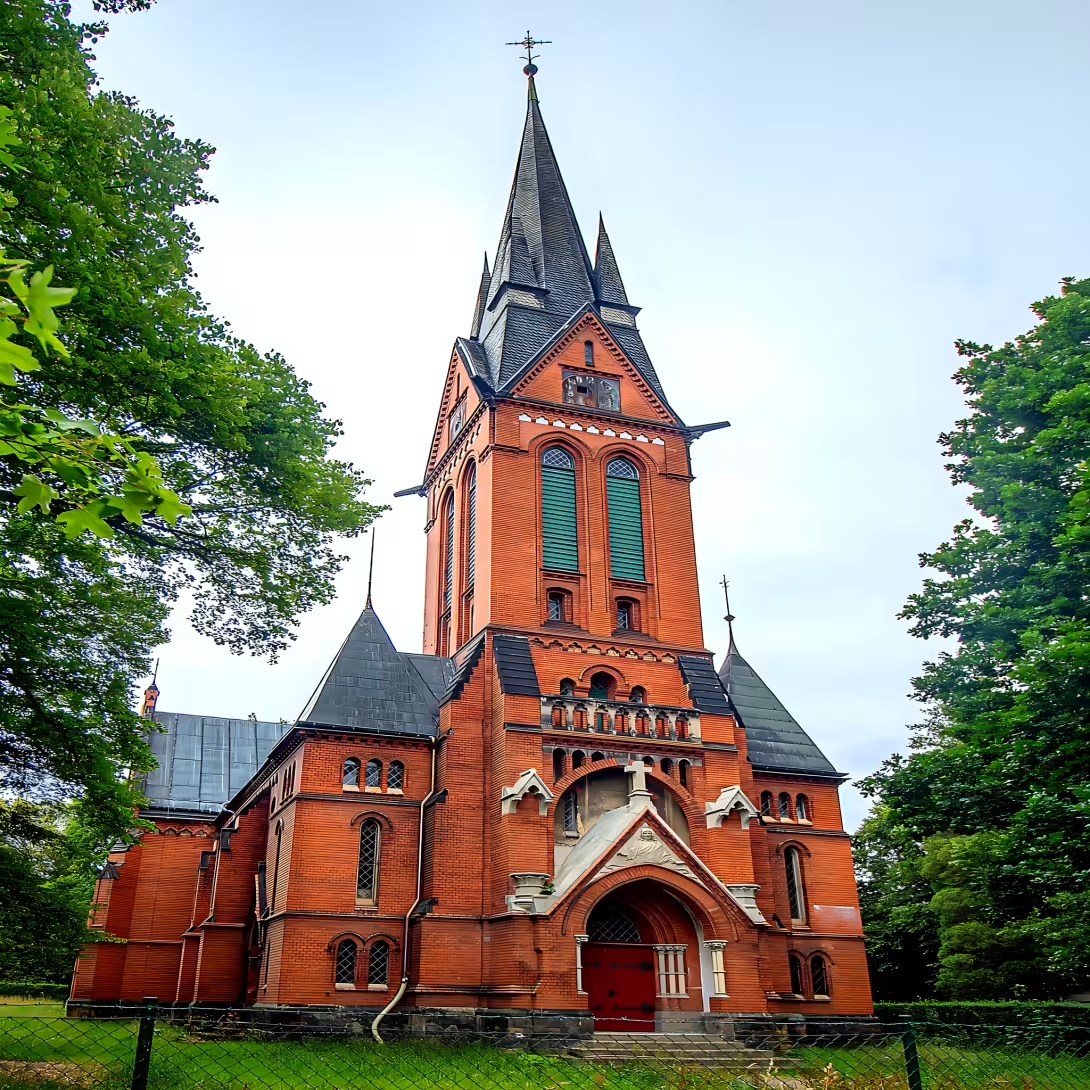
The Evangelical Church in Varnsdorf, the German called Rote Friedenskirche (Red Church of Peace), presents a unique example of the sacral architecture of the Czech Republic. Its uniqueness consists in unusual building technology - the whole building is built from glazed bricks, which give it a characteristic red colour and at the same time makes it памятком European construction in the early 20th century.
The construction of the church was started by laying the base stone on 16 May 1904. The architect of the project was the renowned Dresden architect Woldemar Kandler (1866-1929), who was at that time a recognized creator of sacral structures. The church gradually took its present form until on 3 December 1905 it was festively consecrated and named "The Church of Peace" (Friedenskirche). During this ceremony she was honoured by the Old Catholic Church and Emperor Joseph II for his merit in the question of religious freedom.
The church got rich equipment. The three bells that were in his tower were donated by Gustav Adolf's Upper Lusatian society. Every bell had its meaning and inscription - the greatest bell reported "The Word of the Lord remains forever," the middle bell reminded "Pray and work," and the smallest one reminded of mortality: "I am with you for all days until the end of the world." The bells were imported and first rang on June 28, 1905. The organ was then consecrated on 27 May 1906 and had 21 registers and impressive 1300 whistles, which included the church among the important music centers of the region.
The church was preserved unchanged until 1945. After the end of World War II it was confiscated and handed over to the Church of Czechoslovakia without proper documents; later, the Czech Brotherhood Church also shared it. In 1958, the church was included in the list of cultural monuments. However, since the 1960s, it has gradually begun to decay. During the period of normalisation it was completely bankrupt - church benches were secretly removed, which then served as building material for cottages in the Varnsdorf pond.
In 1974 the Church of Czechoslovakia handed over the Hussite Church to the Municipal National Committee. For years, the building seemed to be able to be lost in oblivion. The coup came in 2010 when the Civil Association Red Church was founded, whose goal was to save this valuable building. In 2015 to 2016, the city of Varnsdorf took over the church and began the first work to remove the emergency condition. Today, the joint efforts of the city and the citizens' initiative promise a gradual renewal of the monument that could revive and return to its historical dignity.
Then and now
Drag the slider to compare how the landmark may have looked when it was built with the view today.
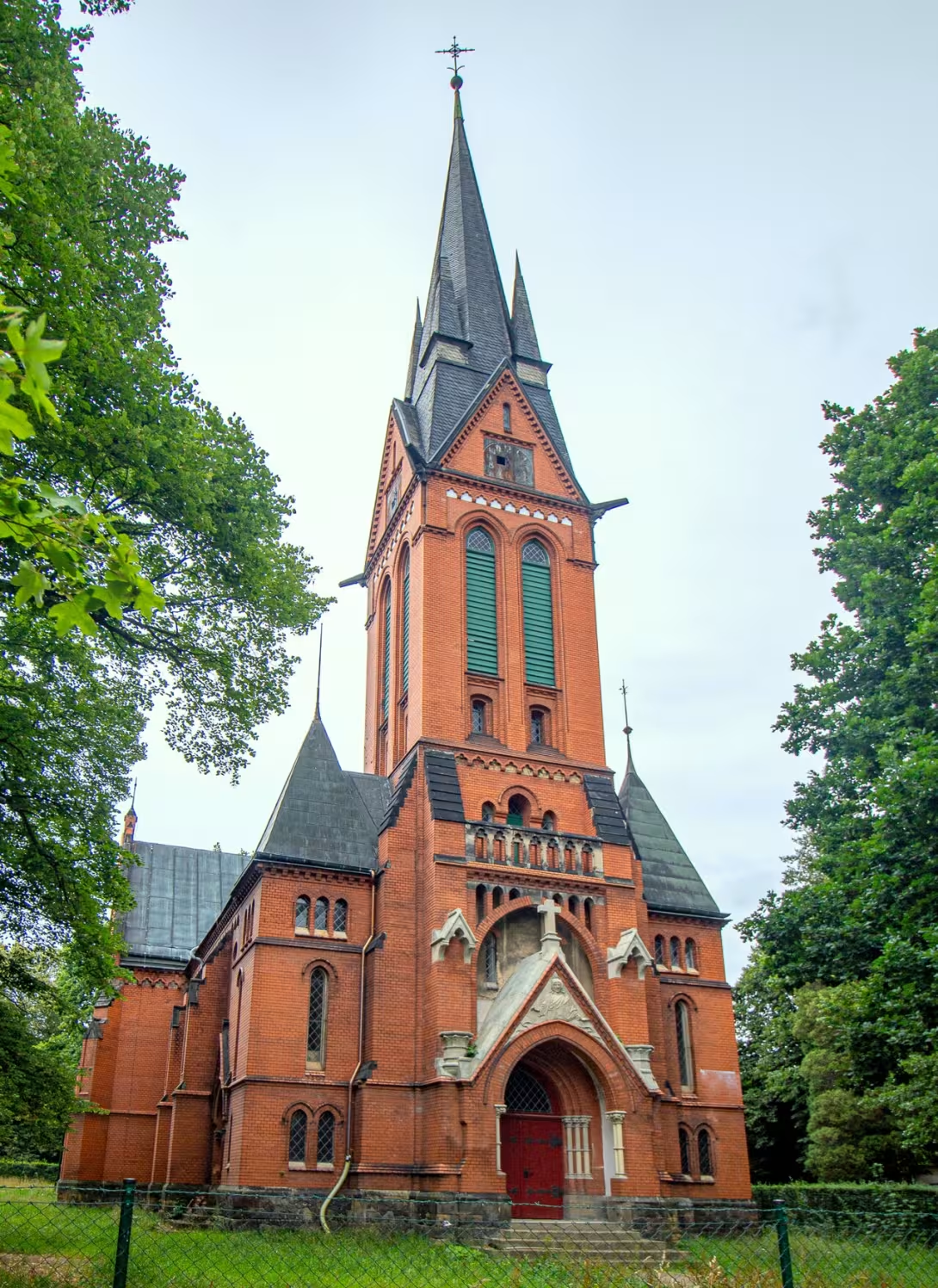

The historical appearance on the left is an AI-generated visualisation and serves as inspiration only.
Historical milestones
- 1904
- The foundation stone for the church was laid.
- 1905
- The church was consecrated and it was named 'Church of Peace'.
Architectural development
The church was built in 1904- 1905 according to the design of architect Woldemar Kandler. It has a pseudo-gothic design with a rectangular plan and a transverse boat, a polygonal closed presbytery and a massive prism tower on the main facade. The construction is made of glazed bricks.
Historical events
- 1905
- The church was consecrated on 3 December and named 'Church of Peace'.
- 1958
- Listed on the list of cultural monuments.
- 2010
- Established by the Civil Association Red Church for its rescue.
Owners
Originally belonged to the German Evangelical Church. After World War II it was confiscated and handed over to the Czechoslovak Church without proper proofs, then co-used by the Czech Brotherhood Church of the Evangelical Church. In 1974, the church was transferred to the Municipal National Committee and has been owned by the city of Varnsdorf since 2016.
Points of interest
- The Evangelical Church in Varnsdorf is a unique example of sacral architecture built from glazed bricks with characteristic red colour. - The church was opened on 16 May 1904 and consecrated on 3 December 1905 by architect Woldemar Kandler. - Three bells in the tower of the church were donated by the Upper Lusatian Association of Gustav Adolf, with the inscription "The Word of the Lord remains forever," "Pray and work" and "I am with you all day long until the end of the world." - Church organ had 21 registers and 1300 whistles, which made them one of the important music centers of the region. - From 2015 to 2016 the city of Varnsdorf took over the church and began its restoration.
Guide
This guide is narrated by a synthetic voice generated by artificial intelligence.
Show guide text
This text was created by artificial intelligence and has not been editorially reviewed. It may contain inaccuracies.
The Red Church in Varnsdorf is a former temple of the German Evangelical Church. It was built in Neo-Gothic style from glazed bricks, and it is precisely this material that makes it a unique sacred structure. In German, it is called Rote Friedenskirche, which means the Red Church of Peace. It is protected as a cultural monument.
The foundation stone was laid on May sixteenth, nineteen hundred and four. The project was designed by the Dresden architect Woldemar Kandler, who lived from eighteen sixty-six to nineteen twenty-nine.
The church received three bells as a gift from the Upper Lusatian Society of Gustav Adolf. They were brought to Varnsdorf on June twenty-fifth, nineteen hundred and five, and they rang for the first time three days later. Each bell bore its own inscription. The largest one read: "The Word of the Lord remains forever." The middle bell greeted day and evening and bore the words: "Pray and work." The smallest bell was meant to remind us that every person is mortal and God is with us. Its inscription read: "I am with you always, even to the end of the world."
The church was consecrated on December third, nineteen hundred and five, and was given the name Church of Peace. At the celebration, thanks were given to the Old Catholic Church. At the monument of Emperor Joseph the Second, thanks were also paid for religious freedom. The organ was consecrated on May twenty-seventh, nineteen hundred and six. It had twenty-one stops and thirteen hundred pipes.
The church survived unchanged until nineteen forty-five. After the Second World War it was confiscated and, without proper documentation, transferred to the Czechoslovak Church. The Evangelical Church of the Czech Brethren also used it with them. In nineteen fifty-eight it was entered in the register of cultural monuments.
From the nineteen sixties onward, however, it began to deteriorate, and during the normalization period it fell into complete ruin. The church pews were secretly removed and used for the construction of cottages near Varnsdorf Pond. In nineteen seventy-four the Hussite Czechoslovak Church transferred the church to the Municipal National Committee.
Since twenty ten, a civic association called Red Church Varnsdorf has been caring for its preservation. In the middle of the last decade, the church was taken into ownership by the town of Varnsdorf. Work began on removing the emergency condition, and the town plans a gradual restoration of the entire building.
Tips for visitors
The best time to visit the Red Church in Varnsdorf is in the spring or autumn period, when there are calmer conditions and nature offers beautiful colors. This time of year also allows photography with ideal light without excessive sunlight.
For those travelling by public transport, it is advisable to check the current connection using an online search engine.
What to take with you: When visiting the Red Church don't forget to take the camera, especially if you like photo architecture. It is also important to have a protective coat or jacket with you, because the construction may not always be fully protected from the weather.
Photography: The best places for photography are especially the back of the church and the surrounding park area where it is possible to capture the overall picture of the building. Ideal lighting conditions offer morning or late afternoon.
What to visit in the surroundings: In the vicinity of the Red Church there is a national park Giant Mountains, which is an ideal place for nature lovers. You can go through the roads and enjoy the beautiful views of the mountain. For those who like history, it is interesting to visit a local museum with exhibitions about the history of the region.
Frequently asked questions
Can the monument be visited?
Religious buildings are usually open mainly during services; at other times a visit is normally arranged with the parish or the operator. We have not verified specific times. According to the heritage register restoration is under way, so access may be restricted.
Where is the monument?
Location: Varnsdorf, Ústecký kraj. The map on this page shows the exact spot.
Why is the monument protected?
It is listed in the Central List of Cultural Monuments of the Czech Republic as a cultural monument (register no. 26639/5-4043).
For kids
Imagine going back to the past and suddenly you find yourself in a beautiful mountain town. This place is Varnsdorf today, but it was once a small settlement of people who lived here thousands of years before Jesus Christ was born.
What would this place look like 2,000 years ago? Was there a big forest animal? You had to be careful not to hit a bear. Most people lived in little huts and worked the land. But it probably wasn't that bad. They were people who knew nature as their best friend.
Businesses nearby
Do you run a restaurant, accommodation, shop, museum, rental, wellness or other visitor service near this monument? Show yourself directly to the people heading to it — this is how they will see you in the app and on the web:
Nearby
Ambient Varnsdorf
Accommodation nearby
Themed route
1. Červený kostel ve Varnsdorfu (monument) - tour of unique brick architecture and observation of the distinctive red color of the facade. 2. Church courtyard (area) - walk in the immediate vicinity of the building for the perception of the overall effect of the building. 3. Interior of the church (space) - admiring the spiritual atmosphere and architectural details inside the building. 4. Church tower (view) - exit to the tower to monitor the surrounding city.
Seasonal recommendations
Spring: In the spring period, Červený kostel ve Varnsdorfu is transformed into a stupid place where flowering shrubs and trees celebrate the restoration of nature. The sun's rays penetrating through the deciduous crowns give the church a gentle flash that emphasizes its historical architecture. At this time it is the perfect time to visit, because the crowd is not too much and the atmosphere is calm. We recommend visiting the church in the early afternoon period when the sun illuminates the building in a special way. Dress comfortably and prepare for mild cooling; short gloves or cape may be useful if suddenly a rainy moment comes.
Summer: For years, the Red Church becomes the center of attention in the main summer season, surrounded by a lively atmosphere and people looking for historical experiences. The sun illuminates the architecture of the church with bright rays, which gives the building an excellent visual effect. At this time, it is recommended to visit the site earlier in the afternoon to avoid the smoothest hours and crowd overload. Don't forget to take your protective sunglasses and plenty of water, and wear light, bright clothes or pants that allow you to relax your walk despite the warm summer air.
Autumn: In autumn Červený kostel ve Varnsdorfu gets a special tone when leaves on trees change colour and fall calmly to roots. The sunny days are beautifully lit and provide ideal conditions for a photograph of the church in its historical context. The atmosphere is calm, but it's worth coming to a place before the start of cold evenings. We recommend visiting the memory between morning and afternoon time, when temperature is best for long walks. Wear layered clothes that allow you to adapt to the rapid change of weather; a short coat or coat may be useful for the sudden rain.
Winter: Winter brings a calm and quiet atmosphere to the Red Church in Varnsdorf, where architecture is lit with special light. Freezing air can give visitors a feeling of complete disconnection from everyday life, which is ideal for a quiet sightseeing tour. Wear warm clothes with helmet and protective gloves to protect yourself from cold. If you are planning a walk in the snow, we recommend fixed shoes with good groove.
Visualizations and artistic views


The visualisations are generated by artificial intelligence and serve as inspiration.
Photos from the area
Real photos taken near the monument


Zdroj a licence jsou uvedeny u každého snímku.
Atmosphere of the place
This atmospheric visualisation of the place and period was generated by artificial intelligence. It is not real footage of the location.
Tips from visitors
No tips yet. Be the first!
Log in and add your tip.
Sources and literature
Photos: Cieslak Jürgen / CC BY-SA 3.0, rozlišení zvýšeno umělou inteligencí — Wikimedia Commons. The author and licence also appear when you hover over the image.
Faktickým podkladem tohoto textu byl článek na Wikipedii, jehož autory jsou přispěvatelé Wikipedie. Článek je dostupný pod licencí CC BY-SA 4.0.
Location on the map
Příběhy a pověsti
Legendy, pověsti a příběhy spjaté s touto památkou
Fotografie návštěvníků
Zatím žádné fotografie. Buďte první, kdo přidá fotografii z návštěvy!
Log in a přidejte svou fotografii nebo hodnoťte.
Za ověřenou návštěvu v aplikaci získáte víc bodů — poznáme podle GPS, že jste na místě.
Reviews and comments