

Chmelařské muzeum Museum building
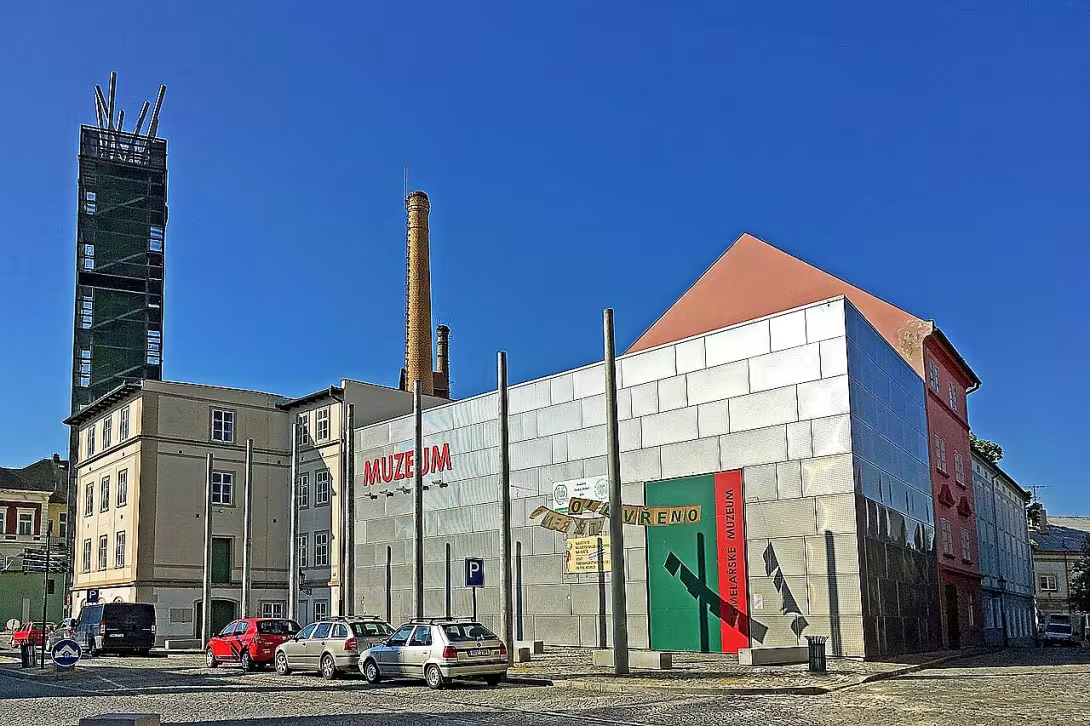
Chmelařské muzeum in Žatci, a situation in the district of Louny in the Ústí Region, is the largest exposure of its kind in the world with an exhibition area of 4,000 m ². It is a technical monument and a demonstration of industrial architecture from the end of the 19th century, which documents the history of the cultivation and processing of hops.
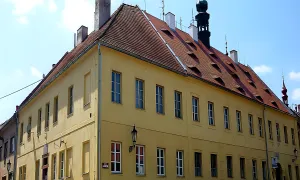
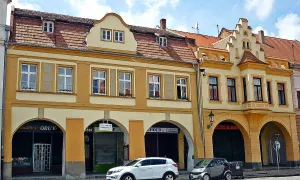
The building is located in Prokopa Square and has a triangular plan. The buildings that originally served as hop and packing warehouses were created in several stages. The oldest parts with the numbers described 305, 306 and 1952 existed already in 1881. Other buildings were added in 1890, 1898 and 1900. In the 1950s, one of the corner houses burned down, where garages were subsequently built.
The history of complex ownership was fragmented. The houses no. 1952 and 305 belonged to the Melzer family since 1881. Other parts of the file were purchased in 1882 by Leonhard and Hahn, and from 1885 until 1945 they were owned by Pfister & Wüstl. In 1939 the buildings fell under the administration of the occupying offices of the Third Reich and in 1943 they were the last private owners of Fritz Roth and Alois Kaiser. After 1945 the complex was nationalized and taken over by the Czech state. Since 1950 the buildings have been managed by the central office for agricultural products and since 1954 they have served as a hop warehouse. Since 1961, the Chmelaří plant has been the owner of the complex, whose successor was the hop factory in 1991, the Žatec cooperative.
The buildings served as warehouses and packing facilities until 1995. There was a quality check, sizing, pressing and storing dried hops into packaging. There were sulfur chambers and packing machines on the premises. One of the chambers was preserved in very good condition, even though her chimney was broken down. The idea of the museum was created at the end of 1995. The institution was officially opened in 1997 on the occasion of the 45th anniversary of the International Hop Congress. The reconstruction of the buildings took place in 2006 and the reopening followed on 5 May 2007 during the Chmelfest festival. Since 2010, the museum has been part of the Temple of hops and beer project.
The exhibition brings the development of the cultivation, harvest and processing of Žetek hops from the early Middle Ages to the present. Displays the technological shift from manual filling of bags to pressing machines to pellet production. The most important exhibits include the 18th-century wooden road designed for hop spraying, sulfur chambers with wire baskets, a model of a 1959 chamber shutter, a 19th-century blinds oven and a 19th-century oven. In the collection there are also passages for the rod of hops, documents, photographs and engravings of Czech cities from Jan Willenberg from the turn of the 16th and 17th centuries.
The museum is today operated by a team of CHALLARIES Žatec. In its immediate surroundings there is the Temple of hops and beer with a hop lighthouse and approximately 500 metres north is located the satirical Museum of Homolupules.
The monument represents a unique insight into the industrial history of the region, which was the world-famous center of hop. Visiting this extensive complex allows you to understand the technological development of one of the most important products of the Czech agricultural tradition.
Then and now
Drag the slider to compare how the landmark may have looked when it was built with the view today.
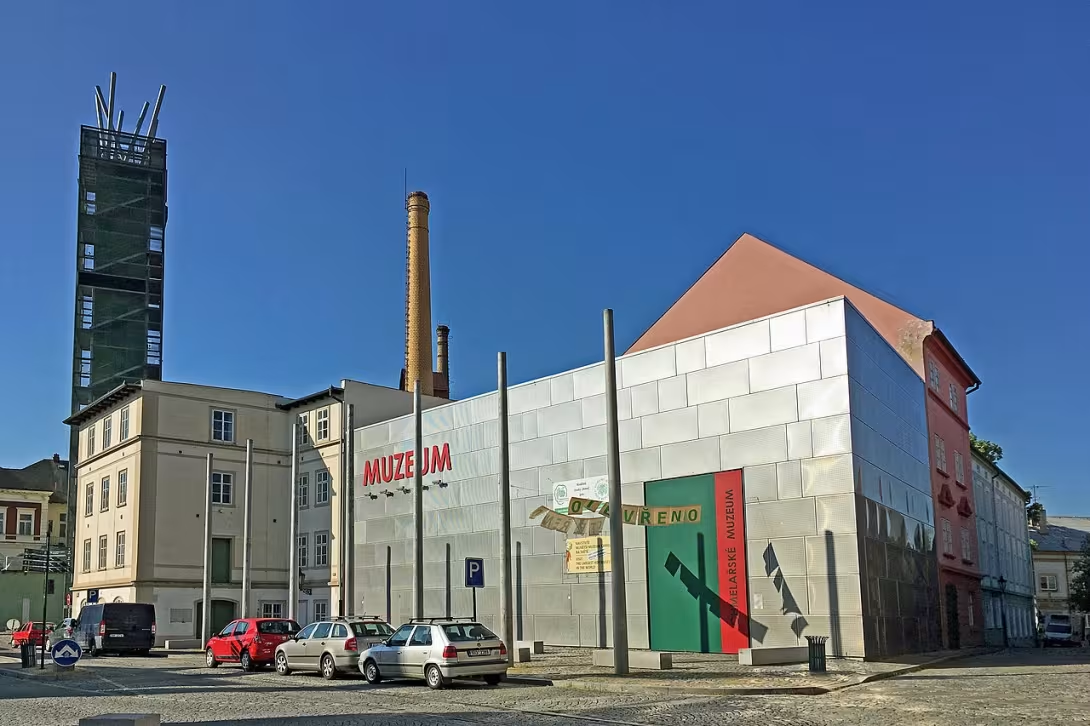
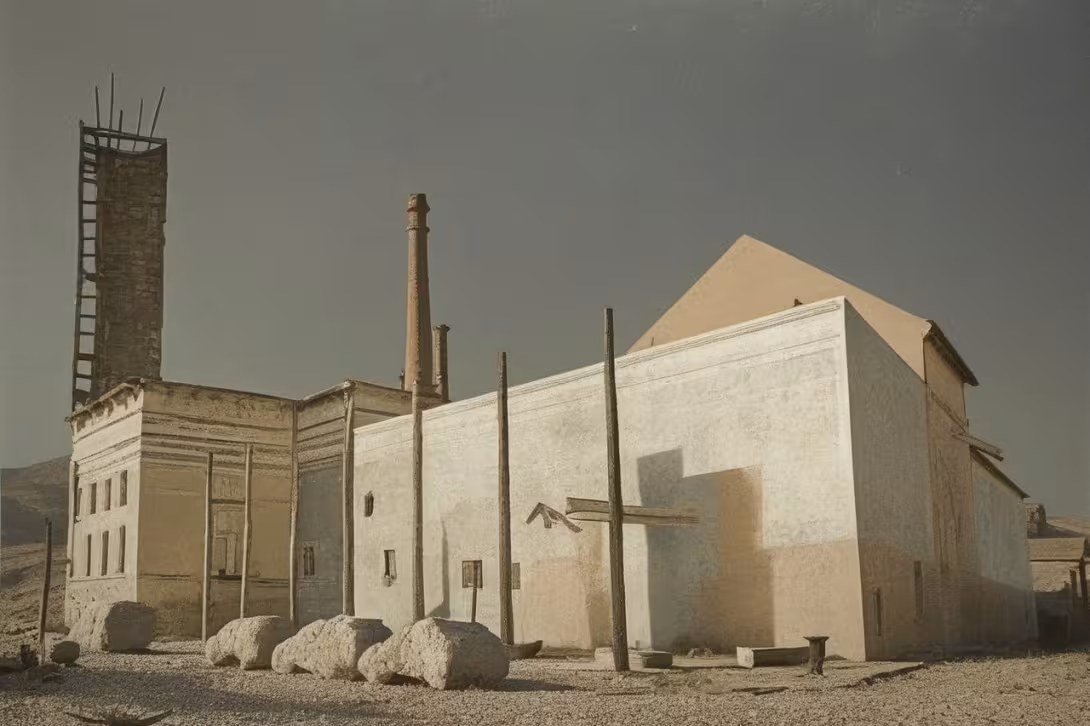
The historical appearance on the left is an AI-generated visualisation and serves as inspiration only.
Historical milestones
- 1881
- the creation of the oldest buildings of the complex
- 1997
- opening of the hop museum
- 2007
- reopening the museum after reconstruction
Architectural development
A set of buildings on a three-wheel plan was created in several stages. The oldest parts from 1881 were supplemented by other buildings in 1890, 1898 and 1900. In the 1950s, one of the corner houses burned down, where the garages were later built.
Historical events
1945: nationalisation of the building complex and takeover by the Czech State; 1997: the official opening of the museum on the occasion of the 45th anniversary of the International Chmelera Congress; 2010: inclusion of the museum in the Temple of hops and beer project.
Owners
family Melzer (from 1881), Leonhard and Hahn (from 1882), company Pfister & Wüstl (1885-1945), Czech State (from 1945), central office for agricultural products (from 1950), plant Chmelaří (from 1961), hop factory cooperative Žatec (from 1991)
Points of interest
- It is the largest exhibition of its kind in the world with a area of 4,000 m ². - The buildings have a triangular plan and served as warehouses of hops and packing rooms. - Important exhibits include the 18th-century wooden road for hops. - The collection shows engravings of Czech cities from the turn of the 16th and 17th centuries. - The museum was officially opened in 1997 for the 45th anniversary of the International Hop Congress.
Guide
This guide is narrated by a synthetic voice generated by artificial intelligence.
Show guide text
This text was created by artificial intelligence and has not been editorially reviewed. It may contain inaccuracies.
Welcome to the beautiful city of Žatec. Right now, you're standing in Prokopa Square, and you have something very special in front of you. In front of your eyes are the buildings that make up Chmelařské muzeum. Feel this atmosphere, feel the weight of history, which is hidden here in every stone and wall. Perhaps at first glance, these structures act as simple, functional objects, but believe me, it is here that the heart of this entire region and the whole tradition that is so crucial to our region. In front of you, there is a space that is not just an ordinary collection of old things, but a living story about work, nature and human ingenuity.
Let us now look together at how this place was created and why it is so important here. If we go back in time, we'll find that the oldest parts of this complex began to emerge in the year one thousand eight hundred eighty-one. At that time, hops were the absolute foundation of the prosperity and wealth of this place. These buildings were not originally built for you, for visitors, but as practical work spaces. They were used as warehouses where hops were kept, and as packing rooms where they were preparing for their next delivery. It is a fascinating view of how the world was changing at the end of the nineteenth century and how industry began to intertwine with agriculture. Only in the year one thousand nine hundred ninety-seven did this place open to the public as a museum so that this rich history would not be forgotten. After thorough reconstruction and repairs, the museum reopened in the year two thousand and seven to serve you and all the other people interested in our history.
Now pay attention to the architecture itself that you are currently observing. Look at these buildings and perceive their industrial character. They are a typical and beautiful example of architecture from the late nineteenth century. If you look at them from a different angle or try to draw their plan in spirit, you'll notice something very unusual. Because they have a triangle shape. This shape was not selected randomly, but had to meet the needs of the then operation and efficient use of storage space. Feel the robustness and the bright structure these buildings emit. Every corner and every wall here tells the story of the hard work and the importance of the product that was kept here. It's an architecture that was created for a specific, clearly defined purpose.
Do you know that you are standing right here in front of something that is unprecedented in the world? This museum is not just an exhibition. It's the largest museum of its kind on the planet. Imagine a vast area of 4,000 square meters filled with knowledge, objects and stories. It's a truly monumental space that can completely consume you. When you decide to enter, prepare for a real journey through time. The exhibition will guide you through the entire development of cultivation, harvest and subsequent processing of hops. This journey begins in the early Middle Ages and stretches to our present days. You will see how the instruments have changed, how the work in the fields and in these buildings has changed, and how the human effort has gradually improved everything.
The most important treasures you will find inside include, for example, an old wooden road dating back to the eighteenth century. This road was used for hop spraying, which was at that time an absolutely essential process for its proper maintenance. It's a fascinating view of the technique at a time when everything depended on wood, metal and the power of human hands. It's an object that allows you to almost feel the old work. In addition, you can look forward to the wonderful engravings of Czech cities that come from the turn of the 16th and 17th centuries. These drawings will show you what our territory looked like in ancient times and will give your tour another dimension and depth.
It's fascinating how they connect so many centuries in this one place. From medieval methods to modern practices, it all forms one great whole. Feel the continuity, the persistence of human endeavor, that this precious gift of nature, which is hops, can best be processed and preserved. Every step you take inside will bring you closer to understanding why this city and this area are so special.
Now I will not hold you back and leave you with your first impressions. But it's just the beginning of your adventure journey. In front of you lies a huge world full of details that await your discovery. Explore every room, pay attention to every subject and get carried away by the story that takes place here. Don't forget to stop at the oldest details and try to imagine what sounds and smells were here hundreds of years ago. Žatec and this museum have a lot to offer you, and I believe that you will bring a lot of new knowledge and experience from here. I wish you a beautiful and inspiring tour.
Tips for visitors
For the best visual experience we recommend a time when light is favourable, for example during late afternoon hours, when the sun will highlight the details of industrial architecture from the end of the nineteenth century. Outdoor photography offers great opportunities to capture technical elements and historical appearance of the building.
Other attractions can be explored in the immediate surroundings. The Temple of hops and beer with a characteristic hop lighthouse is very close and about 500 metres north lies the satirical Museum of Homolupules.
It is particularly interesting for families with children to see the extent of the entire exhibition, which occupies a huge area of four thousand square meters. It is advisable to bring with you comfortable shoes to move in space and, if necessary, own drinks.
You can reach the place by car and public transport; Check the current connection in the search engine.
For lovers of history and architecture, this object is a unique example of industrial style, which is good to observe from different angles to excel at all technical details of the construction.
Frequently asked questions
Can the monument be visited?
Some buildings of this kind are open for guided tours, others serve another purpose or are privately owned. We have not verified whether and when this monument is open – please ask the operator.
What are the opening hours and admission?
We have not verified the opening hours or admission. Current information is published by the operator. Official website: https://www.chchp.cz/prohlidky-chram-chmele-a-piva-zatec/
Where is the monument?
Location: nám. Prokopa Malého 305, Žatec, Ústecký kraj. The map on this page shows the exact spot.
Why is the monument protected?
It is listed in the Central List of Cultural Monuments of the Czech Republic as a cultural monument (register no. 106890).
Businesses nearby
Do you run a restaurant, accommodation, shop, museum, rental, wellness or other visitor service near this monument? Show yourself directly to the people heading to it — this is how they will see you in the app and on the web:
Events nearby

Zdroj akcí: otevřená data měst a obcí ČR (Národní katalog otevřených dat) a kalendář akcí Národního památkového ústavu.
Nearby
🏰 Historic sites (54)
- sv. Barbora 0.2 km
- sv. Jan Nepomucký 0.2 km
- Renesanční sladovna 0.2 km
- sv. Jan Nepomucký 0.2 km
- Pomník obětem 2. světové války 0.2 km
- Ježíš Kristus 0.2 km
- Korunování Panny Marie 0.2 km
- Pomník Edvarda Beneše 0.2 km
- Jan ze Žatce 0.2 km
- Boreš 0.3 km
- Regionální muzeum K. A. Polánka v Žatci 0.4 km Husova 678
- Křížova Vila 0.4 km Zeyerova 344
- Nejsvětější Trojice 0.5 km
- Retro Computer 0.6 km
- sv. Jan Nepomucký 0.7 km
- sv. Václav 0.8 km
- Muzeum pivovarnictví Žatecka 0.8 km +420 603 941 700 web
- Pomník obětem z Českého Malína 0.8 km
- Věnováno obětem války 1.6 km
- Mireček 2.3 km
🍽️ Restaurants and dining (56)
- Restaurant & pivovar "U Orloje" (Chrám Chmele a Piva) 0.1 km web
- Pivovar Pioneer 0.1 km nám. Prokopa Malého 303
- Pioneer Beer 0.1 km nám. Prokopa Velkého 303
- Pizzeria Panamera 0.2 km Nákladní 359 724222299 web
- Hostinec Slunce 0.2 km
- Mlsná koza 0.3 km Dvořákova 22 602111552
- Hříbek 0.3 km
- Jaipur 0.3 km Oblouková 228
- Ramon Cafe 0.4 km třída Obránců míru 8
- Hospůdka U Nás 0.4 km
- U Medvěda 0.4 km Oblouková 222 415710755
- Rock Cafe 0.4 km Volyňských Čechů 1012 733500119
- MAKA - Korejská restaurace 0.4 km náměstí Svobody 43
- Pražská 0.4 km
- Čáp 0.5 km
- Kavárna S Duší 0.5 km náměstí Svobody 53
- Restaurace Kapitán 0.6 km
- Barbar 0.6 km
- Pizza Pizza 0.7 km
- Restaurace Ostrov 0.7 km Svatováclavská 1040
🏨 Accommodation (11)
- Penzion u Orloje 0.1 km nám. Prokopa Malého 883
- Hotel Zlatý Lev 0.3 km web
- Hotel Černý Orel Žatec 0.3 km
- Hotel U Hada 0.5 km
- U svatého Václava 7.5 km web
- Kemp Piraňa 9.9 km
- U Zajíců ve dvoře 10.4 km 474 392 039
- Autokemp Vikletice 11.2 km
- Koruna 11.2 km Masarykova 302
- Penzion Palma 11.8 km Mírové náměstí 62
- Chalupa U lesa 14.0 km +420 737 163 156
🚲 Rentals and sport (10)
- Stadion Mládí 0.3 km
- Sokolovna 0.3 km
- TJ Sever Žatec 1.0 km
- RMP Freesport 1.1 km
- Sportisimo 1.2 km
- Koupaliště 1.3 km
- Plavecký areál Postoloprty 11.5 km
- CykloMolny 14.2 km Kadaňská 301 +420 776 044 015 web
- Kola Mojžíš 14.3 km Dukelská 260 +420 731 344 610 web
- Chevron Nutrition s.r.o. 14.3 km Nerudova 603 +420 775 078 060 web
🥾 Hiking and nature (22)
- Kapucínská zahrada 0.2 km
- Nejmenší chmelnice na světě 0.6 km
- Žatec 2.5 km
- Staňkovice 3.5 km
- Milberk 7.4 km
- Miocenní sladkovodní vápence 9.4 km
- Travertinová kupa 9.7 km
- Slanisko u Škrle 10.4 km
- Výrov 10.7 km
- Údolí Hasiny u Lipence 10.7 km
- Rubín 10.9 km
- Studánka v Koňské rokli 11.1 km
- Homole 11.6 km
- Kozinecká stráň 11.7 km
- U Sklepů 11.9 km
- Špičák 13.2 km
- Výhled na trať a Chomutov 13.4 km
- Fořtova studánka 13.5 km
- Březenský vrch 13.9 km
- U čertova kamene 14.7 km
Accommodation nearby
Themed route
Here is the design of the thematic route:
1. Chmelařské muzeum (museum) - Main stop where you will learn all about the cultivation and processing of this crop. 2. Temple of hops and beer with hop lighthouse (construction) - Located next to the museum, it offers a unique view of the hop culture. 3. Homolupul Museum (Satirical Museum) - A target approximately 500 meters north, offering a funny view of local history.
Seasonal recommendations
In the spring, the surroundings of the museum awaken to life and young hops are growing. Nature around the building is fresh and the light is fine, which is ideal for city walks. We recommend shoes suitable for wet ground and light jacket because the wounds can still be cold.
Summer brings a full green hop field and intense smell of plants. The sun shines the strongest so it's best to start in the morning before the hottest heat comes. The practical is light cotton and a hat to protect your head from direct sun.
Autumn is the harvest season when the landscape is painted in golden and brown shades. The atmosphere is quieter and the air is fresher, which makes it a pleasant experience to travel to Žatka itself. Layer clothing and waterproof shoes are suitable for frequent collisions.
Winter changes the surroundings of the monument into a quiet and minimalist place that can be covered by snow. The light is gray and the days are short, which creates a cozy mood. It is necessary to wear a warm sweater, wool socks and tight shoes with anti-slip soles.
Visualizations and artistic views


The visualisations are generated by artificial intelligence and serve as inspiration.
Photos from the area
Real photos taken near the monument


Zdroj a licence jsou uvedeny u každého snímku.
Atmosphere of the place
This atmospheric visualisation of the place and period was generated by artificial intelligence. It is not real footage of the location.
Tips from visitors
No tips yet. Be the first!
Log in and add your tip.
Sources and literature
Photos: Dieringer63 / CC BY-SA 4.0 — Wikimedia Commons. The author and licence also appear when you hover over the image.
Location on the map
Příběhy a pověsti
Legendy, pověsti a příběhy spjaté s touto památkou

Fotografie návštěvníků
Přidat fotografiiZatím žádné fotografie. Buďte první, kdo přidá fotografii z návštěvy!
Máte k místu vzpomínku nebo zajímavý příběh?
Log in a přidejte svou fotografii nebo hodnoťte.
Za ověřenou návštěvu v aplikaci získáte víc bodů — poznáme podle GPS, že jste na místě.
Reviews and comments