






děkanství Beroun Deanery
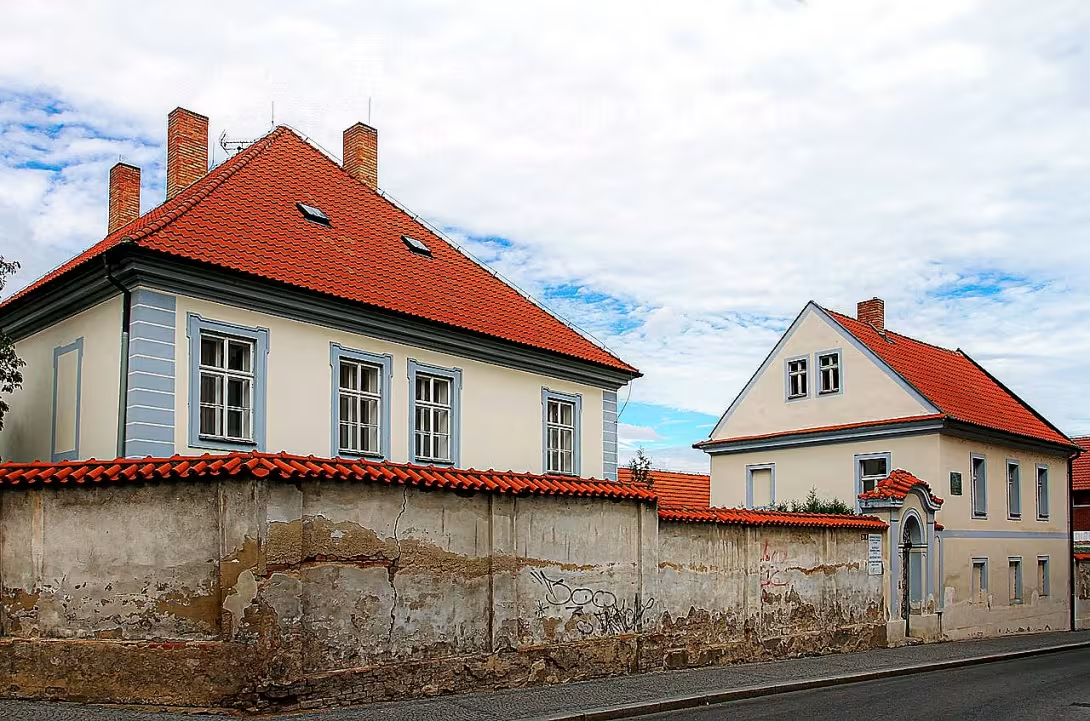
Beroun is a Baroque complex of farms and other buildings from the 18th century, located in the vicinity of St. Jacob's church in the historical centre of Beroun-Centrum. This monument protected area is remarkable thanks to architecture, rich history and cultural connections that reflect the spiritual and social life of the city. The complex includes a building of deanery (originally the rectory), chaplain, chapel, fenced wall with three gates and statue of St. John Nepomuk.
The establishment of the complex is linked to the peak period of Baroque in Czech countries at the turn of the 17th and 18th centuries, when extensive reconstruction of church buildings took place after the Thirty Years War. The original Gothic rectory was replaced by a new Baroque building in 1715-18, reflecting the need to consolidate the Catholic faith in the Czech countryside and in smaller cities. After the fire in 1735, the building was remodified in Baroque style, which became dominant at that time.
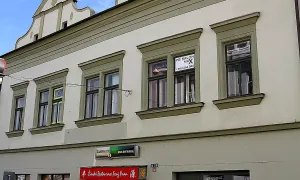
Architecturally, the dean is characterized by his single-storey brick construction with a rectangular plan. The street facade is four-axis, with champagne windows and sometimes metal heart-shaped bars. The facade is decorated with a cordon and a crown ledge, while the facade facing the yard has five axes and rising shallow risties. The chaplain, built already in 1704, is a one-storey building on a narrow rectangular plan with three axes along the street as well as a splendor. Its architectural elements include two Baroque gates and a memorial plate with relief from sculptor Zdeněk Dvořák, which celebrates Dean Josef Antonín Seydle.
An important role in the history of the complex was played by the Berun dean and historian Josef Antonín Seydl, who hosted many important personalities from the building circles such as Šebestián Hněvkovský or František Palacký. The statue of St. John Nepomucký, part of the complex, is currently located in the Museum of Czech Karst.
Today, děkanství Beroun is a monument-protected complex that reflects the rich history and architecture of the city. His visit offers a view of Baroque construction and spiritual life of past times. The area is open to the public and serves as a witness to the historical development of Beroun, which makes its visit not only for historians, but also for any curious tourist. Thus, the Dean is not only a monument to architecture, but also a place full of spiritual and cultural significance that is worth exploring.
Historical milestones
- 1704
- A chaplain building was built.
- 1718
- The construction of a new Baroque farm building has been completed.
- 1735
- The house was rebuilt after the fire.
- 1958
- The area obtained state conservation.
Architectural development
The foundations of the rectory go back to the Gothic period, as evidenced by preserved cellars. In the 18th century the older building was replaced by a Baroque building and the complex was supplemented by a chaplain built in 1704. The rectory is a walled one-storey building on a rectangular floor plan with a divided street front. Part of the complex is also a Baroque chapel on an oval floor plan encapsulated by a plaque with a dome.
Historical events
The new Baroque farm building was built between 1715 and 1718. In 1735, the house was redesigned after a devastating fire. Minor construction modifications were also carried out in 1840 and 1898.
Points of interest
- Beroun is a Baroque complex of farms and other buildings from the 18th century. The area is remarkable thanks to architecture, rich history and cultural connections. - The formation of the complex is related to the peak period of Baroque in Czech countries at the turn of the 17th and 18th centuries. - An important role in the history of the complex was played by the Berun dean and historian Josef Antonín Seydl, who hosted many important personalities from the building circles. - Statue of St. John Nepomuk, part of the complex, is currently located in the Museum of Czech Karst.
Guide
Show guide text
This text was created by artificial intelligence and has not been editorially reviewed. It may contain inaccuracies.
Welcome to the historic heart of Beroun. Right now you're standing in front of one of the most important building units in this place, which will immediately take you to another time. In front of your eyes is a beautiful Baroque complex, which forms a harmonious complex with a nearby church of St. James. Feel the strange atmosphere of peace and nobility radiating from these walls. This whole space is not just a group of buildings, but it is a living story that has been told for centuries and now invites you to explore it. Look around you and notice how the individual parts of the complex intertwine and create a complete space that has been designed with a great sense of beauty and order.
To understand why this place looks the way you see it right now, we need to go back deep into the past together. The entire area has its roots far beyond what it would appear at first sight. Originally there was a Gothic rectory, a building from a much older age, which had a completely different appearance and a different mood. Over time, however, the world and the needs of the city themselves changed. At the turn of the seventeenth and eighteenth centuries, an era began that brought a new way of seeing the world, full of movement and wealth. It was during this period that it was decided that old Gothic buildings would be replaced by new, more representative buildings in the most modern style. This process of transformation was very dynamic and gradual. The first important step in this new era was to build a chaplain, which was completed already in the year thousand seven hundred and four. Fourteen years later, in the year one thousand seven hundred and eighteen, the construction of the new Baroque farm building was completed, which gave the whole place its noble character today.
Now pay attention to the architecture itself and to what you can see directly in front of you. This whole baroque complex is a fascinating example of the art of its time. Notice how the parts are connected into one whole. We have a deanery building that dominates the entire space, and there are added other important elements that form this rich area. You will see the chaplain and also the larger chapel that together create sacred space. The whole area is surrounded by a fenced wall, which is not just a common interface, but is an important part of the whole art. This wall has three gates that lead to the premises and which in the past have served to mengaturize the movement of people and things. And if your gaze stops on the figure that stands here, you will surely encounter the statue of St. John Nepomuk. This statue gives the place spiritual depth and is a typical element that you rarely find in Baroque art. Feel the richness of shapes and how the Baroque style can control the space around it and create a sense of harmony between buildings and their surroundings.
The history of this place is also closely linked to names that have left a mark in our history. Even if the names of the architects themselves who designed these buildings do not disappear in our records, we can mention here the important personalities associated with this place or the whole city. Names like Josef Antonín Seydl or Šebestián Hněvkovský remind us that every building is the result of human effort, faith and social bloom. Even the great Czech scholar and historian František Palacký is part of the broader historical context in which Beroun has moved for centuries. These people and their actions help us to understand that this deanery was not just a set of stone walls, but was the true heart of social and spiritual life in this city.
It is interesting, however, that this complex had to face even heavy tests. His existence was not always easy and he had to overcome unexpected dangers. In the year one thousand seven hundred thirty-five, there was a fire that damaged the building. The site had to be repaired and re-adjusted to continue to fulfil its role. But that shows us how valuable this building was to Beroun and how strong the will of the people to preserve this place was. Over time, the value of this place only deepened, and its importance to our culture continued to deepen. In order to preserve this beauty and history for all future generations, the entire campus gained nine hundred and fifty-eight state conservation. That's proof that you're looking at something really rare.
Today, when you are standing here, you see the peak period of Baroque in Czech countries. It's a place where art, faith, and the rich history of the city clash. The whole area is remarkable by its architecture and how it can tell about the cultural connections that have taken place here. I hope that this short journey has helped you better understand the beauty and importance of this Baroque complex and that you have found a moment of peace and inspiration in it. Don't forget to stop at the statue or look at the details of the wall that can reveal another little secret. Beroun has many other stories worth exploring. I wish you a nice walk further along these historic streets and thank you for spending this moment with us.
Tips for visitors
The best time to visit this place is during the morning hours, when the sun lights up the baroque facades of buildings and surrounding historic alleys beautifully, offering a calm atmosphere without a large crowd of people. For transport and parking, use the possibility of weaning the car on one of the public parking lots in the wider centre of Beroun, from where the whole area of the rectory is easily accessible by pleasant short walking. Don't forget to bring comfortable fixed shoes suitable for walking on historic tiles, camera for capturing picturesque corners, and plenty of drinking water on warmer days. For the best photographic pictures, head to the immediate vicinity of St. James's church, where the breathtaking views of the entire wall with three gates and historical deanery are opened. In the vicinity within 30 minutes' walk you can visit the Museum of Czech Karst and other interesting historical objects located in the heart of the city.
For families with children, this location is ideal for a simple walk in the historical centre, where the discovery of ancient gates and statues will entertain small discoverers and at the same time offer them an educational insight into our past.
Businesses nearby
Do you run a restaurant, accommodation, shop, museum, rental, wellness or other visitor service near this monument? Show yourself directly to the people heading to it — this is how they will see you in the app and on the web:
Events nearby



Zdroj akcí: otevřená data měst a obcí ČR (Národní katalog otevřených dat) a kalendář akcí Národního památkového ústavu.
Nearby
Areál se nachází v historickém centru Berouna v bezprostředním sousedství kostela svatého Jakuba. V blízkosti leží také Muzeum Českého krasu a další historické objekty města.
Accommodation nearby
Trips and activities nearby
Guided tours, tickets and activities nearby from GetYourGuide
Affiliate link: if you buy from the partner, we may receive a commission. The price for you does not change.
Search tours and activities →Themed route
1. Décanice Beroun Type: Other monument Why is it worth a visit: The main destination of our trip is located in the historical center of the city in close proximity to important church buildings. It offers a unique view of the old urban development.
2. Church of St. James Type: Church building Why is it worth a visit: This monument lies in the immediate neighbourhood of the deanery and forms with it the historic heart of the whole location.
3. Museum of Czech Karst Type: Museum Why is worth a visit: It is located in the immediate vicinity of the main destination and brings the history and natural circumstances of the wider surrounding city.
4. Other historical objects of the city Type: Historical installation Why it is worth a visit: These buildings are also close to the Dean's Office and complete the impressive character of the entire historical centre.
Seasonal recommendations
Spring is seen as a waking time when the sun's rays begin to warm up the ancient walls of Berun deantism and the surrounding nature in the historical core of the city is slowly green. The lighting is soft and creates fine shadows on the facade, which will please every photographer. There are not so many tourists in this period, so you will enjoy the tour in peace. We recommend to wear fixed shoes for possible spring humidity and light jacket, because old buildings have cooler interiors. The best time to visit is in the morning, when the city is just getting up to a new day and the atmosphere is most peaceful.
Summer brings the main tourist season full of sun to the centre of Beroun, which radiates the memory in its full strength and lets all architectural details stand out. The surrounding green is already fully developed and creates pleasant shady corners in the surrounding area. The disadvantage is the larger crowds of people flowing through the city, which is why it is best to get up and arrive right after the morning opening, before temperatures rise too high. Put on your air clothes and don't forget your headgear and a bottle of drinking water. The atmosphere is vibrant, pulsating and encourages a day-long discovery of the wider surroundings.
Autumn transforms Berun monuments into a painting canvas thanks to leaves coloured in golden and rusty shades. The sun no longer heats so much and soon in the afternoon it falls below the horizon, creating dramatic lighting conditions for observers of history. Sometimes the more dangerous weather brings the fog that gives the place a mysterious touch. In November, when the end of the year approaches, the streets are half-empty and offer deep peace of mind. It's good for the road with waterproof shoes, a warm sweater and an umbrella. The ideal time for visiting is around noon, when daylight reaches its peak and temperatures are the most pleasant.
Winter covers the deanery in Beroun in silence and occasional snow sheets, which calms all the excitement in the historical centre. Illumination in winter months goes very fast, so early in the afternoon, street lights are lighting up, giving the whole place a warm and fabulous mood, especially in advent time. The opening hours of the monuments are usually shortened and therefore it is necessary to plan your arrival for the morning hours. Hot winter clothes, hats, gloves and tight shoes with anti-slip soles are essential. The number of visitors is minimal, which guarantees an undisturbed experience of quiet winter architecture.
Visualizations and artistic views


The visualisations are generated by artificial intelligence and serve as inspiration.
Photos from the area
Real photos taken near the monument


Zdroj a licence jsou uvedeny u každého snímku.
Tips from visitors
No tips yet. Be the first!
Log in and add your tip.
Sources and literature
Photos: Ondřej Kořínek / CC BY-SA 3.0 — Wikimedia Commons. The author and licence also appear when you hover over the image.
Faktickým podkladem tohoto textu byl článek na Wikipedii, jehož autory jsou přispěvatelé Wikipedie. Článek je dostupný pod licencí CC BY-SA 4.0.
Location on the map

Příběhy a pověsti
Legendy, pověsti a příběhy spjaté s touto památkou
Fotografie návštěvníků
Zatím žádné fotografie. Buďte první, kdo přidá fotografii z návštěvy!
Log in a přidejte svou fotografii nebo hodnoťte.
Za ověřenou návštěvu v aplikaci získáte víc bodů — poznáme podle GPS, že jste na místě.
Reviews and comments