






dělnická kolonie ve Františkově nad Ploučnicí Workers' colony
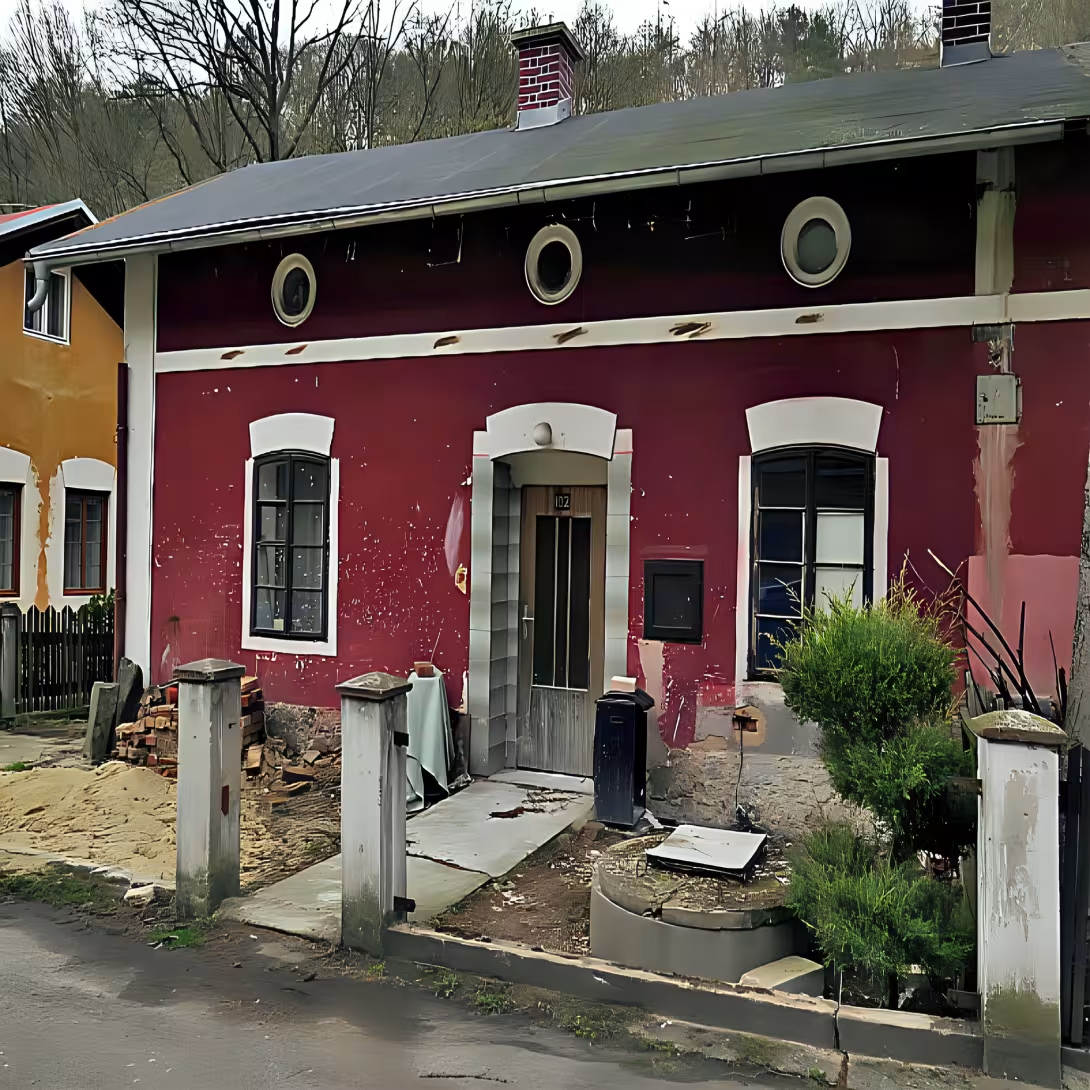
The factory colony Theresienthal in Františkov nad Ploučník (Děčín district, Ústecký region) is a unique set of seven doubles from the second half of the 19th century. It represents one of the oldest preserved examples of working-class housing in the Czech Republic.
The history of Františkov nad Ploučnice begins in 1707. The owner of the Děčín estate, Count Josef František Thun, then provided land on the left bank of the river Ploučnice for construction of a new settlement. The first five houses were built here a year later and by the end of the 18th century the number of buildings increased to twenty. Administration Františkov belonged to Neuland until 1904.
The significant development of the area occurred in the middle of the 19th century thanks to the entrepreneur Friedrich Mattausch. In 1843 he bought the land on which he built the first cotton mill in 1845 and in 1862 another operation opposite the castle of Ostrý. Industrial growth was accompanied by the construction of infrastructure: in 1847 the road was built from Benešov to Františkov and in 1872 the railway line from Česká Lípa to Děčín.
The colony itself was established in 1867. Franz Mattausch, his father's successor at the family company, then started building houses for employees in the vicinity of the third mill in Bedřichov. The orchard, named after the wife of the factory Theresie, was built on the site of a former trout pond. The work was completed in 1869 and the colony provided accommodation to over 100 inhabitants.
The file consists of seven relatively well preserved double houses with descriptive numbers 101 to 114. It is located on the left bank of Ploučnice at an altitude of approximately 200 metres. It lies in the immediate vicinity of the southern edge of the cadastral area of Benešov nad Ploučnice, opposite the island with the remains of the castle Ostrý. The interior of each part was the entrance hall, living room and kitchen, while in the attic there were two chambers serving as bedrooms. Small gardens belonged to the houses.
According to the records in the SAO landmark catalogue, Theresienthal is one of the oldest working colonies in the country. Some sources refer to it as the oldest settlement of this kind in Europe. More precisely, however, the term "one of the oldest preserved," since the previously established Adamov colony of 1784 no longer exists.
A set of houses was entered in the register of cultural monuments on April 4, 1966. The subsequent breakdown into the Central List of Cultural Monuments of the Czech Republic as 14 separate items and the later introduction of a catalogue number for the whole set have made the administrative relations between the different registry numbers unclear.
Theresienthal is a valuable testament to 19th century industrial development and employers' access to housing for their workers. For visitors, the rare archive of the architecture of the workers' estate in the original context.
Historical milestones
- 1867
- The construction of a colony for mill workers.
- 1869
- Completion of the construction of the Theresienthal settlement.
- 1966
- Writing the file into the register of cultural monuments.
Architectural development
The colony was built on a regular plan in the middle of the forest landscape. It consists of seven twin houses which preserved their original character with living rooms and bedrooms in the attic. Small gardens were part of each house.
Historical events
1867: Construction of a colony for mill workers. 1869: Completion of the construction of the Theresienthal settlement. 1966: Writing the file into the register of cultural monuments.
Owners
Count Josef František Thun (since 1707), family of Mattausch (since the middle of the 19th century).
Points of interest
- The factory colony Theresienthal in Františkov nad Ploučnice is a unique set of seven doubles from the second half of the 19th century. - It represents one of the oldest preserved examples of working living in the Czech Republic. - The colony was established in 1867 and its construction was completed in 1869, providing accommodation for more than 100 inhabitants. - A set of houses was entered in the register of cultural monuments on April 4, 1966. - The Theresienthal Workers' Colony is a valuable testament to 19th century industrial development and employers' access to housing for their workers.
Guide
Show guide text
This text was created by artificial intelligence and has not been editorially reviewed. It may contain inaccuracies.
Welcome to Františkov nad Ploučnice. You are standing right where time has stopped and where echoes of ancient work are still struggling with the peace of day. In front of your eyes, a unique set of seven twin houses is spread out to form this strange and very beautiful settlement. He may look like an ordinary neighborhood at first sight, but believe me, you're looking at something special. This group of buildings is not just a cluster of houses, it's a living story of people who once lived here, worked and built their everyday existence. Feel the atmosphere of peace radiating from these walls, and imagine how the lives of thousands of people associated with the emerging industry took place here over 150 years ago. It is a place that bears the proof of human effort and the effort to create a decent home.
Now let's go back to when everything was starting to be built here. We're in the second half of the nineteenth century. At that time, the world around us was changing very quickly, the industrial revolution was changing the face of the landscape and the lives of people around the country. It was during this period, namely in the year one thousand eight hundred sixty-seven, that this colony began to build here. It was not just a random construction, but a very sophisticated project for people who were at the heart of the local economy - for textile workers. Imagine those times when machines kept moving around and people were looking for their place in a new world. This settlement, known as Theresienthal, was created in a place that has its own deep natural history. Before these houses stood here, there was a trout pond. So the place where you now see the buildings and the gardens, there was water flowing once and there were fish swimming in it. This transformation of the landscape from the water world to the residential world is a fascinating example of how a man has transformed his surroundings for the needs of emerging industries. The entire construction was completed very quickly, already in the year one thousand eight hundred sixty-nine, creating this complex and harmonious unit that resisted the trials of time.
Now pay attention to what you see right in front of you. Look at the structure of these seven twin houses. Each one is designed to provide decent and functional housing for working families. Notice how the houses are laid out and how their rhythm works. The architecture of this place is very specific and that is why it is so rare. Each home was divided into two parts, creating a community feeling, but allowing each family to have their own private space. If you look at the ground floor, you realize that this is where the main life in the house took place - the living quarters where the cooking, eating and spending time by the fire. Above these spaces there is an attic which served as a bedroom. It's a very practical way of using space that was very important at the time. And what might be the most beautiful part, if you look at it from a certain angle, is these little gardens. Each house was equipped with its own piece of land where families could grow food or simply enjoy a bit of nature right by their house. This combination of living areas, bedrooms in the upper floors and personal gardens creates a very comprehensive and human picture of living at the time.
But to fully understand the importance of this place, we also need to look at the people behind this project. The history of this place is not just about bricks and mortars, but about individual decisions. In connection with this area and the development of industry, names such as Franz Mattausch or Josef František Thun are written in people's memories. Even if you may not learn their entire résumés, their influence on what today's Františkov nad Ploučnicí looks like is undeniable. They were people who had vision and the ability to change their surroundings. Their decision to build factories and subsequently provide housing for the people who worked in them created this unique whole. Without their efforts and investments, this colony, which we so quietly admire today, would probably never have been created.
Welcome to the part where something might surprise you. You might be wondering why this place is so important when it's just a few houses. The answer is in his incredible rarity. This colony of Theresienthal represents one of the oldest preserved examples of worker housing throughout our country. At a time when most of the old workers' neighborhoods were being rebuilt, demolished or transformed into modern urban areas, this place remained true to its original form. It's like a time capsule that allows us to look into the lives of ordinary people over 150 years ago. There's something mysterious about the fact that these seven twin houses have survived for centuries and they're still telling us their story. It's proof of how important it is to maintain even the smallest pieces of history, because it's the ones that show us how people lived and how our world evolved. And to preserve this monument for future generations, in the year one thousand nine hundred sixty-six it was entered into the register of cultural monuments. That means this place is protected as a valuable treasure of our history.
Now that you have gained a basic view of this historical monument, I suggest you continue your walk. Let the atmosphere of this place drift. Take a look at the details you may have missed at first glance. Feel the silence that exists here, and imagine the voices that once sounded here. This colony is here to inspire you and remind you of the value of work and home. It is a place that requires patience in observation, but rewards anyone who wants to stop and listen. Thank you for spending this moment with us and for your interest in the history of this beautiful place. We wish you another pleasant journey along Františkov over Ploučnice. Goodbye.
Tips for visitors
The best time to visit the working colony Theresienthal is in the summer months, especially in warm and sunny days. This allows full appreciation of the beauty of the rural environment around the settlement and the natural landscape with the river Ploučnice as the background.
Parking for visitors is available near the monument, but due to limited capacity we recommend to arrive by car or public transport. For up-to-date information on parking and public transport connections, see the local search engine.
When visiting, bring shoes suitable for walking on lawns and roads as well as sun protection. The additional recommendation is also water and ice cream bag if you plan to spend more time outside.
For photographers, the Theresienthal settlement offers many interesting places. The best light for photography is in the early morning or evening when the sun is lower in the sky and gives the shadows a beautiful shape. Photograph especially from the river Ploučnice towards the settlement for views with natural background.
The castle is located in the vicinity of the monument, which is ideal for further exploring historical and cultural attractions. In addition, you can visit textile mills in Františkov nad Ploučnice, which will provide insight into the industrial past of the area.
Businesses nearby
Do you run a restaurant, accommodation, shop, museum, rental, wellness or other visitor service near this monument? Show yourself directly to the people heading to it — this is how they will see you in the app and on the web:
Events nearby

Zdroj akcí: otevřená data měst a obcí ČR (Národní katalog otevřených dat) a kalendář akcí Národního památkového ústavu.
Nearby
Hrad Ostrý, řeka Ploučnice, textilní přádelny.
Accommodation nearby
Trips and activities nearby
Guided tours, tickets and activities nearby from GetYourGuide
Affiliate link: if you buy from the partner, we may receive a commission. The price for you does not change.
Search tours and activities →Themed route
1. Textile mill - Industrial object. A place that resembles the history of local textile processing. 2. Workers' colony in Františkov nad Ploučnice - Architectural whole. The main destination of the trip, which shows the way former workers live. 3. River Pložnice - Natural element. Water flow suitable for relaxing walk between monuments. 4. Castle Sharp - Historical construction. Ruins overlooking the surrounding countryside.
Seasonal recommendations
In spring, the workers' colony awakens into life. The first green leaves rise up around the houses and the air is fresh. The soft spring light highlights the details of the buildings beautifully. We recommend to dress in layered clothes because the weather is usually variable. Best to visit the place in the morning when nature is the cleanest.
The summer season brings bright sun and rich colors surrounding the countryside. The atmosphere is playful and relaxed, which is suitable for walking between historic houses. Due to the increased attendance in the high season, you better come early in the morning. Remember light clothes and sun protection.
Autumn wraps the colony with golden and red leaves, creating a nostalgic mood. The fog above the river gives the memory a mysterious touch. Choose waterproof shoes for comfortable travel. The ideal time to visit is late afternoon, when the sun throws long shadows.
In winter the architecture of the colony is more strict and peaceful, especially if snow covers it. It's a time of silence and proportionality. Due to the frost, it is necessary to have warm clothes and solid shoes. Count on a shorter opening time and we recommend a visit at noon when the most light is.
Visualizations and artistic views


The visualisations are generated by artificial intelligence and serve as inspiration.
Photos from the area
Real photos taken near the monument


Zdroj a licence jsou uvedeny u každého snímku.
Tips from visitors
No tips yet. Be the first!
Log in and add your tip.
Sources and literature
Photos: Sovicka169 / CC BY-SA 4.0, rozlišení zvýšeno umělou inteligencí — Wikimedia Commons. The author and licence also appear when you hover over the image.
Faktickým podkladem tohoto textu byl článek na Wikipedii, jehož autory jsou přispěvatelé Wikipedie. Článek je dostupný pod licencí CC BY-SA 4.0.
Location on the map
Příběhy a pověsti
Legendy, pověsti a příběhy spjaté s touto památkou

Fotografie návštěvníků
Zatím žádné fotografie. Buďte první, kdo přidá fotografii z návštěvy!
Log in a přidejte svou fotografii nebo hodnoťte.
Za ověřenou návštěvu v aplikaci získáte víc bodů — poznáme podle GPS, že jste na místě.
Reviews and comments